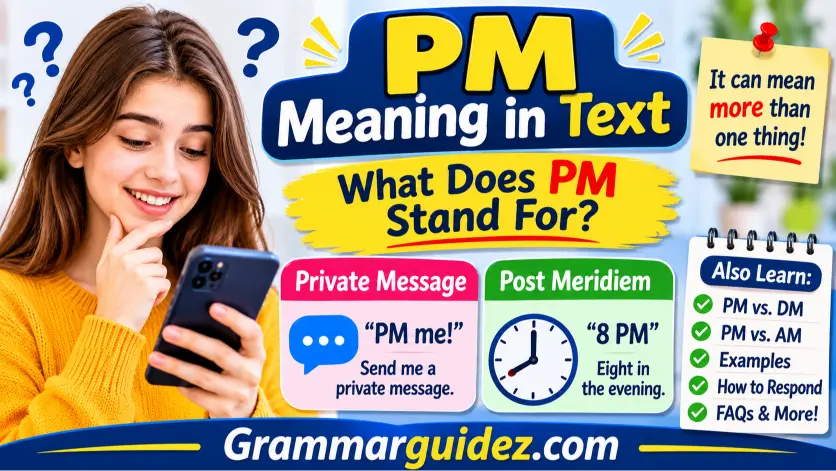
“PM Meaning in Text: PM usually means “private message,” a message sent directly to someone rather than in a public chat. It can also mean “post meridiem” when used with a time, meaning after noon”.
Have you ever received a message that says “PM me” and wondered what the person wants you to do? Or maybe someone told you to meet them at 7 PM, and you were unsure what those letters meant.
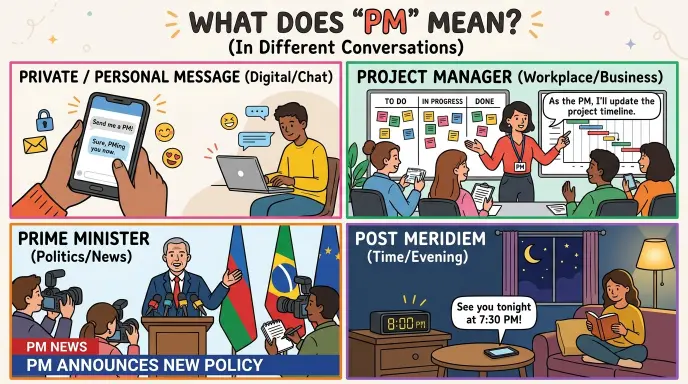
PM has more than one meaning. In online conversations, it usually means “private message.” It refers to a message sent directly to someone instead of being shared publicly. People may also use PM as a verb, as in “PM me the details.”
When PM appears after a number, it usually means “post meridiem.” This is the time from noon until midnight. For example, 8 PM means eight o’clock in the evening.
The meaning depends on how the letters are used. A message such as “PM me” is different from “See you at 8 PM.” Understanding this difference can help you avoid confusion.
In this guide, you will learn the PM meaning in text, see how people use it in different conversations, and discover the difference between PM and similar abbreviations such as DM and AM.
See Also: TMP Meaning in Text: What Does TMP Stand For?
Quick Answer: What Does PM Mean in Text?
PM usually means “private message” in online chats and social media. It can also be used as a verb, meaning to send someone a private message.
When PM appears after a time, such as 8 PM, it means “post meridiem,” or the period from noon until midnight.
What Does PM Stand For?
PM has two common meanings in everyday digital communication.
1. PM means Private Message
A private message is a message sent directly to a person rather than posted publicly.
For example:
“PM me if you want more information.”
This means the sender wants you to contact them privately.
You may see PM used on social media, online forums, and messaging platforms. It is useful when people want to discuss something away from a public comment section.
Cambridge and Oxford both recognize PM as an abbreviation for “private message.”
definition in the Cambridge English Dictionary+1
2. PM means Post Meridiem
When PM appears after a number, it usually refers to a time between noon and midnight.
For example:
“Our meeting starts at 6 PM.”
This means the meeting starts at six o’clock in the evening.
PM comes from the Latin phrase “post meridiem,” meaning “after midday.” It is used in the 12-hour clock system to distinguish afternoon and evening times from morning times.
How Is PM Used in Text Messages?
PM can be used in different ways depending on the conversation.
PM as a noun
A noun names a person, place, thing, or idea. In this case, PM refers to the private message itself.
Example:
“I sent you a PM yesterday.”
The sender is talking about a message they sent privately.
PM as a verb
PM can also describe the action of sending a private message.
Example:
“PM me when you get home.”
The sender is asking the other person to send them a private message.
Cambridge recognizes both uses: PM as a private message and PM as the action of sending one.
PM Meaning in Different Conversations
1. On social media
A person may write “PM me” when they want to move a conversation from a public comment to a private message.
Example:
“PM me for the price.”
This means the seller wants interested people to contact them privately for pricing information.
2. In a group chat
Someone may use PM when they want to share information with one person instead of the whole group.
Example:
“I’ll PM you the address.”
The sender plans to send the address directly to that person.
3. In an online forum
PM can refer to a private message between members of an online community.
Example:
“Send me a PM if you need help.”
The person is inviting another member to contact them privately.
4. In a conversation about plans
PM may refer to a time of day.
Example:
“Let’s meet at 7 PM.”
This means the meeting is planned for seven o’clock in the evening.
The number before PM is a useful clue that the message refers to time rather than a private message.
Practical Examples of PM in Text Messages
Here are 10 examples showing how PM may appear in everyday communication.
| Message | Meaning |
| “PM me for more details.” | Send me a private message for more information. |
| “I sent you a PM.” | I sent you a private message. |
| “Check your PMs.” | Check your private messages. |
| “I’ll PM you later.” | I’ll send you a private message later. |
| “PM me your email address.” | Send your email address privately. |
| “See you at 5 PM.” | See you at five in the afternoon. |
| “The movie starts at 8 PM.” | The movie starts at eight in the evening. |
| “Can you PM the group admin?” | Send a private message to the group administrator. |
| “I got your PM yesterday.” | I received your private message yesterday. |
| “The event ends at 10 PM.” | The event ends at ten at night. |
These examples show why it is important to read the full sentence. The same letters can refer to a private message or a time.
PM vs. DM: What Is the Difference?
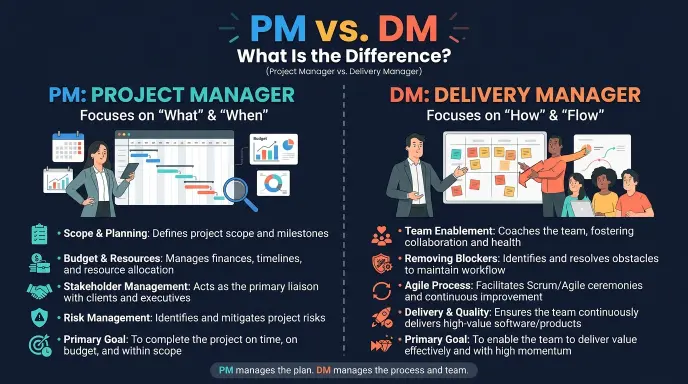
PM and DM are similar because both can refer to private online communication.
| Term | Meaning | Example |
| PM | Private message | “PM me the details.” |
| DM | Direct message | “DM me the details.” |
| AM | Ante meridiem | “The meeting starts at 9 AM.” |
| TTYL | Talk to you later | “I have to go. TTYL!” |
PM vs. DM
Both can refer to a message sent privately rather than posted publicly. Many people use them in similar ways.
For example:
“PM me if you need help.”
“DM me if you need help.”
Both messages ask the reader to contact the sender privately.
The exact term used may depend on the platform. Some platforms use “direct message” as the official name of their messaging feature.
PM vs. AM
AM and PM are used to show different parts of the day.
AM means “ante meridiem,” or the period from midnight until noon. PM means “post meridiem,” or the period from noon until midnight.
Collins English Dictionary+1
For example:
- 9 AM means nine in the morning.
- 9 PM means nine in the evening.
Remember that 12 AM is midnight, while 12 PM is noon.
How to Respond When Someone Says “PM Me”
If someone asks you to PM them, they usually want you to send a private message.
Here are some natural replies:
If you agree to send a message
- “Sure, I’ll PM you.”
- “Okay, I’ll send you a private message.”
- “I’ll message you in a minute.”
If you have already sent the message
- “I just sent you a PM.”
- “Check your inbox.”
- “I sent it privately.”
We are unsure what they mean
You can ask:
- “Do you mean a private message?”
- “Where should I send you the message?”
- “Do you mean PM as in a time, or a private message?”
Asking for clarification is useful when the message does not provide enough context.
Is PM Formal or Informal?
PM is used in both informal and practical communication, but the meaning matters.
When it means “private message,” it is common in online conversations, social media, and forums. It is also used in everyday business communication when someone wants to move a discussion into a private chat.
When PM means “post meridiem,” it is a standard abbreviation used to write times.
For example:
“Please PM me the report.”
This is a casual way to ask someone to send a report privately.
“Please send me the report in a private message.”
This is more formal and clear.
In professional writing, use the full phrase if the abbreviation could confuse your reader.
Common Mistakes When Understanding PM
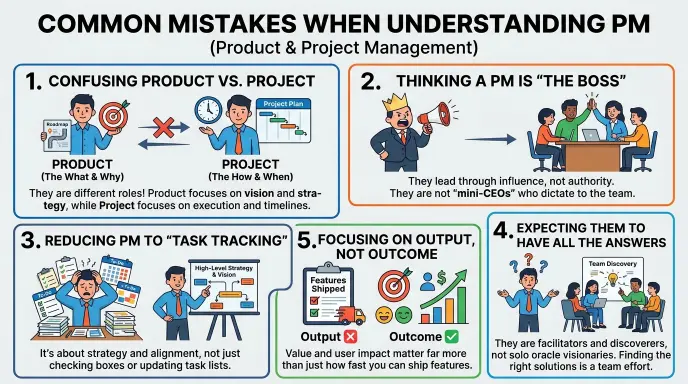
1. Assuming PM always means private message
PM can mean different things. If it appears after a number, it usually refers to a time.
2. Confusing PM with DM
PM means private message, while DM means direct message. Both are used for private communication, but the words are different.
3. Forgetting the difference between AM and PM
AM refers to the time before noon. PM refers to the time after noon.
4. Thinking “PM me” means “call me”
PM usually asks someone to send a private message. It does not automatically mean the sender wants a phone call.
5. Assuming PM is always secret
A private message is not a public post, but that does not mean it is guaranteed to remain confidential. Be careful when sharing personal information online.
Fill in the Blanks
Complete each sentence with the correct answer.
- PM commonly means “private ______” in online conversations.
- PM means “post meridiem” when used after a ______.
- DM stands for “direct ______.”
- AM refers to the time before ______.
- “PM me” usually asks someone to send a ______ message.
Answers:
- Message
- Number
- Message
- Noon
- Private
Mini Quiz
Question 1
What does PM usually mean in online conversations?
A. Public Meeting
B. Private Message
C. Personal Morning
D. Please Mention
Correct answer: B. Private Message. PM usually refers to a message sent privately to another person.
Question 2
What does 8 PM mean?
A. Eight in the morning
B. Eight at night
C. Eight minutes
D. Eight days
Correct answer: B. Eight at night. PM refers to the period from noon until midnight.
Question 3
Which abbreviation means “direct message”?
A. AM
B. TTYL
C. DM
D. PM
Correct answer: C. DM. DM is short for “direct message.”
Question 4
What does “PM me” usually mean?
A. Call me
B. Send me a private message
C. Meet me tomorrow
D. Send me an email
Correct answer: B. Send me a private message. It asks someone to contact the sender privately.
Question 5
What does 12 AM mean?
A. Noon
B. Midnight
C. Evening
D. Afternoon
Correct answer: B. Midnight. 12 AM marks the beginning of a new day.
FAQs
1. What does PM mean in text messages?
PM usually means “private message” in online conversations. It refers to a message sent directly to someone rather than posted publicly. It can also mean “post meridiem” when used after a number to show a time.
2. What does PM mean on Instagram?
PM can mean “private message” on Instagram, but people often use the term DM, meaning “direct message.” If someone says “PM me,” they are usually asking you to contact them privately.
3. What does PM mean on Snapchat?
PM may refer to a private message, but Snapchat users often talk about sending a Snap or a chat. The intended meaning depends on the conversation.
4. Is PM the same as DM?
PM means “private message,” while DM means “direct message.” Both can refer to a message sent privately to another person. The difference is mainly in the wording and the platform’s terminology.
5. What does PM me mean?
“PM me” means “send me a private message.” The sender wants you to contact them directly rather than reply in a public comment section.
6. What does PM mean in time?
When PM appears after a number, it means “post meridiem.” It refers to the time from noon until midnight. For example, 7 PM means seven o’clock in the evening.
7. What is the difference between 12 AM and 12 PM?
12 AM means midnight, the start of a new day. 12 PM means noon, the middle of the day. These two times are often confused, so writing “midnight” or “noon” can be clearer.
8. Is PM formal or informal?
PM is informal when used to mean “private message,” but it is a standard abbreviation for time. In formal writing, use the full phrase when the meaning may not be clear.
9. Can PM mean Prime Minister?
Yes. PM can also mean “Prime Minister,” especially in political news and discussions about government. This meaning is different from private messaging and time.
10. How should I respond to PM me?
If someone asks you to PM them, you can reply, “Sure, I’ll send you a private message.” If you are unsure what they mean, ask for clarification.
Conclusion
The PM meaning in text is usually “private message.” It is a simple way to ask someone to contact you directly instead of replying in a public comment section. PM can also be used as a verb, as in “PM me,” which means “send me a private message.”
However, PM has another important meaning. When it appears after a number, it means “post meridiem,” or the period from noon until midnight. This is why “PM me” and “See you at 8 PM” mean different things.
Remember that context is the key to understanding PM. Look at the words around it, the topic of the conversation, and if a number appears before the abbreviation.
If you are unsure what someone means, ask a simple question. This will help you understand the message and respond naturally.
See Also: LMY Meaning in Text: What Does LMY Stand For?

I am Elliot Hartwell, an English language writer and the author at GrammarGuidez.com. For the 6 years I have been working with English grammar, vocabulary, spelling and everyday language usage with a focus on making confusing topics easier to understand.
I started GrammarGuidez.com with a goal: to give readers clear and practical answers to common English questions. English can sometimes be confusing especially when two words look or sound similar but have meanings or uses. I enjoy breaking down these differences in a way that’s simple and easy to remember.
I believe learning English should feel simple not overwhelming. My goal is to make every article on GrammarGuidez.com useful, for students, writers, bloggers, teachers and anyone who wants to communicate clearly in English.