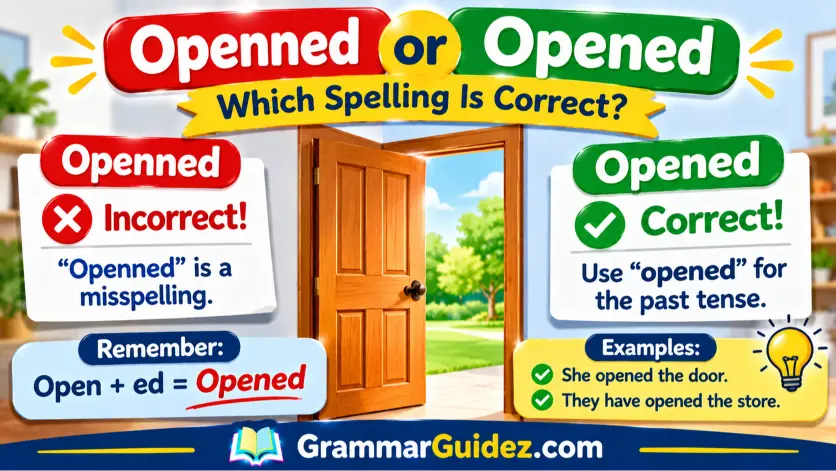
“Opened or Openned: Opened is the correct spelling, meaning made something open or began an event. Openned is a misspelling; the final “n” is not doubled”.
Have you ever written a sentence such as “She openned the door” and wondered if it was correct? The confusion is understandable. English has many verbs that double their final consonant before adding -ed, such as stop → stopped. It may seem that open should follow the same pattern.
But the correct spelling is opened, with only one n. The word openned is a misspelling in standard English.
Use opened when you describe an action that happened in the past, such as “He opened the window.” It is also the past participle, as in “They have opened the store.”
This guide explains why opened is correct, how to use it in different sentences, and why the extra n is not needed. You will also find examples, common mistakes, a memory tip, and practice questions to help you remember the spelling.
Quick Answer: Openned or Opened?
Opened is the correct spelling. Openned is incorrect in standard English.
- Open: the base form of the verb
- Opened: the simple past and past participle
- Openned: a common spelling mistake
Example: “I opened the package yesterday.”
The word open keeps one n when you add -ed: open + ed = opened.
What Does “Opened” Mean?
Opened is the past tense and past participle of the verb open. The verb open can mean to move something so it is no longer closed, to make something available, or to begin something.
Opened means an action happened in the past
Use opened when someone did the action before now.
Examples:
- I opened the door.
- She opened her notebook.
- We opened the gift after dinner.
- The shop opened at nine o’clock.
In each sentence, opened tells the reader that an action happened in the past.
Opened can be used with helping verbs
The word opened also appears with helping verbs such as has, have, had, and was.
Examples:
- They have opened a new café.
- He had opened the file before the meeting.
- The box was opened carefully.
- The doors have been opened.
In these sentences, opened is the past participle. It helps form a perfect or passive verb phrase.
Why Is “Openned” Incorrect?
The correct spelling is opened, not openned. The base word open already ends with one n. When you add -ed to make the past tense or past participle, you do not double that letter.
The spelling is:
open + ed = opened
The form openned adds an extra n that does not belong in the word.
English does have verbs that double a final consonant before adding -ed. For example:
- stop → stopped
- plan → planned
- drop → dropped
However, this spelling pattern does not apply to every verb. The correct form of open is opened.
Open, Opened, and Opening
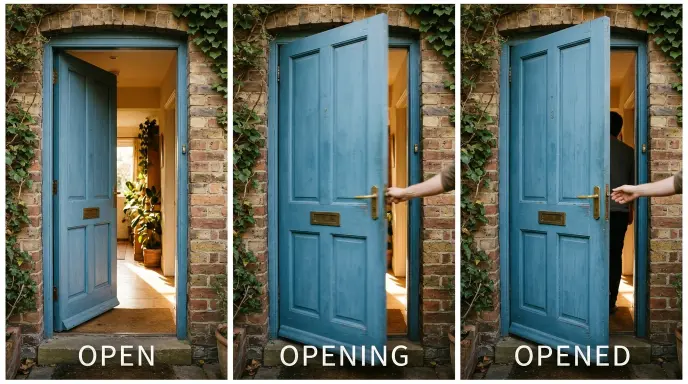
These forms come from the same verb, but they are used in different ways.
| Form | Use | Example |
| Open | Base form or present tense | Please open the window. |
| Opens | Present tense with he, she, or it | The shop opens at ten. |
| Opened | Simple past | She opened the letter. |
| Opened | Past participle | He has opened the box. |
| Opening | -ing form | They are opening the new store. |
Remember that opened is used for both the simple past and the past participle. It does not change to openned in either form.
Examples of “Opened” in Sentences
Here are simple examples showing how to use opened correctly.
Everyday actions
- I opened the door for my friend.
- He opened the fridge to get some water.
- She opened her bag and took out a book.
- We opened the windows because the room was warm.
School and work
- The teacher opened the lesson with a question.
- I opened the document on my computer.
- The manager opened the meeting at noon.
- The students opened their books to page ten.
Shops and events
- The new store opened last week.
- The museum opened its doors to visitors.
- The concert opened with a short song.
- The school opened a new library.
In each example, opened is spelled with one n.
“Open” or “Opened”: What Is the Difference?
The words open and opened are both correct, but they do not always mean the same thing.
Open can describe a state. For example, “The door is open” means the door is not closed.
Opened usually describes an action. For example, “She opened the door” means she performed the action of opening it.
Compare these sentences:
- The shop is open. It is not closed now.
- The shop opened at nine. It began doing business at nine.
- The window is open. The window is not closed.
- He opened the window. He moved the window to make it open.
The difference is between a state and an action.
Does “Opened” Change in American and British English?

No. Opened is the standard spelling in both American and British English.
You should write:
- American English: The store opened early.
- British English: The shop opened early.
The words store and shop may differ by region, but the spelling opened does not.
The same spelling is used in formal writing, schoolwork, emails, and everyday messages.
Common Mistakes to Avoid
Mistake 1: Writing “openned”
Incorrect: “She openned the door.”
Correct: “She opened the door.”
Use one n in opened.
Mistake 2: Writing “openning”
Incorrect: “The store is openning today.”
Correct: “The store is opening today.”
The -ing form also uses one n: open → opening.
Mistake 3: Using “opened” when you mean “open”
Incorrect: “The shop is opened every day.”
More natural: “The shop is open every day.”
Use open to describe the state of being available. Use opened when you mean that someone opened it or that it began operating at a particular time.
Mistake 4: Assuming every verb doubles its final letter
Some verbs double a final consonant, but others do not. Do not apply the pattern from stopped or planned to opened.
How to Remember the Correct Spelling
Use this simple memory tip:
Open + ed = opened
The word open has one n, and it keeps one n when you add -ed.
You can also remember this sentence:
“I opened one door.”
The word opened has only one n, just like the base word open.
Fill in the Blanks
Complete each sentence with the correct form of the word.
- She ________ the door before leaving.
- The store has ________ a new branch.
- Please ________ your book to page five.
- They are ________ the windows now.
- The museum ________ at ten yesterday.
Answers
- opened
- opened
- open
- opening
- opened
Mini Quiz: Openned or Opened?
1. Which spelling is correct?
A. Openned
B. Opened
C. Opennd
D. Oppened
Answer: B. Opened
2. What is the past tense of “open”?
A. Openning
B. Open
C. Opened
D. Openned
Answer: C. Opened
3. Which sentence is correct?
A. He openned the box.
B. He opened the box.
C. He opennd the box.
D. He oppened the box.
Answer: B. He opened the box.
4. Which form is used in “They have ________ the shop”?
A. open
B. opens
C. opened
D. openned
Answer: C. opened
5. Which sentence describes a state rather than an action?
A. She opened the door.
B. The door is open.
C. He opened the file.
D. They opened the shop.
Answer: B. The door is open
FAQs
1. Is “openned” a correct word?
No. Openned is a misspelling in standard English. The correct spelling is opened.
2. What is the past tense of “open”?
The past tense is opened. For example: “I opened the window.”
3. What is the past participle of “open”?
The past participle is also opened. For example: “They have opened the shop.”
4. Why does “opened” have only one “n”?
The base word open keeps one n when -ed is added. The correct form is open + ed = opened.
5. Is “opened” correct in British and American English?
Yes. Opened is the standard spelling in both varieties of English.
6. Should I write “openning” or “opening”?
Write opening. The word has one n before the -ing ending.
7. Is “the door is opened” always wrong?
Not always. “The door is opened” can describe an action, especially in a passive sentence. But if you mean the door is not closed, say “The door is open.”
8. What is an easy way to remember “opened”?
Remember that open has one n, and adding -ed does not double it: open → opened..
Conclusion
Opened is the correct spelling, while openned is a misspelling. The past tense and past participle of open are both opened. You do not double the final n when adding -ed.
Use opened for actions that happened in the past, such as “She opened the window.” Use it with helping verbs, too: “They have opened the store.” When you mean that something is not closed, use open: “The door is open.”
The easiest rule to remember is open + ed = opened. Keep one n, and you will spell the word correctly in schoolwork, messages, and professional writing.
Read More Articles:

I am Evan Whitmore, an English language writer and the person who started GrammarGuidez.com. I made GrammarGuidez.com to make grammar, spelling, vocabulary and words that are often confused easier to understand.
I like taking to understand English words and grammar rules and turning them into simple and clear explanations. My aim is to help students, writers, bloggers, ESL learners and regular English speakers feel more sure when they write and talk.
At GrammarGuidez.com I work on real life examples easy to understand explanations comparing words, spelling changes and how American English is used every day.
I think learning English doesn’t need to be hard. A good explanation and some good examples can make tough grammar topics much simpler to learn