
“Address or Adress: Address is the correct spelling, meaning a location, a place where someone lives, or to speak to someone directly. Adress is a misspelling”.
Have you ever filled out an online form, written an email, or prepared a letter and wondered if to spell the word as address or adress? This small spelling question can confuse English learners because the two forms look almost identical. They differ by just one letter, but only one spelling is accepted in standard English.
The correct spelling is address, with two d’s and two s’s. The spelling adress, with one d, is a common misspelling. You should use address if you are talking about your home location, an email address, a website address, or a problem that needs attention.
Learning this word is important because it appears in everyday conversations, business emails, school assignments, job applications, and official documents. The word also has more than one meaning. It can be a noun or a verb, depending on how you use it in a sentence.
In this guide, you will learn the correct spelling, the meaning of address, its different uses, common mistakes, and simple ways to remember it.
Read More: Site or Cite
Quick Answer: Address or Adress?
Address is the correct spelling in standard English. Adress is a misspelling and should not be used in normal English writing.
- Address: Correct spelling with two d’s and two s’s.
- Adress: Incorrect spelling with one d.
- Address as a noun: A location, an email address, or a formal speech.
- Address as a verb: To speak to someone or deal with a problem.
The correct spelling stays the same in American, British, Canadian, and Australian English. There is no standard English spelling variation that allows you to write adress instead.
What Does Address Mean?
The word address has several meanings. Its meaning depends on the sentence and the situation in which it appears.
1. Address as a Place
An address can tell someone where a person, home, business, or organization is located. A postal address often includes a building number, street name, city, and other details needed for delivery.
For example, a person may need to provide a home address when registering for a service. A business may list its address so customers can find its office.
2. Address as Electronic Information
The word can also refer to an email address or a web address. An email address helps people send electronic messages to the correct account. A web address helps people locate a website or a page online.
These meanings are common in everyday digital communication.
3. Address as a Formal Speech
An address can also mean a formal speech delivered to an audience. For example, a school principal may give an address at a graduation ceremony.
4. Address as an Action
As a verb, address can mean to speak to someone, direct a message to someone, or deal with a problem. The meaning changes according to the context, but the spelling remains the same.
Why Is Address the Correct Spelling?
The standard English spelling is address. It contains seven letters:
A – D – D – R – E – S – S
The word has two pairs of repeated letters: dd and ss. When people write adress, they leave out one of the d’s.
This mistake does not create a different standard English word. It simply creates a misspelling.
A useful way to remember the spelling is to divide the word into two visible parts:
- ADD
- RESS
Think of the first part as “ADD” because the word needs two d’s. Then remember that the ending also has two s’s.
This is a memory trick, not a claim about the word’s historical origin. It can still help you spell the word correctly.
What Is the Difference Between Address and Adress?
The difference is spelling. In standard English, address is correct, while adress is incorrect.
| Feature | Address | Adress |
| Correct in standard English? | Yes | No |
| Number of d’s | Two | One |
| Number of s’s | Two | Two |
| Can be a noun? | Yes | No, not as this spelling |
| Can be a verb? | Yes | No, not as this spelling |
| Used in formal writing? | Yes | No |
| Meaning | Location, speech, or an action | Common misspelling of address |
Unlike some word pairs that have different meanings, address and adress do not represent two separate standard English words with different definitions. You should correct adress to address whenever you find this mistake in your writing.
How to Use Address as a Noun
A noun names a person, place, thing, or idea. When you use address as a noun, you are usually referring to a location, electronic contact information, or a formal speech.
Home Address
A home address identifies where someone lives. It may be needed for deliveries, registration forms, official records, or correspondence.
Examples:
- Please write your home address on the form.
- My new address is different from my old one.
- She gave the delivery driver the correct address.
Business Address
A business address identifies where a company or organization operates. It may appear on invoices, websites, letters, and business documents.
Examples:
- The company changed its business address.
- Please send the documents to our office address.
- The business address appears on the official website.
Email Address
An email address identifies an electronic mailbox where messages can be sent. It usually contains a username, the @ symbol, and a domain name.
Examples:
- Please enter your email address.
- I sent the invitation to the wrong email address.
- Check your email address before submitting the form.
Web Address
A web address helps people find a website or online page. It may be called a URL in technical contexts.
Examples:
- The web address is printed on the brochure.
- Please check the website address before opening the page.
- I saved the address of the online store.
A Formal Address
In formal situations, an address can mean a speech given to a group of people.
Examples:
- The principal delivered an address to the students.
- The president gave a formal address.
- Everyone listened carefully to the speaker’s address.
These uses all require the same spelling: address.
How to Use Address as a Verb
A verb describes an action or state. The word address can be used as a verb in several common ways.
1. To Speak to Someone
When you address a person or audience, you speak to them directly.
Examples:
- The teacher addressed the class.
- The manager addressed the employees.
- She addressed the audience with confidence.
2. To Write Information on a Letter or Package
When you address a letter or package, you write the recipient’s name and delivery details on it.
Examples:
- Please address the envelope carefully.
- He addressed the package to his sister.
- I addressed all the letters before leaving.
3. To Deal With a Problem
The verb address can mean to give attention to a problem, question, concern, or need. It does not necessarily mean that the problem has already been solved. It means that someone is dealing with it.
Examples:
- We must address this problem soon.
- The company is addressing customer concerns.
- The teacher addressed the students’ questions.
Remember that the spelling does not change when you use the word as a verb. It is still address, with two d’s.
Is Adress Ever Correct in English?
In standard English writing, adress is not the correct spelling of the word meaning a location or the act of dealing with an issue. You should use address instead.
You might encounter adress in a text message, an online comment, an unedited document, or a spelling exercise. Its appearance does not make it a standard English alternative.
There can also be similar-looking words in other languages. A spelling used in another language does not automatically become correct in English. When writing in English, follow standard English spelling.
If a spell-checking tool underlines adress, replace it with address.
Is Address Spelled the Same in American and British English?

Yes. Address has the same spelling in American and British English. The same is true in standard Canadian and Australian English.
Some words have different regional spellings. For example, American English generally uses color, while British English generally uses colour. However, address is not one of those words.
| Variety of English | Correct spelling |
| American English | Address |
| British English | Address |
| Canadian English | Address |
| Australian English | Address |
You do not need to change the spelling for a different audience. Use address in formal documents, emails, articles, and everyday messages regardless of the English variety you follow.
Why Do People Spell Address Incorrectly?
There are several possible reasons why people write adress instead of address.
Forgetting the Double D
The word contains two d’s next to each other. When typing quickly, a writer may accidentally leave one out.
Typing Too Quickly
People sometimes make spelling mistakes when they are in a hurry. They may know the correct spelling but fail to notice the missing letter before sending a message.
Relying on Pronunciation
The pronunciation does not clearly tell every learner how many letters to write. Listening carefully may help with some spelling questions, but it is not enough for every English word.
Not Proofreading
A writer may read a sentence quickly and focus on its meaning instead of checking each letter. This can allow a familiar spelling error to remain in the final text.
To avoid the mistake, learn the full spelling, use a reliable spell-checking tool, and proofread important documents before sending or publishing them.
Common Address Spelling Mistakes
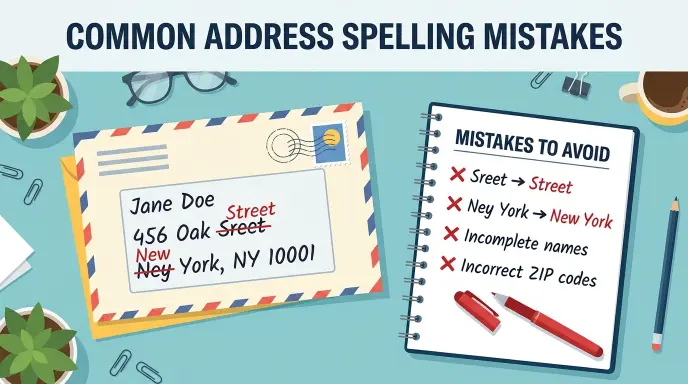
The most common mistake is writing adress with one d. However, there are other errors involving the word and its related forms.
| Incorrect or mistaken form | Correct form | Explanation |
| Adress | Address | One d is missing. |
| Email adress | Email address | The noun must be spelled correctly. |
| Home adress | Home address | Use two d’s. |
| Please adress the issue. | Please address the issue. | The verb also needs two d’s. |
| She adress the class. | She addresses the class. | The verb needs the correct spelling and verb form. |
| He adresssed the audience. | He addressed the audience. | The past tense is addressed. |
Pay attention to grammar as well as spelling. For example, addressed is the past tense of address, while addresses can be the plural noun or the present-tense verb used with he, she, or it.
Address, Addresses, and Addressed: What Is the Difference?
These related forms are useful to learn because they appear often in English.
Address
Address is the basic form. It can be a singular noun or the base form of the verb.
- Please check the address.
- We need to address the issue.
Addresses
Addresses is the plural form of the noun. It is also the present-tense form of the verb used with a singular third-person subject.
- The company has offices at several addresses.
- She addresses each concern carefully.
Addressed
Addressed is the past tense and past participle of the verb.
- He addressed the audience yesterday.
- The problem was addressed during the meeting.
Addressing
Addressing is the -ing form of the verb.
- She is addressing the team.
- We are addressing the problem now.
Notice that the double d remains in all these forms. Learning the word family can help you avoid repeating the same spelling mistake.
Easy Ways to Remember the Correct Spelling
Use these simple methods to remember address.
Remember “Double D, Double S”
The word has two d’s and two s’s. Think of this phrase whenever you are unsure: Address has double D and double S.
Say the Letters in Your Mind
Before submitting a form, remember the spelling:
A-D-D-R-E-S-S
Mentally spelling the word can help you notice a missing letter.
Practise With Common Phrases
Learn the word as part of phrases you use often, such as:
- Home address
- Email address
- Business address
- Postal address
- Website address
- Address a problem
Recognizing these phrases can make the correct spelling easier to recall.
Use Spell Check
Most word processors and browsers can identify common misspellings. If you type adress, a spelling checker may suggest address. However, spell check is not perfect, so proofread important writing yourself as well.
Fill in the Blanks
Complete each sentence with the correct form of the word.
- Please write your home ______ on the application.
- I sent the message to the wrong email ______.
- The manager will ______ the problem tomorrow.
- The teacher ______ the students during the assembly.
- The company has offices at several different ______.
Answers:
- address
- address
- address
- addressed
- addresses
Mini Quiz
Choose the correct answer for each question.
1. Which is the correct spelling?
A. Adress
B. Address
C. Addres
Answer: B. Address
2. How many d’s are in the word address?
A. One
B. Two
C. Three
Answer: B. Two
3. Which sentence uses address as a verb?
A. My address has changed.
B. Please address the problem.
C. I forgot her address.
Answer: B. Please address the problem.
4. What is the plural of address?
A. Adresses
B. Address’s
C. Addresses
Answer: C. Addresses
5. Is address spelled the same in American and British English?
A. Yes
B. No
Answer: A. Yes
Read More: Wellcome or Welcome
FAQs
1. Is it address or adress?
Address is correct. Adress is a misspelling in standard English. Always write the word with two d’s and two s’s.
2. Is adress a real English word?
Adress is not the standard English spelling for a location or the verb meaning to speak to someone or deal with a problem. Use address instead.
3. How do you spell address correctly?
The correct spelling is A-D-D-R-E-S-S. It has two d’s and two s’s.
4. Is address a noun or a verb?
It can be both. As a noun, it can mean a location, electronic contact information, or a formal speech. As a verb, it can mean to speak to someone or deal with a problem.
5. Is address spelled differently in British and American English?
No. The spelling is the same in both varieties. Write address for British, American, Canadian, and Australian audiences.
6. What is the plural of address?
The plural is addresses. It has two d’s and four s’s in total: two in the base word and two in the plural ending.
7. What is the past tense of address?
The past tense is addressed. For example, “The manager addressed the team yesterday.”
8. Why is address often misspelled?
Writers may forget the second d, type too quickly, or fail to proofread. Remembering the double-d and double-s pattern can help prevent the mistake.
9. What does address mean as a verb?
As a verb, address can mean to speak to someone, write delivery details on a package, or deal with a problem or concern.
10. Can I use address in a formal email?
Yes. Address is correct in formal and informal writing. You can use it when giving a location, sharing email details, or discussing an issue.
Conclusion
When choosing between address or adress, always use address in standard English. The word has two d’s and two s’s, and it can be used as both a noun and a verb. As a noun, it can refer to a home location, an email address, a web address, or a formal speech. As a verb, it can mean to speak to someone, write details on a package, or deal with a problem.
The spelling adress is a common mistake, not a standard English alternative. Remember the simple rule: double D and double S. This will help you write the word correctly in emails, forms, assignments, business documents, and everyday messages.
With regular practice and careful proofreading, you can avoid this spelling error and make your English writing clearer and more professional.
Read More:

I am Elliot Hartwell, an English language writer and the author at GrammarGuidez.com. For the 6 years I have been working with English grammar, vocabulary, spelling and everyday language usage with a focus on making confusing topics easier to understand.
I started GrammarGuidez.com with a goal: to give readers clear and practical answers to common English questions. English can sometimes be confusing especially when two words look or sound similar but have meanings or uses. I enjoy breaking down these differences in a way that’s simple and easy to remember.
I believe learning English should feel simple not overwhelming. My goal is to make every article on GrammarGuidez.com useful, for students, writers, bloggers, teachers and anyone who wants to communicate clearly in English.