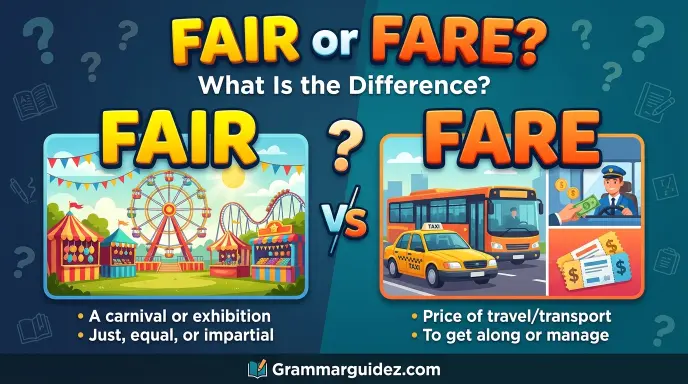
“Fair or Fare: Fair means just, reasonable, or an event where people gather to enjoy activities. Fare means the price of a trip or a type of food. Both are correct words, but they have different meanings”.
You may hear the words fair and fare and think they are the same. They sound alike, but they do not mean the same thing. The right spelling depends on what you want to say.
Use fair when you mean something is just, reasonable, or free from unfair treatment. It can also mean a public event with games, food, or stalls. Use fare when you mean the money paid for a journey, a type of food, or how someone does in a situation.
For example, “The bus fare is high” talks about the cost of a ride. “That is a fair price” means the price is reasonable. The two words can appear in the same sentence, which makes them easier to remember.
This guide explains the meaning of fair and fare in simple English. You will see their different uses, learn common phrases, and practice choosing the correct word.
Quick Answer: Fair or Fare?
Both fair and fare are correct English words. They are homophones, which means they sound alike but have different meanings.
- Fair can mean just, reasonable, light in color, or a public event.
- Fare can mean the cost of a journey, food offered, or how someone performs.
- Memory tip: A fair may have food and rides; the fare is what you pay to travel there.
Example: “We paid a fair fare to get to the fair.”
What Does “Fair” Mean?
The word fair has several meanings. It is often used as an adjective, but it can also be a noun.
1. Fair means just or equal
When something is fair, it treats people in a reasonable and equal way. It does not show unfair favor to one person over another.
Examples:
- The teacher gave every student a fair chance.
- We need a fair way to share the work.
- The judge made a fair decision.
In these sentences, fair means just or reasonable.
2. Fair means reasonable
Fair can describe a price, offer, or deal that seems acceptable and not too high or too low.
Examples:
- The shop offered a fair price for the bicycle.
- We found a fair deal on the hotel room.
- That is a fair amount to pay for lunch.
3. A fair is a public event
As a noun, fair can mean an event where people gather for entertainment, shopping, or learning. A fair may have rides, games, food stands, or displays.
Examples:
- Our town holds a fair every summer.
- We bought snacks at the school fair.
- The book fair opens on Monday.
4. Fair can describe light color
The adjective fair can describe pale skin or light-colored hair.
Examples:
- He has fair hair.
- Her fair skin burns easily in strong sunlight.
This meaning is about color, not justice or price.
5. Fair can describe weather
Fair weather is pleasant weather, often with clear skies and little rain.
Examples:
- We hope for fair weather on Saturday.
- The sky was fair, so we went for a walk.
What Does “Fare” Mean?
The word fare is used as a noun and a verb. Its meaning depends on the sentence.
1. Fare means the cost of a journey
As a noun, fare often means the money you pay to travel by bus, train, taxi, or plane.
Examples:
- The bus fare is five dollars.
- I paid my train fare online.
- The taxi fare was more than I expected.
In each sentence, fare means the cost of transportation.
2. Fare can mean food
Fare can also mean the kind or style of food served or available. This use is common when talking about a restaurant or a place to eat.
Examples:
- The café serves simple, healthy fare.
- We enjoyed traditional Italian fare.
- The restaurant is known for its seafood fare.
Here, fare means food, not a travel fee.
3. Fare means to do or perform
As a verb, fare means to do, progress, or experience a result in a situation. It often appears with words such as well, poorly, better, or worse.
Examples:
- How did you fare on the test?
- The team fared well in the final match.
- I hope she fares better at her new job.
In these sentences, fare means how someone did or what happened to them.
Fair vs. Fare: Main Differences
| Word | Common meaning | Part of speech | Example |
| Fair | Just or reasonable | Adjective | That is a fair decision. |
| Fair | A public event | Noun | We went to the county fair. |
| Fair | Light in color | Adjective | He has fair hair. |
| Fare | Travel cost | Noun | The bus fare increased. |
| Fare | Food offered | Noun | The café serves local fare. |
| Fare | To do or progress | Verb | How did you fare? |
The easiest way to choose is to check the meaning of the sentence. If you mean “reasonable” or “just,” use fair. If you mean a travel cost or how someone did, use fare.
How to Use “Fair” in a Sentence
Use fair when you describe something as just, reasonable, light in color, or connected to an event.
Correct examples:
- Everyone should have a fair chance.
- The price seems fair.
- We visited the county fair.
- The fair weather made our picnic pleasant.
Incorrect: “The bus fair is ten dollars.”
Correct: “The bus fare is ten dollars.”
The second sentence is correct because it refers to the money paid for a ride.
How to Use “Fare” in a Sentence
Use fare when you mean a travel cost, a kind of food, or how someone performs.
Correct examples:
- The train fare is cheaper than the taxi fare.
- The restaurant serves fresh, local fare.
- How did you fare in your interview?
Incorrect: “The ticket fair is too high.”
Correct: “The ticket fare is too high.”
The correct word is fare because the sentence talks about the cost of a ticket.
Common Phrases With “Fair”
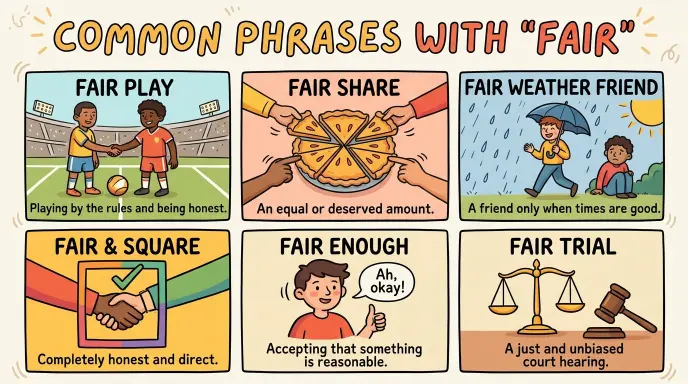
Fair enough
Fair enough means that you understand and accept what someone says or decides.
Example: “You need more time to finish the project? Fair enough.”
Fair play
Example: “The coach praised the players for their fair play.”
Fair share
Your fair share is the part that is reasonable for you to receive or do.
Example: “Everyone must do a fair share of the work.”
Fair weather
Fair weather means pleasant weather, often with sunshine or clear skies.
Example: “We had fair weather during our trip.”
Common Phrases With “Fare”
Bus fare or train fare
A bus fare or train fare is the amount paid for a ride.
Example: “I need money for my bus fare.”
Fare well
The phrase fare well means to do well or have a good result.
Example: “I hope you fare well in your new role.”
Fare poorly
To fare poorly means to do badly or have a poor result.
Example: “The team fared poorly in the first half.”
Farewell
Farewell is a word used when saying goodbye. It is related to the older phrase fare well, meaning to go or do well.
Example: “We said farewell to our friends before leaving.”
“Fair Well” or “Fare Well”?
In most everyday situations, fare well is the correct phrase when you mean “do well” or “have a good result.”
Example: “I hope you fare well in your exams.”
Fair well is not the usual phrase for this meaning. The word fair may appear in special or technical uses, but it is not the normal choice when wishing someone success.
Remember: use fare well for how someone does. Use fair when you mean just, reasonable, or another meaning of the adjective.
“Fair Fare” or “Fare Fair”?
Both words can appear together, but they have different jobs.
Fair fare can mean food or a travel price that is reasonable. For example: “The café offered fair fare at the fair.” This sentence uses fair to describe the price or quality and fare to mean food.
Fare fair is not a common phrase. If you mean “do well,” say fare well. If you mean “treat someone justly,” say be fair.
How to Remember the Difference
Use these quick memory tips:
- Fair = fair treatment: A fair decision treats people justly.
- Fare = fee: A bus fare is the fee you pay for a ride.
- Fair = fairground: A fair can be an event with rides, games, and stalls.
- Fare = food: A restaurant may serve traditional fare.
- Fare = how you do: Ask, “How did you fare?”
A sentence that uses both words can also help:
“We paid a fair fare to travel to the fair.”
- Fair means reasonable.
- Fare means travel cost.
- Fair means the public event.
Common Mistakes to Avoid
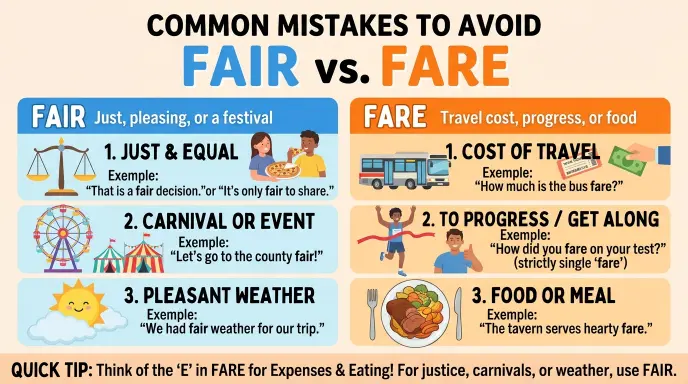
Mistake 1: Writing “bus fair”
A bus fee is a bus fare, not a bus fair.
Mistake 2: Writing “a fare price”
When you mean a reasonable price, write a fair price.
Mistake 3: Writing “How did you fair?”
When asking how someone did, write How did you fare?
Mistake 4: Mixing up a fair and its fare
A fair is an event. Fare may mean the money paid for a ride or the food offered there.
Mistake 5: Assuming one word is always a noun
Both words can have more than one grammatical role. Fair is commonly an adjective and noun. Fare is commonly a noun and verb.
Fill in the Blanks
Choose fair or fare to complete each sentence.
- The bus ________ went up this year.
- The teacher gave everyone a ________ chance.
- We visited the summer ________ on Saturday.
- How did you ________ in the spelling test?
- The restaurant serves traditional Italian ________.
Answers
- fare
- fair
- fair
- fare
- fare
Mini Quiz: Fair or Fare?
1. Which word means the money paid for a journey?
A. Fair
B. Fare
C. Both
D. Neither
Answer: B. Fare
2. Which sentence uses “fair” correctly?
A. The bus fair is expensive.
B. I paid my fair at the station.
C. The judge made a fair decision.
D. How did you fair today?
Answer: C. The judge made a fair decision.
3. What does “How did you fare?” mean?
A. What did you pay?
B. How did you do?
C. Where is the fair?
D. What food did you eat?
Answer: B. How did you do?
4. Which word can mean food served at a restaurant?
A. Fair
B. Fare
C. Both
D. Neither
Answer: B. Fare
5. Which phrase is commonly used to wish someone success?
A. Fair well
B. Fare well
C. Fair fare
D. Fare fair
Answer: B. Fare well
FAQs
1. Are “fair” and “fare” the same?
No. They sound alike, but they have different meanings. Fair can mean just or reasonable, while fare can mean a travel fee, food, or how someone does.
2. Is it “bus fair” or “bus fare”?
It is bus fare. The word fare means the money you pay for a journey.
3. Is it “fair price” or “fare price”?
It is fair price. Here, fair means reasonable or acceptable.
4. Is it “How did you fare?” or “How did you fair?”
The correct phrase is How did you fare? The verb fare means to do or progress in a situation.
5. Can “fare” mean food?
Yes. Fare can mean the kind of food served or available, especially in a restaurant.
6. Can “fair” mean an event?
Yes. A fair can be a public event with rides, games, displays, food, or stalls.
7. What does “fare well” mean?
Fare well means to do well or have a good result. For example: “I hope you fare well in your new job.”
8. What does “fair enough” mean?
Fair enough means that you understand or accept someone’s point, choice, or explanation.
9. Are “fair” and “fare” homophones?
Yes. They are homophones because they are pronounced the same in many varieties of English but have different spellings and meanings.
10. What is an easy way to remember “fair” and “fare”?
Think of fair treatment and a fare fee. Fair often means just or reasonable; fare often means the cost of travel.
Conclusion
Fair and fare sound alike, but their meanings are different. Use fair for something just or reasonable, a public event, light-colored hair or skin, or pleasant weather. Use fare for the cost of a journey, food served, or how someone performs in a situation.
The easiest way to remember the difference is to connect fare with a travel fee and fair with fair treatment. When you are unsure, read the whole sentence and ask what the word means.
For example, you pay a fare to ride a bus, but you hope the price is fair. Once you know the meaning you need, choosing the correct spelling becomes much easier.
Read More Articles:

I am Elliot Hartwell, an English language writer and the author at GrammarGuidez.com. For the 6 years I have been working with English grammar, vocabulary, spelling and everyday language usage with a focus on making confusing topics easier to understand.
I started GrammarGuidez.com with a goal: to give readers clear and practical answers to common English questions. English can sometimes be confusing especially when two words look or sound similar but have meanings or uses. I enjoy breaking down these differences in a way that’s simple and easy to remember.
I believe learning English should feel simple not overwhelming. My goal is to make every article on GrammarGuidez.com useful, for students, writers, bloggers, teachers and anyone who wants to communicate clearly in English.