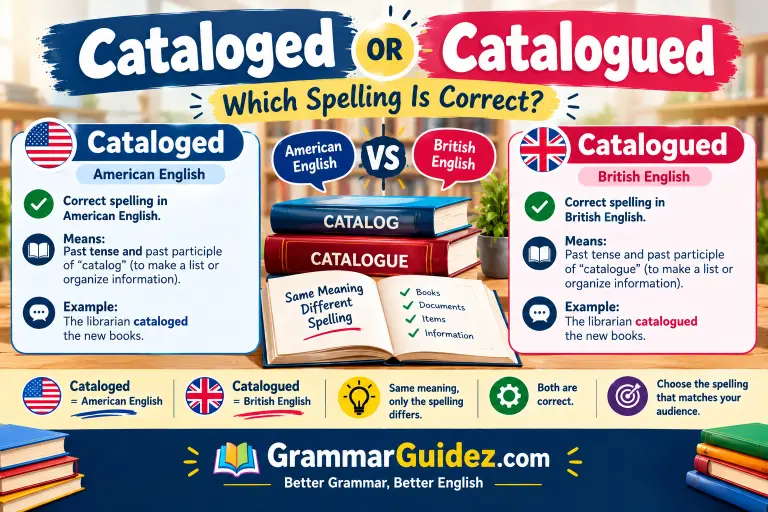
“Cataloged” and “Catalogued” are both correct spellings, but they follow different English spelling styles. Cataloged is the preferred spelling in American English. Catalogued is the preferred spelling in British English. Both mean to make a list or record of items in an organized way
If you are confused about cataloged or catalogued, you may wonder which spelling is correct. The good news is that both cataloged and catalogued are correct.
The main difference is the variety of English being used.
Cataloged is the more common spelling in American English.
Catalogued is the more common spelling in British English and other varieties that follow British spelling.
Both words come from the verb catalog, meaning to make a list of items and organize them in a useful way.
For example, a library may catalog its books. A museum may catalogue its collection. In the past tense, American English usually writes cataloged, while British English usually writes catalogued.
This difference is similar to other British and American spelling pairs, such as organized/organised and color/colour.
In this guide, you will learn the difference between cataloged and catalogued, when to use each spelling, their pronunciation, common mistakes, examples, and an easy way to remember them.
Quick Answer: Cataloged or Catalogued?
Cataloged and catalogued are both correct.
Use cataloged in American English.
Use catalogued in British English.
| Spelling | English Variety | Correct? |
| Cataloged | American English | ✅ Yes |
| Catalogued | British English | ✅ Yes |
Easy Rule
Remember:
American English → cataloged
British English → catalogued
The main difference is the extra u in the British spelling.
What Does Cataloged Mean?
Cataloged is the past tense and past participle of the verb catalog.
To catalog something means to make a detailed list of things and organize information about them.
For example, a library may catalog thousands of books.
The information may include:
- The title
- The author
- The date
- The subject
- The location
- Other useful details
The past tense is:
catalog → cataloged
This spelling is especially common in American English.
Examples
- The librarian cataloged the new books.
- The museum cataloged its collection.
- The company cataloged all its products.
- The researcher cataloged the historical documents.
What Does Catalogued Mean?
Catalogued has the same meaning as cataloged.
It is the British English spelling of the past tense and past participle.
The spelling is:
catalogue → catalogued
British English often keeps the u in words ending in -ogue.
Examples
- The librarian catalogued the new books.
- The museum catalogued its collection.
- The company catalogued its products.
- The researcher catalogued the historical documents.
The meaning does not change.
Only the spelling differs.
Cataloged vs. Catalogued
The main difference between cataloged and catalogued is regional spelling.
| Feature | Cataloged | Catalogued |
| American English | ✅ Common | Less common |
| British English | Less common | ✅ Common |
| Meaning | Same | Same |
| Pronunciation | Same | Same |
| Part of speech | Verb form | Verb form |
| Past tense | Yes | Yes |
| Past participle | Yes | Yes |
| Extra “u” | No | Yes |
So, neither spelling is wrong.
The best choice depends on your target audience.
American English: Cataloged
In American English, the word is commonly written:
catalog
The past tense is:
cataloged
The present participle is:
cataloging
Notice that American English removes the u.
The pattern is:
catalog → cataloged → cataloging
For a US audience, cataloged is normally the best choice.
British English: Catalogued
British English commonly uses:
catalogue
The past tense is:
catalogued
The present participle is:
cataloguing
The pattern is:
catalogue → catalogued → cataloguing
The u stays in these forms.
For a British audience, catalogued is normally the better choice.
Cataloged or Catalogued: Why Is There a Difference?
English has developed different spelling conventions in different countries.
American English often uses shorter spellings.
British English often keeps spellings influenced by older European and French forms.
This is why you can see:
- catalog / catalogue
- cataloged / catalogued
- cataloging / cataloguing
The differences do not normally change the meaning.
They simply show different spelling conventions.
Is Cataloged or Catalogued More Correct?
Neither is more correct in every situation.
Both are standard spellings.
The important thing is consistency.
If your article is written in American English, use:
cataloged
If your article is written in British English, use:
catalogued
Do not switch between the two styles without a reason.
For example, if you use color, organize, and cataloged, you are following common American spelling.
If you use colour, organise, and catalogued, you are following common British spelling.
Catalog vs. Catalogue
To understand cataloged and catalogued, it helps to understand their base forms.
Catalog
Catalog is the common American English spelling.
It can be a noun or a verb.
As a noun, it means a list or collection of items.
As a verb, it means to make such a list.
Catalogue
Catalogue is the common British English spelling.
It can also be a noun or a verb.
It has the same basic meaning as catalog.
So the forms are:
American:
catalog → cataloged → cataloging
British:
catalogue → catalogued → cataloguing
Cataloged or Catalogued in Formal Writing
Both spellings are suitable for formal writing.
The important point is to follow the spelling style of your audience.
For American readers
Use:
cataloged
For British readers
Use:
catalogued
This is especially important in:
- Academic writing
- Business writing
- Websites
- Books
- Reports
- Professional documents
Consistency makes your writing look polished and professional.
Common Mistakes With Cataloged and Catalogued
Mistake 1: Thinking One Spelling Is Always Wrong
Some writers think catalogued is incorrect because they are used to American English.
Others think cataloged is incorrect because they follow British English.
Both assumptions are wrong.
Both spellings are standard.
Mistake 2: Mixing Spelling Styles
A writer may use British spelling in one paragraph and American spelling in another.
For example:
The museum catalogued the items and organized the data.
This sentence mixes catalogued with organized.
It is better to choose one spelling system and follow it consistently.
Mistake 3: Using Cataloguing With Cataloged
If you choose American English, use:
cataloged
and:
cataloging
If you choose British English, use:
catalogued
and:
cataloguing
Cataloged vs. Catalogued Pronunciation
Both cataloged and catalogued have essentially the same pronunciation.
The spelling difference does not create a major pronunciation difference.
This means the distinction is mainly visible in writing.
When you hear someone say the word, you may not know which spelling they would use.
You need to consider the context or the speaker’s English variety.
Examples of Cataloged
Here are examples using the American spelling:
- The library cataloged the new books.
- The museum cataloged every painting.
- The store cataloged its products.
- The researcher cataloged the old documents.
- The team cataloged all the available records.
In each sentence, cataloged is the past tense of catalog.
Examples of Catalogued
Here are examples using the British spelling:
- The library catalogued the new books.
- The museum catalogued every painting.
- The store catalogued its products.
- The researcher catalogued the old documents.
- The team catalogued all the available records.
The meaning is the same as in the previous examples.
Only the spelling changes.
Cataloged or Catalogued for Your Website
If you are writing online, choose the spelling based on your main audience.
Targeting the United States?
Use:
cataloged
Targeting the United Kingdom?
Use:
catalogued
Targeting an international audience?
Either spelling can work, but consistency is important.
If your website mainly follows American English, cataloged may be the better choice.
If your website mainly follows British English, catalogued may be the better choice.
Cataloged or Catalogued in Other English Varieties
English is used in many countries, and spelling preferences can vary.
British-style spelling is commonly found in countries such as the United Kingdom and, with local variations, countries influenced by British English.
American spelling is widely used in the United States and can also influence international English.
For most general writing, the safest approach is to identify your target audience and follow one consistent style guide.
Easy Memory Trick
Here is a simple way to remember the difference:
US drops the U
American English:
cataloged
British English:
catalogued
Think:
American = shorter
British = keeps the U
You can also remember the base words:
Catalog → cataloged
Catalogue → catalogued
Once you know if you are using catalog or catalogue, the past-tense spelling becomes easy.
Cataloged or Catalogued: Comparison Chart
| Word Form | American English | British English |
| Base verb | catalog | catalogue |
| Past tense | cataloged | catalogued |
| -ing form | cataloging | cataloguing |
| Meaning | Same | Same |
| Pronunciation | Nearly the same | Nearly the same |
Which Spelling Should You Use?
Choose cataloged if your writing follows American English.
Choose catalogued if your writing follows British English.
For example:
American English:
The librarian cataloged the books.
British English:
The librarian catalogued the books.
Both sentences are correct.
The only difference is the spelling convention.
FAQs About Cataloged or Catalogued
Is cataloged correct?
Yes. Cataloged is the standard past tense and past participle commonly used in American English.
Is catalogued correct?
Yes. Catalogued is the standard British English spelling.
What is the difference between cataloged and catalogued?
There is no difference in meaning. Cataloged is commonly used in American English, while catalogued is commonly used in British English.
Which is American, cataloged or catalogued?
Cataloged is the common American English spelling.
Which is British, cataloged or catalogued?
Catalogued is the common British English spelling.
Is catalog or catalogue correct?
Both are correct. Catalog is common in American English, while catalogue is common in British English.
Is cataloging or cataloguing correct?
Both are correct. Cataloging is common in American English, while cataloguing is common in British English.
Can I use cataloged in British English?
Catalogued is the traditional and more common British spelling. However, usage can vary, and catalog is also found in British English in some contexts.
Can I use catalogued in American English?
Cataloged is the standard and more common American spelling. Catalogued may appear, especially when following a British style, but it is not the usual American form.
Cataloged or Catalogued: Final Verdict
When choosing between cataloged or catalogued, remember that both spellings are correct.
The difference is mainly based on English variety.
Cataloged is the common American English spelling.
Catalogued is the common British English spelling.
Both forms mean the same thing. They are the past tense and past participle of the verb meaning to make a list or organize information about items.
The easiest way to remember the difference is:
American English → cataloged
British English → catalogued
You can also remember the base forms:
catalog → cataloged
catalogue → catalogued
If you are writing for a US audience, choose cataloged. If you are writing for a British audience, choose catalogued.
Most importantly, stay consistent with your chosen English style throughout your writing.
Remember:
Cataloged = American English 🇺🇸
Catalogued = British English 🇬🇧
Both are correct. The audience decides which spelling fits best.
Read More Articles:

I am Elliot Hartwell, an English language writer and the author at GrammarGuidez.com. For the 6 years I have been working with English grammar, vocabulary, spelling and everyday language usage with a focus on making confusing topics easier to understand.
I started GrammarGuidez.com with a goal: to give readers clear and practical answers to common English questions. English can sometimes be confusing especially when two words look or sound similar but have meanings or uses. I enjoy breaking down these differences in a way that’s simple and easy to remember.
I believe learning English should feel simple not overwhelming. My goal is to make every article on GrammarGuidez.com useful, for students, writers, bloggers, teachers and anyone who wants to communicate clearly in English.