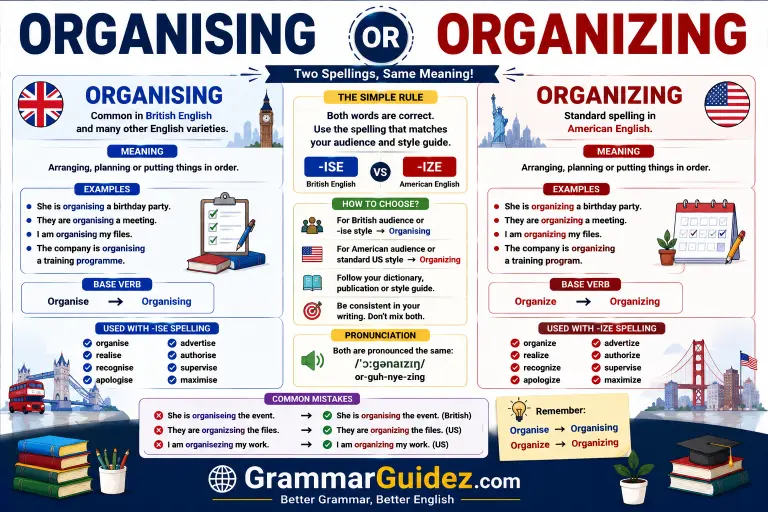
“Organising” and “organizing” are both correct spellings, but their usage depends on the variety of English. “Organizing” is the standard spelling in American English, while “organising” is the standard spelling in British English. Both mean planning, arranging, or putting things in order.
Organising or organizing? Both spellings are correct.
The difference mainly depends on the variety of English and the style guide you follow.
Organizing is the standard spelling in American English.
Organising is very common in British English and other varieties that prefer -ise endings.
However, there is an important detail that many grammar guides miss:
Organizing with a “z” can also be acceptable in British English.
Some British dictionaries and publishing styles, including Oxford-style spelling, use organize and organizing.
So, the best choice is not simply about right and wrong. It is about audience, spelling system, and consistency.
For example:
The company is organizing an event.
This is standard in American English.
The company is organising an event.
This is also correct in British English.
In this guide, you will learn the difference between organising and organizing, where each spelling is used, why both forms exist, and how to choose the best spelling for your writing.
Organising or Organizing: Quick Answer
Here is the simple answer:
| Spelling | Common Use |
| Organizing | American English and Oxford-style British English |
| Organising | British English and many other non-American English styles |
Both words mean the same thing.
They can mean:
- arranging something
- planning something
- putting things in order
- preparing an event
- managing people or activities
Examples
American English:
She is organizing the meeting.
British English:
She is organising the meeting.
The meaning does not change.
Only the spelling changes.
The Best Way to Choose: Think About Your Reader
Instead of asking:
Which spelling is correct?
Ask:
Who am I writing for?
This is the easiest way to choose between organising or organizing.
Writing for an American Audience
Use:
Organizing
Example:
We are organizing a new marketing campaign.
This spelling is standard in American English.
Writing for a British Audience
You may see:
Organising
Example:
We are organising a new marketing campaign.
This is widely used in British English.
However, organizing is also accepted in some British publishing traditions.
The important thing is to follow the spelling style required by your publication, school, company, or editor.
Why Are There Two Spellings?
The difference comes from the endings:
-ise
and
-ize
Many English words can have this spelling difference.
For example:
| -ise | -ize |
| organise | organize |
| realise | realize |
| recognise | recognize |
| apologise | apologize |
American English strongly prefers -ize.
British English often uses -ise, although -ize is also accepted in certain British spelling systems.
This means the spelling difference is part of a larger pattern in English.
Organize vs Organise Comes First
To understand organising or organizing, first look at the base verb.
| Base Form | -ing Form |
| Organise | Organising |
| Organize | Organizing |
The spelling of the base word determines the spelling of the -ing form.
If you write:
organise
then write:
organising
If you write:
organize
then write:
organizing
Do not mix the two spelling systems in the same document without a reason.
Organizing: Meaning and Usage
Organizing is the present participle of organize.
It is commonly used in American English.
Examples
She is organizing her office.
They are organizing a charity event.
I am organizing my files.
The company is organizing a training program.
In each example, organizing means arranging, planning, or putting something in order.
Organising: Meaning and Usage
Organising is the present participle of organise.
It is widely used in British English and spelling systems that prefer -ise.
Examples
She is organising her office.
They are organising a charity event.
I am organising my files.
The company is organising a training programme.
The meaning is exactly the same as organizing.
The difference is spelling.
Do Organising and Organizing Have Different Meanings?
No.
Both words have the same meaning.
Compare:
Sarah is organizing the event.
Sarah is organising the event.
Both sentences mean:
Sarah is planning and arranging the event.
There is no difference in:
- meaning
- pronunciation
- grammar
- tense
The difference is mainly a spelling preference.
Is Organizing Only American English?
Organizing is the standard spelling in American English.
However, it is not limited only to the United States.
The -ize spelling also has a long history in British English and is used in some British dictionaries and publishing styles.
For example, Oxford-style spelling often prefers:
organize
organizing
rather than:
organise
organising
Therefore, saying that organizing is always American and organising is always British is too simple.
A more accurate rule is:
American English generally uses organizing.
British English often uses organising, but organizing may also be accepted depending on the style guide.
Is Organising Wrong in American English?
For standard American English, organizing is the expected spelling.
If you are writing for:
- a US website
- an American audience
- an American school
- a US business
- American publications
use:
organizing
Example:
The team is organizing a conference.
Using organising may look inconsistent to readers expecting American spelling.
The Consistency Rule Matters Most
Imagine you are writing an article using American English.
You write:
organizing
Then later, you write:
organising
This can make your writing look inconsistent.
The same applies to other words.
For American English:
organize
realize
recognize
apologize
For a British -ise style:
organise
realise
recognise
apologise
Choose one spelling system and stay consistent.
Organising or Organizing in a Sentence
Here are some practical examples.
Planning an Event
American English:
We are organizing a birthday party.
British -ise style:
We are organising a birthday party.
Putting Things in Order
American English:
She is organizing her desk.
British -ise style:
She is organising her desk.
Managing a Group
American English:
He is organizing the volunteers.
British -ise style:
He is organising the volunteers.
Preparing a Meeting
American English:
They are organizing a meeting.
British -ise style:
They are organising a meeting.
The action is identical.
Organising vs Organizing: Pronunciation
Both spellings are pronounced the same way.
Organising:
OR-guh-nye-zing
Organizing:
OR-guh-nye-zing
The s in organising does not change the pronunciation into an ordinary /s/ sound in this word.
This is another reason the two spellings can confuse English learners.
They:
- look different
- sound the same
- mean the same
The Grammar Is the Same
Both organising and organizing are forms of a verb.
They can be used in continuous tenses.
Present Continuous
She is organizing the event.
She is organising the event.
Past Continuous
They were organizing the files.
They were organising the files.
As a Present Participle
The team is responsible for organizing the event.
The team is responsible for organising the event.
The grammar does not change.
Only the spelling changes.
Common Expressions With Organizing
Here are some common phrases in American English.
organizing a trip
organizing a project
Example:
She is organizing a trip for her family.
Common Expressions With Organising
The same expressions can be written with the British -ise spelling.
organising an event
organising a meeting
Example:
She is organising a trip for her family.
Again, the meaning remains the same.
Common Mistakes With Organising and Organizing
Mistake 1: Thinking One Is Always Wrong
❌ Only organizing is correct.
❌ Only organising is correct.
Both statements are inaccurate.
Both spellings are correct in appropriate English spelling systems.
Mistake 2: Mixing Spellings
❌ We are organizing the event and organising the volunteers.
This may be acceptable only if there is a specific reason to use different quoted or original spellings.
In normal writing, choose one system.
American style:
We are organizing the event and organizing the volunteers.
British -ise style:
We are organising the event and organising the volunteers.
Mistake 3: Using “Organising” for a Strict American Style Guide
If your school, company, editor, or publication follows American English, use:
organizing
Mistake 4: Assuming British English Never Uses -ize
This is a common oversimplification.
British English publications can use different spelling conventions.
Some prefer:
organising
Others use:
organizing
Always check the required style guide when writing professionally.
A Quick Decision Guide
Use this simple method.
Step 1: Who Is Your Audience?
If your audience is mainly American:
Organizing
If your audience follows a British -ise spelling style:
Organising
Step 2: Check Your Existing Content
Look at other words on your website or document.
Do you write:
realize
or:
realise
Do you write:
apologize
or:
apologise
Your choice for organizing or organising should usually match the same spelling system.
Step 3: Follow the Required Style Guide
For professional writing, always follow the required:
- company style guide
- school style guide
- publication rules
- editorial rules
This is more important than personal preference.
Organising or Organizing: Comparison Table
| Feature | Organising | Organizing |
| Meaning | Same | Same |
| Pronunciation | Same | Same |
| Grammar | Same | Same |
| Common in American English | Less common | Standard |
| Common in British English | Widely used | Also accepted in some styles |
| Base verb | Organise | Organize |
| Main difference | -ise spelling | -ize spelling |
The Easy Memory Trick
Remember the spelling pattern.
If you use:
Organize
then use:
Organizing
The letter z stays.
If you use:
Organise
then use:
Organising
The letter s stays.
Think:
Organize → Organizing
Organise → Organising
Do not change from one system to the other by accident.
Organising or Organizing for a Website
If you run a website, spelling consistency is especially important.
Choose one primary language style for your content.
For a US-focused website, the usual choice is:
organizing
For a website targeting readers who prefer British -ise spelling, you may choose:
organising
However, if your website has an international audience, either spelling can work depending on your editorial style.
The key is consistency.
For example, avoid using:
organizing
in one heading and:
organising
in another heading unless you are intentionally discussing spelling differences.
Content and Spelling Differences
For Growth, it can be useful to understand that users may search for both spellings.
Some users search:
organizing
Others search:
organising
If your article is specifically about the spelling difference, you can naturally include both terms.
However, avoid repeating the keywords unnaturally.
A good article should explain:
- which spelling is common in each variety of English
- that both spellings can be correct
- the meaning of the word
- the importance of consistency
This helps readers understand the topic instead of simply seeing repeated keywords.
Quick Quiz: Organising or Organizing?
Choose the best answer based on the requested spelling style.
1. You are writing for a standard American English website.
A. Organising
B. Organizing
2. Your publication follows a British -ise spelling style.
A. Organising
B. Organizing
3. Do organising and organizing have different meanings?
A. Yes
B. No
4. Do they have different pronunciations?
A. Yes
B. No
5. Which is more important when choosing a spelling style?
A. Consistency
B. Randomly switching spellings
Answers
- B — Organizing
- A — Organising
- B — No
- B — No
- A — Consistency
Fill in the Blanks
Choose the spelling that matches the requested style.
1. American English:
She is ______ the event.
Answer: organizing
2. British -ise style:
She is ______ the event.
Answer: organising
3. American English:
The company is ______ a new project.
Answer: organizing
4. British -ise style:
The company is ______ a new project.
Answer: organising
5. Both spellings have the same ______.
Answer: meaning
FAQs
Is it organising or organizing?
Both are correct. Organizing is the standard spelling in American English. Organising is widely used in British English, although organizing can also be accepted in some British spelling styles.
Is organizing American or British?
Organizing is standard in American English. It can also appear in British English, especially in Oxford-style spelling.
Is organising British English?
Yes. Organising is widely used in British English and in spelling systems that prefer -ise endings.
Is organizing wrong in British English?
No. Organizing can be acceptable in British English depending on the dictionary or style guide being followed.
Is organising wrong in American English?
In standard American English, organizing is the expected spelling. American publications generally prefer the -ize form.
Do organising and organizing mean the same thing?
Yes. They have the same meaning.
Both can mean arranging, planning, managing, or putting something in order.
Which spelling should I use for my website?
Choose the spelling that matches your target audience and editorial style. For a US-focused website, organizing is generally the best choice. Most importantly, remain consistent throughout your content.
How do you pronounce organising and organizing?
Both are pronounced the same way. The difference is spelling, not pronunciation.
Can I use both spellings in the same article?
If the article discusses the spelling difference, yes. However, in ordinary writing, you should normally choose one spelling system and remain consistent.
Conclusion
Both organising and organizing are correct spellings.
The meaning is the same.
The pronunciation is the same.
The grammar is the same.
The main difference is the spelling convention you follow.
For standard American English:
Organizing
For British English that follows the common -ise style:
Organising
It is also important to remember that organizing can be acceptable in some British spelling systems, including Oxford-style spelling.
The best rule is not to search for one universally “correct” spelling.
Instead, choose the spelling that matches:
- your audience
- your country or language style
- your publication’s requirements
- your website’s editorial style
Then remain consistent.
The easiest way to remember is:
Organize → Organizing
Organise → Organising
Once you understand that both spellings can be correct, choosing between organising or organizing becomes simple.
Read More Articles:
- Disenrollment or Unenrollment: Meaning and Usage
- Formulae or Formulas: Which One Should You Use?
- Apologising or Apologizing: Which Spelling Is Correct?

I am Evan Whitmore, an English language writer and the person who started GrammarGuidez.com. I made GrammarGuidez.com to make grammar, spelling, vocabulary and words that are often confused easier to understand.
I like taking to understand English words and grammar rules and turning them into simple and clear explanations. My aim is to help students, writers, bloggers, ESL learners and regular English speakers feel more sure when they write and talk.
At GrammarGuidez.com I work on real life examples easy to understand explanations comparing words, spelling changes and how American English is used every day.
I think learning English doesn’t need to be hard. A good explanation and some good examples can make tough grammar topics much simpler to learn