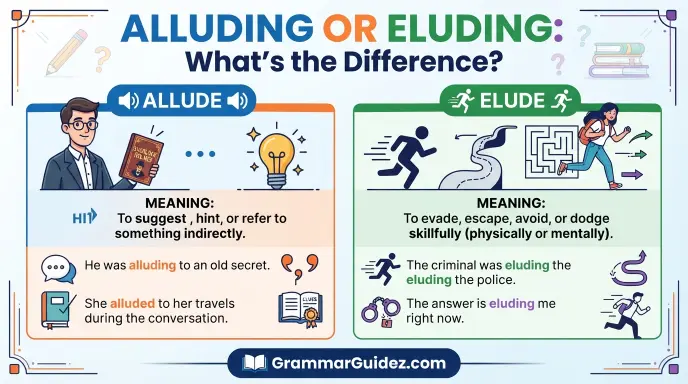
“Alluding” and “eluding” are both correct words, but they have different meanings. “Alluding” means indirectly referring to or hinting at something, while “eluding” means escaping from, avoiding, or being difficult to understand or achieve.
Alluding or eluding is a confusing word comparison because the two words look similar, sound somewhat alike, and both come from related Latin roots. However, their meanings are very different.
The easiest way to understand the difference is this:
Alluding means indirectly referring to something.
Eluding means escaping, avoiding, or remaining difficult to understand or achieve.
For example:
She was alluding to her previous job.
She was indirectly mentioning her previous job.
But:
The answer was eluding me.
The answer was difficult for me to understand or remember.
One letter changes the meaning completely. That is why choosing the correct word matters in academic writing, professional communication, essays, and everyday English.
This guide explains the difference between alluding and eluding with simple meanings, examples, grammar rules, common mistakes, memory tricks, and practice questions.
Alluding vs Eluding at a Glance
Here is the fastest way to remember the difference:
| Word | Main Meaning | Simple Idea |
| Alluding | Referring indirectly | Hinting at something |
| Eluding | Escaping or avoiding | Getting away from something |
Quick Examples
Alluding:
The speaker was alluding to a recent problem.
The speaker mentioned the problem indirectly.
Eluding:
The correct answer was eluding the student.
The student could not find or understand the answer.
Merriam-Webster distinguishes allude as making an indirect reference and elude as evading, escaping perception, or escaping understanding.
The Simple Rule: Hint vs Escape
A useful way to separate these words is to remember two ideas.
Alluding = Hinting
When you allude to something, you mention or suggest it without directly naming or explaining it fully.
She was alluding to an old disagreement.
She did not directly explain the disagreement.
Eluding = Escaping
When something eludes you, it escapes you, avoids you, or remains difficult to catch, understand, remember, or achieve.
Sleep was eluding him.
He could not fall asleep.
Success was eluding the team.
The team could not achieve success.
This is the main difference between alluding and eluding.
What Does Alluding Mean?
Alluding is the present participle form of the verb allude.
The word usually means:
To refer to something indirectly.
It is commonly used with the word to.
Common Pattern
Allude to + person, thing, event, or idea
Examples
She was alluding to her childhood.
The writer was alluding to a famous historical event.
He kept alluding to a problem at work.
The teacher was alluding to something we had studied earlier.
Cambridge Dictionary describes allude to as mentioning someone or something without talking about them directly.
Why Do People Allude to Something?
People often allude to something when they do not want to state it directly.
For example, someone might say:
“We all remember what happened last year.”
The speaker may be alluding to a specific event without naming it.
This can happen in:
- Conversations
- Literature
- Speeches
- Politics
- Business meetings
- Social media
- Academic writing
An allusion often requires the listener or reader to understand the hidden reference.
What Does Eluding Mean?
Eluding is the present participle form of elude.
It usually means:
- Escaping
- Avoiding
- Not being caught
- Remaining difficult to understand
- Remaining difficult to remember
- Being difficult to achieve
Examples
The suspect was eluding the police.
The suspect was avoiding capture.
The answer was eluding me.
I could not understand or remember the answer.
Success was eluding the company.
The company could not achieve success.
The reason for the problem was eluding researchers.
Researchers could not discover the reason.
Cambridge Dictionary notes that elude can mean not being caught, not being achieved, or escaping someone’s understanding or memory.
Alluding or Eluding: A Detailed Comparison
| Feature | Alluding | Eluding |
| Base verb | Allude | Elude |
| Main meaning | Refer indirectly | Escape or avoid |
| Common idea | Hinting | Getting away |
| Typical pattern | Allude to something | Elude someone/something |
| Part of speech | Verb form | Verb form |
| Common context | Conversation, writing, literature | Escape, failure, memory, understanding |
| Example | She was alluding to the past. | The answer was eluding her. |
The words may look similar, but they perform very different jobs.
How to Use Alluding Correctly
The most common structure is:
Someone is alluding to something.
Examples
The author was alluding to a famous novel.
She was alluding to her plans for the future.
The manager was alluding to possible changes.
He kept alluding to an important announcement.
In most standard uses, allude is followed by to.
Correct
She was alluding to a problem.
Usually incorrect
She was alluding a problem. ❌
The phrase allude to is the common structure used to introduce the thing being indirectly referenced.
How to Use Eluding Correctly
Eluding normally takes a direct object.
Examples
The criminal was eluding the police.
The solution was eluding the scientists.
The meaning was eluding me.
Sleep was eluding her.
Notice that we do not normally say:
Eluding to the police. ❌
Instead:
Eluding the police. ✅
This grammar difference can help you remember which word you need.
Alluding to Something vs Eluding Something
Here is a useful comparison.
Alluding To
The speaker was alluding to a recent event.
The speaker was indirectly referring to the event.
Eluding
The event’s true cause was eluding investigators.
Investigators could not discover the cause.
The Difference
Alluding to something means pointing toward it indirectly.
Eluding someone means escaping that person’s understanding, memory, reach, or efforts.
Everyday Situations Where You Use Alluding
In Conversation
Are you alluding to what happened yesterday?
This means:
Are you indirectly referring to what happened yesterday?
In Literature
Writers often allude to famous stories, people, historical events, or myths.
The poem is alluding to Greek mythology.
The poem indirectly refers to something from Greek mythology.
In Business
The manager was alluding to possible changes.
The manager did not clearly announce the changes.
He only suggested them indirectly.
In Social Media
Her post seemed to be alluding to a recent argument.
The post did not directly mention the argument.
However, readers believed it was referring to it.
Everyday Situations Where You Use Eluding
Trying to Catch Someone
The thief was eluding the police.
The thief was avoiding capture.
Trying to Remember Something
Her name is eluding me.
You know the information, but you cannot remember it.
Trying to Understand Something
The meaning of the sentence is eluding me.
You cannot understand it.
Trying to Achieve Something
A major breakthrough was eluding the researchers.
The researchers were trying to achieve something but had not succeeded.
A Grammar Clue That Makes the Difference Easier
One of the easiest ways to choose between alluding and eluding is to look at the words around them.
Alluding Usually Uses “To”
Alluding to a problem
The word to often appears after allude.
Eluding Usually Takes a Direct Object
Eluding the police
This pattern is not a perfect rule for every possible sentence, but it is an excellent memory tool for most everyday writing.
Common Mistakes With Alluding and Eluding
Mistake 1: Using Eluding When You Mean Hinting
❌ She was eluding to her past.
✅ She was alluding to her past.
Why?
She was indirectly referring to her past.
She was not escaping from it.
Mistake 2: Using Alluding When You Mean Escaping
❌ The suspect was alluding the police.
✅ The suspect was eluding the police.
The suspect was avoiding capture.
Therefore, eluding is correct.
Mistake 3: Forgetting “To” After Alluding
❌ He was alluding the problem.
✅ He was alluding to the problem.
The common structure is:
allude to something
Mistake 4: Adding “To” After Eluding
❌ The criminal was eluding to the police.
✅ The criminal was eluding the police.
Elude does not normally use to in this structure.
Mistake 5: Choosing the Word Based Only on Sound
The words sound somewhat similar, but spelling and pronunciation should not be your only guide.
Always ask:
Am I indirectly mentioning something?
Use alluding.
Am I escaping, avoiding, or failing to understand something?
Use eluding.
Alluding and Eluding in Academic Writing
These words are common in academic and formal writing.
Alluding in Academic Writing
The researcher was alluding to an earlier theory.
The article appears to be alluding to a historical event.
The author is alluding to ideas discussed in previous chapters.
Use alluding when discussing indirect references.
Eluding in Academic Writing
A clear explanation continues to elude researchers.
The exact cause has been eluding scientists.
The answer has eluded historians for decades.
Use eluding when something remains difficult to discover, understand, or achieve.
Alluding and Eluding in Professional Writing
Alluding
The email was alluding to possible changes in the company.
The email indirectly suggested changes.
Eluding
The solution has been eluding the development team.
The team has not been able to find the solution.
Professional writers should choose these words carefully because using the wrong one can change the meaning of the sentence.
Origin and History of Allude and Elude
The two words have related historical roots.
Both are connected to the Latin word ludere, meaning “to play.”
However, their prefixes led them to develop different meanings.
Merriam-Webster traces allude to Latin alludere and elude to Latin eludere. It also notes that allude entered English earlier, while elude appeared later.
This shared history helps explain why the words look and sound similar.
However, in modern English, their meanings are clearly different.
British English vs American English
There is no major spelling difference between British and American English for these words.
| Word | British English | American English |
| Allude | Allude | Allude |
| Alluding | Alluding | Alluding |
| Elude | Elude | Elude |
| Eluding | Eluding | Eluding |
The same grammar and spelling rules apply in both varieties of English.
Easy Memory Tricks for Alluding and Eluding
Trick 1: A for Allude and Allusion
Think:
A = Allude = Allusion
Both words are about making a reference.
An allusion is an indirect reference.
So:
Alluding = indirectly referring
Trick 2: E for Elude and Escape
Think:
E = Elude = Escape
If something is escaping you or avoiding you, use elude.
For example:
The answer is eluding me.
The answer is escaping your understanding.
Merriam-Webster also suggests remembering elude through its connection with ideas such as escape and evade.
Trick 3: Look for “To”
If you see:
___ to something
The correct word may be:
alluding to
Example:
She was alluding to the problem.
Trick 4: Ask What Is Happening
Is someone hinting?
Use:
alluding
Is someone escaping or avoiding?
Use:
eluding
Quick Practice: Alluding or Eluding?
Choose the correct word.
1. The speaker was ______ to a recent event.
A. alluding
B. eluding
2. The suspect was ______ the police.
A. alluding
B. eluding
3. She was ______ to problems in her personal life.
A. alluding
B. eluding
4. The answer was ______ the student.
A. alluding
B. eluding
5. The writer was ______ to a famous story.
A. alluding
B. eluding
6. Success was ______ the team.
A. alluding
B. eluding
7. He kept ______ to something important.
A. alluding
B. eluding
8. The criminal was ______ capture.
A. alluding
B. eluding
9. The meaning of the sentence was ______ me.
A. alluding
B. eluding
10. The teacher was ______ to a previous lesson.
A. alluding
B. eluding
Quiz Answers
- A — alluding
- B — eluding
- A — alluding
- B — eluding
- A — alluding
- B — eluding
- A — alluding
- B — eluding
- B — eluding
- A — alluding
Fill in the Blanks
Choose alluding or eluding.
- The author was ______ to an ancient myth.
- The answer was ______ me.
- She was ______ to a recent disagreement.
- The thief was ______ the police.
- The manager was ______ to future changes.
- Sleep was ______ him.
- The article was ______ to an earlier study.
- A solution was ______ the researchers.
- He kept ______ to something he did not explain.
- The truth was ______ investigators.
Answers
- alluding
- eluding
- alluding
- eluding
- alluding
- eluding
- alluding
- eluding
- alluding
- eluding
FAQs
What is the difference between alluding and eluding?
Alluding means indirectly referring to something. Eluding means escaping, avoiding, or remaining difficult to understand, remember, catch, or achieve. The words may sound similar, but they describe very different actions.
Is it alluding to or eluding to?
The common correct phrase is alluding to.
She was alluding to the problem.
Do not normally use eluding to when you mean indirectly referring to something.
The problem was eluding her.
Here, eluding means the problem was difficult for her to understand or solve.
Can you say “the answer is alluding me”?
No. If you mean that you cannot find or understand the answer, use eluding.
The answer is eluding me. ✅
Alluding would relate to making an indirect reference.
What does “alluding to” mean?
Alluding to means indirectly mentioning or referring to someone or something.
For example:
She was alluding to her previous job.
She did not directly discuss the job but suggested or hinted at it.
What does “eluding me” mean?
When something is eluding you, you cannot catch, understand, remember, discover, or achieve it.
For example:
His name is eluding me.
This means you cannot remember his name.
Cambridge Dictionary includes this type of use for information or ideas that escape someone’s memory or understanding.
Are alluding and eluding pronounced the same?
They are pronounced similarly, which is one reason learners confuse them. However, their first vowel sounds differ, and their meanings are completely different.
Allude begins with an “uh” sound, while elude begins with an “ee” or short unstressed “i” sound depending on accent and phonetic context.
The most important difference, however, is meaning.
What is an easy way to remember allude vs elude?
Remember:
Allude = A = Allusion
An indirect reference.
And:
Elude = E = Escape
Something gets away from you or remains difficult to catch or understand.
Conclusion
Although alluding and eluding look similar, they should never be treated as interchangeable.
Use alluding when someone is:
- Hinting
- Indirectly mentioning something
- Referring to something without saying it directly
Example:
She was alluding to a previous conversation.
Use eluding when someone or something is:
- Escaping
- Avoiding capture
- Difficult to understand
- Difficult to remember
- Difficult to achieve
Example:
The answer was eluding me.
The easiest rule is:
Alluding = referring indirectly.
Eluding = escaping or avoiding.
If you remember A for Allusion and E for Escape, you can quickly choose the correct word.
Read More Article:
- Apposed or Opposed: Which Word Is Correct?
- As or Like: Difference and Grammar Rules
- Non or None: Which One Should You Use?

I am Evan Whitmore, an English language writer and the person who started GrammarGuidez.com. I made GrammarGuidez.com to make grammar, spelling, vocabulary and words that are often confused easier to understand.
I like taking to understand English words and grammar rules and turning them into simple and clear explanations. My aim is to help students, writers, bloggers, ESL learners and regular English speakers feel more sure when they write and talk.
At GrammarGuidez.com I work on real life examples easy to understand explanations comparing words, spelling changes and how American English is used every day.
I think learning English doesn’t need to be hard. A good explanation and some good examples can make tough grammar topics much simpler to learn