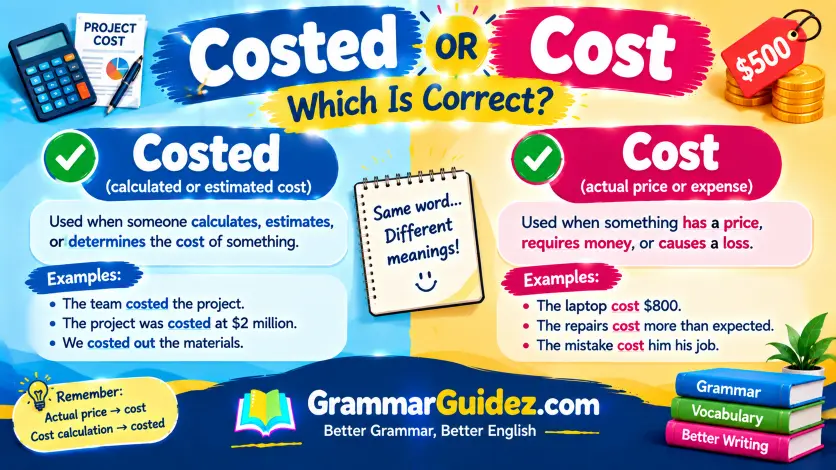
“Costed” and “cost” are both correct, but they are used differently. Cost = the usual past tense and past participle of cost, meaning to have a particular price. Costed = used mainly in business or accounting when calculating or estimating the cost of something
Have you ever written “It costed $500” and wondered if it should be “It cost $500”?
You are not alone. The word cost is unusual because its normal past tense does not change. But costed is also a real English word.
The important point is this: cost and costed have different uses.
When you mean that something had a price or caused a loss, use cost. When you mean that someone calculated or estimated a price, costed can be correct. Cambridge Dictionary makes this same distinction between the ordinary verb cost and the accounting use costed.
Quick Answer: Costed or Cost?
Cost is the normal past tense of cost when you talk about an actual price, expense, or loss.
- The phone cost $800.
- The repairs cost $500.
- The mistake cost him his job.
Costed is used when someone calculates, estimates, or determines the cost of something.
- The team costed the project.
- The project was costed at $2 million.
- We costed out the materials.
So, the correct word depends on the meaning.
| Word | Main use | Example |
| cost | Actual price or expense | The laptop cost $900. |
| costed | Calculated or estimated cost | The team costed the project. |
What Does “Cost” Mean?
Cost can be a noun or a verb.
As a verb, it can mean that something requires a certain amount of money.
For example:
- The ticket cost $50.
- The meal cost $30.
- The new car cost more than expected.
- The repairs cost us $1,000.
It can also mean that something caused a person to lose something valuable.
- The mistake cost him his job.
- The delay cost us two days.
- The decision cost the company a lot of money.
Cambridge lists cost as the past tense and past participle for these ordinary meanings.
Why Does “Cost” Stay the Same?
This is the part that causes most of the confusion.
Many English verbs form the past tense by adding -ed:
- work → worked
- call → called
- clean → cleaned
- open → opened
But cost does not follow that pattern in its ordinary use.
Its basic forms are:
| Verb form | Word | Example |
| Present | cost | These shoes cost $50. |
| Past | cost | These shoes cost $50 yesterday. |
| Past participle | cost | The shoes have cost me $50. |
| -ing form | costing | The shoes are costing too much. |
Cambridge specifically lists cost as the past tense and past participle for the ordinary money-related meaning. (Cambridge Dictionary)
The Easy Rule
Think of it like this:
Present: The book costs $20.
Past: The book cost $20.
Not:
The book costed $20. ❌
The fact that the price was in the past does not mean you add -ed.
When Is “Costed” Correct?
Here is where things become interesting.
Costed is correct when cost means to calculate or estimate the amount of money needed for something.
This use is especially common in business, accounting, construction, budgeting, manufacturing, and project planning.
Cambridge’s Business English Dictionary gives costed as the accounting form used when calculating or deciding how much something will cost.
For example:
The finance team costed the project before approval.
This does not mean the project already spent the money.
It means the finance team calculated the expected cost.
Another example:
The building project was costed at $5 million.
Here, costed means that someone calculated or estimated the project’s cost.
Costed = Cost Calculation
A useful way to remember the difference is:
Cost = price or expense
Costed = calculated price
That small difference solves most of the confusion.
Costed vs. Cost in Real Situations
Imagine that you buy a new laptop for $1,000.
After buying it, you say:
The laptop cost $1,000.
You are talking about the actual price.
Now imagine a company is planning to buy 100 laptops. Before placing the order, an employee calculates the expected total expense.
You could say:
The purchasing team costed the laptop order.
The first sentence describes a price.
The second describes a calculation.
Another Example: Building a House
Before construction begins, an architect or project manager may calculate the expected costs.
They may consider:
- Materials
- Labor
- Equipment
- Transport
- Permits
- Design costs
- Other expenses
You could say:
The company costed the building project at $2 million.
After the building is completed, you might say:
The building cost $2.2 million.
These sentences describe two different stages.
Before or during planning: costed = calculated or estimated.
After spending the money: cost = actual expense.
“Costed” Does Not Simply Mean Past Tense
This is an important distinction.
It would be too simple to say:
“Costed is the past tense of cost.”
That explanation can cause mistakes.
For the ordinary meaning of cost, the past tense is cost.
But English also has a specialized use where costed means calculated or estimated the cost. Cambridge recognizes this accounting use.
So compare:
❌ The shoes costed $100.
✅ The shoes cost $100.
But:
✅ The company costed the shoe production.
The second sentence means the company calculated the production cost.
Cost or Costed? Look at the Verb’s Meaning
When you are unsure, ask yourself one simple question:
Am I talking about the price, or am I talking about calculating the price?
If You Mean the Price → Cost
- The jacket cost $80.
- The trip cost us $2,000.
- The repairs cost more than expected.
- The mistake cost the company thousands of dollars.
If You Mean Calculation → Costed
- The accountant costed the project.
- The company costed the materials.
- The plan was costed at $500,000.
- We costed out the different options.
This meaning-based test is more useful than simply memorizing a tense rule.
What About “Costed Out”?
You may also see costed out.
This is a real expression meaning calculated the cost of something.
For example:
We costed out the materials before starting the project.
This means the team calculated how much the materials would cost.
You may also see:
The company costed out several production options.
Cambridge lists cost something out as a use related to calculating costs. (Cambridge Dictionary)
So:
cost out = calculate the cost
Common Mistakes With Costed and Cost
❌ “The car costed $30,000.”
If you mean the car had a price of $30,000, this is not the normal form.
✅ “The car cost $30,000.”
Here, you are simply stating the price.
❌ “The vacation costed us $2,000.”
You are talking about money actually spent.
✅ “The vacation cost us $2,000.”
That is the normal form.
❌ “The mistake costed him his job.”
Here, cost means caused him to lose his job.
✅ “The mistake cost him his job.”
This is correct.
❌ “The project cost $5 million” when you mean an estimate
This sentence normally sounds like the project actually required $5 million.
If you mean that someone calculated the expected cost, you can say:
✅ “The project was costed at $5 million.”
The passive structure makes the special meaning clearer.
Costed or Cost in Business English
Business writing is one place where you may see costed more often.
Businesses often need to calculate the expected cost of:
- Projects
- Products
- Services
- Materials
- Construction
- Marketing plans
- Manufacturing
- New equipment
- Business proposals
For example:
The finance department costed the new project.
Or:
The proposal has been fully costed.
The second sentence means the expected financial requirements have been calculated.
Cambridge also uses costing for the process of calculating how much a product or service will cost.
Costing vs. Costed
These related words can help you understand the idea:
Costing = the process of calculating a cost.
Costed = calculated or estimated the cost.
For example:
We are preparing the costing for the project.
The project has been costed.
Cost in Everyday English
In normal conversation, cost is much more common when you are talking about a price.
You would naturally say:
How much did it cost?
Not:
How much did it costed?
You would say:
It cost me $50.
Not:
It costed me $50.
You would say:
The tickets cost $200.
Not:
The tickets costed $200.
This is why English learners should not automatically add -ed to cost.
Cost in Academic and Formal Writing
The same rule applies in academic writing.
For example:
The study cost approximately $100,000.
The research project cost more than expected.
If the sentence describes an estimated financial calculation, costed may be appropriate:
The proposed research project was costed at $100,000.
The exact context matters.
In formal writing, choose the word that clearly expresses if you mean actual expense or cost calculation.
American and British English
The basic distinction between cost and costed is not simply an American-versus-British spelling difference.
Both forms can appear in English.
The more important difference is meaning and context.
Cambridge’s American and British dictionary entries give cost as the ordinary past form, while its Business English entry recognizes costed for the accounting meaning of calculating or deciding a cost. (Cambridge Dictionary)
So you should not think:
American = cost
British = costed
That would be misleading.
Instead, remember:
Actual price or loss → cost
Calculated or estimated price → costed
Cost, Costed, and Costing
These three forms are easy to mix up.
| Word | Meaning | Example |
| cost | Have or require a price | The car cost $20,000. |
| costed | Calculated or estimated a cost | We costed the project. |
| costing | The process of calculating cost | The costing took two days. |
Notice that costing is commonly used as a noun in business and accounting. Cambridge defines it as the process or calculation of determining how much a product or service will cost. (Cambridge Dictionary)
A Simple Memory Trick
Use this short rule:
Price = Cost
If you are saying what something actually cost, use cost.
The phone cost $700.
Calculation = Costed
If someone worked out the expected price, use costed.
The company costed the project.
You can also remember:
“What did it cost?” → cost
“Who calculated the cost?” → costed
This trick works well for everyday writing.
Costed or Cost: Examples
Here are more examples to make the difference clear.
Everyday Examples
- The meal cost $40.
- The shoes cost too much.
- The movie tickets cost $60.
- The repair cost me $300.
- The holiday cost more than expected.
Business Examples
- The finance team costed the proposal.
- The project was costed at $3 million.
- We costed out the materials.
- The company needs to cost the new service before launching it.
- The plan has been fully costed.
Loss or Consequence
- The mistake cost him his position.
- The delay cost the company valuable time.
- The accident cost several people their jobs.
- The error cost us the contract.
Notice that costed does not work in these loss-related examples.
Practice Quiz: Cost or Costed?
Choose cost or costed.
- The laptop ___ $900 last year.
- The accountant ___ the project before approval.
- The repairs ___ more than expected.
- The mistake ___ him his job.
- The company ___ the materials for the new building.
- The holiday ___ us $3,000.
- The proposal was ___ at $2 million.
- The delay ___ the company thousands of dollars.
- We ___ out the different options.
- The new machine ___ $50,000.
Answers
- cost
- costed
- cost
- cost
- costed
- cost
- costed
- cost
- costed
- cost
The pattern is simple: actual price, expense, or loss takes cost. Calculation or estimation takes costed.
FAQs
Is “costed” a correct word?
Yes. Costed is a correct English word when it means calculating, estimating, or determining the cost of something. Cambridge specifically recognizes this accounting use. (Cambridge Dictionary)
What is the past tense of “cost”?
For the ordinary meaning of having a price or causing a loss, the past tense is cost.
The phone cost $500.
Is “The car costed $20,000” correct?
If you mean that the car had an actual price of $20,000, use:
The car cost $20,000.
Costed is normally used for calculating or estimating a cost.
Can I say “The project was costed”?
Yes.
The project was costed at $4 million.
This means someone calculated or estimated the project’s cost. (Cambridge Dictionary)
Can I say “It has costed me a lot”?
If you mean something caused an actual loss or expense, use cost:
It has cost me a lot.
If you mean someone calculated the cost, costed can be appropriate:
The project has been costed carefully.
What does “costed out” mean?
Costed out means calculated the cost of something.
We costed out the materials before ordering them.
Is “cost” an irregular verb?
Yes, in its ordinary money-related use, cost keeps the same form in the present, past, and past participle.
cost → cost → cost
Is costed more common in business?
It is especially useful in business, accounting, project planning, and other situations where people calculate or estimate costs. Cambridge identifies this as an accounting use. (Cambridge Dictionary)
Costed or Cost: Final Answer
So, costed or cost?
Both can be correct, but they do not normally mean the same thing.
Use cost when you talk about an actual price, expense, or loss:
- The phone cost $800.
- The repairs cost $500.
- The mistake cost him his job.
Use costed when someone calculates, estimates, or determines a cost:
- The team costed the project.
- The proposal was costed at $2 million.
- We costed out the materials.
The easiest rule is:
Actual price → cost
Cost calculation → costed
Once you understand this difference, the choice becomes much easier. You do not need to add -ed just because you are talking about the past.
Read More Articles:

I am Elliot Hartwell, an English language writer and the author at GrammarGuidez.com. For the 6 years I have been working with English grammar, vocabulary, spelling and everyday language usage with a focus on making confusing topics easier to understand.
I started GrammarGuidez.com with a goal: to give readers clear and practical answers to common English questions. English can sometimes be confusing especially when two words look or sound similar but have meanings or uses. I enjoy breaking down these differences in a way that’s simple and easy to remember.
I believe learning English should feel simple not overwhelming. My goal is to make every article on GrammarGuidez.com useful, for students, writers, bloggers, teachers and anyone who wants to communicate clearly in English.