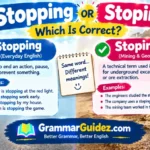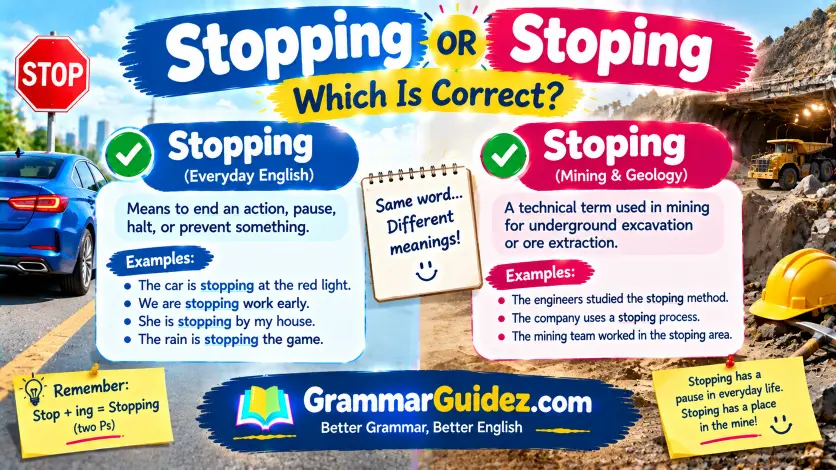
“Stopping” and “Stoping” are not equally correct. Stopping the correct standard spelling. It is the present participle of stop, meaning to cease or bring something to an end. Stoping generally a misspelling of stopping in everyday English
If you are confused about stopping or stoping, you are not alone. These two words look almost the same, but they do not have the same meaning.
For normal English, stopping is the correct spelling when you mean ending an action, coming to a halt, pausing, or preventing something from continuing.
Stoping is also a real word, but it has a special meaning in mining and geology. It is related to stope, a term used for underground excavation or ore extraction.
So, the correct choice depends on what you mean.
Quick Answer: Stopping or Stoping?
| Word | Meaning | Common Use |
| Stopping | Ending, pausing, or bringing something to a halt | Everyday English |
| Stoping | A mining or geological process | Technical writing |
Simple rule
If you mean “to stop,” use:
stop → stopping
If you are talking about mining or geology, stoping may be the word you need.
What Does “Stopping” Mean?
Stopping is the present participle and gerund form of the verb stop.
The verb stop can mean to finish an action, stop movement, pause, prevent something, or cause something to no longer operate. Cambridge lists stopping as the standard -ing form of stop. (Cambridge Dictionary)
For example:
- The bus is stopping at the next station.
- She is stopping the car.
- Please stop stopping the music.
- We are stopping work at five.
- The rain is stopping the game.
- He is stopping by the office later.
In all these sentences, stopping has the normal everyday meaning of bringing something to an end or pausing it.
Why Does “Stop” Become “Stopping”?
This is where many spelling mistakes happen.
The base word is:
stop
When we add -ing, we do not simply write:
❌ stop + ing = stoping
Instead, the final p is doubled:
✅ stop + ping = stopping
The same pattern appears in the past tense:
stop → stopped
So you can remember the word family like this:
| Form | Correct Word |
| Base verb | stop |
| Present tense | stops |
| -ing form | stopping |
| Past tense | stopped |
| Past participle | stopped |
The double p helps keep the spelling consistent when the suffix is added.
Why Is “Stoping” Sometimes a Real Word?
This is the interesting part.
Stoping is not simply a misspelling in every situation.
In mining and geology, stoping is a technical term. It describes a method or process involving the excavation of rock or ore, especially in underground mining. Several current grammar and spelling sources point out this specialized use. (GrammerLearn.com)
The word comes from stope, a mining term.
For example:
The engineers studied the stoping method used in the mine.
Here, stoping is not the everyday verb stop with -ing added. It is a technical word connected with mining.
That is why saying “stoping is never a word” is too broad.
Stopping vs. Stoping: The Real Difference
The easiest way to understand the difference is to focus on meaning.
Stopping
Stopping means:
- coming to a halt
- ending an action
- pausing
- preventing something
- causing movement to end
Example:
The driver is stopping the car.
The sentence has nothing to do with mining.
Stoping
Stoping is a specialized technical term used mainly in mining and geology.
Example:
The mining company changed its stoping method.
Here, the word refers to a mining process.
Compare them
Stopping: ordinary English
Stoping: specialized technical vocabulary
The missing p is not just a spelling detail. It can change the word completely.
Stopping in Everyday English
You will see stopping in many common situations.
Stopping a vehicle
The driver is stopping at the red light.
Stopping an activity
We are stopping the meeting for lunch.
Stopping a machine
The technician is stopping the machine.
Stopping an event
Heavy rain is stopping the outdoor event.
Stopping by somewhere
Stopping by means visiting a place for a short time.
I am stopping by your office later.
This is a very common expression in everyday English.
Stopping in Academic and Business Writing
The word stopping is also normal in formal writing.
For example:
The study examines the effects of stopping the treatment.
The company is stopping production temporarily.
The system automatically detects when the machine is stopping.
The government announced plans for stopping illegal activity.
The word does not become different just because the writing is formal.
A Common Mistake: “Stoping”
One of the most common spelling mistakes is writing stoping when you mean stopping.
Incorrect
❌ She is stoping at the store.
Correct
✅ She is stopping at the store.
Incorrect
❌ The bus is stoping here.
Correct
✅ The bus is stopping here.
Incorrect
❌ They are stoping the machine.
Correct
✅ They are stopping the machine.
If the sentence is about stopping, pausing, ending, or preventing something, use stopping.
What About “Stopped”?
The same spelling idea appears with the past form.
The correct form is:
stop → stopped
Not:
❌ stoped
For example:
The car stopped suddenly.
She stopped talking.
The machine stopped working.
So remember these two forms together:
stopped
stopping
Both contain a double p.
Stopping or Stoping in American and British English
This is not a normal American-versus-British spelling difference.
Both American and British English use stopping for the everyday verb form.
For example:
- American English: The train is stopping.
- British English: The train is stopping.
The spelling does not normally change between these varieties.
Stoping, when used as a technical mining term, also has a specialized meaning rather than being a British alternative to stopping.
How to Remember the Correct Spelling
Here is an easy memory trick:
Stop has a short vowel sound.
When you add -ing, double the final p:
STOP + PING = STOPPING
You can also remember the word family:
stop → stopped → stopping
If you are writing about a bus, car, person, machine, meeting, activity, or process coming to an end, think:
“Two Ps in stopping.”
Stop Doing vs. Stop to Do
There is another useful grammar point involving stop.
Stop doing something means you end an activity.
She stopped talking.
This means she was talking and then ended the activity.
But stop to do something means you pause one activity so that you can do another activity. Cambridge explains this distinction in its grammar guidance. (Cambridge Dictionary)
For example:
We stopped to eat lunch.
The people stopped their previous activity so they could eat.
Compare:
We stopped eating lunch.
This means they ended the activity of eating.
The spelling remains stopping when you use the -ing form:
We are stopping to eat.
“Stopping” in Different Contexts
| Context | Example |
| Driving | The car is stopping. |
| Travel | The train is stopping here. |
| Work | We are stopping work early. |
| Business | The company is stopping production. |
| Technology | The program is stopping unexpectedly. |
| Sports | The referee is stopping the game. |
| Conversation | He is stopping to think. |
| Daily life | I am stopping by later. |
Notice that the meaning changes with the sentence, but the spelling stays the same.
“Stoping” in Mining and Geology
If you work with mining, engineering, or geology, you may come across stoping.
In this context, the word relates to stope, an underground excavation or the process of extracting ore from such a working area.
This is very different from the ordinary verb stop.
For example:
The engineers evaluated the stoping operation.
In a mining report, stoping can therefore be completely correct.
But if you are writing:
The bus is stoping at the station.
that is a spelling error.
The correct sentence is:
The bus is stopping at the station.
A Simple Context Test
Not sure which word to use?
Ask yourself:
Am I talking about stopping something, or about mining?
If you mean:
- ending
- pausing
- halting
- preventing
- ceasing movement
Use stopping.
If you mean:
- underground excavation
- extracting ore
- mining methods
- a stope
Use stoping.
This quick test can solve most cases.
Common Mistakes to Avoid
Mistake 1: Using one “p”
❌ The train is stoping.
✅ The train is stopping.
Mistake 2: Writing “stoped”
❌ The car stoped suddenly.
✅ The car stopped suddenly.
Mistake 3: Treating stoping as an alternative spelling
❌ “Stoping” is the British spelling of “stopping.”
This is not correct. Stoping is a separate technical term, not a British spelling variant of everyday stopping.
Mistake 4: Ignoring context
A mining article may correctly use stoping.
An everyday email usually needs stopping.
Always look at the meaning before deciding.
Quick Examples: Correct or Incorrect?
| Sentence | Answer |
| The bus is stopping here. | ✅ Correct |
| She is stoping the car. | ❌ Incorrect |
| The machine stopped suddenly. | ✅ Correct |
| He was stoping by the store. | ❌ Incorrect |
| They are stopping production. | ✅ Correct |
| The engineers studied stoping methods. | ✅ Correct in a mining context |
| The train is stoping at noon. | ❌ Incorrect |
| The mining team examined the stoping area. | ✅ Technical use |
A 10-Question Quick Quiz
Choose stopping or stoping.
- The driver is ______ at the traffic light.
- Please stop ______ the machine.
- She is ______ by my house later.
- The company is ______ production.
- The train is ______ at the next station.
- The engineers studied underground ______.
- He is ______ the car outside.
- They are ______ the game because of rain.
- The mining report discusses ______ methods.
- We are ______ to get some food.
Answers
- stopping
- stopping
- stopping
- stopping
- stopping
- stoping
- stopping
- stopping
- stoping
- stopping
FAQs
Is stopping the correct spelling?
Yes. Stopping is the correct everyday form of the verb stop when adding -ing.
Is stoping a word?
Yes, but it has a specialized meaning. Stoping is used mainly in mining and geology.
Why does stopping have two Ps?
The final p in stop is doubled before adding -ing, giving stopping.
Is “stoping” a spelling mistake?
Usually, if you mean the everyday verb stop, then yes. However, stoping is a legitimate technical term in mining and geology.
Is stopping the same in British and American English?
Yes. Both varieties normally use stopping for the -ing form of stop.
Is “stoped” correct?
For the ordinary verb stop, the correct past form is stopped, with two Ps.
What is the difference between stopping and stoping?
Stopping means halting, pausing, ending, or preventing something. Stoping is a specialized mining or geological term.
How do you remember stopping?
Think:
STOP + PING = STOPPING
The extra p makes the spelling easier to remember.
Final Answer: Stopping or Stoping?
For almost every everyday English sentence, the correct word is stopping.
Use stopping when you mean:
- coming to a halt
- ending an action
- pausing
- preventing something
- making something stop
Use stoping only when you are discussing its specialized mining or geological meaning.
The easiest rule is:
Stop → Stopping
So if you are writing an email, school assignment, website article, social media post, or everyday message, you will usually want stopping, not stoping.
Read More Articles:

I am Evan Whitmore, an English language writer and the person who started GrammarGuidez.com. I made GrammarGuidez.com to make grammar, spelling, vocabulary and words that are often confused easier to understand.
I like taking to understand English words and grammar rules and turning them into simple and clear explanations. My aim is to help students, writers, bloggers, ESL learners and regular English speakers feel more sure when they write and talk.
At GrammarGuidez.com I work on real life examples easy to understand explanations comparing words, spelling changes and how American English is used every day.
I think learning English doesn’t need to be hard. A good explanation and some good examples can make tough grammar topics much simpler to learn