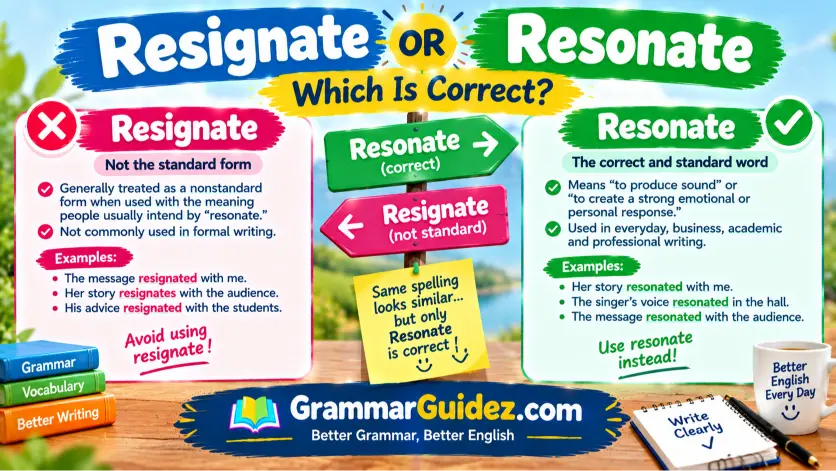
“Resignate” and “Resonate” are not interchangeable. Resonate to produce a strong, clear sound, or to create a strong feeling or connection. Resignate not a standard word in modern English. It is usually a misspelling of “resonate.”
Resignate or resonate? If you have ever wondered which word is correct, you are not alone. These two words look very similar, so it is easy to type resignate when you actually mean resonate.
In modern standard English, resonate is the word you normally need. It can describe a sound that vibrates or fills a space. It can also describe an idea, story, message, or experience that creates a strong emotional or personal connection.
Resignate is generally treated as a nonstandard form when used with the meaning people usually intend by “resonate.” In normal school, business, academic, and professional writing, use resonate instead.
Quick Answer: Resignate or Resonate?
Resonate is the standard modern English word.
Resignate is generally a misspelling or nonstandard form when someone means resonate.
| Word | Standard modern usage? | Meaning |
| Resonate | ✅ Yes | To produce sound, vibrate, or create a strong response |
| Resignate | ❌ Generally no | Usually a mistaken form of “resonate” |
For example:
❌ Her story resignated with me.
✅ Her story resonated with me.
The second sentence is the correct modern English form.
What Does “Resonate” Mean?
Resonate is a verb.
It has two main uses.
First, it can describe something that produces or carries sound.
Her voice resonated throughout the hall.
Second, it can describe something that creates a strong emotional, personal, or intellectual response.
Her story resonated with me.
Cambridge defines resonate in its sound-related sense as producing or filling a space with sound through vibration. Dictionary.com also records the figurative sense of producing a positive feeling or emotional response.
What Does “Resignate” Mean?
In modern standard English, resignate is generally not the word you should use when you mean that something connects with someone or creates a strong response.
Many people write resignate because it looks similar to resonate.
For example:
❌ The message resignated with the audience.
The standard form is:
✅ The message resonated with the audience.
So, if you are writing an article, email, essay, report, presentation, or social media post, resonate is the safer and standard choice.
Resonate vs. Resignate
The difference is simple.
Resonate is an established modern English verb.
Resignate is generally considered a nonstandard form when used in place of resonate.
Compare:
| Incorrect / Nonstandard | Correct |
| The story resignated with me. | The story resonated with me. |
| His words resignate with readers. | His words resonate with readers. |
| The idea resignated with the team. | The idea resonated with the team. |
| Her message resignates with people. | Her message resonates with people. |
The important word to remember is resonate.
Why Do People Confuse Resignate and Resonate?
The confusion is easy to understand.
The words look almost the same:
resignate
resonate
Both begin with res- and contain several of the same letters.
There is also the word resign, which is a completely different word. Because English has many verbs ending in -ate, some writers may assume that resignate is a normal verb.
But when you want to say that an idea or message creates a strong connection, use resonate.
How to Use “Resonate” Correctly
The most common structure is:
resonate with + person/group
Examples
- Her story resonated with me.
- The message resonated with the audience.
- His advice resonated with many students.
- The song resonated with young listeners.
- The idea resonated with the team.
The phrase resonate with is especially common when talking about emotions, ideas, experiences, stories, and messages.
Resonate for Emotional Connection
One of the most common modern uses of resonate is to describe an emotional connection.
When something resonates with you, it feels meaningful or strongly connected to your thoughts, feelings, or experiences.
Examples
Her experience really resonated with me.
The movie’s message resonated with many viewers.
His advice resonated with the students.
The story resonated with people around the world.
In these sentences, resonate does not mean that something literally makes a sound.
It means that something creates a strong response or connection.
Resonate for Sound
Resonate can also be used in a literal sense related to sound.
A sound can resonate when it vibrates, echoes, or fills a space.
Examples
- The singer’s voice resonated throughout the hall.
- The bell resonated through the building.
- Deep music resonated across the room.
- His voice resonated in the empty church.
This is one of the original and literal uses of the word. Cambridge specifically gives sound-related examples of resonate.
Resonate in Business Writing
Resonate works well in professional and business English.
It is often used when discussing customers, audiences, employees, ideas, products, or messages.
Examples
The campaign resonated with its target audience.
The new design resonated with customers.
The presentation resonated with the team.
The company’s message resonates with young consumers.
These uses describe a strong response or connection.
Resonate in Academic Writing
You can also use resonate in academic writing when the context calls for it.
Examples
The findings resonated with previous research.
The author’s argument resonated with many readers.
The theory continues to resonate with modern scholars.
However, always choose the word based on the exact meaning you want to express.
Resonate in Everyday English
Resonate is not limited to formal writing.
People use it in everyday conversations too.
Examples
That really resonates with me.
Does that idea resonate with you?
Her story really resonated with me.
I think his message will resonate with many people.
One of the most natural expressions is:
“That resonates with me.”
It means that something feels meaningful, familiar, or personally relevant.
Resonate: Common Word Forms
Learning the different forms of resonate can help you avoid mistakes.
| Form | Word |
| Base form | resonate |
| Third-person singular | resonates |
| Past tense | resonated |
| Past participle | resonated |
| Present participle | resonating |
| Related noun | resonance |
Examples
Resonate:
This idea may resonate with readers.
Resonates:
This message resonates with me.
Resonated:
Her speech resonated with the audience.
Resonating:
The message is resonating with young people.
Resonance:
The story has emotional resonance.
“Resonated With Me” or “Resignated With Me”?
The correct phrase is:
✅ resonated with me
Not:
❌ resignated with me
For example:
His advice really resonated with me.
This means his advice created a strong personal response or connection.
Another example:
Her story resonated with me because I had a similar experience.
This is one of the most common places where people make the resignate/resonate mistake.
Common Mistakes With Resignate and Resonate
Mistake 1: Writing “Resignate With”
❌ This message resignates with me.
✅ This message resonates with me.
Mistake 2: Writing “Resignated With”
❌ Her story resignated with me.
✅ Her story resonated with me.
Mistake 3: Adding “Sig” to Resonate
Some people remember the word incorrectly because of words such as resign.
The correct spelling is:
RESONATE
Not:
RESIGNATE
Mistake 4: Using “Resonate” When You Mean “Resign”
Be careful with resonate and resign.
They are completely different words.
Resign means to leave a job or position voluntarily.
She decided to resign from her job.
Resonate can mean to produce sound or create a strong emotional connection.
Her message resonated with the audience.
Do not confuse these words.
An Easy Memory Trick
Here is a simple way to remember the correct spelling:
RESONATE = SOUND
Think of resonate as something that echoes or rings.
A bell can resonate.
A voice can resonate.
A message can also resonate with people.
Remember:
RESONATE → SOUND → CONNECTION
If you want to say that something connects strongly with someone, use resonate.
Resonate vs. Relate
Resonate and relate can sometimes be close in meaning, but they are not exactly the same.
Relate can mean to understand or identify with something.
I can relate to your experience.
Resonate often suggests that something creates a strong emotional, personal, or intellectual response.
Your story really resonates with me.
Both can express connection, but resonate often gives the idea of something having a strong effect.
Is Resignate Ever Used?
You may occasionally see resignate online or in informal writing.
However, seeing a word used does not automatically make it standard English.
For modern standard writing, especially in:
- School assignments
- Academic papers
- Business emails
- Professional documents
- Websites
- Reports
- Formal communication
use resonate when you mean “connect strongly,” “have an emotional effect,” or “produce a sound.”
Resignate or Resonate: Example Sentences
Incorrect
❌ The movie resignated with me.
Correct
✅ The movie resonated with me.
Incorrect
❌ Her speech resignated with the audience.
Correct
✅ Her speech resonated with the audience.
Incorrect
❌ This idea really resignates with readers.
Correct
✅ This idea really resonates with readers.
Incorrect
❌ His advice resignated deeply with me.
Correct
✅ His advice resonated deeply with me.
Correct Sound Usage
The singer’s voice resonated throughout the theater.
Quick Comparison
| Word | Meaning | Example |
| Resonate | Produce or carry sound | The bell resonated through the hall. |
| Resonate | Create a strong connection | Her story resonated with me. |
| Resignate | Generally nonstandard for this intended meaning | ❌ Her story resignated with me. |
Quick Quiz: Resignate or Resonate?
Choose the correct word.
- Her story really ______ with me.
- The speaker’s voice ______ throughout the hall.
- Does this message ______ with you?
- His advice ______ with the students.
- The idea ______ with many readers.
Answers
- resonated
- resonated
- resonate
- resonated
- resonated
FAQs
Is “resignate” a correct English word?
In modern standard English, resignate is generally not the form you should use when you mean resonate. It is commonly treated as a nonstandard or mistaken form.
Is “resonate” the correct word?
Yes. Resonate is a standard English verb. It can describe sound and can also describe a strong emotional, personal, or intellectual response.
Is it “resonated with me” or “resignated with me”?
The correct phrase is “resonated with me.”
Her story resonated with me.
What does “resonate with me” mean?
Resonate with me means that something creates a strong personal, emotional, or intellectual connection with you.
Can “resonate” describe sound?
Yes. Resonate can describe a sound that vibrates, echoes, or fills a space.
Can I use “resonate” in professional writing?
Yes. Resonate can be used naturally in professional writing when describing a strong response or connection.
What is the past tense of resonate?
The past tense is resonated.
The message resonated with the audience.
What is the present participle of resonate?
The present participle is resonating.
The message is resonating with readers.
What is the easiest way to remember resonate?
Think of resonate as something that echoes. A sound can resonate, and an idea can also resonate with someone.
Conclusion
Resonate is the standard modern English word to use when you mean that something produces sound or creates a strong emotional, personal, or intellectual response.
Resignate is generally a nonstandard or mistaken form when used with this meaning.
So remember:
✅ Resonate
❌ Resignate
The most useful phrase to remember is:
That really resonated with me.
Use resonate in your everyday, academic, professional, and online writing when you want to describe a strong connection or response.
Read More Articles:

I am Elliot Hartwell, an English language writer and the author at GrammarGuidez.com. For the 6 years I have been working with English grammar, vocabulary, spelling and everyday language usage with a focus on making confusing topics easier to understand.
I started GrammarGuidez.com with a goal: to give readers clear and practical answers to common English questions. English can sometimes be confusing especially when two words look or sound similar but have meanings or uses. I enjoy breaking down these differences in a way that’s simple and easy to remember.
I believe learning English should feel simple not overwhelming. My goal is to make every article on GrammarGuidez.com useful, for students, writers, bloggers, teachers and anyone who wants to communicate clearly in English.