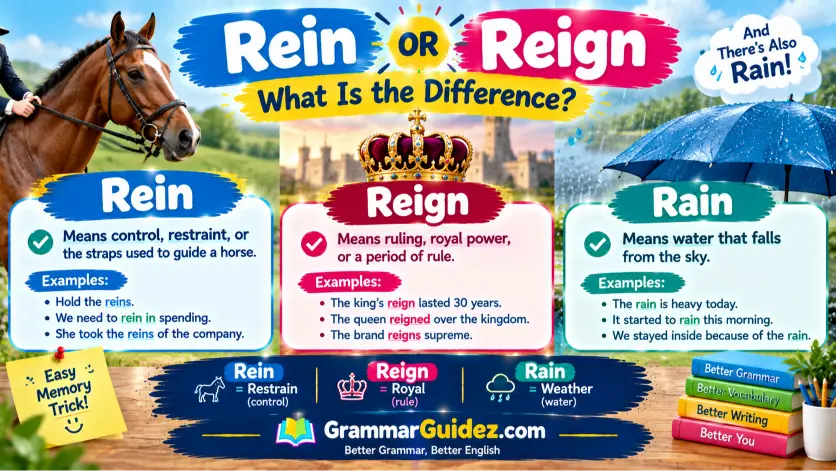
“Rein” and “Reign” are both correct words, but they have different meanings. Rein a strap used to control a horse, or control over something. Reign the period when a king or queen rules, or their rule
Rein or reign? These two words sound exactly the same, but they do not mean the same thing.
This makes them easy to confuse when writing.
Use rein when you are talking about control, restraint, or the straps used to guide a horse.
Use reign when you are talking about ruling, royal power, or a period of rule.
For example:
- The rider pulled the reins.
- The king’s reign lasted many years.
There is also a third word that sounds the same: rain. It refers to water that falls from the sky.
So the easiest way to remember the three is:
Rein = control
Reign = rule
Rain = weather
Rein or Reign: The Quick Answer
Both rein and reign are correct words. They simply have different meanings.
| Word | Main meaning | Simple example |
| Rein | A strap used to control a horse; control or restraint | Hold the reins tightly. |
| Reign | Rule or a period of ruling | The king’s reign lasted 30 years. |
| Rain | Water falling from the sky | Heavy rain fell overnight. |
All three words are pronounced /reɪn/ in standard English.
The spelling depends on the meaning you want.
What Does “Rein” Mean?
Rein is mainly connected with control.
In its literal meaning, a rein is a long strap, usually attached to a horse’s bridle, that a rider uses to guide or control the horse.
The word is often used in the plural:
reins
Examples
- The rider held the reins firmly.
- She pulled on the reins to slow the horse.
- He dropped the reins for a moment.
- The horse responded to the rider’s reins.
Cambridge defines rein as a long, thin piece of material used to control and direct a horse. It also records business uses connected with power and control.
But rein is not limited to horses.
English also uses it figuratively to describe controlling something.
Rein as a Word for Control
Over time, the idea of controlling a horse with reins developed into several expressions about controlling people, actions, emotions, spending, or other activities.
For example:
The manager needs to rein in spending.
Here, nobody is talking about a horse.
The sentence means that the manager needs to control or reduce spending.
Other examples include:
- She tried to rein in her anger.
- The company must rein in costs.
- He struggled to rein in his excitement.
- The government introduced measures to rein in spending.
This figurative use is one of the most important reasons people need to know the difference between rein and reign.
What Does “Reign” Mean?
Reign is connected with ruling or having power.
As a noun, reign means the period during which a king, queen, or other ruler holds power.
Examples
The queen’s reign lasted for decades.
The museum has an exhibition about the reign of Henry VIII.
During his reign, the kingdom changed greatly.
Cambridge defines reign as the period when a king or queen rules a country. It also uses reign for a period when someone or something has strong influence or importance.
Reign Can Also Be a Verb
This is an important point that some simple word-comparison articles do not explain clearly.
Reign can be a verb.
It means to rule as a king or queen or, more broadly, to dominate or be the strongest influence in a situation.
Examples
Queen Victoria reigned over Britain for many years.
The king reigned for decades.
Chaos reigned after the announcement.
Silence reigned throughout the room.
The last two examples use reign in a figurative way. No king is necessary.
Cambridge also records this broader use, including expressions such as “confusion reigned” and “love reigned supreme.” (Cambridge Dictionary)
The Easiest Way to Separate Rein and Reign
Do not focus only on the spelling.
Instead, ask:
Is the sentence about control?
Use rein.
We need to rein in our expenses.
Is the sentence about ruling or dominance?
Use reign.
The king’s reign was peaceful.
This simple meaning test works in most situations.
Rein vs. Reign in One Simple Table
| Rein | Reign |
| Control | Rule |
| Restraint | Authority |
| Horse straps | Period of rule |
| Guide something | Govern something |
| rein in | reign over |
| free rein | reigning champion |
| take the reins | reign supreme |
| keep a tight rein | reign of terror |
Think:
Rein = hold/control
Reign = rule
The Phrase “Rein In” Not “Reign In”
This is probably the most useful spelling rule in this entire topic.
The correct phrase is:
✅ rein in
Not:
❌ reign in
Rein in means to control, limit, reduce, or restrain something.
The phrase comes from horseback riding: a rider pulls on the reins to slow or stop a horse. Cambridge specifically defines the expression in both its literal horse-riding sense and its figurative sense of controlling an activity, emotion, or situation. (Cambridge Dictionary)
Correct Examples
We need to rein in spending.
She tried to rein in her emotions.
The company is trying to rein in costs.
Parents sometimes need to rein in excessive screen time.
Common Error
❌ The company needs to reign in its expenses.
✅ The company needs to rein in its expenses.
Remember:
You rein something in when you control it.
“Free Rein” or “Free Reign”?
The correct expression is:
✅ free rein
Not:
❌ free reign
Free rein means giving someone complete freedom to act or make decisions.
Examples
The designer was given free rein to create the new logo.
The children were given free rein to choose their activities.
My manager gave me free rein over the project.
The expression comes from the literal idea of loosening a horse’s reins and allowing it to move freely. Cambridge lists free rein as an established idiom. (Cambridge Dictionary)
Why Do People Write “Free Reign”?
The mistake makes sense because reign is associated with power and authority.
But the expression is based on horse reins, not royal rule.
So:
Free rein = complete freedom
Free reign = incorrect in this standard idiom
“Take the Reins” Means Take Control
Another common expression is:
take the reins
It means to take control or responsibility.
Examples
She took the reins of the company after her father retired.
The new manager will take the reins next month.
He is ready to take the reins of the project.
Here, reins refers metaphorically to control.
Cambridge also records take over/up the reins and uses the reins for power and control in business contexts. (Cambridge Dictionary)
“Keep a Tight Rein” Means Control Carefully
You may also see:
keep a tight rein on something
This means to control something very carefully.
Examples
The company keeps a tight rein on expenses.
She keeps a tight rein on the household budget.
The coach keeps a tight rein on the team’s training schedule.
Again, the idea comes from controlling a horse.
“Reign Supreme” Has a Different Meaning
Now look at this expression:
reign supreme
Here, the correct word is reign, because the idea is dominance or being the most powerful or important.
Examples
The team has reigned supreme for several seasons.
In this market, quality still reigns supreme.
For many years, the brand reigned supreme.
This is about dominance, not controlling something with a rein.
What Is a “Reigning Champion”?
You may hear sports commentators say:
reigning champion
A reigning champion is the person or team that currently holds a championship title.
Examples
She is the reigning champion.
The reigning champion returned to defend the title.
The reigning champion lost in the final.
The spelling is reigning, with -eign.
It comes from reign, because the champion is being described as the current holder of the title. Cambridge defines reigning as being the most recent winner of a competition.
The Third Word: Rain
If you only study rein vs. reign, you may miss another common source of confusion.
Rain sounds the same as both words.
But its meaning is completely different.
Rain means water from the sky.
The rain started in the afternoon.
Heavy rain flooded the streets.
We stayed inside because of the rain.
Rain can also be a verb:
It rained all night.
It is raining outside.
So remember:
Rain = weather
Rein = control
Reign = rule
A Three-Word Test
When you hear /reɪn/, ask what the sentence is about.
1. Weather?
Use rain.
The rain is heavy today.
2. Control?
Use rein.
We need to rein in our spending.
3. Rule or dominance?
Use reign.
The king’s reign lasted 40 years.
This three-question test is easier than trying to memorize every spelling separately.
Rein and Reign in Business English
These words are especially important in business writing because both can appear when talking about control and leadership.
Use Rein
When you mean controlling or limiting something:
The company needs to rein in costs.
The manager is trying to rein in unnecessary spending.
Use Reign
When you mean dominance or a period of leadership:
The company enjoyed a long reign as the market leader.
The brand reigned supreme for many years.
Notice the difference:
rein = control something
reign = dominate or rule
Rein and Reign in Formal Writing
Both words are standard and appropriate for formal English.
The important thing is choosing the word that matches the meaning.
Formal examples with rein
The organization must rein in administrative costs.
The committee recommended measures to rein in unnecessary spending.
Formal examples with reign
The monarch’s reign had a major effect on the country’s history.
The period marked the beginning of a new reign.
Do not choose reign simply because it looks more powerful or formal.
Meaning comes first.
Common Rein and Reign Mistakes
Mistake 1: Free Reign
❌ The manager gave us free reign.
✅ The manager gave us free rein.
Mistake 2: Reign In
❌ The government needs to reign in inflation.
✅ The government needs to rein in inflation.
Mistake 3: Take the Reigns
❌ She will take the reigns of the company.
✅ She will take the reins of the company.
The phrase is about taking control, so use reins.
Mistake 4: The King Reined
❌ The king reined for 30 years.
✅ The king reigned for 30 years.
A king reigns.
Mistake 5: The Queen’s Reins
❌ The queen’s reins lasted 50 years.
✅ The queen’s reign lasted 50 years.
A period of royal rule is a reign.
How to Remember the Spelling
Here are two easy memory tricks.
Rein = Restrain
Look at the idea:
REIN → RESTRAIN
Both are connected with control.
Think of a rider pulling the reins to restrain a horse.
Reign = Royal
Think:
REIGN → ROYAL
A king or queen reigns.
The extra g can remind you of words connected with royalty, such as regal.
Rain = Roof
For rain, think about water falling on your roof.
So:
Rein → Restrain
Reign → Royal
Rain → Roof
Rein or Reign? Check the Sentence
Try replacing the word with a simpler word.
If “control” fits:
Use rein.
We need to in spending.
“Control spending” works.
✅ We need to rein in spending.
If “rule” fits:
Use reign.
The king’s lasted 25 years.
“Rule lasted 25 years” works.
✅ The king’s reign lasted 25 years.
If “weather” fits:
Use rain.
Heavy is expected.
“Weather water” points to:
✅ Heavy rain is expected.
This substitution test can help you choose the spelling quickly.
Pronunciation of Rein and Reign
Rein and reign have the same standard pronunciation:
/reɪn/
They sound like rain.
This is why they are called homophones: words that sound alike but have different spellings and meanings.
The spelling, not the sound, tells the reader which meaning you intend.
Word Forms You Should Know
Learning related forms makes these words easier to use correctly.
Rein
- rein
- reins
- reined
- reining
Examples:
Hold the reins.
The rider reined in the horse.
She was reining in her excitement.
Reign
- reign
- reigns
- reigned
- reigning
Examples:
The queen reigned for many years.
The king’s reign ended peacefully.
She is the reigning champion.
Rein vs. Reign: Real-Life Sentence Patterns
Instead of memorizing isolated definitions, learn these useful patterns.
Rein
rein in + noun
take the reins of + noun
take the reins of the company
give someone free rein to + verb
give the team free rein to experiment
keep a tight rein on + noun
keep a tight rein on expenses
Reign
the reign of + ruler
the reign of Henry VIII
reign over + place/group
reign over a kingdom
the brand reigned supreme
reigning + title
the reigning champion
These patterns make the difference much easier to remember.
A Short Story to Remember Both Words
Imagine a king riding a horse.
The king wears a crown and reigns over his kingdom.
He holds the horse’s reins to control the animal.
Outside the castle, rain falls from the sky.
Now you have all three:
The king reigns.
The rider holds the reins.
The rain falls.
Quick Practice
Choose rein, reign, or rain.
- The king’s ______ lasted 20 years.
- We need to ______ in our spending.
- Heavy ______ damaged the crops.
- She was given free ______ to design the website.
- The rider pulled the ______.
- Silence ______ throughout the room.
- The company must ______ in unnecessary costs.
- She is the ______ champion.
- The ______ began before sunset.
- He took the ______ of the organization.
Answers
- reign
- rein
- rain
- rein
- reins
- reigned
- rein
- reigning
- rain
- reins
FAQs
Is “rein” or “reign” correct?
Both are correct words. Rein relates to control or horse reins, while reign relates to ruling or a period of rule.
Is it “rein in” or “reign in”?
The standard phrase is rein in.
The company needs to rein in costs.
Is it “free rein” or “free reign”?
The standard expression is free rein.
It means complete freedom to act.
What is the difference between rein and reign?
Rein means a horse’s control strap or, figuratively, control and restraint. Reign means ruling or the period during which someone rules.
Are rein and reign homophones?
Yes. They have the same pronunciation in standard English but different spellings and meanings.
What does “take the reins” mean?
Take the reins means to take control or responsibility.
She took the reins of the company.
What does “reign supreme” mean?
Reign supreme means to be the most powerful, successful, important, or dominant.
What does “reigning champion” mean?
A reigning champion is the current holder of a championship title.
What is the difference between rein, reign, and rain?
Rein = control.
Reign = rule.
Rain = water from the sky.
Is “reign in” ever correct?
When you mean “control or restrain,” the standard expression is rein in, not reign in.
How do I remember rein vs. reign?
Think rein = restrain and reign = royal.
If you are talking about weather, use rain.
Final Takeaway
Rein and reign sound the same, but their meanings are different.
Use rein for control, restraint, or a horse’s straps.
Use reign for ruling, royal power, or dominance.
And remember the third homophone:
Rain is the water that falls from the sky.
The most important expressions are:
- rein in = control
- free rein = complete freedom
- take the reins = take control
- keep a tight rein = control carefully
- reign over = rule
- reign supreme = dominate
- reigning champion = current champion
The easiest memory trick:
REIN → RESTRAIN
REIGN → ROYAL
RAIN → WEATHER
Once you connect each spelling with its meaning, rein or reign becomes much easier to get right.
Read More Articles:

I am Elliot Hartwell, an English language writer and the author at GrammarGuidez.com. For the 6 years I have been working with English grammar, vocabulary, spelling and everyday language usage with a focus on making confusing topics easier to understand.
I started GrammarGuidez.com with a goal: to give readers clear and practical answers to common English questions. English can sometimes be confusing especially when two words look or sound similar but have meanings or uses. I enjoy breaking down these differences in a way that’s simple and easy to remember.
I believe learning English should feel simple not overwhelming. My goal is to make every article on GrammarGuidez.com useful, for students, writers, bloggers, teachers and anyone who wants to communicate clearly in English.