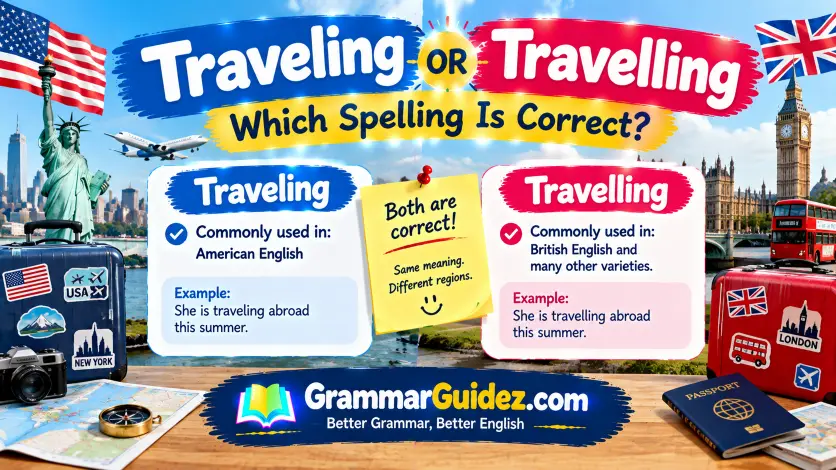
“Traveling” and “Travelling” are both correct spellings. The difference is mainly American vs. British English. Traveling = American English spelling. Travelling = British English spelling.
Traveling and travelling are both correct spellings.
The difference is mainly based on the variety of English you use. Traveling is the standard spelling in American English, while travelling is the usual spelling in British English and many other varieties of English.
The meaning does not change.
So, if you are writing for a U.S. audience, use traveling. If you are following British English, use travelling.
Quick Answer: Traveling or Travelling?
| Spelling | Common Usage |
| Traveling | American English |
| Travelling | British English and many other varieties |
| Meaning | The same |
| Pronunciation | Essentially the same |
| Grammar | The same |
Both forms come from the verb travel.
The only visible difference is the extra l.
What Does Traveling Mean?
Traveling is the American English spelling of the present participle or gerund form of travel.
It describes going from one place to another. It can refer to travel for work, vacation, study, family, or other reasons.
American English normally uses one l before -ing:
travel → traveling
The same spelling is used in related forms such as:
- traveling abroad
- traveling by plane
- traveling for work
- traveling alone
- traveling companion
Cambridge identifies traveling as the U.S. spelling of travelling. Oxford also lists traveling as the American English form.
What Does Travelling Mean?
Travelling has the same meaning as traveling.
It is the spelling commonly used in British English.
The form is:
travel → travelling
The extra l is part of the spelling convention used in British English.
You may see travelling in British books, newspapers, websites, business documents, and educational materials.
Oxford lists travelling as the main form and identifies traveling as the U.S. English form.
Traveling vs Travelling: The Real Difference
There is no important difference in meaning.
Both words describe the act of going from one place to another.
The difference is regional spelling.
This is similar to other spelling differences such as:
- color / colour
- recognized / recognised
- fueled / fuelled
- cataloged / catalogued
The same idea applies here.
Traveling and travelling belong to different spelling conventions, but they describe the same action.
Why Does One Version Have Two Ls?
The difference comes from spelling conventions in different varieties of English.
American English often uses a simpler spelling in words such as traveling and traveled.
British English normally keeps the doubled consonant:
- travelling
- travelled
- traveller
This creates a clear pattern.
American English
travel → traveling → traveled → traveler
British English
travel → travelling → travelled → traveller
Oxford specifically lists travelled and travelling as the standard forms, while giving traveled and traveling as U.S. forms.
Traveling in American English
If your website, essay, report, or business document follows American English, use:
traveling
You will also normally use:
- traveled
- traveler
For example, American English follows this pattern:
travel → traveling → traveled → traveler
This spelling is common in U.S. schools, newspapers, businesses, and online content.
Travelling in British English
If you are following British English, use:
travelling
The related forms are usually:
- travelled
- traveller
The pattern is:
travel → travelling → travelled → traveller
British English therefore keeps the double l in these forms.
What About Canada and Australia?
English spelling can vary outside the United States and United Kingdom.
Canadian English generally uses travelling, while Australian English also commonly follows the British-style spelling.
Oxford’s American English entry specifically notes that Canadian English usually uses travelling.
For international writing, the best approach is to choose one spelling system and use it consistently.
Is Traveling Wrong in British English?
No.
Traveling is not a spelling mistake in English.
It is the standard American form.
However, if you are writing specifically in British English, travelling is normally the expected spelling.
The same principle works in reverse.
Travelling is not wrong English. It is simply not the usual American spelling.
Is Travelling Wrong in American English?
No.
American readers can easily understand travelling.
However, traveling is the standard American spelling.
If you are writing for a U.S. audience, using American spelling consistently will make your writing fit that style better.
Traveling and Travelling Have the Same Pronunciation
The two spellings are normally pronounced the same way.
The extra l does not create a different word or a different meaning.
This is why the difference can be confusing when you hear the word rather than see it.
When spoken aloud, you usually cannot tell if the writer would spell it traveling or travelling.
The Forms of Travel
Understanding the base word makes the spelling easier.
| Form | American English | British English |
| Base verb | travel | travel |
| -ing form | traveling | travelling |
| Past tense | traveled | travelled |
| Past participle | traveled | travelled |
| Person | traveler | traveller |
The important point is that the difference continues through several related forms.
If you choose American English, keep the single l pattern.
If you choose British English, keep the double l pattern.
Traveling or Travelling in Formal Writing
Both spellings are suitable for formal writing.
The important thing is consistency.
For example, if your article uses American spelling, you should normally write:
- traveling
- traveled
- traveler
Do not switch to British forms without a reason.
If your article uses British spelling, use:
- travelling
- travelled
- traveller
This makes your writing look more consistent and professional.
What About Growing Content?
For growing content, the spelling should match the audience and the keyword you are targeting.
If the target keyword is traveling or travelling, you can naturally explain both forms.
You do not need to treat one spelling as an error.
If your website mainly targets U.S. readers, American spelling may fit your site’s overall style.
If your website follows British English, use the British form consistently.
The important thing is to satisfy the reader’s search intent while keeping the content natural.
Common Mistakes
Mistake 1: Calling travelling incorrect
Travelling is a standard spelling in British English and other varieties.
It is not simply a typo.
Mistake 2: Calling traveling incorrect
Traveling is the standard American English spelling.
It is also a correct English form.
Mistake 3: Mixing spelling styles
Using traveling, travelled, and traveller in the same document can create an inconsistent style.
Choose one regional spelling system.
Mistake 4: Adding an extra L in American English
If you are following American English, use:
traveling
not:
travelling
Mistake 5: Removing the second L in British English
If you are following British English, use:
travelling
rather than:
traveling
A Simple Memory Trick
Use this easy rule:
American = one L
British = two Ls
Think:
traveling → American
travelling → British
You can also remember the related forms:
American: traveled, traveler
British: travelled, traveller
Once you remember this pattern, the spelling becomes much easier.
Traveling vs Travelling in Different Sentences
The meaning stays the same even though the spelling changes.
| American English | British English |
| She is traveling abroad. | She is travelling abroad. |
| He enjoys traveling by train. | He enjoys travelling by train. |
| They are traveling this summer. | They are travelling this summer. |
| I have traveled to several countries. | I have travelled to several countries. |
| She is an experienced traveler. | She is an experienced traveller. |
The grammar and meaning remain the same.
Only the spelling convention changes.
Traveling or Travelling for a Job
Both forms can describe travel connected with work.
For example, someone may travel frequently for business.
American English uses:
traveling for work
British English uses:
travelling for work
The difference is spelling, not the type of travel.
Oxford lists travelling as a noun referring to the activity of travelling and also as an adjective for something connected with moving from place to place.
Traveling or Travelling as a Noun
The -ing form can also function as a noun.
In British English, travelling can refer to the activity of making journeys.
American English uses traveling in the same way.
For example, a person can talk about enjoying traveling or travelling.
The grammatical function remains the same.
Traveling or Travelling as an Adjective
The word can also describe something or someone that moves from place to place.
Common combinations include:
- traveling companion
- travelling companion
- traveling salesman
- travelling salesman
- traveling exhibition
- travelling exhibition
Cambridge lists travelling as an adjective for something or someone moving from one place to another, with traveling as the U.S. form.
Travel, Traveling, Trip, and Journey
These words are related, but they are not interchangeable in every situation.
Travel can describe the general activity of going from place to place.
Traveling/travelling is the -ing form of the verb and can also work as a gerund.
Trip usually refers to a particular journey or occasion.
Journey often focuses on the movement from one place to another.
For clear writing, choose the word that fits the sentence rather than treating all four as identical.
Is “Traveling” or “Travelling” More Common?
The answer depends on the English variety and audience.
American English normally uses traveling.
British English normally uses travelling.
Therefore, it is not useful to ask which spelling is universally more common without specifying the English variety.
The better question is:
Which English style am I using?
That tells you which spelling to choose.
Quick Grammar Test
Complete each sentence with traveling or travelling.
- She is ______ around Europe this summer.
- He enjoys ______ by train.
- The job involves a lot of ______.
- They are ______ abroad next month.
- She became a frequent ______ for work.
Answers
The spelling depends on your chosen variety of English.
American English:
- traveling
- traveling
- traveling
- traveling
- traveler
British English:
- travelling
- travelling
- travelling
- travelling
- traveller
FAQs
Is traveling or travelling correct?
Both are correct. Traveling is the standard American English spelling, while travelling is the usual British English spelling.
Is traveling American or British?
Traveling is the standard American English spelling.
Is travelling American or British?
Travelling is the standard British English spelling and is also common in several other varieties of English.
Does traveling mean something different from travelling?
No. They have the same meaning. The difference is spelling.
Is travelling with two Ls correct?
Yes. Travelling is a standard spelling, especially in British English.
Is traveling with one L correct?
Yes. Traveling is the standard American English spelling.
Is it traveled or travelled?
Both are correct regional spellings. Traveled is standard American English, while travelled is standard British English.
Is it traveler or traveller?
Both are correct. Traveler is the American form, while traveller is the British form.
Which spelling should I use for a U.S. audience?
Use traveling.
Which spelling should I use for a British audience?
Use travelling.
Does the pronunciation change?
Usually, no. The two spellings are normally pronounced the same way.
Is travelling a spelling mistake?
No. It is a standard spelling used in British English and other varieties.
Final Answer
Traveling and travelling are both correct.
The difference is mainly regional:
- Traveling = American English
- Travelling = British English
- Both have the same basic meaning.
- Both are grammatically correct.
- The pronunciation is essentially the same.
- The related forms also change: traveled/travelled and traveler/traveller.
If you write for a U.S. audience, choose traveling.
If you follow British English, choose travelling.
The most important rule is simple: pick one spelling style and use it consistently throughout your writing.
Read More Articles:

I am Evan Whitmore, an English language writer and the person who started GrammarGuidez.com. I made GrammarGuidez.com to make grammar, spelling, vocabulary and words that are often confused easier to understand.
I like taking to understand English words and grammar rules and turning them into simple and clear explanations. My aim is to help students, writers, bloggers, ESL learners and regular English speakers feel more sure when they write and talk.
At GrammarGuidez.com I work on real life examples easy to understand explanations comparing words, spelling changes and how American English is used every day.
I think learning English doesn’t need to be hard. A good explanation and some good examples can make tough grammar topics much simpler to learn