“Farther” and “Furthe” are not equally correct. Farther = the correct word, usually used for greater physical distance. Furthe = incorrect spelling in standard English.
Farther and further are two English words that often confuse learners.
Both words come from far, and both can talk about greater distance. However, further has some extra uses that farther does not have.
The easiest traditional rule is:
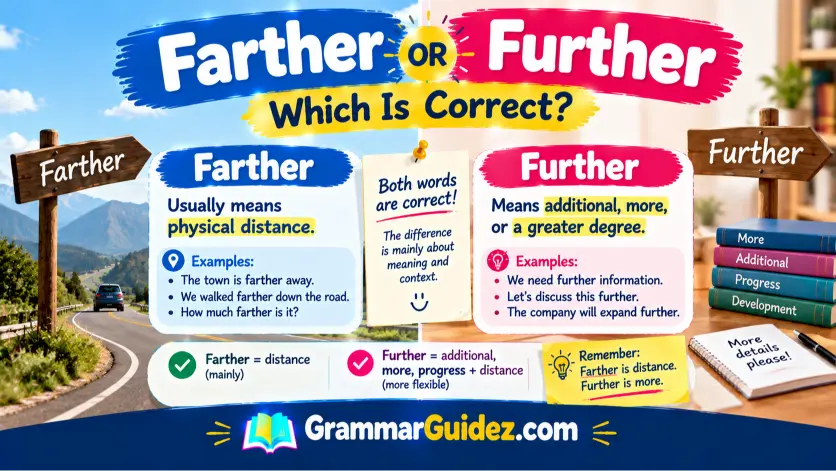
Farther → physical distance
Further → additional, more, or greater extent
For example, you can travel farther down a road, but you may need further information before making a decision.
However, the rule is not completely strict. Modern dictionaries accept further for physical distance too, and it is especially common in British English. Cambridge says there is no difference in meaning between the two when talking about distance, while Oxford notes that further/furthest are more common in British English.
So, both farther and further are correct words. The right choice depends on the meaning and style of the sentence.
Quick Answer: Farther or Further?
Use farther when you want to clearly talk about physical distance.
Use further when you mean additional, more, to a greater degree, or to a more advanced stage.
You can also use further for physical distance.
| Word | Main Use | Example |
| Farther | Greater physical distance | We walked farther. |
| Further | Additional or greater degree | We need further information. |
| Further | Physical distance too | We walked further down the road. |
| Further | Progress or development | We need to investigate further. |
The most useful rule is:
Farther is mainly about distance. Further is more flexible.
What Does Farther Mean?
Farther is the comparative form of far.
It means at or to a greater physical distance.
You normally use it when something is located, moved, or traveled at a greater distance.
For example:
- The airport is farther away.
- We walked farther than expected.
- How much farther do we have to go?
- The house is farther down the road.
- She moved farther from the city.
Cambridge defines farther as being at or going to a greater distance.
Farther and Physical Distance
The traditional distinction is very useful when you are talking about something you could measure.
Think about:
- miles
- kilometers
- meters
- blocks
- steps
- road distance
If you are comparing these types of distances, farther is a clear choice.
For example:
The second store is farther from my house.
We drove farther than we planned.
How much farther is the station?
What Does Further Mean?
Further has a wider range of meanings.
It can mean:
- more
- additional
- to a greater degree
- to a more advanced stage
- farther away
For example:
We need further information.
Here, further means additional.
You can also say:
Let’s discuss this further.
Here, further means more deeply or to a greater extent.
Cambridge lists these meanings for further, including greater distance, greater degree, additional information, and progress.
Farther vs Further: The Main Difference
The easiest way to understand the difference is to separate distance from additional meaning.
Farther = Greater Distance
Use farther when the main idea is physical distance.
The blue house is farther from the school.
The sentence compares physical locations.
Further = Additional or More
Use further when you mean something additional.
Please send further information.
Here, you are not talking about physical distance.
You mean more information.
This is where farther cannot normally replace further.
You would not write:
For farther information, contact us.
The natural form is:
For further information, contact us.
Cambridge specifically identifies these cases where further, but not farther, means “extra,” “additional,” or “more.”
Can Further Mean Physical Distance?
Yes.
This is one of the most important points about this word pair.
Many learners are taught:
Farther = physical distance
Further = figurative distance
That rule is useful, but it is not a complete description of modern English.
Cambridge says farther and further can both refer to distance, with further being more common overall. Oxford also says either form can be used for distance, while further/furthest are more common in British English.
So both can be correct:
We walked farther down the road.
We walked further down the road.
The first can make the physical-distance idea more explicit. The second is also standard.
Further Is More Flexible
If you are unsure which word to choose, further is often the safer option because it has more uses.
You can use further for:
- physical distance
- additional information
- greater degree
- progress
- development
- advanced stages
- figurative distance
For example:
We need further research.
Let’s investigate the matter further.
Do you have any further questions?
The project cannot go any further.
The road continues further into the valley.
Grammarly also notes that further can be used for physical distance as well as meanings such as “additional,” and it can function as a verb meaning to promote or advance something.
Further Can Be a Verb
This is a major difference.
Further can be used as a verb.
As a verb, it means to help something develop, advance, or progress.
For example:
The program will further her career.
Education can further your goals.
The organization works to further scientific research.
Here, farther cannot replace further.
You cannot use farther as a verb in these sentences.
Cambridge lists further as a verb meaning to develop or make progress in something.
Further Means “Additional”
One of the most common uses of further is before a noun.
It can mean extra or additional.
Common phrases include:
- further information
- further details
- further questions
- further discussion
- further research
- further investigation
- further education
- further assistance
- further notice
- further changes
For example:
Please contact us for further information.
The scientist called for further research.
We need further details before we decide.
In all these cases, farther would be incorrect.
Further Means “More”
Further can also mean more.
For example:
I do not want to discuss this further.
This means:
I do not want to discuss this any more.
Another example is:
The problem became further complicated.
Here, further means the situation became more complicated.
Cambridge lists this use of further for a greater degree or more advanced level.
Further in Formal and Business Writing
You will often see further in professional and academic writing.
Common phrases include:
For further information…
Further research is needed.
Further investigation is required.
Please provide further details.
We will discuss this further.
Further to your email…
The expression further to is especially common in formal British business writing. It refers to an earlier letter, email, conversation, or meeting.
For example:
Further to your email, we have reviewed the proposal.
This means the writer is following up on the earlier email.
Farther or Further Away?
Both can be used with away.
For example:
The hotel is farther away than I expected.
The hotel is further away than I expected.
Both forms occur in standard English.
If you want to follow the traditional American distinction, farther away is often preferred for physical distance.
Oxford notes that North American English favors farther/farthest for distance, while British English more commonly uses further/furthest.
Farther vs Further in American English
American English often follows a clearer traditional distinction:
Farther → physical distance
Further → figurative distance, additional meaning, or degree
For example:
The store is farther away.
We need further information.
Let’s discuss the issue further.
This distinction is useful in American writing, especially when you want to make the meaning very clear.
However, further is still used for physical distance in American English. It is not automatically wrong.
Farther vs Further in British English
British English commonly uses further for physical distance.
For example:
We walked further down the road.
How much further is the station?
The village is further away than I remembered.
Oxford specifically notes that further/furthest are more common in British English, while farther/farthest are more common in North American English for distance.
So regional style can influence the choice.
Farther, Further, Farthest, and Furthest
These words are comparative and superlative forms related to far.
| Basic | Comparative | Superlative |
| far | farther / further | farthest / furthest |
Farther and further are comparative forms.
Farthest and furthest are superlative forms.
The same basic distinction applies:
farthest often focuses on physical distance.
furthest has a wider range and can mean the greatest degree or most advanced point.
Cambridge notes that both farthest and furthest can refer to distance, with furthest more common overall.
Further Can Mean Progress
Another useful use of further appears when talking about progress.
For example:
We need to take the project further.
This does not mean moving the project to a physical location.
It means developing or advancing the project.
You can also say:
The discussion did not go any further.
Here, further means the discussion did not progress.
This is another reason why farther cannot replace further in every situation.
Common Mistakes
❌ For farther information, contact us.
✅ For further information, contact us.
Use further for additional information.
❌ We need farther details.
✅ We need further details.
Again, further means additional.
❌ The company wants to farther its goals.
✅ The company wants to further its goals.
Further can be a verb meaning to advance or promote.
✅ We walked farther than yesterday.
This is a clear use of farther for physical distance.
✅ We walked further than yesterday.
This is also possible, especially in British English and in general modern usage.
A Simple Memory Trick
Use this memory trick:
Farther has “far” inside it → think physical distance.
Further = more or additional.
For example:
How much farther do we have to walk?
Think:
farther → far → distance
Then:
Do you need further information?
Think:
further → additional
This is not an absolute grammar rule, but it is a useful guide.
Farther or Further: A Quick Decision Test
Ask yourself three questions.
1. Am I talking about physical distance?
If yes, farther is a clear traditional choice.
2. Do I mean additional or extra?
Use further.
3. Do I mean progress, development, or greater degree?
Use further.
If you are talking about physical distance, further can also be correct.
This makes the choice much easier than trying to memorize a strict rule.
Examples of Farther
Here are common uses of farther:
- The next town is farther away.
- We drove farther than expected.
- How much farther is the airport?
- She moved farther north.
- The lake is farther from here.
- The hikers walked farther into the forest.
- The house is farther down the road.
- The mountain looked farther away than before.
In each case, farther focuses on distance.
Examples of Further
Here are common uses of further:
- We need further information.
- Please provide further details.
- Let’s discuss this further.
- The issue needs further investigation.
- Do you have any further questions?
- The company plans to further expand its services.
- The research could further our understanding.
- We cannot take the project any further.
Here, further has meanings such as additional, more, or progress.
Further or Farther: Common Phrases
Some phrases are strongly associated with further.
Further information
Means additional information.
Further details
Means more details.
Further questions
Means additional questions.
Further research
Means additional research.
Further discussion
Means more discussion.
Further notice
As in until further notice, meaning until another announcement is made.
Nothing could be further from the truth
This means something is completely untrue.
These expressions should normally use further, not farther.
Farther or Further: What Should You Use?
If you are writing for a general international audience, further is often a practical choice when you are not dealing with a clearly measurable physical distance.
Use farther when you want to clearly emphasize physical distance.
For formal writing, consistency matters more than forcing a rule that native speakers do not always follow.
The key is to understand the meaning first.
Practice Quiz
Choose farther or further.
- How much ______ is the airport?
- We need ______ information.
- The hikers walked ______ than the other group.
- Do you have any ______ questions?
- Let’s investigate the problem ______.
- The store is ______ down the road.
- The company wants to ______ its goals.
- We cannot go any ______ without permission.
Answers
- farther / further
- further
- farther / further
- further
- further
- farther / further
- further
- farther / further
When the sentence refers to physical distance, both forms may work. When the meaning is additional, more, or progress, further is the correct choice.
FAQs
Is farther or further correct?
Both farther and further are correct. Farther is traditionally associated with physical distance, while further also means additional, more, or to a greater degree.
What is the difference between farther and further?
The traditional difference is that farther refers to physical distance, while further refers to additional amount, degree, progress, or figurative distance. However, further can also describe physical distance.
Is further always correct?
No. While further is very flexible, some writers prefer farther when they want to clearly express physical distance.
Is farther only used for physical distance?
That is its main traditional use. However, historical and modern usage can be more flexible. For everyday clear writing, using farther for measurable physical distance is a useful guideline.
Which is more common: farther or further?
Further is more common overall. Cambridge specifically notes that further is more common when the two words are used for distance.
Is farther American or British?
Farther is especially common in North American English for physical distance. British English commonly uses further for the same meaning.
Is further American or British?
Further is used in both American and British English. It is especially common in British English for physical distance and is also used in both varieties for meanings such as additional or more.
Should I write “further information” or “farther information”?
The correct phrase is further information.
Should I write “farther away” or “further away”?
Both occur. Farther away is a clear traditional choice for physical distance, while further away is also standard, especially in British English.
Is it “further education” or “farther education”?
The standard phrase is further education because it means additional or higher education, not physical distance.
Is “further” a verb?
Yes. Further can be a verb meaning to promote, advance, develop, or help something progress.
What is the easiest way to remember farther and further?
Remember:
Farther = physical distance
Further = additional, more, or progress
But remember that further can also be used for physical distance.
Final Answer: Farther or Further?
Farther and further are both correct.
The traditional difference is simple:
Farther usually refers to physical distance.
Further can refer to additional information, greater degree, progress, or something more advanced.
However, further can also refer to physical distance. This use is especially common in British English, and major dictionaries recognize both forms for distance.
So remember:
Farther = a clear choice for physical distance.
Further = additional, more, progress, or distance.
If you are writing “for further information,” “further research,” “further questions,” or “discuss it further,” always choose further.
If you are describing a measurable physical distance, farther is a clear traditional choice, although further can also be correct.
Once you understand this difference, choosing between farther and further becomes much easier.
Read More Articles:

I am Elliot Hartwell, an English language writer and the author at GrammarGuidez.com. For the 6 years I have been working with English grammar, vocabulary, spelling and everyday language usage with a focus on making confusing topics easier to understand.
I started GrammarGuidez.com with a goal: to give readers clear and practical answers to common English questions. English can sometimes be confusing especially when two words look or sound similar but have meanings or uses. I enjoy breaking down these differences in a way that’s simple and easy to remember.
I believe learning English should feel simple not overwhelming. My goal is to make every article on GrammarGuidez.com useful, for students, writers, bloggers, teachers and anyone who wants to communicate clearly in English.