“More” and “Less” are both correct words, but they have opposite meanings. More = a greater amount, number, or degree. Less = a smaller amount, number, or degree.
More or less is a common English phrase with several related meanings.
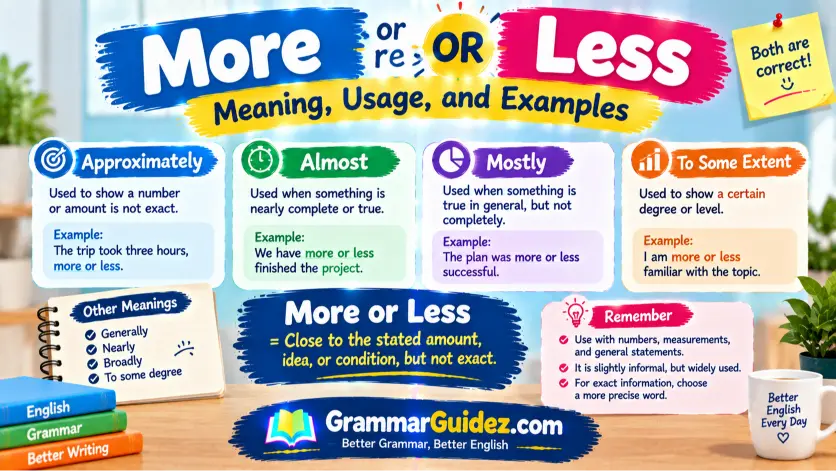
It can mean approximately, almost, mostly, or to some extent. The exact meaning depends on the sentence.
For example, when someone says a trip took three hours, more or less, they mean approximately three hours. When someone says a plan was more or less successful, they mean it was mostly successful, but perhaps not completely.
Cambridge Dictionary describes more or less as meaning “mostly,” “nearly,” or “approximately.” It also notes that the phrase is slightly informal.
So, more or less is not simply about the words more and less. Together, they form a common phrase that helps speakers show approximation, uncertainty, or a general degree.
Quick Answer: What Does More or Less Mean?
More or less usually means one of these:
- approximately
- about
- nearly
- almost
- mostly
- to some extent
- in general
The meaning changes with context.
| Meaning | Simple Explanation |
| Approximately | Close to a number or amount |
| Almost | Very close to being complete |
| Mostly | True in general, but not completely |
| To some extent | True to a certain degree |
For example:
The box weighs 10 kilograms, more or less.
Here, more or less means approximately.
We have more or less finished the project.
Here, it means almost or mostly finished.
These different uses are recognized by major dictionaries.
More or Less as “Approximately”
One of the most common uses of more or less is to give an approximate number.
It tells the reader or listener that the number is not exact.
Examples
The journey took two hours, more or less.
The package weighs five kilograms, more or less.
The repair will cost $500, more or less.
In these sentences, the speaker is giving an estimate.
The exact amount could be slightly higher or lower.
Cambridge specifically notes that more or less is commonly used after numbers and measurements.
More or Less Means “Almost”
The phrase can also mean almost.
In this use, it describes an action or situation that is nearly complete.
For example:
I have more or less finished the report.
This means the report is almost finished.
Another example:
The meeting is more or less over.
This means the meeting is almost finished or effectively finished.
Oxford also lists almost as one meaning of more or less.
More or Less Means “Mostly”
Sometimes more or less means mostly or generally.
This use tells us that something is largely true, but there may be some exceptions.
For example:
The plan was more or less successful.
This means the plan was generally successful, although it may have had some problems.
Similarly:
The story is more or less true.
This means the story is generally true, but it may not be completely accurate.
Cambridge gives mostly as one of the main meanings of the phrase.
More or Less Means “To Some Extent”
Another use is to show that something is true to a certain degree.
For example:
I am more or less familiar with the topic.
This does not necessarily mean complete knowledge. It means the person has some level of familiarity.
You may also see:
She seemed more or less comfortable with the decision.
Here, the phrase softens the statement.
Collins describes this use as meaning something like to some extent or somewhat.
Where Do You Put More or Less?
The position of more or less depends on what it modifies.
Cambridge Grammar Today explains that the phrase often appears in the middle of a sentence, including between the subject and main verb or after a modal or auxiliary verb. It can also appear after a number or measurement.
Before or Around a Verb
We have more or less completed the work.
She more or less agreed with the idea.
He had more or less forgotten about it.
Here, the phrase modifies the overall action or description.
After a Number
The package weighs 20 kilograms, more or less.
The journey takes three hours, more or less.
Here, the phrase shows that the number is approximate.
More or Less at the End of a Sentence
Putting more or less at the end of a sentence is common when you are giving an approximate amount.
For example:
It costs $100, more or less.
The journey takes an hour, more or less.
There were 50 people there, more or less.
This position is especially natural when the phrase refers to the number or measurement immediately before it.
More or Less Before a Number
You may sometimes hear:
It took more or less three hours.
This can be understood as approximately three hours, especially in informal speech.
However, for clear standard writing, a form such as:
It took about three hours.
or:
It took three hours, more or less.
is often easier to read.
Cambridge specifically recommends the use of more or less after numbers and measurements and notes this common pattern.
More or Less Than: A Different Structure
Be careful with more or less than.
The phrase can create a different meaning depending on the sentence.
For example:
Does the trip take more or less than three hours?
This asks if the trip takes more than three hours or less than three hours.
That is different from:
The trip takes three hours, more or less.
The second sentence means approximately three hours.
This small difference is important.
Compare
More or less than three hours
= more than three hours or less than three hours
Three hours, more or less
= approximately three hours
The punctuation and sentence structure can therefore affect how the phrase is understood.
More or Less in Formal Writing
More or less is common and grammatically acceptable, but Cambridge describes it as slightly informal.
In everyday writing, it is completely natural:
The work is more or less finished.
In formal or academic writing, you may sometimes prefer a more precise word.
Instead of:
The results were more or less the same.
You could write:
The results were approximately the same.
Or:
The results were broadly similar.
The best choice depends on how precise your writing needs to be.
More or Less vs About
About and more or less can both express approximation when used with numbers.
Compare:
The car costs about $20,000.
The car costs $20,000, more or less.
Both suggest that $20,000 is an approximate amount.
However, about is often simpler and more direct.
More or less can sound more conversational and can also describe ideas, situations, or actions rather than only numbers.
For example:
She is about 30 years old.
But:
She more or less agreed.
The second sentence is not about an exact number.
More or Less vs Almost
These two expressions can sometimes be similar, but they are not always interchangeable.
Almost usually means something is very close to being complete or true.
The work is almost finished.
More or less can mean almost, but it can also mean generally or approximately.
The work is more or less finished.
The second sentence can suggest that the work is generally finished, even if a few small things remain.
Oxford lists almost as one meaning of more or less.
More or Less vs Mostly
When more or less means mostly, it describes something that is generally true.
Compare:
The plan was mostly successful.
The plan was more or less successful.
Both suggest that the plan was successful overall, although neither statement necessarily means it was perfect.
Cambridge includes mostly among the core meanings of the phrase.
More or Less vs Exactly
More or less often signals that something is not exact.
Compare:
The answer is exactly 50.
The answer is 50, more or less.
The first statement presents 50 as exact.
The second presents 50 as an approximation.
This is why more or less is useful when you do not know or do not need to give the exact number.
Can More or Less Mean “Basically”?
Yes.
In some contexts, more or less means basically or in substance.
For example:
We more or less agree on the main point.
This means the speakers generally agree, although they may disagree about some details.
Dictionary.com also lists a meaning close to basically or essentially.
This use is especially common when discussing opinions, plans, decisions, or general situations.
More or Less in Business English
The phrase is often useful in business conversations when an exact figure or result is not necessary.
For example:
The project is more or less complete.
The cost will be $10,000, more or less.
The two proposals are more or less similar.
However, business documents involving exact financial, legal, or technical information should use precise figures when precision matters.
Instead of saying:
The total cost is $10,000, more or less.
a formal financial document may need the exact amount.
So the phrase is useful, but context matters.
More or Less in Academic Writing
Students may use more or less when discussing approximate ideas or general agreement.
For example:
The two theories are more or less similar.
However, academic writing often benefits from precise language.
Depending on the intended meaning, you might use:
- approximately
- generally
- largely
- mostly
- nearly
- broadly
- to some extent
This does not mean more or less is grammatically wrong. It simply means that a more precise alternative may sometimes communicate the idea better.
More or Less With Ages
There is one useful restriction to remember.
Cambridge Grammar Today says that we do not normally use more or less before people’s ages. Instead, about is normally used.
For example:
She is about 35.
This is natural.
A sentence such as:
She is more or less 35.
is not the normal choice when simply estimating someone’s age.
Use:
about 35
instead.
More or Less With Measurements
The phrase works naturally with measurements.
You can use it with:
- weight
- distance
- time
- price
- length
- quantity
- temperature
- size
Examples:
The box weighs 15 kilograms, more or less.
The journey is 100 miles, more or less.
The repair will take two hours, more or less.
The table is six feet long, more or less.
Cambridge specifically notes this use after numbers and measurements.
Common Mistakes With More or Less
Mistake 1: Thinking It Always Means “Approximately”
More or less can mean approximately, but it can also mean almost, mostly, or to some extent.
Context determines the meaning.
Mistake 2: Using It for Exact Information
If an exact figure is required, more or less may be too vague.
Use the exact number when precision matters.
Mistake 3: Confusing “More or Less Than” With “Approximately”
These structures are different.
More or less than 10
means above or below 10.
But:
10, more or less
means approximately 10.
Mistake 4: Using It Before an Age
For an approximate age, use about.
She is about 30.
rather than:
She is more or less 30.
Cambridge specifically warns against this usage.
More or Less: Easy Memory Trick
Think of more or less as a phrase that reduces exactness.
When you see it, ask:
“Is this exact?”
If the answer is no, more or less may mean:
approximately
or:
mostly / almost / to some extent
A simple memory line is:
More or less = close, but not exact.
This will help you understand many common uses.
More or Less in Different Sentences
Here is a quick guide:
| Sentence | Meaning |
| It costs $100, more or less. | Approximately |
| The work is more or less finished. | Almost |
| The plan was more or less successful. | Mostly |
| I more or less agree. | To some extent |
| They are more or less the same. | Nearly the same |
| The story is more or less true. | Generally true |
| The box weighs 10 kg, more or less. | Approximately 10 kg |
The phrase is flexible because its meaning depends on what it modifies.
Is More or Less Formal or Informal?
More or less is standard English, but it has a slightly informal tone according to Cambridge Grammar Today.
It is very common in:
- everyday conversation
- emails
- general articles
- informal reports
- business conversations
- casual writing
For highly formal writing, you can often replace it with a more exact expression when appropriate.
For example:
More or less
→ approximately
→ nearly
→ mostly
→ generally
→ to some extent
Choose the replacement based on the intended meaning.
FAQs About More or Less
What does more or less mean?
More or less can mean approximately, almost, mostly, or to some extent. The exact meaning depends on context.
Is more or less an idiom?
Yes. Dictionaries commonly classify more or less as an idiomatic phrase.
Does more or less mean approximately?
Yes, especially when it follows a number or measurement.
The package weighs 20 kg, more or less.
Does more or less mean almost?
Yes. It can mean almost when describing an action or situation that is nearly complete.
Does more or less mean mostly?
Yes. It can mean mostly or generally.
Is more or less informal?
It is standard English, but Cambridge describes it as slightly informal.
Can I use more or less in academic writing?
Yes, but consider if a more precise word such as approximately, generally, or mostly would be clearer.
Can I say more or less than?
Yes, but the meaning can differ from more or less meaning approximately.
Is it more or less than $100?
asks if the amount is above or below $100.
Can I use more or less for someone’s age?
It is better to use about for an approximate age.
She is about 30.
What is another word for more or less?
Depending on the context, alternatives include approximately, about, almost, nearly, mostly, generally, broadly, and to some extent.
Final Answer: More or Less
More or less is a standard English phrase with several meanings.
It can mean:
- approximately
- almost
- mostly
- generally
- to some extent
When it follows a number, it often means approximately:
The trip took three hours, more or less.
When it describes an action or situation, it can mean almost:
We have more or less finished.
When it describes a general truth, it can mean mostly:
The statement is more or less true.
The easiest way to remember it is:
More or less = close to the stated amount, idea, or condition, but not necessarily exact.
Use it when you want to show approximation or soften a statement. When exact information matters, choose a more precise expression instead.
Read More Articles:

I am Evan Whitmore, an English language writer and the person who started GrammarGuidez.com. I made GrammarGuidez.com to make grammar, spelling, vocabulary and words that are often confused easier to understand.
I like taking to understand English words and grammar rules and turning them into simple and clear explanations. My aim is to help students, writers, bloggers, ESL learners and regular English speakers feel more sure when they write and talk.
At GrammarGuidez.com I work on real life examples easy to understand explanations comparing words, spelling changes and how American English is used every day.
I think learning English doesn’t need to be hard. A good explanation and some good examples can make tough grammar topics much simpler to learn