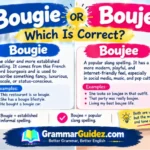
“Bougie” and “Boujee” are both used in English, but bougie is the original spelling, while boujee is a popular slang variant. Bougie = slang for fancy, luxurious, or associated with an upper-class lifestyle. Boujee = a slang variant of bougie, with the same basic meaning.
If you have seen the words bougie and boujee online, you may wonder which spelling is correct.
The answer is: both bougie and boujee are used, but they are not always used in exactly the same way.
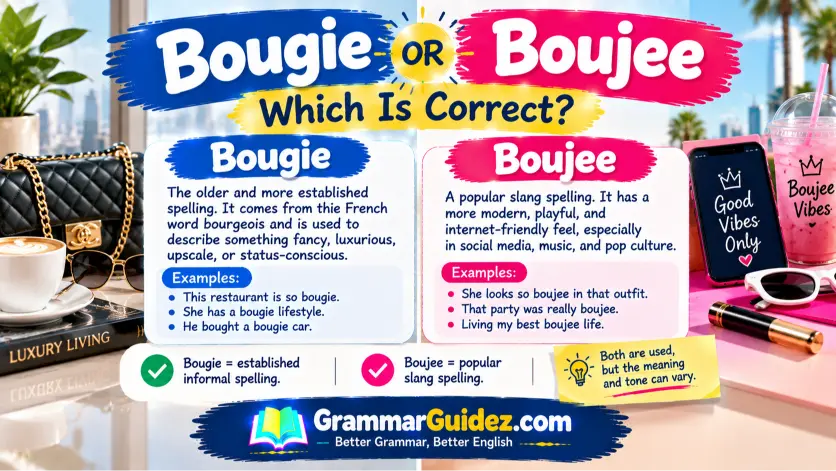
Bougie is the older spelling and comes from the French word bourgeois, which relates to the middle class. In modern informal English, it can describe someone or something that seems fancy, upscale, expensive, or concerned with wealth and status.
Boujee is a popular slang spelling. It became especially common in modern internet culture, social media, music, and African American English.
So, if you are asking “bougie or boujee?”, the best answer depends on the context.
Quick Answer: Bougie or Boujee?
Bougie and boujee can both be correct in informal English.
| Word | Common Use | Meaning |
| Bougie | Informal English | Fancy, upscale, luxurious, or status-conscious |
| Boujee | Slang / internet language | Fancy, stylish, luxurious, or acting high-class |
The two words often overlap in meaning.
For example:
This restaurant is so bougie.
Her new apartment looks boujee.
Both sentences suggest something stylish, expensive, or luxurious.
However, bougie is the more established spelling, while boujee is a newer slang form.
What Does Bougie Mean?
Bougie is an informal word used to describe someone or something that seems fancy, sophisticated, expensive, or concerned with social status.
The word comes from bourgeois, a French term associated with the middle class.
Over time, the word developed a more informal meaning in English.
Today, someone might call a restaurant bougie because it has:
- expensive food
- stylish decoration
- fancy service
- high prices
- an upscale atmosphere
The word can be positive, negative, or playful depending on the context.
For example:
This hotel is really bougie.
The speaker may mean that the hotel feels luxurious.
But someone could also say:
That place is too bougie for me.
Here, the speaker may mean that the place feels too expensive, pretentious, or fancy.
What Does Boujee Mean?
Boujee is a slang spelling related to bougie.
It is often used to describe someone or something that appears:
- luxurious
- stylish
- expensive
- fashionable
- high-class
- status-conscious
The spelling boujee became especially popular through modern slang, music, social media, and internet culture.
For example:
She loves her boujee lifestyle.
They went to a boujee restaurant.
His new car looks boujee.
The meaning often depends on the speaker’s tone.
Someone can use boujee as a compliment, a joke, or mild criticism.
Bougie vs Boujee: Main Difference
The biggest difference is not the basic meaning.
The main difference is spelling, history, and style.
Bougie
Bougie is the more established form.
It is connected to bourgeois and has been used in English for longer.
It can appear in dictionaries as an informal word.
Boujee
Boujee is a newer slang spelling.
It became popular through contemporary culture and social media.
It often gives the word a more playful, trendy, or slang-heavy feeling.
So you can remember:
Bougie = established informal spelling
Boujee = popular slang spelling
Is Bougie or Boujee More Correct?
If you need the more established spelling, choose bougie.
However, that does not mean boujee is simply a spelling mistake.
Boujee is a real slang form that is widely used in informal communication.
The two forms can be treated as variants when they are being used to describe something fancy, luxurious, or status-conscious.
For formal writing, however, neither word is usually the best choice.
Instead, use a clearer word such as:
- luxurious
- upscale
- expensive
- sophisticated
- fashionable
- pretentious
- high-end
The best replacement depends on what you actually mean.
Is Bougie a French Word?
The modern English slang word bougie comes from the French word bourgeois.
In French, bourgeois has a broader historical and social meaning connected with the middle class and the bourgeoisie.
English slang shortened and changed the word.
This eventually helped produce the informal English use of bougie.
So bougie has a French connection, but its modern slang meaning is not exactly the same as the original French meaning.
Is Boujee a Real Word?
Yes.
Boujee is widely used as an informal slang spelling.
It appears frequently in:
- social media
- text messages
- online conversations
- music
- popular culture
- informal articles
However, it is much more casual than standard words such as luxurious or upscale.
If you are writing a formal report, academic paper, or professional document, avoid boujee unless you are specifically discussing slang or quoting a term.
Bougie vs Boujee in Social Media
Both spellings are common on social media.
Boujee can feel more playful and modern.
For example:
Feeling boujee tonight.
Bougie can feel slightly more established.
For example:
This café is so bougie.
On social media, people may choose either spelling simply because they prefer how it looks.
There is no strict rule that every informal speaker must use one spelling.
What Does It Mean When Someone Calls You Bougie?
When someone calls you bougie, they may mean that you like expensive or luxurious things.
The word can be positive or negative.
Positive Meaning
It can mean:
- stylish
- sophisticated
- luxurious
- fashionable
- refined
For example:
Your new apartment is so bougie!
This could be a compliment.
Negative Meaning
It can also suggest:
- pretentious
- materialistic
- overly concerned with status
- too fancy
- out of touch
For example:
He has become too bougie for that old restaurant.
The speaker may be criticizing his changing lifestyle.
What Does It Mean When Someone Calls You Boujee?
Boujee usually has a similar meaning.
Someone may use it to describe a person who likes:
- expensive clothes
- luxury hotels
- fancy restaurants
- designer products
- stylish homes
- high-end experiences
It can be serious, playful, or sarcastic.
For example:
She is living her boujee life.
This often sounds playful or positive.
But:
He is acting boujee now.
may suggest that the person is acting too fancy or trying to appear wealthy.
Bougie or Boujee for a Person
Both can describe a person.
For example:
She is a little bougie.
He has become very boujee.
The exact meaning depends on the speaker.
It may suggest that the person enjoys luxury or wants to appear sophisticated.
However, bougie or boujee does not simply mean “rich.”
A person can be called bougie because of their taste, behavior, lifestyle, or attitude, even if they are not actually wealthy.
Bougie or Boujee for Food
Both words can describe food or dining experiences.
For example:
This brunch is so bougie.
This may suggest that the restaurant is expensive, stylish, or fancy.
You might also hear:
We had a boujee dinner last night.
Here, the speaker is emphasizing the upscale or luxurious feeling of the meal.
The word is usually informal and playful.
Bougie or Boujee for a Lifestyle
The words are also common when talking about lifestyle.
A bougie lifestyle may include things such as:
- luxury travel
- expensive restaurants
- designer clothing
- stylish homes
- premium products
- exclusive experiences
For example:
She enjoys a bougie lifestyle.
This does not necessarily mean she is wealthy.
It may simply mean that she enjoys luxury or expensive-looking experiences.
Bougie or Boujee: Is There a Difference in Meaning?
Usually, the meanings overlap.
Both can suggest something that is:
fancy + stylish + expensive + luxurious + status-conscious
However, boujee often has a stronger slang or playful feeling.
Bougie can feel slightly more established and can sometimes sound more critical.
But there is no universal rule that makes one positive and the other negative.
Context and tone matter.
Bougie or Boujee Pronunciation
Both bougie and boujee are commonly pronounced in a similar way.
The spelling boujee makes the pronunciation easier for some readers to understand because it visually resembles other words ending in -jee.
The exact pronunciation can vary by speaker or dialect.
The important point is that changing bougie to boujee does not normally create a completely different concept.
Bougie vs Boujee: Spelling
The two spellings look different:
B-O-U-G-I-E
B-O-U-J-E-E
The -gie ending in bougie reflects the older form.
The -jee ending in boujee represents a slang-style spelling.
This is one reason the newer spelling can feel more informal.
Common Mistakes With Bougie and Boujee
Mistake 1: Saying Boujee Is Always Wrong
This is not accurate.
Boujee is a recognized slang form and is widely used in informal English.
It is not simply a random spelling error.
Mistake 2: Thinking Bougie Always Means Rich
Not necessarily.
Someone can be called bougie because they like expensive-looking things or have upscale tastes.
The word does not automatically mean that the person is wealthy.
Mistake 3: Using Bougie in Formal Writing
Although bougie is established as informal English, it is still casual.
In formal writing, a more precise word may be better.
Instead of:
The hotel is very bougie.
You could write:
The hotel is very luxurious.
Or:
The hotel has an upscale atmosphere.
Mistake 4: Assuming Bougie Is Always an Insult
It is not.
People often use bougie or boujee positively or jokingly.
The meaning depends on the context and tone.
Mistake 5: Treating Bougie and Boujee as Completely Different Words
In modern slang, they often have the same basic meaning.
The biggest difference is their spelling and stylistic feel.
When Should You Use Bougie?
Use bougie when you want an informal word for something that seems:
- fancy
- luxurious
- upscale
- stylish
- expensive
- status-conscious
It works well in casual conversation and informal online writing.
When Should You Use Boujee?
Use boujee when you want a more slang-heavy or playful style.
It is especially common in:
- social media captions
- text messages
- memes
- casual conversations
- popular culture
For example:
Just enjoying my boujee weekend.
This sounds very casual.
Which Is Better: Bougie or Boujee?
There is no single answer for every situation.
If you want the more established spelling, choose bougie.
If you want a modern slang spelling, boujee is also widely used.
For formal writing, choose a more standard adjective that explains the exact meaning.
For example:
luxurious if you mean expensive and comfortable.
upscale if you mean high-end.
fashionable if you mean stylish.
pretentious if you mean someone is trying too hard to appear important or sophisticated.
This makes your writing more precise.
FAQs
Is bougie or boujee correct?
Both bougie and boujee are used in informal English. Bougie is the more established spelling, while boujee is a popular slang variant.
Is boujee a real word?
Yes. Boujee is widely used as an informal slang spelling related to bougie.
What does bougie mean?
Bougie usually describes someone or something that seems fancy, luxurious, upscale, stylish, or concerned with status.
What does boujee mean?
Boujee has a similar meaning. It often describes something fancy, expensive, stylish, or luxurious and usually has a casual slang tone.
Is bougie a bad word?
No. Bougie is not inherently offensive. It can be positive, negative, or playful depending on context.
Is boujee an insult?
Not necessarily. It can be a compliment, joke, or criticism depending on how someone uses it.
Does bougie mean rich?
Not exactly. Bougie can describe expensive tastes or a luxurious lifestyle, but it does not necessarily mean that someone is wealthy.
Is bougie formal English?
No. Bougie is generally informal. In formal writing, words such as luxurious, upscale, or sophisticated may be better.
Is boujee slang?
Yes. Boujee is generally considered a slang or informal variant of bougie.
How do you pronounce bougie?
Bougie and boujee are commonly pronounced similarly in modern English, although pronunciation can vary by speaker.
Final Answer: Bougie or Boujee?
Bougie and boujee are both used in informal English.
Bougie is the older and more established spelling. It comes from bourgeois and is commonly used to describe something fancy, luxurious, upscale, or status-conscious.
Boujee is a popular slang spelling. It has a more modern, playful, and internet-friendly feel.
The two words often have the same basic meaning, so the choice usually depends on your style.
For casual writing:
Bougie ✅
Boujee ✅
For formal writing, choose a more precise word such as luxurious, upscale, sophisticated, or fashionable, depending on what you mean.
The easiest way to remember the difference is:
Bougie = established informal form
Boujee = popular slang form
Read More Articles:
- Aid or Aide
- Payed or Paid
- Color or Colour

I am Evan Whitmore, an English language writer and the person who started GrammarGuidez.com. I made GrammarGuidez.com to make grammar, spelling, vocabulary and words that are often confused easier to understand.
I like taking to understand English words and grammar rules and turning them into simple and clear explanations. My aim is to help students, writers, bloggers, ESL learners and regular English speakers feel more sure when they write and talk.
At GrammarGuidez.com I work on real life examples easy to understand explanations comparing words, spelling changes and how American English is used every day.
I think learning English doesn’t need to be hard. A good explanation and some good examples can make tough grammar topics much simpler to learn