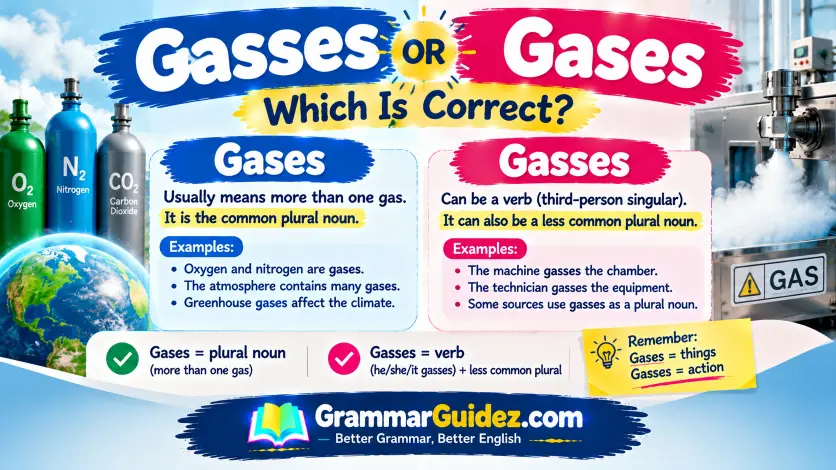
“Gasses” and “Gases” are both correct words, but they have different uses. Gases = the standard plural of gas, referring to more than one gas. Gasses = the third-person singular form of the verb gas, meaning to attack or treat with gas
Gases and gasses look almost the same, so it is easy to confuse them.
If you are writing about oxygen, nitrogen, carbon dioxide, or other types of gas, the usual spelling is gases.
But gasses is not simply a spelling mistake. It is also a real English form. It can be the third-person singular form of the verb gas, and some dictionaries also recognize gasses as a less common plural of gas.
The safest rule for everyday, academic, and scientific writing is:
gas → gases
Use gasses mainly when the grammar calls for the verb form gasses, or when a specific style or source uses it as a plural noun.
Quick Answer: Gasses or Gases?
When you mean more than one gas, use gases in most situations.
When gasses is used as a verb, it means that a person, machine, or other subject performs an action involving gas.
| Word | Main Use | Example |
| Gases | Usual plural noun of gas | Several gases were detected. |
| Gasses | Verb form of gas | The machine gasses the chamber. |
| Gasses | Less common plural noun | Some sources use gasses for more than one gas. |
Cambridge lists gasses as a plural of gas, while Dictionary.com says both gases and gasses can be acceptable plural forms but notes that gases is much more common.
So, if you simply need the plural of gas, gases is the best default.
What Does Gases Mean?
Gases is the most common plural form of the noun gas.
A gas is a state of matter that does not have a fixed shape or volume.
When you talk about more than one gas, you normally use gases.
For example:
- Oxygen and nitrogen are gases.
- Scientists study different gases.
- The experiment produced several gases.
- The atmosphere contains many gases.
- Some gases can be harmful.
This form is especially common in science and academic writing.
Gas → Gases
The basic pattern is simple:
gas → gases
Just as:
class → classes
and
bus → buses
the noun gas normally forms its plural with -es.
However, English spelling does not always follow one simple rule, which is why gasses can look tempting.
What Does Gasses Mean?
Gasses has more than one possible use.
The most important use is as a verb.
It can be the third-person singular present form of gas.
For example:
The machine gasses the chamber.
Here, gasses describes an action.
The subject is the machine, so the verb takes the third-person singular form.
Gasses as a Verb
The verb gas can have different meanings depending on context.
It can mean:
- to supply something with gas
- to fill something with gas
- to expose something to gas
- to treat something with gas
- in some informal contexts, to talk excessively
So gasses can describe an action performed by one person, machine, organization, or thing.
Cambridge lists gasses as a plural of gas, and other dictionary sources also recognize its use in verb forms.
Gases vs Gasses: The Main Difference
The easiest way to understand this pair is to look at the job the word does in the sentence.
Gases Is Usually a Noun
When you are naming or discussing several gases, use gases.
For example:
The laboratory tested several gases.
Here, gases refers to substances.
Gasses Can Be a Verb
When the word describes an action, gasses may be correct.
For example:
The equipment gasses the container.
Here, gasses is a verb.
The difference is therefore not always about spelling alone.
It can be about grammar and meaning.
Is Gases the Correct Plural of Gas?
Yes.
Gases is the standard and most familiar plural form of gas.
If you are writing a school assignment, scientific article, laboratory report, textbook, or general English sentence, gases is normally the best choice.
For example:
Greenhouse gases affect Earth’s climate.
Different gases were found in the sample.
The experiment measured three gases.
This is the form most readers expect.
Is Gasses a Real Word?
Yes.
This is an important point.
It would be too simple to say that gasses is always wrong.
Cambridge has a dictionary entry for gasses and defines it as a plural of gas. Dictionary.com also says that both gases and gasses can be acceptable plural forms, although gases is much more common.
So:
gasses is a real word.
However, that does not mean it is the best choice in every sentence.
For normal plural use, gases is clearer and more familiar.
Why Do People Write Gasses?
The spelling gasses seems logical because the singular word gas already ends in s.
Many learners think:
gas + es = gasses
But the usual plural spelling is:
gas + es = gases
The extra s is not normally added.
This is one reason the word pair causes confusion.
English has many spelling patterns, but they do not always work in exactly the same way.
Gases in Science
Gases is especially common in scientific writing.
Scientists may discuss:
- oxygen gases
- greenhouse gases
- noble gases
- toxic gases
- atmospheric gases
- industrial gases
- exhaust gases
- fuel gases
- medical gases
For example:
The atmosphere contains several different gases.
Scientific writing usually benefits from the familiar gases form because it is immediately clear that the word is a plural noun.
Greenhouse Gases or Greenhouse Gasses?
The standard and much more common phrase is:
greenhouse gases
You will see this spelling frequently in scientific, educational, and environmental writing.
For example:
Greenhouse gases can contribute to climate change.
Although gasses can appear as a plural form in some sources, greenhouse gases is the normal choice for general and scientific writing.
Exhaust Gases or Exhaust Gasses?
The usual form is:
exhaust gases
For example:
The engine releases exhaust gases.
Here, gases is a plural noun referring to substances released from the engine.
Using gasses here may appear in some texts, but gases is the safer and more familiar choice.
Gases in Academic Writing
If you are writing an academic paper, thesis, laboratory report, or science assignment, use gases when you mean more than one gas.
For example:
The researchers measured the concentration of several gases.
This is clear and conventional.
Using gasses as the plural noun may distract some readers because gasses is much less common in this role.
A good writing rule is:
When the plural noun is needed, choose the form most readers expect: gases.
When Should You Use Gasses?
There are two main situations where gasses can appear.
1. As a Verb
Gasses can be the third-person singular form of gas.
For example:
The technician gasses the equipment.
The subject is the technician, so the verb becomes gasses.
Compare:
I gas the equipment.
They gas the equipment.
He gasses the equipment.
This shows the grammatical difference clearly.
2. As a Less Common Plural
Some dictionaries recognize gasses as a plural of gas.
For example:
Several gasses were released.
This usage exists, but it is much less common than gases.
Dictionary.com explicitly notes that both forms can be acceptable plural forms while describing gases as the much more common form.
So you should not automatically call every use of gasses incorrect.
Gases vs Gasses in a Simple Table
| Form | Grammar | Meaning | Best Use |
| gas | Singular noun | One gas | One substance |
| gases | Plural noun | More than one gas | Normal plural |
| gasses | Plural noun | More than one gas | Less common variant |
| gas | Verb | To gas | Base verb |
| gasses | Verb | He/she/it gases | Third-person singular |
| gassed | Verb | Past action | Past tense |
| gassing | Verb | Ongoing action | -ing form |
This table shows why context matters.
Gas, Gases, Gassed, and Gassing
It helps to learn the whole word family.
Gas
The singular noun or base verb.
The tank contains gas.
Gases
The usual plural noun.
Several gases were tested.
Gassed
The past tense or past participle of gas.
The chamber was gassed before the procedure.
Gassing
The present participle of gas.
The system is gassing the chamber.
Gasses
The third-person singular present form of gas.
The machine gasses the chamber.
Cambridge lists gassing as the present participle of gas, confirming this verb pattern.
Gases or Gasses for “More Than One Gas”?
If your sentence simply means more than one gas, choose:
gases
This is the easiest rule to follow.
For example:
Correct: The atmosphere contains several gases.
Less common: The atmosphere contains several gasses.
The second form is recorded in English, but the first is the normal choice for most readers.
Gasses as a Verb: How to Recognize It
A useful test is to look at the word before gasses.
If the subject is a singular person or thing doing an action, gasses may be a verb.
For example:
The machine gasses the material.
The technician gasses the chamber.
The system gasses the container.
The word describes an action.
But:
Different gases were found in the container.
Here, gases names substances.
Common Mistakes With Gases and Gasses
❌ The atmosphere contains several gasses.
✅ The atmosphere contains several gases.
Use gases as the normal plural noun.
❌ Scientists study many different gasses.
✅ Scientists study many different gases.
Again, gases is the standard choice for the plural noun.
❌ The machine gases the chamber.
✅ The machine gasses the chamber.
When gas is used as a third-person singular verb, gasses can be correct.
❌ One gases was detected.
✅ One gas was detected.
Gas is singular.
❌ Two gas were detected.
✅ Two gases were detected.
Gases is plural.
Gases vs Gasses: Singular and Plural
The basic pattern is:
| Singular | Plural |
| one gas | two gases |
| a gas | several gases |
| this gas | these gases |
| one type of gas | several types of gases |
This pattern is useful in everyday and scientific writing.
Remember:
One gas
Two gases
Many gases
Is “Gasses” an American or British Spelling?
No.
This is not mainly an American-versus-British spelling difference like color/colour or recognized/recognised.
The main issue is grammar and usage.
Gases is widely used in both American and British English.
Gasses can also be found in English usage, especially in its verb function and as a less common plural noun.
So you should not treat gasses as simply the British or American version of gases.
Gases or Gasses in Formal Writing
For formal writing, the safest choice is usually gases when you mean multiple gases.
This includes:
- academic papers
- scientific reports
- school assignments
- laboratory reports
- websites
- business documents
- educational articles
- technical writing
Why?
Because gases is familiar, standard, and immediately understood as the plural of gas.
If you need the verb form, however, gasses may be exactly right.
A Simple Memory Trick
Use this simple rule:
Gases = things
Gasses = action
Think:
Gases names several gas substances.
Gasses can describe what someone or something does.
Another quick reminder is:
gas → gases
when you need the normal plural.
A Three-Second Decision Test
When you see gases or gasses, ask:
Am I talking about more than one gas?
Use gases.
Am I describing an action performed by one subject?
Check if gasses is the third-person singular form of the verb gas.
Is the word being used as a plural noun?
Gases is the best default.
This test will solve most cases.
Examples of Gases
Here are common sentences using gases:
- Oxygen and nitrogen are gases.
- The experiment produced several gases.
- Some gases are invisible.
- The atmosphere contains many gases.
- Scientists study greenhouse gases.
- The factory monitors harmful gases.
- Different gases react in different ways.
- The machine detects dangerous gases.
- The sample contained several gases.
- Some gases can be compressed.
Examples of Gasses
Here are examples where gasses functions as a verb:
- The machine gasses the chamber.
- The technician gasses the equipment.
- The system gasses the container.
- The device gasses the material.
- The process gasses the sample.
In each case, gasses describes an action performed by a singular subject.
Quick Practice Quiz
Choose gases or gasses.
- Oxygen and nitrogen are ______.
- The laboratory detected several ______.
- The machine ______ the chamber.
- Scientists study greenhouse ______.
- The technician ______ the equipment.
- The atmosphere contains many ______.
- Several harmful ______ were detected.
- The system ______ the container.
Answers
- gases
- gases
- gasses
- gases
- gasses
- gases
- gases
- gasses
The pattern is simple: gases is normally the plural noun, while gasses can be the third-person singular verb.
FAQs
Is it gases or gasses?
For the normal plural of gas, gases is the best and most common choice. Gasses is also a real English form and can be used as a verb or, less commonly, as a plural noun.
Is gasses a correct word?
Yes. Gasses is a real English word. It can be a plural of gas, and it can also be the third-person singular form of the verb gas.
What is the plural of gas?
The usual plural is gases.
gas → gases
Some dictionaries also record gasses as an alternative plural.
Is “gasses” a plural?
Yes. Gasses is recorded as a plural of gas in Cambridge. However, gases is the more common plural form.
Is “gasses” a verb?
Yes. Gasses can be the third-person singular present form of gas.
For example:
The machine gasses the chamber.
Should I use gases in scientific writing?
Yes. Gases is normally the best choice when you mean more than one gas in scientific, academic, or educational writing.
Is “greenhouse gases” correct?
Yes. Greenhouse gases is the standard and widely used form.
Is “greenhouse gasses” wrong?
It is not necessarily impossible because gasses is recorded as a plural form, but greenhouse gases is much more common and is the better choice for normal scientific writing.
Are gases and gasses pronounced the same?
Yes. When they are used as plural forms, they are normally pronounced the same.
Is gases American or British English?
Gases is used in both American and British English. It is not a regional spelling difference.
Is gasses an American spelling?
No. The difference is not simply American versus British English. Gasses has grammatical uses in English generally.
Why is the plural of gas spelled gases?
The conventional plural is formed as gas → gases. English spelling does not require every word ending in s to double that letter when forming a plural.
What is the easiest way to remember gases and gasses?
Remember:
Gases = plural noun
Gasses = verb form or less common plural
For most sentences about more than one gas, choose gases.
Final Answer: Gasses or Gases?
Both gases and gasses are real English forms, but they are not equally common.
Use gases as your normal plural of gas.
Gas → gases
Use gasses when it is the third-person singular form of the verb gas, or when a source or specialized context uses it as a less common plural.
The safest everyday rule is:
More than one gas = gases.
For example:
Oxygen and nitrogen are gases.
But:
The machine gasses the chamber.
The key is to look at the grammar and meaning, not just the spelling.
If you are writing a school assignment, science article, academic paper, or general English content, gases is almost always the best default when you mean more than one gas.
Read More Articles:

I am Evan Whitmore, an English language writer and the person who started GrammarGuidez.com. I made GrammarGuidez.com to make grammar, spelling, vocabulary and words that are often confused easier to understand.
I like taking to understand English words and grammar rules and turning them into simple and clear explanations. My aim is to help students, writers, bloggers, ESL learners and regular English speakers feel more sure when they write and talk.
At GrammarGuidez.com I work on real life examples easy to understand explanations comparing words, spelling changes and how American English is used every day.
I think learning English doesn’t need to be hard. A good explanation and some good examples can make tough grammar topics much simpler to learn