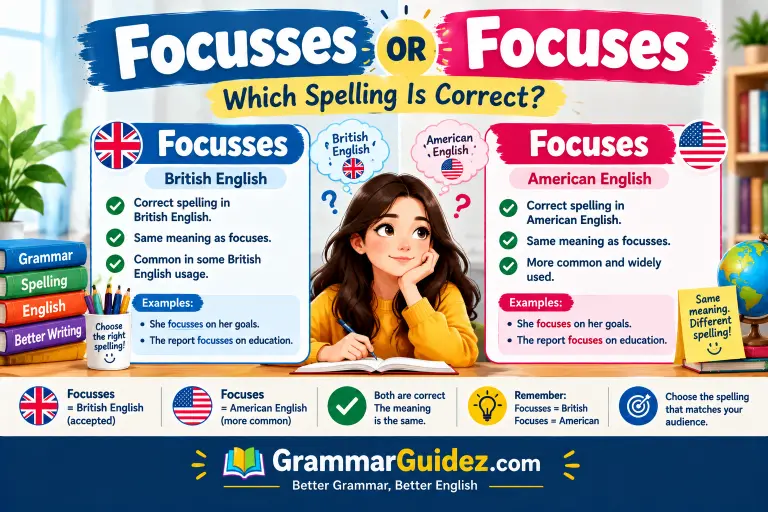
“Focusses” and “Focuses” are both correct spellings, but they are used more often in different English styles. Focuses is the preferred spelling in American English. Focusses is also correct and is more common in British English. Both are forms of the verb focus.
If you are confused about focusses or focuses, you may wonder which spelling is correct. The good news is that both focusses and focuses are accepted spellings.
The difference mainly comes from spelling preferences in different varieties of English.
Focuses is the more common spelling, especially in American English. It is also widely used in British English.
Focusses is also accepted, particularly in British English, where some writers prefer to double the final s before adding -es.
Both forms come from the verb focus.
For example:
- She focuses on her studies.
- She focusses on her studies.
Both sentences can be correct, depending on the spelling style being followed.
In this guide, you will learn the difference between focusses and focuses, their meanings, grammar, American and British usage, pronunciation, common mistakes, examples, and an easy way to remember which form to use.
Quick Answer: Focusses or Focuses?
Focuses and focusses can both be correct.
Focuses is the more common form and is especially common in American English.
Focusses is also accepted, especially in British English.
| Spelling | Correct? | Common Usage |
| Focuses | ✅ Yes | Very common in American and British English |
| Focusses | ✅ Yes | More common in some British English usage |
Easy Rule
For most general writing, focuses is the safest and most widely recognized choice.
If you are following a British English style guide that uses focusses, that spelling can also be correct.
What Does Focuses Mean?
Focuses is usually the third-person singular form of the verb focus.
The verb focus means to give attention to something or to concentrate on something.
The basic forms are:
focus → focuses → focused/focussed → focusing/focussing
For example:
He focuses on his work.
Here, focuses means that he gives his attention to his work.
The word can also refer to directing attention, effort, or discussion toward a particular subject.
What Does Focusses Mean?
Focusses has the same basic meaning as focuses.
It is another spelling of the third-person singular form of focus.
For example:
The teacher focusses on the main problem.
The meaning is the same as:
The teacher focuses on the main problem.
The difference is spelling, not meaning.
Focuses vs. Focusses
The main difference is the number of s letters before -es.
Focuses:
f-o-c-u-s-e-s
Focusses:
f-o-c-u-s-s-e-s
The second spelling doubles the final s.
| Feature | Focuses | Focusses |
| Meaning | To concentrates on something | To concentrates on something |
| Correct? | ✅ Yes | ✅ Yes |
| Common in American English | ✅ Very common | Less common |
| Used in British English | ✅ Yes | ✅ Yes |
| Third-person singular verb | ✅ Yes | ✅ Yes |
| Pronunciation | Same | Same |
A small grammar correction is important here: focuses means concentrates, not “to concentrates.” The base verb is focus, while focuses is used with he, she, it, or a singular noun.
Focuses in American English
Focuses is the normal and very common spelling in American English.
American English generally writes:
focus → focuses
For example:
- The student focuses on math.
- The company focuses on customer service.
- The article focuses on grammar.
- The team focuses on improving its results.
For a website targeting a US audience, focuses is usually the best choice.
Focusses in British English
Focusses is accepted in British English.
Some British writers use the double s to make the spelling pattern clear.
The form is:
focus → focusses
For example:
- The report focusses on education.
- The teacher focusses on grammar.
- The study focusses on language development.
However, focuses is also widely used in British English. Therefore, British English does not require focusses.
Is Focuses More Common Than Focusses?
Yes.
Focuses is generally more common.
It is widely understood and used in both American and British English.
Focusses is less common but still accepted, especially in British English.
If you want the spelling that will look natural to the largest number of English readers, focuses is usually the better choice.
Why Does Focusses Have Two S’s?
The spelling focusses follows a pattern used by some writers for verbs ending in -s.
The idea is that the final s of focus is retained and another s is added before -es:
focus + es → focusses
However, another standard spelling simply uses:
focus + es → focuses
Both forms are found in standard English.
This is why dictionaries and style guides may show both forms, with different preferences depending on region or style.
Focuses or Focusses: American vs. British English
Here is a simple comparison:
| English Variety | Preferred/Common Form |
| American English 🇺🇸 | focuses |
| British English 🇬🇧 | focuses and focusses |
| International English | focuses is widely recognized |
Unlike some spelling differences, this is not a strict US-versus-UK rule.
British English allows both forms.
Focuses, Focused, and Focusing
It is important not to confuse the different forms of focus.
Present tense
focus
Example:
I focus on my work.
Third-person singular
focuses
Example:
She focuses on her work.
Past tense
focused or focussed
Example:
She focused on her work.
or:
She focussed on her work.
-ing form
focusing or focussing
Example:
She is focusing on her work.
or:
She is focussing on her work.
These forms can vary by English variety and style.
Focuses or Focusses in a Sentence
Both forms can be used in the same type of sentence.
Using Focuses
The teacher focuses on grammar.
Using Focusses
The teacher focusses on grammar.
The meaning does not change.
Both sentences say that the teacher gives attention to grammar.
Common Mistakes With Focuses and Focusses
Mistake 1: Thinking Focusses Is Always Wrong
Some people see the double s and assume it is a spelling error.
That is not always true.
Focusses is an accepted spelling, especially in British English.
Mistake 2: Thinking Focuses Is Only American
This is also incorrect.
Focuses is used in both American and British English.
It is simply much more common than focusses.
Mistake 3: Mixing Styles
A writer may use focusses, focused, and focusing without considering the spelling style they are following.
It is better to choose a consistent style.
For example, if your website follows a British spelling style, you may choose:
focusses → focussed → focussing
If you use the more widely common form, you may choose:
focuses → focused → focusing
How Do You Pronounce Focuses?
Focuses and focusses are pronounced the same.
They are commonly pronounced approximately as:
FOH-kuh-siz
The spelling difference does not normally create a pronunciation difference.
This means you cannot hear if someone means focuses or focusses.
You have to see the spelling or understand the writing style.
Is Focusses a British Spelling?
Yes, focusses is an accepted British English spelling.
However, it is important to understand that focuses is also used in British English.
So it is not correct to say:
Focusses = British only
and:
Focuses = American only
A better explanation is:
Focuses = common in both varieties
Focusses = accepted, especially in British English
Which Spelling Should You Use?
For most writers, focuses is the easiest choice.
Use focuses if:
- You write for an American audience.
- You want the more common spelling.
- You want a spelling that is widely recognized.
- Your website uses American English.
Use focusses if:
- You follow a British English style.
- Your style guide prefers the double-s spelling.
- You want consistency with other British spellings such as focussed and focussing.
The most important rule is consistency.
Examples of Focuses
Here are some simple examples using focuses:
- She focuses on her studies.
- The book focuses on English grammar.
- The company focuses on quality.
- He focuses on his goals.
- The lesson focuses on spelling.
- The report focuses on climate change.
- Our website focuses on English learners.
- The team focuses on customer needs.
Examples of Focusses
Here are examples using focusses:
- She focusses on her studies.
- The book focusses on English grammar.
- The company focusses on quality.
- He focusses on his goals.
- The lesson focusses on spelling.
- The report focusses on climate change.
- Our website focusses on English learners.
- The team focusses on customer needs.
The meanings are the same.
Only the spelling changes.
Focuses or Focusses in Formal Writing
Both forms can appear in formal writing.
However, focuses is usually the safer choice when you are writing for a broad international audience.
If your organization, school, publisher, or website follows British English and prefers focusses, you can use it.
The key is to follow the relevant style guide.
In professional writing, consistency matters more than choosing one form as universally “correct.”
Easy Memory Trick
If you want the simplest option, remember:
Focuses = the common form
It has only one s before -es:
focus + es = focuses
If you prefer British spelling with the doubled consonant, remember:
focus + es = focusses
You can also remember the word family:
focus → focuses
and:
focus → focussed → focussing
if you are following the double-s spelling style.
Focuses or Focusses: Comparison Chart
| Word | Status | Common Usage |
| Focus | ✅ Correct | Base verb |
| Focuses | ✅ Correct | Very common |
| Focused | ✅ Correct | Very common |
| Focussed | ✅ Correct | Common in British English |
| Focusing | ✅ Correct | Very common |
| Focussing | ✅ Correct | Used in British English |
This shows why focusses should not automatically be treated as a misspelling.
FAQs
Is focuses correct?
Yes. Focuses is a standard English spelling and is the more common form.
Is focusses correct?
Yes. Focusses is also an accepted spelling, especially in British English.
Which is more common, focuses or focusses?
Focuses is generally more common.
Is focusses British English?
Focusses is accepted in British English, although focuses is also widely used in British English.
Is focuses American English?
Yes. Focuses is the common spelling in American English.
Do focuses and focusses mean the same thing?
Yes. They have the same meaning when used as the third-person singular form of focus.
Are focuses and focusses pronounced the same?
Yes. They are normally pronounced the same.
Should I use focuses or focusses?
For most general writing, focuses is the easiest and most widely recognized choice. If you follow a British style that uses double s, focusses is also correct.
What is the past tense of focus?
Both focused and focussed are accepted. Focused is very common, while focussed is especially associated with British English.
What is the -ing form of focus?
Both focusing and focussing are used. Focusing is more widely common, while focussing is used in British English.
Conclusion
When choosing between focusses or focuses, you do not need to worry that one is completely wrong.
Focuses is the more common spelling and is standard in American English. It is also widely used in British English.
Focusses is also an accepted spelling, especially in British English.
Both forms mean the same thing when they are used as the third-person singular form of the verb focus.
For example:
She focuses on her work.
and:
She focusses on her work.
Both are correct.
If you want the simplest and most widely recognized option, choose focuses.
If your writing follows a British style that prefers double consonants, focusses is a valid choice.
Remember:
Focuses = more common and widely used ✅
Focusses = accepted, especially in British English ✅
The most important thing is to choose one spelling style and use it consistently throughout your writing.
Read More Articles:

I am Evan Whitmore, an English language writer and the person who started GrammarGuidez.com. I made GrammarGuidez.com to make grammar, spelling, vocabulary and words that are often confused easier to understand.
I like taking to understand English words and grammar rules and turning them into simple and clear explanations. My aim is to help students, writers, bloggers, ESL learners and regular English speakers feel more sure when they write and talk.
At GrammarGuidez.com I work on real life examples easy to understand explanations comparing words, spelling changes and how American English is used every day.
I think learning English doesn’t need to be hard. A good explanation and some good examples can make tough grammar topics much simpler to learn