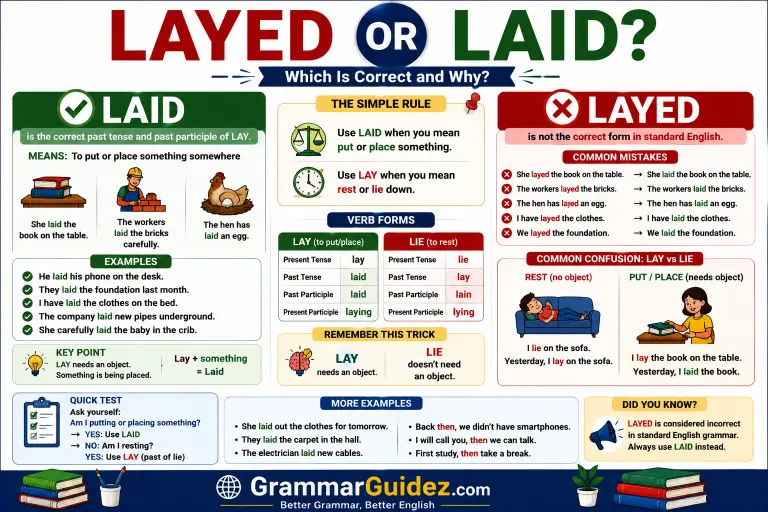
“Laid” is the correct past tense and past participle of “lay,” while “layed” is generally incorrect in standard English. “Laid” means put or placed something down, whereas “layed” is only used in rare, specialized contexts, such as some technical terminology.
Is it layed or laid?
The short answer is simple:
Laid is the correct standard spelling.
If you mean the past tense or past participle of lay, you should normally use laid, not layed.
For example:
She laid the book on the table.
The workers laid the foundation.
The hen has laid an egg.
The spelling layed looks logical because many English verbs form the past tense by adding -ed. However, lay is an irregular verb. Its past tense and past participle are both laid.
The confusion becomes even harder because another verb, lie, has lay as its past tense.
For example:
Yesterday, I lay on the sofa.
This is correct because it comes from lie, not lay.
So, English learners often face several similar words:
lay → laid → laid
and:
lie → lay → lain
This guide explains the difference between layed and laid, why laid is the standard correct form, and how to avoid confusing lay with lie.
The Quick Answer
When choosing between layed or laid, use:
✅ Laid
Avoid:
❌ Layed
in standard English when you mean the past tense or past participle of lay.
Correct
She laid the baby in the crib.
He laid his phone on the desk.
The workers laid new tiles.
They had laid the groundwork for the project.
Incorrect
❌ She layed the baby in the crib.
❌ He layed his phone on the desk.
Major dictionaries and grammar references identify laid as the past tense and past participle of lay. Cambridge specifically notes that the correct past and past-participle spelling is laid, not layed.
Why Does “Layed” Look Correct?
The mistake is understandable.
Many English verbs follow a regular pattern.
For example:
| Present | Past |
| Walk | Walked |
| Play | Played |
| Clean | Cleaned |
| Watch | Watched |
Because of this pattern, someone may think:
Lay → Layed
However, lay does not follow the normal -ed pattern.
It is an irregular verb.
The correct forms are:
| Verb Form | Correct Word |
| Present | Lay |
| Past | Laid |
| Past participle | Laid |
| Present participle | Laying |
So:
Today, I lay the book here.
Yesterday, I laid the book here.
I have laid the book here before.
I am laying the book here.
What Does “Lay” Mean?
The verb lay usually means:
to put or place something somewhere
Importantly, lay normally needs an object.
An object is the person or thing being placed.
For example:
Lay the book on the table.
What is being placed?
The book.
So, the book is the object.
More examples:
She laid the baby in the crib.
He laid his jacket on the chair.
They laid the carpet on the floor.
The workers laid the bricks carefully.
The action happens to something.
That is an important clue.
Merriam-Webster and Cambridge both describe lay in this common sense as a verb meaning to put or place something down, and its past form is laid.
The Easy Formula: Lay + Something
One of the easiest ways to understand laid is to remember this pattern:
Lay + something
Present:
I lay the phone on the desk.
Past:
I laid the phone on the desk.
The word something represents the object.
More Examples
Present:
She lays the clothes on the bed.
Past:
She laid the clothes on the bed.
Present:
They lay the tools on the floor.
Past:
They laid the tools on the floor.
If you are talking about placing something somewhere in the past, laid is usually the word you need.
Layed or Laid? Use This Simple Decision Test
When writing, ask yourself:
Question 1: Am I talking about putting something somewhere?
If yes, you may be using the verb lay.
Then ask:
Question 2: Did the action happen in the past?
If yes, use:
laid
Example:
Yesterday, she the keys on the table.
She put the keys somewhere in the past.
Correct answer:
She laid the keys on the table.
The Real Reason People Get Confused
The problem is not only layed vs laid.
The bigger problem is the relationship between lay and lie.
These are two different verbs.
Unfortunately, some of their forms look the same.
Verb One: Lay
Lay means:
To put or place something down.
It usually needs an object.
Forms of Lay
| Verb Form | Word |
| Present | Lay |
| Past | Laid |
| Past participle | Laid |
| -ing form | Laying |
Example:
Today, I lay the book down.
Yesterday, I laid the book down.
I have laid the book down.
I am laying the book down.
Verb Two: Lie
Lie can mean:
To rest in a flat position.
This meaning normally does not need an object.
Forms of Lie
| Verb Form | Word |
| Present | Lie |
| Past | Lay |
| Past participle | Lain |
| -ing form | Lying |
Example:
Today, I lie on the bed.
Yesterday, I lay on the bed.
I have lain on the bed.
I am lying on the bed.
This is where many people become confused.
The word lay can be:
- The present tense of lay.
- The past tense of lie.
Cambridge and Merriam-Webster both explain this overlap and distinguish lay → laid from lie → lay → lain.
Laid vs Lay: The Difference Matters
Look at these two sentences.
Sentence One
I laid the book on the table.
This means:
I put the book on the table.
The book is the object.
Sentence Two
I lay on the bed.
This means:
I rested on the bed.
There is no object.
The speaker is describing their own position.
This is one of the most important grammar differences to remember.
Layed Is Not the Standard Past Form
In standard English grammar, do not add -ed to make:
lay → layed
Instead, the correct form is:
lay → laid
Cambridge gives the rule clearly:
lay → laid
and identifies layed as incorrect for the standard past and past-participle form of this verb.
Correct
The company laid new cables.
Incorrect
❌ The company layed new cables.
Everyday Situations Where You Should Use “Laid”
The word laid appears in many common situations.
1. Putting Something on a Surface
She laid her phone on the table.
He laid the papers on my desk.
I laid the keys beside the door.
2. Putting a Person Down
The mother laid the baby in the crib.
He carefully laid the child on the bed.
Notice that another person can also be the object.
3. Construction
The workers laid the bricks.
The company laid new pipes.
They laid the foundation last year.
The road crew laid fresh asphalt.
4. Eggs
Animals can also lay eggs.
Present:
The hen lays an egg.
Past:
The hen laid an egg.
Present perfect:
The hen has laid an egg.
Not:
❌ The hen has layed an egg.
Merriam-Webster lists producing and depositing an egg as one of the established meanings of lay, with laid as its past form.
“Laid” as a Past Participle
Laid is not only the simple past tense.
It is also the past participle of lay.
This means it can appear with words such as:
- has
- have
- had
Examples
She has laid the book on the table.
They have laid the carpet.
He had laid the documents on my desk.
The correct form remains:
laid
Not:
❌ has layed
❌ have layed
Laid in Passive Sentences
You can also see laid in passive structures.
For example:
The carpet was laid yesterday.
New pipes were laid under the road.
The foundation was laid last month.
In these sentences, the focus is on the thing that received the action.
The person who performed the action may not be mentioned.
Common Expressions With “Laid”
Learning common phrases can make the correct spelling easier to remember.
Laid Out
She laid out the clothes for tomorrow.
The teacher laid out the rules clearly.
Laid Off
This phrase has a different meaning.
The company laid off several workers.
Laid off can mean ending someone’s employment, usually because there is not enough work or because a company is reducing staff.
Laid Down
He laid down the book.
The government laid down new rules.
The literal meaning involves placing something down, but the phrase can also have a figurative meaning.
Laid the Foundation
They laid the foundation for a successful business.
This can be literal or figurative.
Literally, it may mean constructing a foundation.
Figuratively, it means creating an important beginning for something.
Common Mistakes
Mistake 1: Adding -ed to Lay
❌ She layed the bag on the floor.
✅ She laid the bag on the floor.
Why?
The past tense of lay is irregular.
The correct word is laid.
Mistake 2: Using Laid When You Mean Lay Down
❌ Yesterday, I laid on the sofa.
In standard grammar, this is usually incorrect when you mean that you rested on the sofa.
Correct:
Yesterday, I lay on the sofa.
Why?
The verb is lie, meaning to rest.
Its past tense is lay.
Mistake 3: Writing “Have Lay”
❌ I have lay the book on the table.
Correct:
I have laid the book on the table.
The past participle of lay is laid.
Mistake 4: Confusing Lying and Laying
These words also cause problems.
Lying
Use lying when someone is resting.
She is lying on the bed.
Laying
Use laying when someone is putting something somewhere.
She is laying the book on the table.
The first sentence has no object.
The second sentence has an object:
the book
This distinction is a key part of the standard grammar difference between lay and lie.
A Quick Comparison Chart
| Meaning | Present | Past | Past Participle |
| Put something down | Lay | Laid | Laid |
| Rest in a flat position | Lie | Lay | Lain |
| Tell an untruth | Lie | Lied | Lied |
This chart explains why the words can be confusing.
Look carefully:
Lay → Laid
But:
Lie → Lay
And:
Lie → Lied
when lie means telling an untruth.
Real-Life Examples
At Home
She laid the dishes on the table.
Yesterday, I lay on the sofa for an hour.
At School
The teacher laid the books on each student’s desk.
The students laid their bags beside their chairs.
At Work
He laid the report on the manager’s desk.
The team had laid the groundwork before starting the project.
During Construction
Workers laid the bricks carefully.
The company laid new cables underground.
With Animals
The chicken laid three eggs.
The bird has laid its eggs in the nest.
The Best Memory Trick
Try remembering this simple pattern:
LAY → LAID
The vowel changes.
It does not simply add -ed.
You can also remember this sentence:
If you put something down yesterday, you LAID it down.
For example:
Yesterday, I laid the book down.
If you can identify the thing being placed, laid is often the correct past form.
Quick Quiz: Layed or Laid?
Choose the correct word.
1. She ___ the keys on the table.
A. Layed
B. Laid
2. The workers ___ new bricks yesterday.
A. Layed
B. Laid
3. The hen has ___ an egg.
A. Layed
B. Laid
4. He carefully ___ the baby in the crib.
A. Layed
B. Laid
5. They had ___ the foundation before winter.
A. Layed
B. Laid
6. She ___ her jacket on the chair.
A. Layed
B. Laid
- 7. The company ___ new pipes underground.
A. Layed
B. Laid
8. We ___ the carpet last week.
A. Layed
B. Laid
Answers
- B — Laid
- B — Laid
- B — Laid
- B — Laid
- B — Laid
- B — Laid
- B — Laid
- B — Laid
Fill in the Blanks
Choose laid or lay.
- Yesterday, I ___ on the beach.
- She ___ the book on the desk.
- The dog ___ beside the door yesterday.
- He ___ his phone on the table.
- They had ___ the groundwork already.
- Last night, I ___ awake for an hour.
- The workers ___ new tiles.
- She ___ the baby in the crib.
Answers
- lay
- laid
- lay
- laid
- laid
- lay
- laid
- laid
FAQs
Is “layed” a correct word?
In standard English, layed is not the correct past tense or past participle when you mean lay in the sense of putting or placing something down. The standard form is laid.
Is it “layed down” or “laid down”?
If you mean placing something down, use laid down in the past tense.
She laid down the book.
However, if you mean resting in the past, standard grammar uses lay down.
Yesterday, I lay down for an hour.
The correct choice depends on if the verb is lay or lie.
Why is “laid” correct instead of “layed”?
Lay is an irregular verb. It does not form its past tense by simply adding -ed. Its correct forms are lay, laid, laid, laying.
What is the past tense of lay?
The past tense of lay, meaning to put something down, is laid.
Today I lay the book on the desk.
Yesterday I laid the book on the desk.
What is the difference between lay and laid?
Lay is the present form. Laid is the past tense and past participle.
I lay the book here every day.
Yesterday, I laid the book here.
Is “I laid on the bed” correct?
In standard grammar, if you mean resting on the bed, the correct past-tense form is usually:
I lay on the bed.
This comes from lie, whose past tense is lay.
Is “the hen layed an egg” correct?
No. In standard English, write:
The hen laid an egg.
The past tense of lay an egg is laid.
What is the easiest way to remember lay and lie?
Look for an object.
If you are putting something somewhere:
lay → laid
If a person or animal is simply resting:
lie → lay
This simple object test helps in many sentences.
Conclusion
When choosing between layed or laid, the correct standard answer is:
Laid
Use laid as the past tense and past participle of lay when you mean putting or placing something somewhere.
She laid the book down.
They laid the foundation.
The hen laid an egg.
The spelling layed may look natural because English often creates past forms with -ed, but lay does not follow that regular pattern.
The larger challenge is remembering the difference between lay and lie.
Keep this simple rule in mind:
Put something down → laid
Rested in the past → lay
Once you remember that lay needs an object and lie usually does not, the confusing forms become much easier to understand.
Do not worry if you still need to check yourself at first. Even experienced English speakers confuse these words. With practice, laid will start to look natural, and the mistake layed will become easier to spot.
Read More Articles:
- Alluding or Eluding: Meaning, Difference, and Examples
- To or Too: Meaning and Grammar Rules
- Then or Than: Difference and Correct Usage

I am Elliot Hartwell, an English language writer and the author at GrammarGuidez.com. For the 6 years I have been working with English grammar, vocabulary, spelling and everyday language usage with a focus on making confusing topics easier to understand.
I started GrammarGuidez.com with a goal: to give readers clear and practical answers to common English questions. English can sometimes be confusing especially when two words look or sound similar but have meanings or uses. I enjoy breaking down these differences in a way that’s simple and easy to remember.
I believe learning English should feel simple not overwhelming. My goal is to make every article on GrammarGuidez.com useful, for students, writers, bloggers, teachers and anyone who wants to communicate clearly in English.