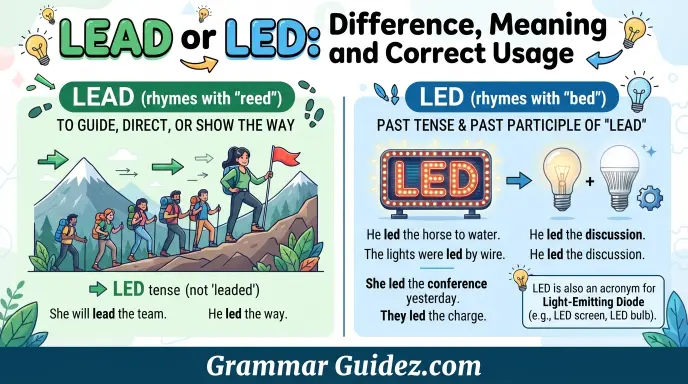
“Lead” and “led” are both correct words, but they are used in different contexts. “Lead” is usually the present tense of the verb meaning to guide or direct, while “led” is the past tense and past participle of “lead.”
Lead or led? These two words are easy to confuse because they are closely connected. In fact, led is the past tense of lead. However, the word lead has more than one meaning, and its pronunciation can also change.
That is where the confusion begins.
For example:
She will lead the team tomorrow.
Here, lead means to guide or direct someone.
Now look at this:
She led the team yesterday.
Here, led is the past tense.
But there is another important point:
The pipe contains lead.
In this sentence, lead refers to a metal. It is pronounced led, just like the past tense of the verb.
So, the spelling and pronunciation can make this grammar question confusing.
The simplest rule is:
Use lead for the present or future.
Use led for the past.
This guide explains the difference between lead and led, their meanings, pronunciation, common mistakes, and simple ways to remember which word to use.
Lead or Led: The Fast Answer
If someone is doing the action of guiding or directing now, use lead.
I lead the group every Monday.
If the action happened in the past, use led.
I led the group last Monday.
Here is the basic pattern:
| Time | Correct Word |
| Present | Lead |
| Past | Led |
| Future | Lead |
| Past participle | Led |
Examples:
They lead the project.
They led the project last year.
The main grammar difference is about time.
Start With the Time: A Simple Decision Method
When choosing between lead or led, do not look only at the spelling.
First, check the time of the sentence.
Ask yourself:
Is the action happening now?
Use lead.
I lead a small team.
She leads the department.
They lead the competition.
Did the action happen before now?
Use led.
I led a small team last year.
She led the department in 2025.
They led the competition for several weeks.
Will the action happen later?
Use lead.
I will lead the meeting tomorrow.
She will lead the project.
They may lead the team next season.
This time-based method solves most lead vs led mistakes.
Lead as a Verb: What Does It Mean?
As a verb, lead usually means to guide, direct, control, or show someone the way.
Examples
The teacher will lead the students.
Sarah leads the marketing team.
Please lead us to the meeting room.
A guide will lead the visitors through the museum.
The verb can also have other meanings.
For example:
This road leads to the airport.
This means the road goes toward the airport.
Another example:
Hard work can lead to success.
Here, lead to means:
cause or result in something
Led Is the Past Tense of Lead
The word led is the simple past tense and past participle of the verb lead.
This means:
lead → led → led
Examples:
Present
He leads the team.
Past
He led the team last year.
Present Perfect
He has led the team for five years.
Past Perfect
He had led the team before joining the company.
The spelling changes completely from lead to led.
This is why writing leaded is usually incorrect when you mean the past tense of the verb lead.
Lead or Led: Look at the Timeline
A timeline makes the difference easier to understand.
Present
I lead the class.
The action happens now.
Yesterday
I led the class yesterday.
The action happened in the past.
Tomorrow
I will lead the class tomorrow.
The action will happen in the future.
Already Completed
I have led the class before.
The action happened before now.
The easiest pattern to remember is:
Now → Lead
Past → Led
Future → Lead
Completed → Led
Why Are Lead and Led So Confusing?
The confusion exists for two main reasons.
Reason 1: The Spelling Changes
Many English verbs create the past tense by adding -ed.
For example:
Walk → Walked
Play → Played
Watch → Watched
However, lead is irregular.
The correct forms are:
Lead → Led → Led
Not:
❌ Lead → Leaded
The spelling changes from ea to e.
Reason 2: Lead Has Two Pronunciations
This is where English becomes especially confusing.
The word lead can be pronounced in two different ways depending on its meaning.
Lead Meaning “Guide”
Pronounced like:
leed
Example:
She will lead the team.
Lead Meaning the Metal
Pronounced like:
led
Example:
The old paint contained lead.
This means the same spelling can have different pronunciations.
Lead the Verb vs Lead the Metal
The word lead can have different meanings.
| Word | Meaning | Pronunciation |
| Lead | To guide | Leed |
| Lead | A position ahead | Leed |
| Lead | A metal | Led |
| Led | Past tense of lead | Led |
Look at these examples.
Maria will lead the group.
Pronunciation:
Leed
Now:
The scientist tested the material for lead.
Pronunciation:
Led
And:
Maria led the group yesterday.
Pronunciation:
Led
This is one reason English learners sometimes find lead or led difficult.
The Most Common Meaning of Lead
In everyday English, lead often means to guide people.
For example:
The manager leads the team.
Our teacher leads the discussion.
The captain leads the players.
A guide leads tourists through the city.
The person who leads is usually responsible for guiding others.
This can happen in:
- schools
- businesses
- sports
- organizations
- projects
- meetings
- groups
Using Lead in Professional Writing
The word lead is common in workplaces.
Present Tense
I lead a team of writers.
She leads the sales department.
They lead important projects.
Future
He will lead the presentation.
Our manager will lead the meeting.
Modal Verbs
After words such as will, can, should, may, and might, use lead.
She will lead the project.
He can lead the team.
They should lead the discussion.
Do not write:
❌ She will led the project.
The word after will should be the base form.
Correct:
She will lead the project.
Using Led in Past Events
Use led when the action of guiding happened in the past.
Yesterday
She led the meeting yesterday.
Last Week
He led the project last week.
Last Year
They led the company through a difficult period last year.
Earlier
The teacher led the students to the library.
The action is finished.
Therefore, use led.
Lead and Led in Common Expressions
These words appear in many useful expressions.
Lead the Way
Present:
Sarah will lead the way.
Past:
Sarah led the way.
Meaning:
To go first and show others where to go.
Lead a Team
Present:
He leads a team of engineers.
Past:
He led a team of engineers.
Lead to Success
Present:
Good habits can lead to success.
Past:
The decision led to success.
Lead a Discussion
Present:
The teacher will lead the discussion.
Past:
The teacher led the discussion yesterday.
Lead or Led After “Have,” “Has,” and “Had”
This is another area where people make mistakes.
Use led after:
- have
- has
- had
Correct
I have led several projects.
She has led the company successfully.
They had led the team before.
Incorrect
❌ I have lead several projects.
❌ She has lead the company.
The past participle of lead is:
led
So the correct form is always:
have led
has led
had led
Common Mistakes With Lead and Led
Mistake 1: Using Lead for the Past
❌ Yesterday, she lead the meeting.
✅ Yesterday, she led the meeting.
The word yesterday shows that the action happened in the past.
Use led.
Mistake 2: Using Led for the Present
❌ She led the marketing team now.
✅ She leads the marketing team now.
The word now shows present time.
Use the present form.
Mistake 3: Using Led After Will
❌ He will led the group.
✅ He will lead the group.
After will, use the base form.
Mistake 4: Using Lead After Have
❌ She has lead the company for years.
✅ She has led the company for years.
After has, use the past participle.
The correct past participle is led.
Mistake 5: Confusing the Verb With the Metal
Look at this sentence:
The worker found lead in the old pipe.
Here, lead is a metal.
It is not the present tense of the verb lead.
It is pronounced:
led
This is a vocabulary difference, not a tense difference.
A Useful Sentence Test
When proofreading your writing, try changing the subject.
For example:
She ___ the team yesterday.
Add:
Yesterday
The answer should be:
She led the team yesterday.
Now change the sentence:
She will the team tomorrow.
The answer is:
She will lead the team tomorrow.
Time words can help you choose the correct spelling.
Common Past Clues
Look for:
- yesterday
- last week
- last year
- earlier
- before
- in 2024
- ago
These words often suggest led.
Common Present or Future Clues
Look for:
- now
- every day
- usually
- today
- tomorrow
- will
- can
- should
These often suggest lead, depending on the sentence structure.
Everyday Examples
At School
The teacher will lead the class activity.
The teacher led the class activity yesterday.
At Work
Ahmed leads the design team.
Ahmed led the design team last year.
In Sports
The captain will lead the players.
The captain led the players to victory.
While Traveling
The guide will lead us to the hotel.
The guide led us to the hotel.
In Daily Life
This path will lead you to the park.
The path led us to the park.
The “Will Test”
Here is a very easy grammar trick.
If the sentence contains will, use:
lead
Correct:
I will lead the meeting.
Incorrect:
❌ I will led the meeting.
Why?
English modal structures use the base form of the verb.
Other examples include:
can lead
may lead
should lead
might lead
For example:
She can lead the team.
They should lead by example.
The “Yesterday Test”
If you can naturally add yesterday to the sentence, you may need led.
Example:
Yesterday, he led the group.
Not:
❌ Yesterday, he lead the group.
The action happened and finished in the past.
Therefore:
led
A Small Pronunciation Guide
The pronunciation of these words can confuse learners.
Lead as a Verb
Lead the team.
Pronounced:
leed
Led as Past Tense
Led the team.
Pronounced:
led
Lead as a Metal
Lead pipe.
Pronounced:
led
The same spelling can have a different pronunciation.
This is a common feature of English.
Lead vs Led: Quick Comparison Table
| Feature | Lead | Led |
| Main verb form | Present/base form | Past tense |
| Can follow will | Yes | No |
| Can follow can | Yes | No |
| Can follow has/have | Usually no | Yes |
| Meaning | Guide or direct | Guided or directed |
| Verb pronunciation | Leed | Led |
| Can refer to metal | Yes | No |
Easy Ways to Remember the Difference
Here are some simple memory tricks.
1. Think About Time
Present or future = lead
Past = led
2. Remember the Verb Pattern
Lead → Led → Led
Write this pattern a few times.
It becomes easier to remember.
3. Use “Yesterday”
If the sentence is about yesterday, use:
led
Example:
Yesterday, she led the team.
4. Use “Will”
After will, use:
lead
Example:
She will lead the team.
5. Remember the Sound
The past word led is pronounced exactly like the word red, but with an l.
Red
Led
This can help you remember the spelling.
Quick Quiz: Lead or Led?
Choose the correct word.
1. She will ___ the meeting tomorrow.
A. Lead
B. Led
2. He ___ the team last year.
A. Lead
B. Led
3. They have ___ several successful projects.
A. Lead
B. Led
4. Our manager can ___ the discussion.
A. Lead
B. Led
5. Yesterday, Sarah ___ us to the hotel.
A. Lead
B. Led
6. This road will ___ to the airport.
A. Lead
B. Led
7. The captain ___ the team to victory.
A. Lead
B. Led
8. She has ___ the company for ten years.
A. Lead
B. Led
9. Who will ___ the next project?
A. Lead
B. Led
10. The teacher ___ the students yesterday.
A. Lead
B. Led
Answers
- Lead
- Led
- Led
- Lead
- Led
- Lead
- Led
- Led
- Lead
- Led
Fill in the Blanks
Choose lead or led.
- The manager will ___ the meeting.
- She ___ the team last week.
- I have ___ this project before.
- Can you ___ us to the correct room?
- They ___ the company through a difficult time.
- This road will ___ to the beach.
- The guide ___ the tourists yesterday.
- He wants to ___ the team.
- She has ___ many successful projects.
- Who ___ the discussion last night?
Answers
- lead
- led
- led
- lead
- led
- lead
- led
- lead
- led
- led
FAQs
What is the difference between lead and led?
Lead is usually the present or base form of the verb meaning to guide or direct. Led is the past tense and past participle. For example, “I lead the team” refers to the present, while “I led the team yesterday” refers to the past.
Is it “I lead” or “I led”?
Both can be correct depending on time. Use I lead when talking about the present. Use I led when talking about the past.
I lead the team now.
I led the team last year.
Why is lead pronounced differently?
The word lead has different meanings. When it means to guide, it is pronounced leed. When it refers to the metal, it is pronounced led. Context tells readers which meaning is intended.
Is “lead” the past tense of anything?
In standard English, lead is not the past tense of the verb meaning to guide. The correct past tense is led.
Present: lead
Past: led
Is it “has lead” or “has led”?
The correct form is:
has led
This is because led is the past participle of lead.
Example:
She has led the company for five years.
Is it “will lead” or “will led”?
The correct form is:
will lead
After will, English uses the base form of the verb.
She will lead the meeting.
Not:
❌ She will led the meeting.
How do you remember lead vs led?
Think about time. If the action is happening now or will happen later, use lead. If the action happened in the past, use led.
Conclusion
The difference between lead and led mainly depends on time.
Use lead for the present or future:
I lead the team.
I will lead the meeting.
Use led for the past:
I led the team yesterday.
I have led several projects.
The easiest rule to remember is:
Lead = now or later
Led = before now
Also remember that lead can refer to a metal. In that meaning, it is pronounced led, which can make the two words even more confusing.
When you are unsure, look for clues in the sentence. Words such as yesterday, last week, and ago often point to led. Words such as will, can, and should usually require the base form lead.
Once you start checking the time of the action, choosing between lead or led becomes much easier. With a little practice, this common grammar mistake will quickly become easier to avoid.
Read More Article:
- Apologising or Apologizing: British vs American English
- Then or Than: Difference and Correct Usage
- Layed or Laid: Which Spelling Is Correct?

I am Evan Whitmore, an English language writer and the person who started GrammarGuidez.com. I made GrammarGuidez.com to make grammar, spelling, vocabulary and words that are often confused easier to understand.
I like taking to understand English words and grammar rules and turning them into simple and clear explanations. My aim is to help students, writers, bloggers, ESL learners and regular English speakers feel more sure when they write and talk.
At GrammarGuidez.com I work on real life examples easy to understand explanations comparing words, spelling changes and how American English is used every day.
I think learning English doesn’t need to be hard. A good explanation and some good examples can make tough grammar topics much simpler to learn