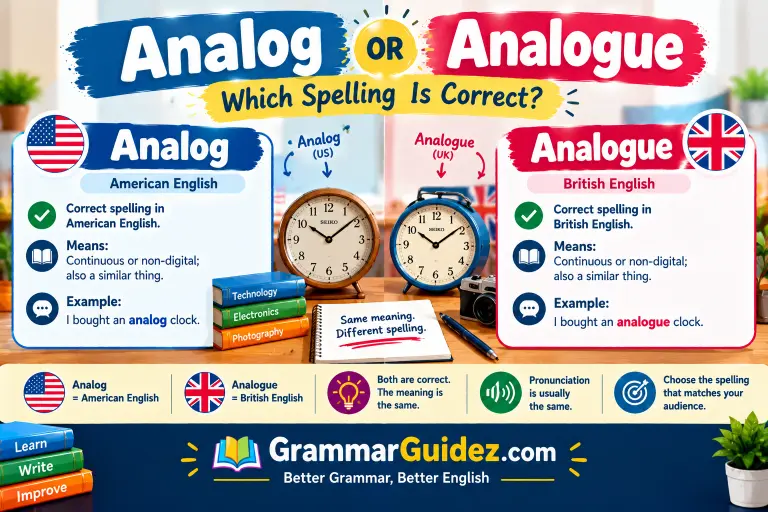
“Analog” and “Analogue” are both correct spellings, but they are used in different English styles. Analog is preferred in American English. Analogue is preferred in British English. Both refer to something that represents or measures information using continuously changing physical values
If you are confused about analog or analogue, you may wonder which spelling is correct. The good news is that both analog and analogue are correct.
The main difference is regional spelling.
Analog is the more common spelling in American English.
Analogue is the traditional and common spelling in British English and some other varieties of English.
Both words have the same basic meaning. They can describe something that is continuous rather than digital, or something that is similar to or comparable with another thing.
For example:
- analog technology 🇺🇸
- analogue technology 🇬🇧
Both refer to the same type of technology.
The word is common in areas such as technology, electronics, science, photography, music, and everyday English.
In this guide, you will learn the difference between analog and analogue, their meanings, American and British usage, examples, pronunciation, common mistakes, and an easy way to remember which spelling to use.
Quick Answer: Analog or Analogue?
Analog and analogue are both correct spellings.
The main difference is the English variety being used.
- Analog = American English
- Analogue = British English
| Spelling | Correct? | Common Usage |
| Analog | ✅ Yes | American English |
| Analogue | ✅ Yes | British English |
Easy Rule
If you are writing for a US audience, use analog.
If you are following British English, use analogue.
The meaning is the same.
What Does Analog Mean?
Analog can be used as an adjective or a noun.
As an adjective, it describes something that uses continuous signals or represents information in a continuous form rather than as digital data.
For example:
I still use an analog clock.
An analog clock normally uses hands that move around a dial.
The word can also be used more broadly to describe something that is not digital.
Examples:
- analog camera
- analog watch
- analog signal
- analog television
- analog recording
- analog device
Analog as a Noun
Analog can also be a noun.
For example:
The old system was an analog, not a digital system.
In some contexts, an analog can also mean something that is similar or comparable to another thing.
What Does Analogue Mean?
Analogue has the same basic meanings as analog.
It is the spelling commonly associated with British English.
For example:
I still use an analogue clock.
This means the same thing as:
I still use an analog clock.
Other examples include:
- analogue camera
- analogue watch
- analogue signal
- analogue television
- analogue recording
- analogue device
So, in most cases, the difference between analog and analogue is simply a spelling difference.
Analog vs Analogue
The main difference is the final letter.
Analog ends with:
-og
Analogue ends with:
-ogue
The pronunciation is usually the same.
| Feature | Analog | Analogue |
| Meaning | Same | Same |
| Correct? | ✅ Yes | ✅ Yes |
| Main usage | American English | British English |
| Part of speech | Noun / adjective | Noun / adjective |
| Pronunciation | Usually the same | Usually the same |
| Common examples | analog clock | analogue clock |
Analog in American English
Analog is the standard and common spelling in American English.
Examples:
- analog clock
- analog camera
- analog signal
- analog recording
- analog device
For example:
The museum displays several old analog cameras.
Another example:
An analog signal changes continuously over time.
If your website targets readers in the United States, analog is generally the better spelling to use.
Analogue in British English
Analogue is the traditional spelling in British English.
Examples:
- analogue clock
- analogue camera
- analogue signal
- analogue recording
- analogue device
For example:
The museum displays several old analogue cameras.
Another example:
The engineer studied an analogue signal.
If your website follows British English spelling, analogue is a natural choice.
Is Analog American or British?
Analog is strongly associated with American English.
It is the standard spelling commonly used in the United States.
For example:
The company still sells analog equipment.
American English commonly removes the final -ue in words where British English retains it.
Other examples include:
- analog / analogue
- catalog / catalogue
- dialog / dialogue
However, spelling preferences can vary by industry and style guide.
Is Analogue British or American?
Analogue is strongly associated with British English.
It is the traditional British spelling.
For example:
The company still sells analogue equipment.
British English commonly keeps the -ue ending in this word.
Analog or Analogue in Technology
You will often see both spellings when talking about technology.
American English
The device converts an analog signal into digital data.
British English
The device converts an analogue signal into digital data.
The technology and meaning are the same.
Only the spelling changes.
Common technology phrases include:
- analog signal
- analogue signal
- analog audio
- analogue audio
- analog electronics
- analogue electronics
- analog device
- analogue device
- analog input
- analogue input
Analog or Analogue in Music
The word is also common in music.
Analog or analogue equipment processes or records sound using continuous signals.
Examples:
American English
Many musicians love the sound of analog recording.
British English
Many musicians love the sound of analogue recording.
You may also see:
- analog synthesizer
- analogue synthesizer
- analog mixer
- analogue mixer
- analog recording
- analogue recording
Analog or Analogue in Photography
The word is also used when talking about older photographic technology.
For example:
American English
She prefers analog photography.
British English
She prefers analogue photography.
Both sentences refer to the same general type of photography.
The spelling depends on the English style.
Analog or Analogue in Everyday English
Although the word is strongly connected with technology, it can be used in many other contexts.
Examples include:
He prefers an analog watch.
She bought an analogue watch.
The school still uses some analog equipment.
The laboratory has several analogue devices.
We studied the difference between digital and analog signals.
The British versions simply use analogue where American English uses analog.
Analog vs Digital
Analog and digital are not simply two spellings of the same word.
They describe different types of technology or signals.
Analog
Analog systems generally represent information through continuously varying physical quantities or signals.
Example:
An analog clock uses moving hands to show time.
Digital
Digital systems represent information using discrete values, commonly through electronic digital data.
Example:
A digital clock shows time using numerical digits.
This is why you may see phrases such as:
- analog vs digital
- analogue vs digital
- analog technology
- analogue technology
Common Mistakes With Analog and Analogue
Mistake 1: Thinking Analogue Is Wrong
Some American English learners may see analogue and think it is misspelled.
It is not.
Analogue is a standard spelling, especially in British English.
Mistake 2: Thinking Analog Is Wrong
Some British English learners may think analog is incorrect.
It is not.
Analog is the standard American English spelling.
Mistake 3: Using Both Forms Without a Reason
Using both spellings in one article can make your writing look inconsistent.
For example:
The article discusses analog cameras and analogue signals.
This is not necessarily grammatically wrong, but if you are following one spelling style, it is better to stay consistent.
Choose either:
American English:
analog cameras and analog signals
or:
British English:
analogue cameras and analogue signals
Mistake 4: Thinking They Have Different Meanings
In most common uses, analog and analogue have the same meaning.
The difference is mainly spelling.
Analog or Analogue Pronunciation
Analog and analogue are normally pronounced the same.
A common pronunciation is approximately:
AN-uh-log
The final -ue in analogue does not normally create an extra sound.
So:
analog → AN-uh-log
analogue → AN-uh-log
This is why you may hear the word before you see it and not know which spelling the writer uses.
Analog or Analogue: British vs American English
Here is a simple comparison:
| English Variety | Common Spelling |
| 🇺🇸 American English | Analog |
| 🇬🇧 British English | Analogue |
| International English | Both are understood |
| Technology writing | Both are used, depending on style |
For a US-focused website, analog is usually the better choice.
For a UK-focused website, analogue is usually the better choice.
Analog and Analogue Word Family
The spelling difference also appears in related words.
American English
- analog
- analogs
- analogize
- analogized
- analogizing
British English
- analogue
- analogues
- analogise
- analogised
- analogising
However, usage can vary by field and English variety, so always follow the style guide used by your publication or organization.
Analog or Analogue in Formal Writing
Both forms can be used in formal writing.
The correct choice depends on your target audience and style guide.
If you are writing a US academic paper, article, or business document, analog is usually appropriate.
If you are writing for a British publication, analogue is usually appropriate.
The most important thing is consistency.
Which Spelling Should You Use?
The best choice depends on your audience.
Use “Analog” if:
- You write for an American audience.
- Your website follows American English.
- Your company uses US spelling.
- You are writing for a US-based publication.
Use “Analogue” if:
- You write for a British audience.
- Your website follows British English.
- Your publisher uses British spelling.
- Your organization prefers British English.
If you write for a global audience, either form can be understood. However, choosing one spelling style and using it consistently will make your content look more professional.
Easy Memory Trick
Here is a simple way to remember the difference:
🇺🇸 America → Analog
Think:
American English = shorter spelling
Analog
🇬🇧 Britain → Analogue
Think:
British English = keeps “ue”
Analogue
You can remember a similar pattern:
catalog → catalogue
dialog → dialogue
analog → analogue
So:
US = analog
UK = analogue
Analog or Analogue Examples
American English
- I bought an analog clock.
- The engineer measured the analog signal.
- She enjoys analog photography.
- The studio uses analog equipment.
- He prefers analog audio.
- The old machine has an analog display.
- The device accepts an analog input.
- We studied analog electronics.
British English
- I bought an analogue clock.
- The engineer measured the analogue signal.
- She enjoys analogue photography.
- The studio uses analogue equipment.
- He prefers analogue audio.
- The old machine has an analogue display.
- The device accepts an analogue input.
- We studied analogue electronics.
The meaning remains the same.
Analog or Analogue: Comparison Table
| Point | Analog | Analogue |
| Correct spelling | ✅ Yes | ✅ Yes |
| Main English variety | American | British |
| Meaning | Continuous/non-digital; also comparable thing | Same |
| Pronunciation | Usually the same | Usually the same |
| Technology usage | Very common | Very common |
| Photography | Analog photography | Analogue photography |
| Audio | Analog audio | Analogue audio |
| Clock | Analog clock | Analogue clock |
FAQs About Analog or Analogue
Is analog or analogue correct?
Both are correct. Analog is the common American English spelling, while analogue is the traditional British English spelling.
Is analogue British English?
Yes. Analogue is the traditional and common British English spelling.
Is analog American English?
Yes. Analog is the standard spelling commonly used in American English.
Do analog and analogue mean the same thing?
Yes. In common usage, they have the same meaning. The main difference is the spelling.
Are analog and analogue pronounced the same?
Yes. They are normally pronounced the same.
Which is better, analog or analogue?
Neither is universally better. Use analog for American English and analogue for British English.
Should I use analog for a US website?
Yes. Analog is generally the best choice for a website that follows American English.
Should I use analogue for a UK website?
Yes. Analogue is a natural choice for a website following British English.
Is analog a noun or adjective?
It can be both a noun and an adjective, depending on the sentence.
What is an analog clock?
An analog clock is a clock that normally shows time with moving hands on a dial rather than with numerical digital displays.
What is an analogue clock?
An analogue clock is the British spelling for the same type of clock.
What is the difference between analog and digital?
Analog technology generally uses continuously varying signals, while digital technology represents information using discrete values or digital data.
Analog or Analogue: Final Verdict
So, analog or analogue — which spelling is correct?
Both are correct. ✅
The difference is mainly based on regional spelling.
Analog is the standard and common spelling in American English.
Analogue is the traditional and common spelling in British English.
For example:
American English:
I bought an analog camera.
British English:
I bought an analogue camera.
Both sentences have the same meaning.
If you are writing for readers in the United States, choose analog.
If you are following British English, choose analogue.
The most important rule is to stay consistent throughout your website, article, assignment, or professional document.
Remember:
Analog = American English 🇺🇸
Analogue = British English 🇬🇧
Same meaning. Different spelling.
Read More Articles:

I am Evan Whitmore, an English language writer and the person who started GrammarGuidez.com. I made GrammarGuidez.com to make grammar, spelling, vocabulary and words that are often confused easier to understand.
I like taking to understand English words and grammar rules and turning them into simple and clear explanations. My aim is to help students, writers, bloggers, ESL learners and regular English speakers feel more sure when they write and talk.
At GrammarGuidez.com I work on real life examples easy to understand explanations comparing words, spelling changes and how American English is used every day.
I think learning English doesn’t need to be hard. A good explanation and some good examples can make tough grammar topics much simpler to learn