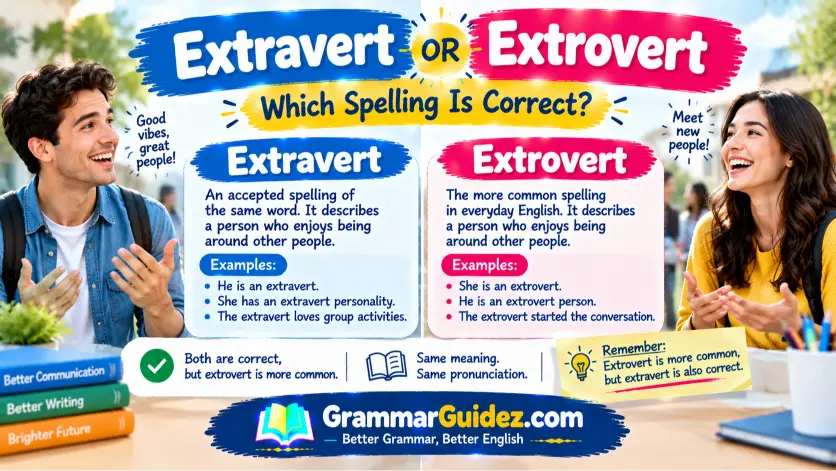
“Extravert” and “extrovert” are both correct spellings and have the same meaning. Extravert: A person who enjoys social activities and gains energy from being around others. This spelling is common in psychology. Extrovert: A more common spelling in everyday English, with the same meaning.
Have you ever wondered if to write extravert or extrovert? Both spellings are correct. They describe a person who enjoys being around other people and feels comfortable in social situations.
However, extrovert is the more common spelling in everyday English. Extravert is also accepted, especially in psychology and academic writing. Oxford and Cambridge dictionaries recognize both forms.
In this guide, you will learn the meaning of each word, how to use it, and which spelling is best for your writing.
Quick Answer: Extravert vs. Extrovert
Extrovert is the more common spelling. Extravert is an accepted alternative with the same meaning. Both words describe someone who is outgoing, sociable, and comfortable around other people.
| Word | Meaning | Usage |
| Extrovert | A person who enjoys social interaction | More common in everyday English |
| Extravert | A person who enjoys social interaction | Accepted alternative, often used in psychology |
Both spellings are correct. You do not need to treat one as a misspelling of the other.
What Does Extrovert Mean?
Extrovert is a noun that describes a person who enjoys being with others. Extroverts often like meeting new people, joining group activities, and talking in social settings.
The word can also work as an adjective. In this use, it describes a person or personality that is outgoing and sociable.
Examples:
- My brother is an extrovert who enjoys meeting new people.
- She has an extrovert personality.
- The extrovert in our group often starts conversations.
- He feels comfortable speaking in front of a crowd.
The word extroverted is another common form. It describes someone who shows extrovert traits.
For example: She is friendly and extroverted.
What Does Extravert Mean?
Extravert is another correct spelling of the same word. It describes a person who is outgoing and enjoys social contact.
The meaning does not change when you replace the letter o with a.
Examples:
- He is an extravert who enjoys group discussions.
- She has an extravert personality.
- The extravert felt comfortable meeting new people.
- My friend is an extravert who likes social events.
The spelling extravert is also associated with psychological writing. Carl Jung used this form in his work on personality types, and it remains relevant in some academic contexts.
However, you can use extrovert in most everyday situations without changing the meaning.
What Is the Difference Between Extravert and Extrovert?
There is no major difference in meaning between these words. The main difference is spelling and usage preference.
Extrovert is more familiar to most English readers. It is usually the safer choice for blog posts, emails, schoolwork, and everyday communication.
Extravert is a valid alternative. You may see it in psychology books, research papers, or discussions of personality theory.
Consider these points:
- Meaning: Both describe an outgoing, sociable person.
- Spelling: Extrovert uses an “o,” while extravert uses an “a.”
- Everyday use: Extrovert is generally more common.
- Psychology: Extravert may appear in technical writing.
- Pronunciation: Both are usually pronounced the same way.
Do not choose extravert because you think it describes a different personality. It does not have a separate everyday meaning.
Extravert or Extrovert: Which Is More Common?
Extrovert is more common in modern everyday English. It is widely recognized by English speakers and appears as the main spelling in many dictionaries.
Oxford lists extravert as an alternative to the more frequent extrovert. Cambridge also recognizes both spellings.
This means that extrovert is usually the better choice when you want your writing to sound natural to a broad audience.
Use extravert when it fits the style of your writing or when you are following a specific academic source that prefers it.
The important rule is consistency. If you choose one spelling for an article, use that spelling throughout the article.
Is Extravert Wrong?
No. Extravert is not wrong. It is a recognized spelling of extrovert.
Some writers believe that only extrovert is correct because it is more common. Others believe that extravert must be the only correct form because of its history in psychology.
Neither claim is accurate. Both forms are accepted.
If you write extravert in a sentence, you do not need to correct it simply because another writer uses extrovert.
However, when writing for a general audience, choosing the more common spelling can make your content easier for readers to recognize.
How to Use Extrovert and Extravert in Sentences
Both words can be used as nouns and, in suitable contexts, adjectives.
Using Extrovert as a Noun
A noun names a person, place, thing, or idea. In this case, extrovert names a person with an outgoing personality.
Examples:
- My cousin is an extrovert.
- The extrovert enjoyed talking with the guests.
- Our team has several extroverts.
Using Extrovert as an Adjective
An adjective describes a person or thing. Extrovert can describe a personality or a person’s social nature.
Examples:
- She has an extrovert personality.
- He is an extrovert person.
The phrase extroverted person is also very common and often sounds more natural.
Using Extravert in Sentences
The same basic rules apply to extravert.
Examples:
- My cousin is an extravert.
- She has an extravert personality.
- The extravert joined the group discussion.
Remember that both spellings have the same basic meaning.
Extrovert vs. Introvert
An extrovert and an introvert have different social preferences.
An extrovert often enjoys social interaction and may feel comfortable in busy group settings. An introvert may prefer quiet settings, smaller groups, or time alone.
These terms describe broad personality tendencies. They do not mean that every extrovert is always talkative or that every introvert dislikes people.
A person can also show both traits in different situations.
| Extrovert | Introvert |
| Often enjoys social interaction | Often prefers quieter settings |
| May enjoy meeting new people | May prefer a few close friends |
| May feel comfortable in groups | May prefer smaller gatherings |
| Often likes active social settings | May need time alone to recharge |
Neither personality type is better than the other. People have different needs and preferences.
Common Mistakes to Avoid
Mistake 1: Calling Extravert a Misspelling
Incorrect claim: Extravert is always wrong.
Correct information: Both extravert and extrovert are accepted spellings.
Mistake 2: Assuming the Words Have Different Meanings
The two spellings do not describe different personality types. Both refer to an outgoing, sociable person.
Mistake 3: Using Different Spellings Without a Reason
Changing between extrovert and extravert in the same article may confuse readers.
Choose one spelling and use it consistently.
Mistake 4: Thinking Every Extrovert Is Always Talkative
An extrovert may enjoy social interaction but still need quiet time. Personality traits exist on a range, and people behave differently in different situations.
Why Are There Two Spellings?
The word has a connection to the idea of turning outward. The form extravert is linked to the Latin element extra-, meaning outside, and vertere, meaning to turn.
The spelling extrovert became common partly through the influence of introvert. The two words look more alike when both contain the letter “o.”
Over time, extrovert became the more familiar spelling in general English, while extravert remained in use.
This history explains why both forms exist today. It does not make either spelling incorrect.
Fill in the Blanks
Complete each sentence with the correct word or phrase.
- An __________ is someone who often enjoys being around other people.
- Both extravert and extrovert are __________ spellings.
- __________ is the more common spelling in everyday English.
- The opposite of an extrovert is usually an __________.
- The adjective __________ describes someone who is outgoing.
Answer Key
- extrovert
- correct
- Extrovert
- introvert
- extroverted
Mini Quiz
1. Which spelling is more common in everyday English?
A. Extravert
B. Extrovert
C. Neither
Answer: B. Extrovert. It is the more frequent spelling in general use.
2. Is extravert an incorrect spelling?
A. Yes
B. No
C. Only in American English
Answer: B. No. It is an accepted alternative spelling.
3. Do extravert and extrovert have different meanings?
A. Yes
B. No
C. Only in psychology
Answer: B. No. Both words describe an outgoing, sociable person.
4. What is the usual opposite of extrovert?
A. Extravert
B. Introvert
C. Extroverted
Answer: B. Introvert. An introvert may prefer quieter settings or smaller groups.
5. Which spelling is a sensible choice for most general writing?
A. Extrovert
B. Extravert only
C. Both spellings in every sentence
Answer: A. Extrovert. It is more familiar to most readers, though extravert is also correct.
FAQs
Is extravert or extrovert correct?
Both are correct. Extrovert is more common in everyday English, while extravert is an accepted alternative.
Is extrovert more common than extravert?
Yes. Major dictionaries identify extrovert as the more frequent spelling in general use.
Do extravert and extrovert mean the same thing?
Yes. Both describe someone who enjoys being around people and is often socially outgoing.
Which spelling should I use in an essay?
Use extrovert for most general essays. If your teacher, university, or style guide prefers extravert, follow that preference.
Is extravert used in psychology?
Yes. Extravert and related forms such as extraversion appear in psychological writing, including work connected to personality theory.
What is the opposite of an extrovert?
The usual opposite is introvert, a person who may prefer quiet settings, smaller groups, or time alone.
Is extroverted the same as extrovert?
They are related but have different grammatical roles. Extrovert is commonly a noun, while extroverted is an adjective describing an outgoing personality.
Conclusion
Both extravert and extrovert are correct English spellings. They have the same meaning and describe a person who enjoys social interaction.
The main difference is how often people use each form. Extrovert is more common in everyday writing, while extravert is an accepted alternative that may appear in psychology.
For most articles, schoolwork, and daily communication, choose extrovert. If you prefer extravert or need to follow a particular style guide, that spelling is also acceptable.

I am Elliot Hartwell, an English language writer and the author at GrammarGuidez.com. For the 6 years I have been working with English grammar, vocabulary, spelling and everyday language usage with a focus on making confusing topics easier to understand.
I started GrammarGuidez.com with a goal: to give readers clear and practical answers to common English questions. English can sometimes be confusing especially when two words look or sound similar but have meanings or uses. I enjoy breaking down these differences in a way that’s simple and easy to remember.
I believe learning English should feel simple not overwhelming. My goal is to make every article on GrammarGuidez.com useful, for students, writers, bloggers, teachers and anyone who wants to communicate clearly in English.