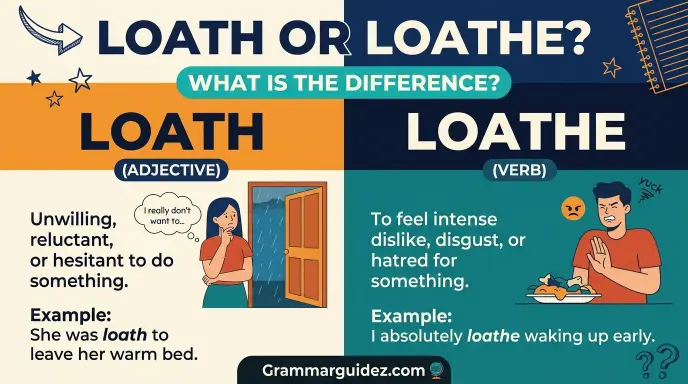
“Loath” and “loathe” are both correct words, but they have different meanings and uses. Loath: An adjective meaning unwilling or reluctant to do something. Loathe: A verb meaning to hate or dislike something intensely
Loath and loathe are both correct English words, but they have different meanings and uses. The main difference is that loath means unwilling or reluctant, while loathe means to hate something or someone strongly.
These words look almost the same. The only spelling difference is the final e in loathe. However, that small difference changes the meaning and the part of speech.
Use loath when someone does not want to do something. Use loathe when someone feels strong dislike or hatred.
Quick Answer: Loath vs. Loathe
- Loath: An adjective that means unwilling or reluctant to do something.
- Loathe: A verb that means to hate or strongly dislike someone or something.
For example, someone may be loath to leave a comfortable home, but they may loathe the idea of being treated unfairly.
Remember: Loath means reluctant. Loathe means hate.
What Does Loath Mean?
Loath is an adjective. It describes a person who is unwilling or reluctant to do something.
People often use it in the phrase “be loath to do something.” This phrase means that someone does not want to do something or feels hesitant about it.
The word is more common in formal writing than in casual conversation. In everyday English, people may use reluctant or unwilling instead.
Examples of Loath
- She was loath to admit her mistake.
- He is loath to spend his savings.
- They were loath to leave their old home.
- I am loath to make a decision without more information.
- The manager was loath to change the plan.
In these sentences, loath describes reluctance. It does not mean that the person hates something.
How to Use Loath in a Sentence
The most common pattern is:
Subject + be + loath + to + verb
For example, a person can be loath to speak, leave, agree, spend, or admit something.
The word usually describes hesitation or unwillingness. It does not always mean strong dislike. A person may be loath to leave a place because they enjoy being there, not because they hate leaving.
What Does Loathe Mean?
Loathe is a verb. It means to hate someone or something strongly. It can also describe a feeling of intense dislike or disgust.
Unlike loath, which describes reluctance, loathe expresses a strong negative feeling toward a person, activity, idea, or thing.
Examples of Loathe
- I loathe dishonesty.
- She loathes waking up early.
- He loathes being treated unfairly.
- They loathe the smell of smoke.
- Many people loathe cruelty toward animals.
In these sentences, loathe describes strong dislike or hatred.
How to Use Loathe in a Sentence
You can use loathe with a noun or a verb ending in -ing.
For example, someone can loathe a habit, a behavior, a situation, or doing a particular task.
The verb also changes form according to the sentence:
- Loathe: I loathe that behavior.
- Loathes: She loathes dishonesty.
- Loathed: He loathed the unfair treatment.
- Loathing: They are loathing the experience.
The word loathing is also a noun that means intense hatred or disgust.
Loath vs. Loathe: Key Differences
| Feature | Loath | Loathe |
| Part of speech | Adjective | Verb |
| Meaning | Unwilling or reluctant | Hate strongly |
| Common pattern | Be loath to do something | Loathe someone or something |
| Describes | Hesitation or unwillingness | Strong dislike or hatred |
| Example | She is loath to complain. | She loathes rude behavior. |
The easiest way to choose between these words is to check the meaning of your sentence. If you mean reluctant, use loath. If you mean hate, use loathe.
Why Are Loath and Loathe Confused?
There are several reasons these words cause confusion.
1. They Look Almost Identical
Both words contain the same letters, except for the final e in loathe. This small difference is easy to miss when writing quickly.
However, the final letter matters because the words have different meanings.
2. Both Words Have Negative Meanings
Both words relate to negative feelings, which can make them seem interchangeable.
The difference is that loath describes unwillingness, while loathe describes strong hatred or disgust.
A person can be reluctant to do something without hating it. Likewise, a person can hate something without being reluctant to do it.
3. Their Pronunciations Are Similar
The words are pronounced very similarly, but their final sounds can differ.
In common American pronunciation, loathe ends with the voiced “th” sound heard in breathe. Loath is often pronounced with the unvoiced “th” sound heard in both, although pronunciations can vary.
Because the difference is subtle, it is safer to choose the spelling based on meaning rather than sound.
Common Mistakes With Loath and Loathe
Writers sometimes choose the wrong word because they focus on the spelling instead of the meaning.
Incorrect: I loathe to admit that I was wrong.
Better: I am loath to admit that I was wrong.
Use loath when you mean that someone is reluctant to do something.
Incorrect: I loath dishonesty.
Correct: I loathe dishonesty.
Use loathe when you mean to hate something strongly.
Incorrect: She is loathe to spend her money.
Correct: She is loath to spend her money.
The adjective loath commonly follows a form of be and comes before to plus a verb.
Incorrect: He loaths unfair treatment.
Correct: He loathes unfair treatment.
The correct present-tense form of loathe for he, she, or it is loathes.
Is It Loath or Loathe to Do Something?
When you want to say that someone is unwilling to do something, the correct phrase is “loath to do something.”
For example, a person can be loath to speak, agree, leave, or accept an offer.
The word loathe does not fit this pattern when you mean reluctance. It is a verb that expresses strong hatred or dislike.
Compare the two meanings:
- Loath to speak: Unwilling or reluctant to speak.
- Loathe speaking: Strongly dislike speaking.
Both sentences can be correct, but they express different ideas.
Is Loathe Stronger Than Dislike?
Yes, loathe usually expresses a much stronger feeling than dislike. It often suggests intense hatred, disgust, or aversion.
Dislike can describe a mild negative feeling. Loathe usually communicates a deeper and stronger reaction.
For example, a person may dislike a certain food but loathe the idea of cruelty. The strength of the word depends on the feeling the writer wants to express.
Use loathe when you want to show strong dislike. For a mild preference, dislike may be more suitable.
How to Remember Loath vs. Loathe
Use this simple memory trick:
- Loath = reluctant. Both words describe being unwilling to do something.
- Loathe = hate. Both words end with an e when written as loathe and hate.
You can also replace the word in your sentence.
If reluctant fits the meaning, choose loath. If hate fits the meaning, choose loathe.
This quick test can help you avoid the most common mistake.
Fill in the Blanks: Loath or Loathe
Complete each sentence with the correct word: loath or loathe.
- She was ______ to share her personal information.
- I ______ dishonesty and unfair treatment.
- He is ______ to admit that he made a mistake.
- They ______ waiting in long lines.
- The manager was ______ to change the schedule.
Answers
- loath
- loathe
- loath
- loathe
- loath
Mini Quiz: Loath or Loathe
Choose the correct answer for each question.
1. Which word means unwilling or reluctant?
A. Loathe
B. Loath
C. Loathing
D. Loathes
2. Which word means to hate something strongly?
A. Loath
B. Loathed
C. Loathe
D. Loathsome
3. Which sentence is correct?
A. I loath unfair behavior.
B. I am loathe to leave.
C. I loathe unfair behavior.
D. I am loathing to leave.
4. Complete the sentence: “He is ______ to accept the offer.”
A. loathe
B. loath
C. loathes
D. loathing
5. Which sentence uses “loathe” correctly?
A. She is loathe to speak.
B. They loath to admit the truth.
C. He loathes rude behavior.
D. I am loathe to spend money.
Quiz Answers and Explanations
- B Loath. It means unwilling or reluctant.
- C Loathe. It is a verb that means to hate strongly.
- C I loathe unfair behavior. The verb loathe expresses strong dislike.
- B Loath. The phrase “be loath to accept” means to be reluctant to accept.
- C He loathes rude behavior. The verb loathe takes the form loathes with he, she, or it.
FAQs
Is loath or loathe correct?
Both are correct English words. Loath means unwilling or reluctant, while loathe means to hate something or someone strongly.
What is the difference between loath and loathe?
Loath is an adjective that describes reluctance. Loathe is a verb that expresses strong hatred or dislike.
Is loath a real word?
Yes. Loath is a standard English adjective. It is often used in the phrase “be loath to do something.”
Is loathe a real word?
Yes. Loathe is a standard English verb meaning to hate or strongly dislike someone or something.
Is it loath to admit or loathe to admit?
The correct phrase is “loath to admit.” It means that someone is reluctant or unwilling to admit something.
Can loathe be followed by a verb ending in -ing?
Yes. You can use loathe before a verb ending in -ing to describe an activity you strongly dislike.
Is loath the same as reluctant?
They have similar meanings. Loath means unwilling or reluctant, but it is generally more formal than reluctant in everyday writing.
How do you pronounce loath and loathe?
They sound very similar. In common American pronunciation, loath often ends with the unvoiced “th” sound, while loathe ends with the voiced “th” sound. Pronunciation may vary.
Conclusion
Loath and loathe are both correct, but they are not interchangeable. Loath means unwilling or reluctant and is commonly followed by to and a verb. Loathe means to hate or strongly dislike someone or something.
Remember the simple rule: loath means reluctant, while loathe means hate. Checking the meaning of your sentence will help you choose the right word every time.
Read More Articles:

I am Evan Whitmore, an English language writer and the person who started GrammarGuidez.com. I made GrammarGuidez.com to make grammar, spelling, vocabulary and words that are often confused easier to understand.
I like taking to understand English words and grammar rules and turning them into simple and clear explanations. My aim is to help students, writers, bloggers, ESL learners and regular English speakers feel more sure when they write and talk.
At GrammarGuidez.com I work on real life examples easy to understand explanations comparing words, spelling changes and how American English is used every day.
I think learning English doesn’t need to be hard. A good explanation and some good examples can make tough grammar topics much simpler to learn