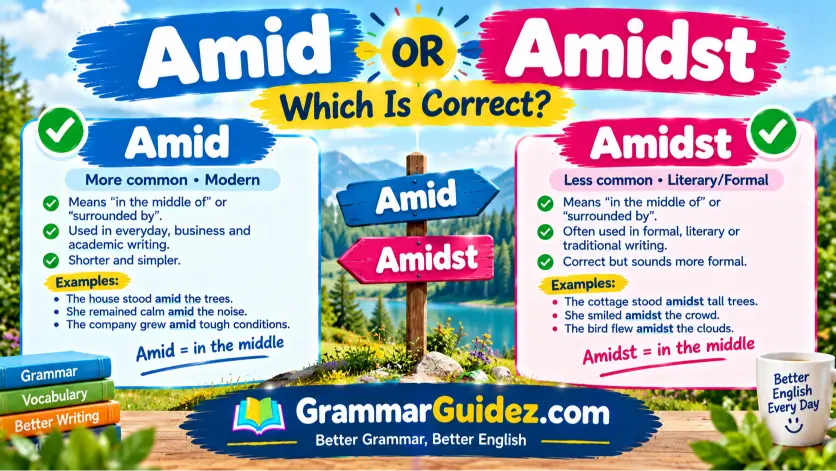
“Amid” and “Amidst” are both correct words, and they have the same basic meaning. Amid in the middle of or surrounded by something. Amidst the same as “amid,” but it can sound a little more formal or literary
Amidst and amid are both correct English words. They have almost the same meaning and are used in very similar ways.
The main difference is style and frequency. Amid is more common in modern English, while amidst can sound more literary, formal, or traditional.
Both words mean “in the middle of,” “surrounded by,” or “during a particular situation.”
For example:
- The house stood amid the trees.
- The house stood amidst the trees.
Both sentences are correct.
Quick Answer: Amidst or Amid?
Amid and amidst are both correct.
| Word | Correct? | Meaning | Style |
| Amid | ✅ Yes | In the middle of; surrounded by | More common |
| Amidst | ✅ Yes | In the middle of; surrounded by | More literary/formal |
If you want the more common and simple choice, use amid.
If you want a slightly more literary or traditional style, amidst can work well.
What Does “Amid” Mean?
Amid is a preposition. It means in the middle of something or surrounded by something.
It can describe a physical place or a situation.
Examples of Amid
- The cottage stood amid green trees.
- She remained calm amid the noise.
- The team celebrated amid loud cheers.
- He worked amid many distractions.
- The announcement came amid growing concerns.
In these sentences, amid shows that something happens while surrounded by another thing or situation.
What Does “Amidst” Mean?
Amidst is also a preposition. It has almost the same meaning as amid.
It means in the middle of, surrounded by, or during something.
Examples of Amidst
- The house stood amidst tall trees.
- She smiled amidst the crowd.
- He remained calm amidst the confusion.
- The bird flew amidst the clouds.
- They continued working amidst the difficulties.
The meaning is essentially the same as amid.
Amid vs. Amidst: The Main Difference
The biggest difference is not meaning. It is style and usage.
Amid is generally more common in everyday and modern writing.
Amidst is also correct, but it can sound more formal, literary, or old-fashioned.
Compare these sentences:
The school opened amid celebrations.
The school opened amidst celebrations.
Both are correct. The first sentence sounds more direct and modern. The second can sound slightly more literary.
Is “Amid” More Common Than “Amidst”?
Yes. Amid is generally more common in modern English.
You will often see amid in:
- News articles
- Business writing
- Academic writing
- Formal reports
- Everyday English
- Professional communication
Amidst is still widely understood and used, especially when a writer wants a more literary or expressive tone.
Simple Tip
If you are unsure which word to use, amid is usually the safer and more natural choice.
Are Amid and Amidst Prepositions?
Yes.
Both amid and amidst normally function as prepositions.
They are followed by a noun or noun phrase.
Examples
- amid the noise
- amidst the crowd
- amid the confusion
- amidst the trees
- amid the crisis
The basic structure is:
amid + noun
or
amidst + noun
Examples
- She stood amid the crowd.
- She stood amidst the crowd.
Both are grammatically correct.
Amid or Amidst in Everyday English
For normal everyday English, amid is often the simpler choice.
Examples
- He stayed calm amid the noise.
- We walked amid the trees.
- She worked amid the chaos.
- The decision was made amid growing pressure.
You can replace amid with amidst in these examples without changing the basic meaning.
However, amidst may make the sentence sound slightly more formal or poetic.
Amid or Amidst in Formal Writing
Both words can be used in formal writing.
However, amid is especially common in professional and news-style writing because it is short and direct.
Business Example
The company expanded amid strong market demand.
Academic Example
The study was conducted amid growing interest in the topic.
News Example
The announcement came amid rising concerns.
You can also use amidst:
The announcement came amidst rising concerns.
This is grammatically correct, but amid often sounds more concise.
When to Use “Amid”
Use amid when you want to say that something happens:
- In the middle of something
- While surrounded by something
- During a situation
- Among a group or environment
Examples
Physical surroundings:
The cabin stood amid tall mountains.
A crowd:
She walked amid the people.
A difficult situation:
He remained hopeful amid the difficulties.
A changing situation:
The company grew amid economic uncertainty.
When to Use “Amidst”
Use amidst when you want the same basic meaning but prefer a more literary, expressive, or traditional tone.
Examples
The flowers bloomed amidst the ruins.
The child played amidst the falling leaves.
She found peace amidst the noise.
The castle stood amidst the hills.
These sentences are correct, but the use of amidst can give the writing a more descriptive feel.
Can “Amid” and “Amidst” Be Used Interchangeably?
In most situations, yes.
For example:
The village was located amid the mountains.
and:
The village was located amidst the mountains.
Both mean that the village was surrounded by or situated in the middle of the mountains.
Another example:
She remained calm amid the chaos.
She remained calm amidst the chaos.
Again, the meaning stays almost the same.
The main difference is tone, not meaning.
Amidst or Amid: Which Sounds More Natural?
This depends on the sentence and your audience.
For modern, simple, and direct English, amid is usually the better choice.
For literary, poetic, or expressive writing, amidst can sound natural.
Compare
Simple and direct:
The house stood amid the trees.
More literary:
The house stood amidst the trees.
Neither sentence is wrong.
Common Mistakes With Amid and Amidst
Mistake 1: Thinking “Amidst” Is Incorrect
Some learners think amid is correct and amidst is wrong.
That is not true.
Both are standard English words.
❌ Amidst is always wrong.
✅ Amidst is correct.
Mistake 2: Thinking They Have Different Meanings
The two words have almost the same meaning.
❌ Amid means one thing, while amidst means something completely different.
✅ Amid and amidst usually mean in the middle of or surrounded by.
Mistake 3: Using “Amid” Without a Suitable Noun
Both words normally introduce a noun or noun phrase.
For example:
✅ She remained calm amid the confusion.
✅ She walked amidst the crowd.
A noun or noun phrase usually follows the preposition.
Mistake 4: Using “Amidst” Only Because It Sounds Fancy
Some writers use amidst when amid would be clearer and more natural.
For simple professional writing, you usually do not need the longer form.
Instead of:
The company continued its work amidst increasing pressure.
You can simply write:
The company continued its work amid increasing pressure.
Both are correct, but the second is more concise.
Amid vs. Amidst Examples
Here are several examples showing how both words work.
Example 1
Amid:
The children played amid the flowers.
Amidst:
The children played amidst the flowers.
Example 2
Amid:
She remained calm amid the confusion.
Amidst:
She remained calm amidst the confusion.
Example 3
Amid:
The building stood amid tall trees.
Amidst:
The building stood amidst tall trees.
Example 4
Amid:
The news arrived amid growing concerns.
Amidst:
The news arrived amidst growing concerns.
Example 5
Amid:
He found peace amid the noise.
Amidst:
He found peace amidst the noise.
The basic meaning remains the same in each pair.
Is “Amidst” More British Than “Amid”?
It is better not to treat amidst as simply a British spelling of amid.
Both words are used in different varieties of English.
The main difference is usually style and frequency, not a strict American-versus-British spelling rule.
So this is not like:
- color / colour
- recognize / recognise
- center / centre
Instead:
amid = common modern form
amidst = also correct, often more literary or formal
Amid or Amidst in Academic Writing
Both can appear in academic writing.
However, academic writers often prefer clear and concise language.
For example:
The research was conducted amid significant changes in the industry.
This is clear and direct.
You can also write:
The research was conducted amidst significant changes in the industry.
This is grammatically correct, but amid may feel more concise.
For academic writing, focus more on clarity than on choosing the longer word.
Amid or Amidst in Business Writing
Amid is often a good choice for business writing.
Examples
The company grew amid strong demand.
The business expanded amid difficult market conditions.
The new product launched amid intense competition.
Amidst is also possible, but it may sound slightly more literary.
For reports, emails, and professional documents, amid is usually a simple choice.
Amid vs. Among
Do not confuse amid with among.
They can sometimes have similar meanings, but they are not always interchangeable.
Among usually refers to being part of or surrounded by a group of people or things.
She sat among her friends.
Amid often emphasizes being in the middle of a situation, environment, or surrounding condition.
She remained calm amid the confusion.
Simple Difference
Among = in a group
Amid = in the middle of a situation or surrounding condition
However, context can overlap.
Easy Memory Trick
Here is an easy way to remember these words:
Amid = In the middle
Think:
AMID = IN THE MIDDLE
Amidst = Amid + ST
Think of amidst as a slightly longer version of amid.
Both carry the idea of being in the middle of something.
If you are writing simple modern English and cannot decide, choose amid.
Quick Comparison Table
| Feature | Amid | Amidst |
| Correct word? | ✅ Yes | ✅ Yes |
| Part of speech | Preposition | Preposition |
| Basic meaning | In the middle of | In the middle of |
| Meaning difference | Almost none | Almost none |
| Modern usage | Very common | Less common |
| Style | Direct and common | Literary/formal |
| American English | Used | Used |
| British English | Used | Used |
| Suitable for formal writing | Yes | Yes |
| Suitable for everyday writing | Yes | Yes |
Quick Quiz: Amid or Amidst?
Choose the word that best completes each sentence.
- The house stood ___ the trees.
- She remained calm ___ the confusion.
- The company grew ___ difficult conditions.
- The children played ___ the flowers.
- He found peace ___ the noise.
Answers
All of these sentences can use either amid or amidst.
For example:
The house stood amid the trees.
or:
The house stood amidst the trees.
Both are correct.
FAQs
Is “amidst” a correct word?
Yes. Amidst is a correct standard English word. It generally means the same as amid.
Is “amid” or “amidst” more common?
Amid is generally more common in modern English. Amidst is also correct but can sound more literary or formal.
Do amid and amidst have the same meaning?
Yes. In most contexts, they mean in the middle of, surrounded by, or during something.
Is amidst more formal than amid?
Amidst can sound more formal, literary, traditional, or poetic. However, it is not wrong to use it in ordinary writing.
Can I use amidst in academic writing?
Yes. Amidst is grammatically correct in academic writing. However, amid may be preferred when you want concise and direct language.
Is amid a preposition?
Yes. Amid is normally used as a preposition.
Is amidst a preposition?
Yes. Amidst is also normally used as a preposition.
Which should I use: amid or amidst?
If you want a simple and common choice, use amid. If you prefer a more literary or traditional tone, amidst is also correct.
Final Verdict: Amidst or Amid?
Amid and amidst are both correct.
They have almost the same meaning and can often be used in the same sentence.
The main difference is style and frequency. Amid is more common and direct, while amidst can sound more literary, formal, or traditional.
Remember:
Amid = correct and common
Amidst = correct and more literary/formal
So, if you are writing an email, article, report, or everyday sentence and want the simplest option, amid is usually a good choice.
But if you use amidst, you are not making a spelling or grammar mistake.
Read More Articles:

I am Evan Whitmore, an English language writer and the person who started GrammarGuidez.com. I made GrammarGuidez.com to make grammar, spelling, vocabulary and words that are often confused easier to understand.
I like taking to understand English words and grammar rules and turning them into simple and clear explanations. My aim is to help students, writers, bloggers, ESL learners and regular English speakers feel more sure when they write and talk.
At GrammarGuidez.com I work on real life examples easy to understand explanations comparing words, spelling changes and how American English is used every day.
I think learning English doesn’t need to be hard. A good explanation and some good examples can make tough grammar topics much simpler to learn