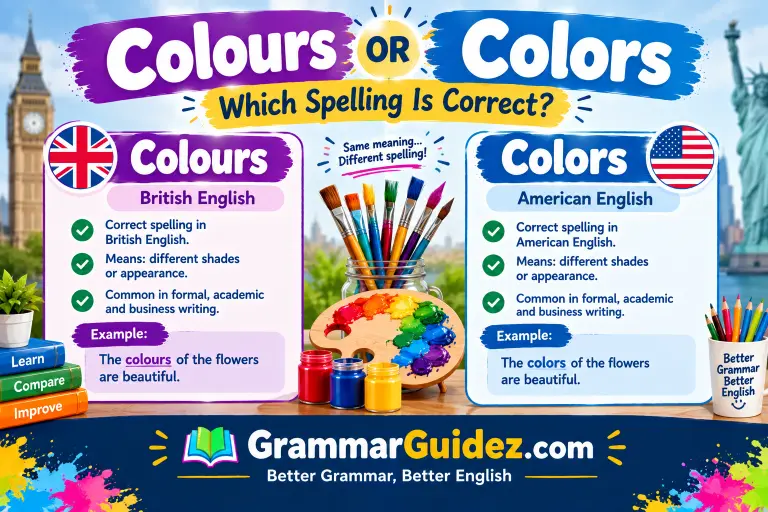
“Colours” and “Colors” are both correct spellings, but they are used in different English styles. Colors is preferred in American English 🇺🇸. Colours is preferred in British English 🇬🇧. Both mean the same thing: the appearance of something based on the light it reflects
If you are confused about colours or colors, you are not alone. Both spellings are correct.
The difference is based on British and American English.
Colors is the standard spelling in American English.
Colours is the standard spelling in British English and other varieties of English that follow British spelling.
Both words have the same meaning. They refer to the different shades that we see, such as red, blue, green, yellow, and black.
For example:
- The colors of the flag are red, white, and blue. 🇺🇸
- The colours of the flag are red, white, and blue. 🇬🇧
Both sentences are correct.
The only main difference is the spelling.
In this guide, you will learn the difference between colours and colors, when to use each spelling, how they are pronounced, common mistakes, examples, and an easy way to remember the correct spelling.
Quick Answer: Colours or Colors?
Colours and colors are both correct spellings.
- Colors = American English
- Colours = British English
| Spelling | English Variety | Correct? |
| Colors | American English | ✅ Yes |
| Colours | British English | ✅ Yes |
The meaning is the same.
If you write for an American audience, use colors.
If you write for a British audience, use colours.
What Does Color Mean?
Color is a noun that describes the appearance of something based on the way it reflects or absorbs light.
Common colors include:
- red
- blue
- green
- yellow
- orange
- purple
- pink
- black
- white
- brown
In American English, the word is spelled color.
For example:
My favorite color is blue.
The room has a bright color scheme.
She likes the color of the dress.
The plural form is colors.
The artist used many different colors.
What Does Colour Mean?
Colour has the same meaning as color.
The difference is that colour is the British English spelling.
For example:
My favorite colour is blue.
The room has a bright colour scheme.
She likes the colour of the dress.
The plural form is colours.
The artist used many different colours.
So, there is no difference in meaning between color and colour.
Colours vs Colors
The main difference between colours and colors is the letter u.
American English
color
colors
British English
colour
colours
American English removes the u.
British English keeps the u.
This spelling pattern also appears in other words, such as:
- color → colour
- favorite → favourite
- honor → honour
- humor → humour
- behavior → behaviour
These differences are common between American and British English.
Colors in American English
Colors is the normal plural spelling in American English.
American writers usually use:
color
colors
For example:
The colors of the sunset were beautiful.
What are your favorite colors?
The website uses bright colors.
The artist mixed several colors.
If your website targets readers in the United States, colors is usually the better choice.
Colours in British English
Colours is the normal plural spelling in British English.
British writers usually use:
colour
colours
For example:
The colours of the sunset were beautiful.
What are your favourite colours?
The website uses bright colours.
The artist mixed several colours.
If your website follows British English, use colours.
Is Colors American or British?
Colors is the standard American English spelling.
American English usually drops the u found in the British spelling.
For example:
The school logo has three colors.
These colors look great together.
I like bright colors.
The singular form is color.
Is Colours American or British?
Colours is the standard British English spelling.
It is also common in other English varieties influenced by British spelling.
For example:
The school logo has three colours.
These colours look great together.
I like bright colours.
The singular form is colour.
Do Colours and Colors Mean the Same Thing?
Yes.
Colours and colors have exactly the same basic meaning.
They refer to the visual properties of objects and things.
For example:
American English:
The colors of the flowers are beautiful.
British English:
The colours of the flowers are beautiful.
The meaning does not change.
Only the spelling changes.
Colours or Colors Pronunciation
Colours and colors are normally pronounced the same way.
The pronunciation is roughly:
KUL-erz
The letter u in colours does not create a different pronunciation.
This makes colours and colors another example of a spelling difference between English varieties.
You may hear the word many times before you ever see it written.
When you see the spelling, the extra u can tell you which English style the writer is using.
Colours or Colors in a Sentence
Both spellings can be used in the same types of sentences.
American English
The colors of the painting are bright.
British English
The colours of the painting are bright.
Another example:
American English
She chose her favorite colors for the design.
British English
She chose her favourite colours for the design.
Notice that British English may change more than one word in the same sentence.
favorite → favourite
colors → colours
Common Phrases With Colors and Colours
The word color/colour appears in many common phrases.
Favorite colors / favourite colours
Blue and green are my favorite colors.
Blue and green are my favourite colours.
Bright colors / bright colours
The painting uses bright colors.
The painting uses bright colours.
Dark colors / dark colours
She prefers dark colors.
She prefers dark colours.
Colors of the rainbow / colours of the rainbow
We learned about the colors of the rainbow.
We learned about the colours of the rainbow.
Different colors / different colours
The store sells shirts in different colors.
The store sells shirts in different colours.
Color vs Colour as a Verb
Color and colour can also be used as verbs.
As a verb, they mean to add color to something.
American English:
The children will color the picture.
British English:
The children will colour the picture.
The spelling changes in the same way.
American English
color
colored
coloring
British English
colour
coloured
colouring
For example:
She colored the picture yesterday.
British:
She coloured the picture yesterday.
Both forms are correct in their respective spelling systems.
Color vs Colour as an Adjective
The word can also appear in phrases that describe something related to color.
For example:
The color wheel shows different shades.
British:
The colour wheel shows different shades.
Some words and phrases may use color as part of a larger term.
The same British-American spelling difference often remains.
Colours vs Colors in Formal Writing
Both spellings are correct in formal writing.
The important thing is to choose the spelling that matches your English style.
If you are writing an American English article, use:
colors
If you are writing a British English article, use:
colours
For example, a US publication may write:
The study examined the effects of different colors on people.
A British publication may write:
The study examined the effects of different colours on people.
Neither sentence is wrong.
Common Mistakes With Colours and Colors
Mistake 1: Thinking Colours Is Wrong
Some American English learners may think colours is misspelled.
It is not.
Colours is the standard British spelling.
Mistake 2: Thinking Colors Is Wrong
Some British English learners may think colors is incorrect.
It is not.
Colors is the standard American spelling.
Mistake 3: Mixing Both Spellings
A writer may use colors in one section and colours in another.
This is not normally a grammar mistake, but it can make the article look inconsistent.
Try to use one spelling style throughout the same piece of writing.
Mistake 4: Changing the Meaning
Some learners think colour and color have different meanings.
They do not.
They have the same meaning.
The difference is mainly regional spelling.
Colours or Colors: American vs British English
Here is a simple comparison:
| Feature | Colors | Colours |
| English variety | American | British |
| Singular | Color | Colour |
| Plural | Colors | Colours |
| Verb | Color | Colour |
| Past form | Colored | Coloured |
| -ing form | Coloring | Colouring |
| Meaning | Same | Same |
| Pronunciation | Usually the same | Usually the same |
| Extra letter | No “u” | Includes “u” |
Colours or Colors in Different Countries
English spelling can vary around the world.
Colors is strongly associated with American English.
Colours is commonly used in British English and in several countries where British spelling has traditionally been influential.
You may therefore see:
- colors in the United States
- colours in the United Kingdom
- colours in many British-style English contexts
- colors in American-style English contexts
Different countries and organizations may have their own preferred style.
When writing professionally, follow the style guide used by your school, company, publisher, or website.
Which Spelling Should You Use?
The best spelling depends on your audience.
Use “Colors” if:
- Your audience is mainly American.
- Your website uses American English.
- Your company follows US spelling.
- You are writing for a US publication.
- Your style guide requires American spelling.
Use “Colours” if:
- Your audience is mainly British.
- Your website uses British English.
- Your company follows UK spelling.
- You are writing for a British publication.
- Your style guide requires British spelling.
For a Global Audience
Both forms are widely understood.
However, it is better to choose one spelling style and use it consistently.
For example, if you choose British English, you may also use:
- favourite
- behaviour
- honour
- colour
If you choose American English, you may use:
- favorite
- behavior
- honor
- color
Consistency makes your writing look more professional.
Easy Memory Trick for Colors or Colours
Here is a simple trick:
🇺🇸 American English = Colors
Think:
American English = shorter spelling
COLOR → COLORS
🇬🇧 British English = Colours
Think:
British English = keeps the U
COLOUR → COLOURS
So remember:
Colors = American 🇺🇸
Colours = British 🇬🇧
The extra u is the easiest clue.
Colours or Colors: Examples
American English Examples
- The colors of the flowers are beautiful.
- Blue is one of my favorite colors.
- The artist used bright colors.
- These colors look good together.
- The flag has three colors.
- She likes warm colors.
- The room has soft colors.
- The children mixed different colors.
- The design uses several colors.
- The sunset showed many colors.
British English Examples
- The colours of the flowers are beautiful.
- Blue is one of my favourite colours.
- The artist used bright colours.
- These colours look good together.
- The flag has three colours.
- She likes warm colours.
- The room has soft colours.
- The children mixed different colours.
- The design uses several colours.
- The sunset showed many colours.
The meaning is the same in all of these examples.
Colours or Colors: Quick Test
Choose the correct spelling for each sentence based on the English variety.
1. American English
The artist used bright ______ in the painting.
Answer: colors
2. British English
The artist used bright ______ in the painting.
Answer: colours
3. American English
Blue is my favorite ______.
Answer: color
4. British English
Blue is my favourite ______.
Answer: colour
5. American English
The children ______ the picture.
Answer: colored
6. British English
The children ______ the picture.
Answer: coloured
FAQs About Colours or Colors
Is colours or colors correct?
Both are correct. Colors is the American English spelling, while colours is the British English spelling.
Is colors American or British?
Colors is the standard American English spelling.
Is colours British or American?
Colours is the standard British English spelling.
Do colors and colours mean the same thing?
Yes. They have the same meaning. The difference is mainly the spelling used in different English varieties.
Why does British English use colour?
British English traditionally keeps the u in words such as colour, while American English commonly uses the shorter form color.
Why does American English use color?
American English commonly uses the shorter spelling color, without the u found in colour.
How do you spell colors in the UK?
In British English, the spelling is colours.
How do you spell colors in the US?
In American English, the spelling is colors.
Are colours and colors pronounced differently?
Usually no. They are normally pronounced the same way.
Which spelling should I use for my website?
Choose the spelling that matches your target audience. Use colors for American English and colours for British English.
Colours or Colors: Final Verdict
So, colours or colors which spelling is correct?
Both are correct.
The difference comes from British and American English spelling.
Colors is the standard American spelling.
Colours is the standard British spelling.
Both words have the same meaning and are normally pronounced the same way.
For example:
American English:
The colors of the flowers are beautiful.
British English:
The colours of the flowers are beautiful.
The meaning does not change.
If you are writing for American readers, use colors.
If you are writing for British readers, use colours.
Most importantly, stay consistent with your chosen English style.
Remember:
Colors = American English 🇺🇸
Colours = British English 🇬🇧
Same meaning. Different spelling.
Read More Articles:

I am Elliot Hartwell, an English language writer and the author at GrammarGuidez.com. For the 6 years I have been working with English grammar, vocabulary, spelling and everyday language usage with a focus on making confusing topics easier to understand.
I started GrammarGuidez.com with a goal: to give readers clear and practical answers to common English questions. English can sometimes be confusing especially when two words look or sound similar but have meanings or uses. I enjoy breaking down these differences in a way that’s simple and easy to remember.
I believe learning English should feel simple not overwhelming. My goal is to make every article on GrammarGuidez.com useful, for students, writers, bloggers, teachers and anyone who wants to communicate clearly in English.