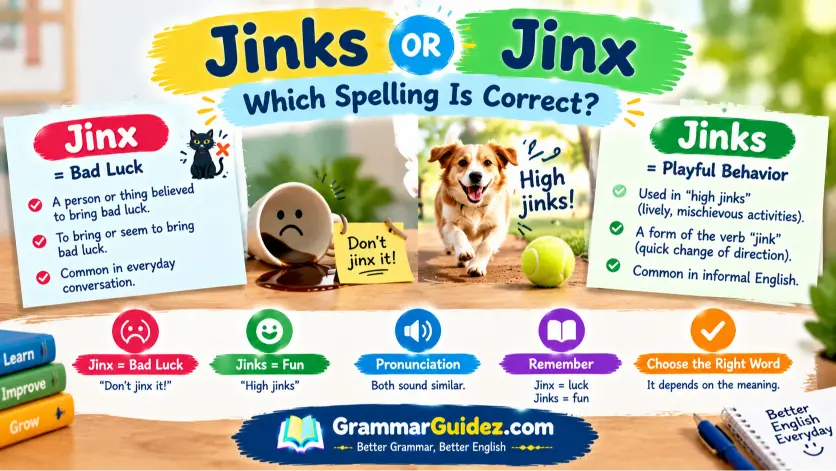
“Jinks or Jinx: Jinx is the standard spelling, meaning bad luck or a person or thing believed to bring bad luck. Jinks is less common and usually appears in names or specific expressions”.
Have you ever wanted to say that something might bring bad luck, but stopped because you were unsure if to write jinks or jinx? These words look almost the same and sound very similar. However, they do not usually have the same meaning. Choosing the wrong one can make your sentence confusing or incorrect.
The word jinx is the standard choice when you talk about bad luck, a person or thing believed to cause bad luck, or an action that might bring misfortune. You may hear someone say, “Do not jinx it!” when they do not want to risk ruining a good situation.
The word jinks has different uses. It commonly appears in the expression high jinks, which means playful, noisy, or mischievous behavior. It can also be a form of the less common verb jink, meaning to move quickly while changing direction.
In this guide, you will learn the meanings, differences, spelling rules, and correct uses of both words.
Read More: Wellcome or Welcome: Which Is Correct?
Quick Answer: Jinks or Jinx?
Jinx is the correct word when you mean bad luck, something believed to cause bad luck, or the act of bringing bad luck to a situation.
Jinks is a different word. It most commonly appears in the expression high jinks, which describes lively, playful, or mischievous activity. It can also be the plural of jink or a verb form of jink.
Remember this simple rule:
- Jinx: Bad luck or bringing bad luck.
- Jinks: Playful activity, especially in “high jinks,” or a form of jink.
For example, “I hope I do not jinx the game” is correct when talking about bad luck. “The children got into high jinks” is correct when describing playful behavior.
What Does Jinx Mean?
Jinx is a noun and a verb. It is commonly used in everyday English, especially when people talk about luck, success, games, plans, and unexpected problems.
As a noun, a jinx is a person, thing, or situation believed to bring bad luck. People may use the word seriously when discussing superstitions or playfully when something goes wrong.
As a verb, jinx means to bring or seem to bring bad luck to someone or something. People often use it when they want to avoid making a prediction that might not come true.
Examples of Jinx as a Noun
- Everyone thought the old car was a jinx.
- He jokingly called himself a jinx because his team kept losing.
- The team believed its losing streak was caused by a jinx.
- She felt that the broken watch was a jinx.
- They blamed the jinx for their bad luck.
Examples of Jinx as a Verb
- Do not jinx our chances of winning.
- I hope I did not jinx the interview.
- Talking about success too early might jinx the plan.
- He did not want to jinx their good luck.
- She joked that mentioning the rain had jinxed the picnic.
In these sentences, jinx relates to bad luck or the belief that something could cause an unlucky result. It is also common in lighthearted conversation, so using the word does not mean someone must believe in curses or supernatural forces.
What Does Jinks Mean?
Jinks is a real English word, but it is not a standard alternative spelling of jinx when you mean bad luck.
One common use is in the expression high jinks. This phrase describes playful, lively, noisy, or sometimes mischievous behavior. It is often used when people are having fun or acting in a slightly wild way.
The word jinks also has a grammatical connection to jink. The verb jink means to make a quick or sudden turn, especially to avoid something or change direction. The form jinks can be used with a singular subject in the present tense.
Examples of Jinks in Sentences
- The party was full of high jinks.
- The children enjoyed their high jinks during the holiday.
- The film follows a group of friends and their silly high jinks.
- The football player jinks past a defender.
- The cyclist jinks to avoid an obstacle.
These examples show that the meaning depends on the context. In the first three sentences, jinks appears in the expression high jinks. In the final two, it is a verb form of jink, describing a sudden change of direction.
If you are talking about bad luck, do not use jinks as a replacement for jinx.
Jinks vs. Jinx: Main Differences
Although the words sound alike, their meanings and grammatical uses are different.
| Feature | Jinx | Jinks |
| Main meaning | Bad luck or something believed to cause bad luck | Playful activity or a form of jink |
| Part of speech | Noun and verb | Usually a noun in “high jinks”; also a verb form of jink |
| Common expression | “Don’t jinx it” | “High jinks” |
| Related forms | Jinxed, jinxing, jinxes | Jink, jinks |
| Use for bad luck | Yes | No |
| Use for playful behavior | No, not usually | Yes, especially in “high jinks” |
| Formal writing | Standard for the meaning of bad luck | Correct in its specific meanings |
| Regional spelling difference | Not an American-only spelling | Not simply a British spelling of jinx |
The most important difference is meaning. Jinx is the word for bad luck, while jinks is used for playful behavior or in connection with the verb jink.
Why Do People Confuse Jinks and Jinx?
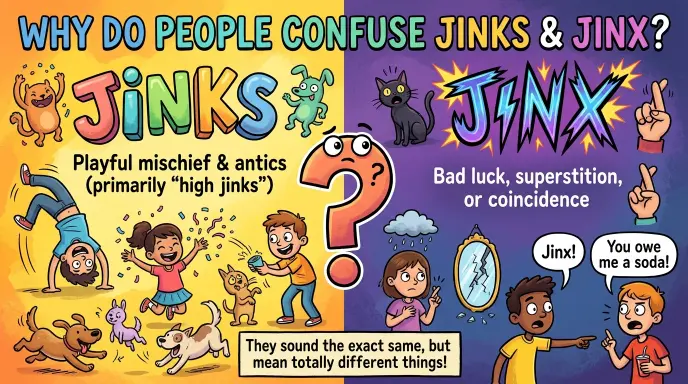
People often confuse these words because their pronunciation is very similar. In fact, jinks and jinx are pronounced alike in many varieties of English.
There are several reasons why this confusion happens.
1. The Words Sound Almost Identical
When people hear a word rather than read it, they may not know which letters to use. The final sounds of jinks and jinx are very similar, so the difference is easy to miss.
Someone who hears “Don’t jinx it” might later write “Don’t jinks it” because the spelling is not clear from the sound alone.
2. The Phrase “High Jinks” Is Familiar
Many English speakers know the expression high jinks but do not use the word jinks on its own very often. When they see jinx, they may assume it is another spelling of the familiar word.
However, the two words serve different purposes. High jinks refers to lively or mischievous behavior, while jinx relates to bad luck.
3. Both Words Can Appear in Everyday Conversation
People use jinx in casual speech when they are talking about plans, sports, exams, or good fortune. They use high jinks when describing fun or playful behavior.
Because both words occur in informal situations, learners may assume they are interchangeable. They are not.
4. English Spelling Does Not Always Match Pronunciation
English has many words that sound alike but have different spellings and meanings. These words can be difficult for learners because pronunciation alone may not help them choose the correct form.
The easiest solution is to identify what you want to say. If the meaning is bad luck, use jinx. If you mean playful behavior, use jinks in the appropriate expression.
How to Use Jinx Correctly
The word jinx is flexible because it can function as both a noun and a verb.
As a noun, it refers to bad luck or something believed to cause it. As a verb, it describes an action that someone believes could bring bad luck.
Jinx as a Noun
Use jinx when you are naming a source of bad luck or a situation associated with misfortune.
- He believes that the old house is a jinx.
- The team joked that its new uniform was a jinx.
- She called the broken computer a jinx.
The word can be used seriously, but it is often humorous. A person may call something a jinx simply because several unlucky events happened close together.
Jinx as a Verb
Use jinx when you mean to bring or seem to bring bad luck to something.
- Do not jinx the match by celebrating too early.
- I hope I have not jinxed our plans.
- She thought she had jinxed the trip by talking about problems.
- He did not want to jinx his chances of getting the job.
This verb is common in everyday English. It often expresses a superstition or a playful fear rather than a proven cause of bad luck.
What Does “Don’t Jinx It” Mean?
“Don’t jinx it” is a common expression. People say it when they do not want someone to talk too confidently about a good result before it happens.
For example, a person might say, “We are definitely going to win.” Another person may reply, “Don’t jinx it!”
The second person is asking them not to tempt fate by making a confident prediction. The expression does not prove that words can cause bad luck. It simply reflects a common superstition and a familiar way of speaking.
The phrase is often used during sports matches, job interviews, exams, trips, and other important events.
Remember that “Don’t jinx it” is correct, while “Don’t jinks it” is incorrect for this meaning.
What Does “High Jinks” Mean?
High jinks is an expression that means lively, playful, noisy, or mischievous activity. It can describe people having fun, playing tricks, or behaving in a silly way.
The phrase is often used when the activity is energetic or slightly wild, but not necessarily harmful.
For example, a writer might describe a group of friends enjoying high jinks during a weekend trip. The phrase suggests fun and mischief rather than bad luck.
Common Uses of High Jinks
The expression can describe:
- Playful behavior at a party.
- Silly activities among friends.
- Mischievous behavior during a holiday.
- Fun and noisy activities during a celebration.
- Humorous incidents in a story or film.
The word high in this expression does not mean that something is physically high. Together, the words form an established expression.
When discussing lively or mischievous behavior, use high jinks, not high jinx, in standard usage.
Is Jinks Ever Correct?
Yes. It would be inaccurate to say that jinks is always wrong.
The word is correct in established expressions such as high jinks. It can also be the plural of jink or the third-person singular form of the verb jink.
For example, in “The player jinks to the left,” the word describes a quick change of direction. It is not related to bad luck.
However, if you are writing about a curse, bad luck, or the act of bringing bad luck, the correct word is jinx.
This distinction matters because spelling corrections should depend on the intended meaning. A spelling tool might flag an unfamiliar use, but that does not automatically make the word incorrect in every context.
Jinxed, Jinxing, and Jinxes: Related Word Forms
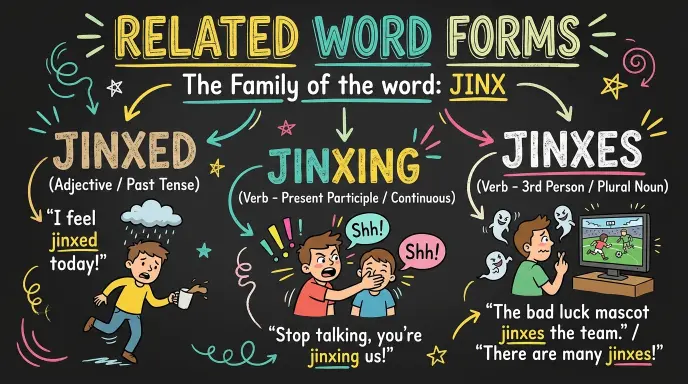
Learning related forms can help you use jinx more confidently.
Jinxed
Jinxed is the past tense and past participle of the verb jinx. It can also work as an adjective to describe someone or something believed to be affected by bad luck.
Example: The team felt jinxed after losing several matches.
Jinxing
Jinxing is the -ing form of the verb. It describes the act of bringing or seeming to bring bad luck.
Example: She joked that talking about the prize was jinxing their chances.
Jinxes
Jinxes is the usual plural form of the noun jinx. It can refer to more than one person, thing, or situation believed to bring bad luck.
Example: The story includes several strange jinxes.
Do not form these words by adding letters to jinks. The forms jinxed, jinxing, and jinxes belong to the word jinx.
Is Jinks the British Spelling of Jinx?
No. Jinks is not simply the British spelling of jinx.
The word jinx is used in both British and American English when talking about bad luck or bringing bad luck. Similarly, high jinks is an established expression in English, not a spelling reserved for one country.
The difference is mainly about meaning and grammar, rather than nationality.
A British writer can use jinx to describe bad luck. An American writer can use high jinks to describe playful behavior. Both forms are understood in standard English.
If you are unsure which one to use, focus on the meaning rather than the country of your audience.
Common Mistakes to Avoid
Mistake 1: Writing “Don’t Jinks It”
This is incorrect when the intended meaning is “do not bring bad luck.”
Correct form: Don’t jinx it.
Mistake 2: Using “Jinx” in “High Jinks”
The established expression is high jinks, which describes lively or mischievous behavior.
Correct form: The children were enjoying high jinks.
Mistake 3: Treating Jinks as a Variant Spelling of Jinx
The two words have different meanings and uses. Jinks is not the standard spelling of jinx.
Better approach: Learn the meaning of each word and choose it based on the sentence.
Mistake 4: Spelling the Past Tense Incorrectly
The past tense of jinx is jinxed, not jinksed.
Correct form: I hope I did not jinx our chances.
Mistake 5: Assuming Jinks Is Never a Real Word
Although jinks is wrong for the usual meaning of bad luck, it is correct in certain expressions and grammatical forms.
Better approach: Check the meaning before deciding that a word is incorrect.
Easy Ways to Remember the Difference
You can remember these words with two simple ideas.
Jinx = bad luck. Think of the familiar expression “Don’t jinx it!” Whenever you are talking about bad luck or trying not to tempt fate, choose jinx.
Jinks = high jinks. Connect the word with playful behavior, silly activities, and mischief. This will help you remember its most familiar use.
You can also remember the spelling by looking at the final letter. Jinx ends in x, while jinks ends in ks. The spellings may look similar, but their meanings are different.
If you are still unsure, ask yourself what your sentence means. If you can replace the word with “bring bad luck,” use jinx.
Fill in the Blanks
Complete each sentence with the correct word or word form.
- Do not ______ our chances of winning by celebrating too early.
- The children were full of ______ during the holiday.
- She hoped she had not ______ the interview by talking about success.
- The football player ______ quickly to avoid the defender.
- The plural of jinx is ______.
Answers
- Jinx
- High jinks
- Jinxed
- Jinks
- Jinxes
Mini Quiz
Choose the correct answer for each question.
1. Which word means bad luck or something believed to bring bad luck?
A. Jinks
B. Jinx
C. Jink
D. Jinking
Answer: B. Jinx
2. What does “high jinks” mean?
A. Bad weather
B. A serious problem
C. Playful or mischievous behavior
D. A lucky charm
Answer: C. Playful or mischievous behavior
3. Which sentence is correct?
A. Don’t jinks the game.
B. Don’t jinx the game.
C. Don’t jinksed the game.
D. Don’t jinxes the game.
Answer: B. Don’t jinx the game.
4. What is the past tense of “jinx”?
A. Jinksed
B. Jinxing
C. Jinxed
D. Jinks
Answer: C. Jinxed
5. Is “jinks” always an incorrect word?
A. Yes, it is never correct.
B. Yes, it is only a spelling error.
C. No, it is used in “high jinks” and as a form of “jink.”
D. No, it is always another spelling of “jinx.”
Answer: C. No, it is used in “high jinks” and as a form of “jink.”
FAQs
1. Is it jinks or jinx?
Use jinx when you mean bad luck or bringing bad luck. Use jinks in expressions such as high jinks, meaning playful or mischievous behavior, or when using a form of jink.
2. Is jinks a real English word?
Yes. Jinks is a real word. It appears in the expression high jinks and can also be a form of jink. However, it is not the standard spelling for bad luck.
3. What does jinx mean in simple English?
A jinx is something or someone believed to bring bad luck. As a verb, jinx means to bring or seem to bring bad luck to a person, plan, or situation.
4. What does high jinks mean?
High jinks means lively, playful, noisy, or mischievous behavior. It often describes people having fun or doing silly things.
5. Is “Don’t jinx it” correct?
Yes. “Don’t jinx it” is a common and correct expression used when someone does not want to risk bad luck or tempt fate.
6. Is “Don’t jinks it” correct?
No, not when you mean “do not bring bad luck.” The correct sentence is “Don’t jinx it.”
7. What is the past tense of jinx?
The past tense is jinxed. For example, “I think I jinxed our chances.” The -ing form is jinxing.
8. What is the plural of jinx?
The usual plural is jinxes. For example, “The characters in the story believe in several jinxes.”
9. Is jinx American or British English?
Jinx is used in both American and British English. It is not a word limited to one variety of English.
10. Can jinks mean quick movement?
Yes. Jinks can be the third-person singular form of jink, a verb meaning to make a quick or sudden change of direction. This is a less common use than the expression high jinks.
Conclusion
The difference between jinks and jinx becomes easy to understand when you focus on their meanings. Jinx is the standard word for bad luck, something believed to cause bad luck, or the act of bringing bad luck to a situation. It appears in common expressions such as “Don’t jinx it.”
Jinks has a different role. It commonly appears in high jinks, which describes playful, lively, or mischievous behavior. It can also be a grammatical form of the verb jink, which means to make a quick change of direction.
Neither word should automatically be treated as incorrect in every situation. The right choice depends on the meaning you want to express. Remember the simple rule: use jinx for bad luck and jinks for high jinks or the appropriate form of jink. This will help you choose the right word in everyday conversation, schoolwork, and professional writing.
Read More: Sherbert or Sherbet: Which Spelling Is Correct?

I am Evan Whitmore, an English language writer and the person who started GrammarGuidez.com. I made GrammarGuidez.com to make grammar, spelling, vocabulary and words that are often confused easier to understand.
I like taking to understand English words and grammar rules and turning them into simple and clear explanations. My aim is to help students, writers, bloggers, ESL learners and regular English speakers feel more sure when they write and talk.
At GrammarGuidez.com I work on real life examples easy to understand explanations comparing words, spelling changes and how American English is used every day.
I think learning English doesn’t need to be hard. A good explanation and some good examples can make tough grammar topics much simpler to learn