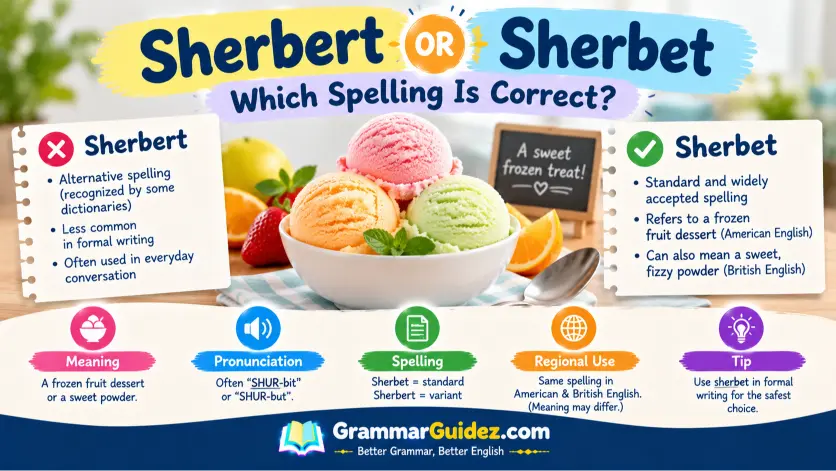
“Sherbet or Sherbert: Sherbet is the standard spelling for a frozen dessert made with fruit juice and usually some dairy. Sherbert is a common variant spelling and pronunciation, especially in American English”.
Imagine walking into an ice cream shop on a warm summer day. You want a cold, fruity dessert, so you look at the menu. One person calls it sherbet, while another calls it sherbert. Both people seem sure that their spelling is correct. This can make you wonder which word you should use.
The confusion between sherbert and sherbet is common because the words look and sound similar. The difference is just one extra letter, but that letter can cause questions in schoolwork, online searches, recipes, and everyday writing.
The standard spelling is sherbet. It refers to a frozen fruit dessert in American English and a sweet, fizzy powder in British English. However, some dictionaries recognize sherbert as a variant spelling of the same word. This means the longer form is not always treated as a simple spelling mistake.
In this guide, you will learn what both spellings mean, how they are pronounced, where the word comes from, and which form is best for formal writing.
Read More: Wellcome or Welcome: Which Is Correct?
Quick Answer: Sherbert or Sherbet?
Sherbet is the standard and most widely recommended spelling. In American English, it commonly refers to a frozen, fruit-flavored dessert that contains a small amount of dairy.
Sherbert is a recognized variant in some dictionaries, especially in American usage, but many style guides and dictionaries prefer sherbet.
If you are writing an essay, school assignment, recipe, or professional document, choose sherbet. It is the safest spelling to use when you want your writing to follow standard English conventions.
What Does Sherbet Mean?
Sherbet is a noun. Its meaning depends on the variety of English and the context in which it appears.
In American English, sherbet usually means a cold, sweet dessert made with fruit juice or fruit purée, sugar, and a small amount of milk, cream, or another dairy ingredient. It is often served in a bowl or cone.
In British English, sherbet commonly refers to a sweet, fruit-flavored powder. The powder may be eaten as candy or mixed with water to make a fizzy drink.
The word has also been used historically for sweet fruit drinks. Its meaning developed over time as the word traveled between languages and cultures.
Examples of Sherbet in Sentences
- We bought orange sherbet for dessert.
- My sister prefers raspberry sherbet to chocolate ice cream.
- The children enjoyed a bowl of rainbow sherbet.
- The shop sells lemon sherbet during the summer.
- In Britain, sherbet powder is a popular type of sweet.
These sentences show how sherbet can describe different sweet treats. The intended meaning depends on the country and the situation.
What Does Sherbert Mean?
Sherbert is an alternative spelling of sherbet. It is often used when speakers pronounce the word with an extra “r” sound.
Some English dictionaries recognize sherbert as a variant spelling. Other dictionaries and language guides describe it as a common misspelling or a nonstandard form. Therefore, its status can vary depending on the reference source.
In everyday conversation, people may say sherbert when they mean the frozen fruit dessert. Readers will usually understand what they mean. However, the spelling is less widely recommended than sherbet.
Examples of Sherbert in Sentences
- He asked for a scoop of sherbert.
- She called the orange dessert sherbert.
- My grandfather always says sherbert instead of sherbet.
- The family discussed if sherbert was an acceptable spelling.
These examples illustrate how the variant appears in everyday language. They do not mean that sherbert is the preferred spelling in formal writing.
When accuracy matters, use sherbet unless you are discussing the variant spelling itself or following a publication that accepts sherbert.
Sherbet vs. Sherbert: Main Differences
The two spellings generally refer to the same food or sweet product. The main difference is their spelling and their acceptance in standard written English.
| Feature | Sherbet | Sherbert |
| Spelling | Standard form | Variant form |
| General acceptance | Widely accepted | Accepted by some dictionaries |
| Meaning | A sweet or frozen fruit dessert, depending on region | Usually the same meaning as sherbet |
| Pronunciation | Often “SHUR-bit” or “SHUR-but” | Often “SHUR-bert” |
| Formal writing | Recommended | Usually best avoided |
| School assignments | Safest choice | May be marked nonstandard |
| Recipes and menus | Preferred spelling | May appear as a variant |
| Extra letter | No second “r” before the final syllable | Includes an extra “r” |
The table shows why sherbet is the better general choice. It is the standard form used by major dictionaries, while sherbert has a more mixed status.
Why Do People Confuse Sherbet and Sherbert?
There are several reasons why these words cause confusion.
1. People Add an Extra Sound
Some speakers naturally pronounce sherbet as if it contains an extra “r.” They may then use that sound when spelling the word.
This is a common kind of spelling confusion. People often write words the way they believe those words sound. However, pronunciation does not always provide a reliable guide to standard spelling.
2. The Words Look Almost Identical
The two forms share nearly all their letters. The only spelling difference is the extra “r” in sherbert.
When a word is familiar in speech but less familiar in writing, this small difference can easily go unnoticed.
3. The Variant Appears in Everyday Language
People may see sherbert on a menu, in an online discussion, or in a family recipe. Seeing a spelling used by others can make it seem equally standard.
However, common usage and preferred formal spelling are not always the same thing. A form can be familiar without being the best choice for every type of writing.
4. Dictionaries Do Not Always Label the Variant the Same Way
Some dictionaries list sherbert as an alternative spelling, while others identify it as a common misspelling.
This difference in dictionary treatment can create uncertainty. The practical solution is to use the standard spelling sherbet in formal writing.
How Do You Pronounce Sherbet?
The pronunciation of sherbet varies slightly among English speakers.
Cambridge Dictionary gives pronunciations that can be represented approximately as “SHUR-buht” in American English and “SHUR-buht” with a different vowel quality in British English. Many speakers also pronounce it closer to “SHUR-bit.”
The important point is that the standard spelling does not contain the extra letter r found in sherbert.
Is Sherbert a Different Pronunciation?
Often, yes. People who say sherbert may pronounce an additional “r” sound before the final syllable. This is one reason the alternative spelling has become familiar.
However, the pronunciation difference does not usually indicate a different dessert. In most conversations about frozen fruit treats, both forms refer to the same thing.
If you are learning English, practice the standard spelling and pronunciation together. Reading the word in reliable dictionaries and hearing its audio pronunciation can help you remember it.
Is Sherbert a Real Word?
This question does not have a simple yes-or-no answer because dictionaries treat the word differently.
Some dictionaries recognize sherbert as a variant of sherbet. For example, Merriam-Webster has been cited as accepting it as an alternative spelling. Other language authorities consider it a common misspelling and recommend sherbet instead.
For this reason, it is more accurate to say that sherbert is a recognized variant in some references, rather than claiming that it is never a word.
Still, if your goal is to use standard written English, sherbet is the preferred form. It is the most reliable option for schoolwork, formal documents, and edited content.
Sherbet in American English
In the United States, sherbet commonly refers to a frozen dessert made mainly from fruit ingredients, sugar, and a small amount of dairy.
It is similar to ice cream because it can contain milk or cream, but it usually has a lighter texture and a stronger fruit flavor. Common flavors include orange, raspberry, lemon, lime, and rainbow combinations.
The word appears frequently on dessert menus, in grocery stores, and in recipes.
Examples include:
- Orange sherbet is a refreshing summer dessert.
- The recipe uses fresh fruit to make raspberry sherbet.
- We served rainbow sherbet after dinner.
Although some Americans spell the word sherbert, sherbet remains the safest choice for standard writing.
Sherbet in British English
In British English, sherbet often has a different meaning. It commonly refers to a sweet powder with a fruity flavor that may fizz in the mouth or when mixed with water.
This powder can be eaten as a sweet or used to prepare a fizzy drink. It is different from the frozen dessert that many Americans picture when they hear the word.
British usage may also include informal meanings in certain contexts. However, the meaning most relevant to learners is the sweet powder.
The regional difference is important because a person in the United States and a person in the United Kingdom may imagine different products when they hear sherbet.
The spelling remains the same in both varieties of English, even when the meaning changes.
What Is the Difference Between Sherbet and Sorbet?

Sherbet and sorbet are related frozen treats, but they are not exactly the same.
Sherbet generally contains a small amount of dairy, such as milk or cream, in its American dessert meaning. This gives it a slightly creamy texture.
Sorbet is usually made from fruit, water, and sugar without dairy. It often has a lighter, more icy texture.
Both desserts can have fruity flavors and are served cold. However, their ingredients are the main difference.
For example, an orange sherbet may contain milk, while an orange sorbet is generally dairy-free. Always check the ingredient list if you need to avoid dairy because recipes and commercial products can vary.
Do not confuse sorbet with sherbert. Sorbet is a separate, correctly spelled word for a different type of frozen dessert.
The History and Origin of Sherbet

The word sherbet has a long history. It entered English through languages that include Turkish and Persian, with a connection to the Arabic word sharba, meaning “drink.”
The earlier forms referred to sweetened drinks made with fruit juice, syrup, or other flavorings. These drinks were enjoyed in parts of the Middle East before the word became established in English.
Over time, the meaning changed in different regions. In some places, the word continued to describe a drink or a sweet powder. In the United States, it became strongly associated with a frozen fruit dessert.
The spelling sherbert developed as an alternative form influenced by pronunciation. The additional “r” became familiar to many speakers, even though sherbet remained the preferred spelling in standard usage.
Understanding this history helps explain why the two forms exist. Language changes as people speak, travel, and share food traditions. However, historical variation does not mean every spelling is equally suitable for formal writing.
Common Mistakes to Avoid
Learners often make a few mistakes when using these words.
Mistake 1: Assuming Both Spellings Are Equally Preferred
Some people assume that because sherbert is used in conversation, it must be the preferred spelling everywhere.
Better approach: Use sherbet in formal writing. Mention sherbert as a variant when discussing spelling differences.
Mistake 2: Calling Sherbert Always Incorrect
It is also too broad to say that sherbert is never accepted. Some dictionaries recognize it as an alternative spelling.
Better approach: Explain that its status varies by dictionary and that sherbet is the standard recommendation.
Mistake 3: Confusing Sherbet With Sorbet
These words describe related but different frozen treats. Sherbet usually contains some dairy in American usage, while sorbet is generally dairy-free.
Better approach: Check the spelling and ingredients instead of treating the words as exact synonyms.
Mistake 4: Ignoring Regional Meaning
A British reader may think of fizzy sweet powder when reading sherbet, while an American reader may think of a frozen dessert.
Better approach: Consider the audience and provide a short explanation if the meaning could be unclear.
Mistake 5: Trusting Pronunciation Alone
A familiar pronunciation can influence spelling, but spoken English does not always match standard written forms.
Better approach: Check a reliable dictionary when you are uncertain.
Easy Ways to Remember the Correct Spelling
You do not need a complicated rule to remember sherbet.
Remember the Shorter Form
The standard spelling is S-H-E-R-B-E-T. There is no extra r between the e and the b.
Connect It With the Dessert
Think of a bowl of orange sherbet. Picture the word printed on a menu with the standard spelling. Connecting a word with a familiar object can make it easier to remember.
Check the Dictionary
If you see sherbert, check if the source lists it as a variant or labels it nonstandard. This teaches you how different references treat the word.
Use the Standard Form in Your Own Writing
Write sherbet in your recipes, school assignments, blog posts, and professional documents. Repeated correct use can help the spelling become automatic.
Which Spelling Should You Use?
The best choice depends on your purpose, but sherbet is the recommended option for most situations.
| Situation | Recommended spelling |
| School assignment | Sherbet |
| Formal article | Sherbet |
| Recipe writing | Sherbet |
| Professional email | Sherbet |
| Dictionary definition | Sherbet |
| Discussion about spelling variants | Sherbet and sherbert |
| Quoting a source that uses “sherbert” | Preserve the source’s spelling when needed |
If you are writing for an audience that follows a particular dictionary or style guide, follow that guide consistently. Otherwise, choose sherbet.
Fill in the Blanks
Complete each sentence with the best word or spelling.
- The standard spelling of the frozen fruit dessert is ______.
- Some dictionaries recognize ______ as a variant spelling.
- American-style sherbet usually contains a small amount of ______.
- ______ is generally made without dairy.
- In British English, sherbet can refer to a sweet, fizzy ______.
Answers
- Sherbet
- Sherbert
- Dairy
- Sorbet
- Powder
Mini Quiz
Choose the best answer for each question.
1. Which is the standard spelling?
A. Sherbert
B. Sherbet
C. Sherbbet
D. Shurbert
Answer: B. Sherbet
2. How do some dictionaries describe “sherbert”?
A. A type of vegetable
B. A completely unrelated word
C. A variant spelling of sherbet
D. The only correct spelling
Answer: C. A variant spelling of sherbet
3. What does sherbet usually mean in American English?
A. A frozen fruit dessert
B. A hot drink
C. A type of bread
D. A vegetable soup
Answer: A. A frozen fruit dessert
4. What is a common difference between sherbet and sorbet?
A. Sorbet always contains cheese.
B. Sherbet is always hot.
C. Sorbet is generally dairy-free, while sherbet may contain dairy.
D. They are two spellings of the same word.
Answer: C. Sorbet is generally dairy-free, while sherbet may contain dairy.
5. Which spelling is best for a formal school assignment?
A. Sherbert
B. Sherbet
C. Sherburt
D. Sherbbet
Answer: B. Sherbet
FAQs
1. Is sherbert or sherbet correct?
Sherbet is the standard and widely recommended spelling. Some dictionaries also recognize sherbert as a variant, while others label it a common misspelling.
2. Is sherbert spelled with an extra R?
Yes. Sherbert contains an additional r compared with sherbet. The standard spelling is sherbet.
3. Is sherbert a misspelling?
It is often treated as a misspelling, but not by every dictionary. Some references accept it as an alternative spelling. For formal writing, sherbet is the safest choice.
4. Do sherbet and sherbert mean the same thing?
Usually, yes. When referring to the sweet or frozen dessert, the two forms generally refer to the same product. Their main difference is spelling and acceptance in standard usage.
5. How do you pronounce sherbet?
It is commonly pronounced approximately “SHUR-bit” or “SHUR-but,” depending on the speaker and accent. The exact vowel sound can vary between British and American English.
6. Why do people say sherbert?
Some speakers naturally add an extra “r” sound when saying the word. This pronunciation has helped make the alternative spelling familiar in everyday conversation.
7. Is sherbet the same as sorbet?
No. American-style sherbet usually contains a small amount of dairy, while sorbet is generally made without dairy. Both are fruity frozen desserts.
8. Does sherbet mean the same thing in Britain and America?
Not always. In the United States, it usually means a frozen fruit dessert. In Britain, it commonly refers to a sweet, fizzy powder that can be eaten or mixed with water.
9. Should I use sherbet in an academic essay?
Yes. Sherbet is the preferred spelling for an academic essay because it follows standard usage and is widely recognized.
10. Can I use sherbert in casual conversation?
You may hear and see sherbert in casual conversation. Most people will understand it, but sherbet is the better choice when writing carefully.
Conclusion
The choice between sherbert or sherbet can be confusing because both forms appear in English. However, sherbet is the standard spelling and the best choice for most formal and everyday writing. It commonly describes a frozen fruit dessert in American English and a sweet, fizzy powder in British English.
Sherbert is an alternative form recognized by some dictionaries, although others consider it a common misspelling. The two forms usually refer to the same product, so the extra letter does not normally create a different meaning.
If you want to write clearly and follow standard English conventions, remember one simple rule: use sherbet unless you have a specific reason to use the variant sherbert. With this spelling in mind, you can write about recipes, desserts, and English usage with greater confidence.
Read More: Develop or Develope: Which Spelling Is Correct?

I am Elliot Hartwell, an English language writer and the author at GrammarGuidez.com. For the 6 years I have been working with English grammar, vocabulary, spelling and everyday language usage with a focus on making confusing topics easier to understand.
I started GrammarGuidez.com with a goal: to give readers clear and practical answers to common English questions. English can sometimes be confusing especially when two words look or sound similar but have meanings or uses. I enjoy breaking down these differences in a way that’s simple and easy to remember.
I believe learning English should feel simple not overwhelming. My goal is to make every article on GrammarGuidez.com useful, for students, writers, bloggers, teachers and anyone who wants to communicate clearly in English.