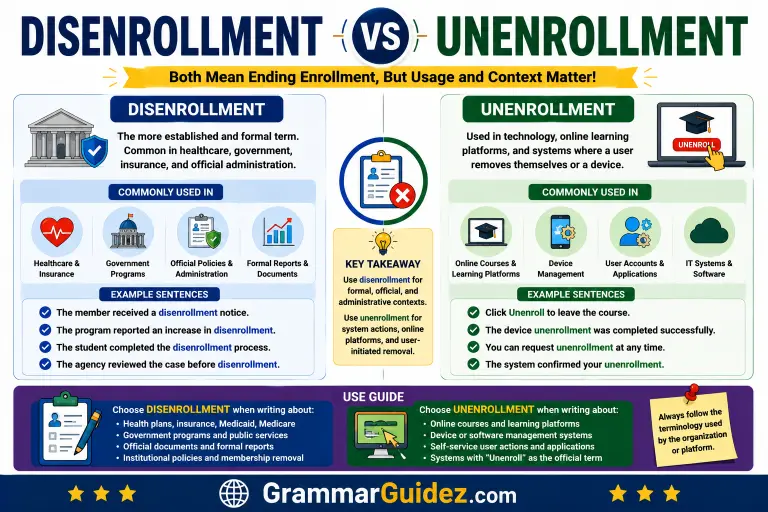
“Disenrollment” and “unenrollment” are both used, but “disenrollment” is the more common and widely accepted term. “Disenrollment” means the process of officially removing someone from a school, program, course, or plan, while “unenrollment” is less common and usually refers to the act of canceling or reversing an enrollment.
If you are leaving a school, course, health plan, online program, or managed device, you may see two similar terms:
disenrollment and unenrollment.
At first glance, they seem to mean exactly the same thing. Both describe the process of ending an existing enrollment. However, the two words are not used in exactly the same way across all contexts.
The safest answer is this:
Disenrollment is the more established dictionary and official administrative term.
Unenrollment is also used, especially in technology and self-service education systems, but it is less common as a general formal term.
For example, a government health program may use:
disenrollment from a health plan
An online learning platform may use:
unenrollment from a course
Both describe the end of enrollment, but the preferred wording often depends on the organization and the situation.
This guide explains the difference between disenrollment and unenrollment, where each word is commonly used, which term is safer for formal writing, and how to choose the right one.
Quick Answer: Disenrollment or Unenrollment?
Both words refer to ending or removing an existing enrollment.
However, disenrollment is generally the more established term in dictionaries, government documents, healthcare administration, and formal institutional writing.
Unenrollment is also understandable and actively used, especially in technology, online learning, device management, and systems that allow users to remove themselves from enrollment.
| Feature | Disenrollment | Unenrollment |
| Main idea | Ending or removing enrollment | Ending or reversing enrollment |
| Formal dictionary support | Strong | Less widely established |
| Government use | Common | Less common |
| Healthcare use | Very common | Rare |
| Education systems | Used | Common in some platforms |
| Technology | Used | Common in device management |
| Formal writing | Usually safer | Depends on context |
| General meaning | Removal from enrollment | Process of becoming unenrolled |
Simple Rule
If you are writing a formal document and no organization has given you a preferred term, disenrollment is usually the safer choice.
If you are following the language used by a specific course platform, app, or technical system, use the term that system uses.
What Does Disenrollment Mean?
Disenrollment is the noun form of disenroll.
It means the removal of a person or name from enrollment, membership, a program, or another official list.
The process may happen because:
- The person chooses to leave.
- An organization removes the person.
- Eligibility ends.
- A program ends.
- Requirements are not met.
- Membership is terminated.
Examples
The student completed the disenrollment process.
The program reported an increase in disenrollment.
The member received a notice about health plan disenrollment.
The school reviewed the student’s possible disenrollment.
Cambridge Dictionary defines disenrollment as the fact of someone’s name being removed from a list, including lists connected with organizations or medical care plans.
What Does Unenrollment Mean?
Unenrollment refers to the process of becoming unenrolled or removing an existing enrollment.
The word is understandable because it follows a familiar English pattern:
enroll → unenroll → unenrollment
In practice, you may see unenrollment in systems where a user actively reverses an enrollment.
For example:
Course unenrollment
Device unenrollment
User unenrollment
Program unenrollment
The term is particularly visible in technology and digital systems.
For example, Microsoft Learn uses unenrollment when discussing the removal of devices from management systems, while Vanderbilt University Brightspace support uses “Unenrollment Complete” for leaving a course.
So, unenrollment is real and understandable usage, especially when a system or platform has adopted it as its standard term.
The Main Difference Between Disenrollment and Unenrollment
The biggest difference is usually context and institutional preference, not a completely different basic meaning.
Both words involve ending enrollment.
However, disenrollment is more strongly established in formal administrative language.
Unenrollment often feels more natural in systems that describe the action as reversing enrollment.
Think of It This Way
Disenrollment often focuses on:
Removal from an existing enrollment.
Unenrollment often focuses on:
Reversing or ending enrollment.
In many real-world situations, the final result is the same: the person, member, student, or device is no longer enrolled.
Why Do Both Words Exist?
English has more than one prefix that can suggest reversal, removal, or the end of a condition.
Two of these prefixes are:
- dis-
- un-
The Prefix “Un-”
The prefix un- often suggests reversing an action.
Examples include:
- lock → unlock
- tie → untie
- install → uninstall
Because of this pattern:
enroll → unenroll
feels logical to many English speakers.
The Prefix “Dis-”
The prefix dis- can suggest removal, separation, reversal, or the opposite of an action.
Examples include:
- connect → disconnect
- continue → discontinue
- qualify → disqualify
This pattern gives us:
enroll → disenroll
Both formations are understandable. However, usage has developed differently across industries and institutions.
Disenrollment in Healthcare and Government
Disenrollment is especially common in healthcare and government administration.
For example, the U.S. Centers for Medicare & Medicaid Services uses enrollment and disenrollment when discussing the establishment or termination of health plan membership.
This makes disenrollment a very familiar term in contexts involving:
- Health insurance
- Medicaid
- Medicare-related programs
- Government services
- Managed care
- Official eligibility programs
Example
The member received a disenrollment notice.
This sounds natural in formal healthcare administration.
Another Example
The agency reviewed the member’s eligibility before disenrollment.
Again, the word fits an official administrative context.
If you are writing about health coverage or a government program, disenrollment is usually the stronger choice.
Unenrollment in Education and Online Learning
In education, both terms may appear.
However, many online learning platforms use unenroll as a user action.
For example:
Unenroll from a course
Click here to unenroll.
Your unenrollment is complete.
Google’s official Classroom help uses unenroll from a class when describing how a student leaves a class.
Similarly, Vanderbilt University’s Brightspace instructions use Unenroll and Unenrollment Complete for removing yourself from a course.
This shows an important point:
Always consider the language already used by the institution or platform.
If a university’s system says Unenroll, it is usually better to use unenroll and unenrollment when writing instructions about that system.
Unenrollment in Technology
Unenrollment is also common in technical and device-management language.
A device may be enrolled in:
- Mobile device management
- Workplace systems
- School systems
- Enterprise management
- Security programs
When the device is removed, technical documentation may describe the process as:
unenrollment
For example, Microsoft Learn describes device-management disconnection using the term unenrollment and explains both user-initiated and administrator-initiated unenrollment.
Other official technology documentation also uses unenroll as the action of removing a device from an enrollment system.
Example
The administrator started the device unenrollment process.
This wording is natural in a technical context.
Who Starts the Process?
Some writers try to create a strict difference based on who starts the action.
For example, they may say:
Unenrollment = voluntary
Disenrollment = forced or administrative
This distinction can sometimes describe real-world usage, but it is not a universal grammar rule.
A person can voluntarily disenroll from a program.
An organization can also process an unenrollment action in a technical system.
For example, official healthcare and administrative documents can use disenrollment for voluntary termination, while technical systems can use unenrollment for actions initiated by users or administrators.
Therefore, do not rely only on the question:
“Who started the process?”
Instead, look at the industry and institutional terminology.
Which Term Should Schools Use?
The answer depends on the school’s existing terminology.
Use Disenrollment When:
- Writing official policies
- Writing administrative reports
- Following institutional language
- Discussing removal from school enrollment
- Using formal government or regulatory terminology
Example:
The district completed the student’s disenrollment.
Use Unenrollment When:
- Referring to an online course system
- Writing instructions for a platform that uses “Unenroll”
- Describing a user-controlled course action
- Following the wording shown inside a learning platform
Example:
Select Unenroll to leave the course.
The most important rule is consistency.
Do not write:
The student completed unenrollment, and the school later processed the disenrollment.
unless the two terms have specific meanings in that organization’s system.
Otherwise, choose one term and use it consistently.
Disenrollment vs Unenrollment in Formal Writing
If you are writing:
- A report
- An academic paper
- A government document
- A healthcare policy
- An official notice
Disenrollment is generally the safer general-purpose choice.
Why?
Because disenroll and disenrollment have strong support in major dictionary and official administrative usage.
Merriam-Webster defines disenroll as removing a name from a roll and, more broadly, releasing an individual from membership in an organization.
Cambridge Dictionary also recognizes disenroll and disenrollment in standard usage.
That makes disenrollment a strong option when you need neutral, formal wording.
Common Mistakes
Mistake 1: Thinking Unenrollment Is Always Wrong
❌ Unenrollment is not a real word.
This is too strong.
Unenrollment is actively used in real educational and technology systems.
Better:
Unenrollment is less established as a general formal term but is used by some organizations and platforms.
Mistake 2: Thinking the Words Always Mean Different Things
❌ Disenrollment and unenrollment always describe completely different actions.
Not necessarily.
In many contexts, both describe ending enrollment.
The difference is often about:
- Industry
- Institution
- Tone
- Existing system terminology
Mistake 3: Ignoring Official Terminology
Suppose a platform says:
Click Unenroll.
Do not rewrite its instructions as:
Click Disenroll.
The second version may be understandable, but it does not match the actual interface.
When writing instructions, always follow the exact wording used by the system.
Mistake 4: Using the Wrong Term in Healthcare
For formal healthcare and insurance writing, disenrollment is often the established administrative term.
Example:
Health plan disenrollment
The U.S. Centers for Medicare & Medicaid Services specifically uses the paired terminology enrollment and disenrollment for transactions that establish or terminate health-plan coverage.
Everyday Examples
Education
The student’s disenrollment was processed before the new term.
Click Unenroll if you no longer want to take the course.
Healthcare
The member received a disenrollment notice.
The health plan reported the member’s disenrollment date.
Technology
The employee completed device unenrollment.
You must unenroll the device before transferring ownership.
Business Programs
The company reviewed customer disenrollment rates.
Users can request unenrollment from the training platform.
A Practical Decision Guide
Use this quick test when choosing between disenrollment or unenrollment.
Are you writing about healthcare or government administration?
Choose:
Disenrollment
Are you writing about a course platform that uses an “Unenroll” button?
Choose:
Unenrollment
Are you writing about device management?
Check the platform’s documentation.
Many technology systems use:
Unenrollment
Are you writing a general formal document?
Choose:
Disenrollment
Are you unsure?
Use the terminology already used by the organization you are discussing.
This is often better than applying a general rule that may not match the institution’s official language.
British and American Spelling
The focus keyword uses the American-style ending:
disenrollment
unenrollment
In British English, words related to enrolment often use one l before -ment.
You may therefore encounter:
disenrolment
and:
unenrolment
The correct spelling may depend on the spelling style followed by the institution or publication.
Simple Guide
| Style | Common Form |
| American English | enrollment |
| British English | enrolment |
For consistency, match the spelling system used throughout your document.
If your article uses:
enrollment
then use:
disenrollment / unenrollment
rather than mixing spelling systems.
Easy Way to Remember the Difference
Use this simple memory guide.
DISenrollment = Formal Removal
Think of:
DIS = administrative removal
This can help you remember the word in official contexts.
UNenrollment = Undoing Enrollment
Think of:
UN = undo
You were enrolled.
Now the enrollment is being undone.
This is especially useful when thinking about:
- Courses
- Apps
- Devices
- Online platforms
These memory tricks are not strict grammar rules. They are simply practical ways to remember common usage patterns.
Quick Quiz: Disenrollment or Unenrollment?
Choose the better word for each context.
1. A health insurance member loses coverage.
A. Unenrollment
B. Disenrollment
2. A course platform has a button that says “Unenroll.”
A. Unenrollment
B. Disenrollment
3. A government report discusses people leaving a public health plan.
A. Disenrollment
B. Unenrollment
4. A managed device is removed from an organization’s system.
A. Unenrollment
B. Disenrollment
5. A formal administrative report discusses removal from a program.
A. Disenrollment
B. Unenrollment
Answers
- B — Disenrollment
- A — Unenrollment
- A — Disenrollment
- A — Unenrollment
- A — Disenrollment
Remember that institutional terminology can change the preferred answer.
FAQs
Is disenrollment a correct word?
Yes. Disenrollment is a standard noun formed from disenroll. It refers to the removal of a person or name from enrollment, membership, or an official program. Major dictionaries and government agencies use the term.
Is unenrollment a real word?
Yes, unenrollment is used to describe the process of becoming unenrolled or ending enrollment. It is especially common in some educational platforms and technology systems, although it is less established than disenrollment as a broad formal administrative term.
What is the difference between disenrollment and unenrollment?
Both terms can describe ending enrollment. Disenrollment is more established in formal, healthcare, government, and administrative contexts. Unenrollment is commonly found in some digital, technical, and self-service education systems.
Which is more formal: disenrollment or unenrollment?
In general formal writing, disenrollment is usually the safer choice. However, you should follow the terminology used by the organization or system you are writing about.
Is disenrollment voluntary or forced?
It can be either. A person may voluntarily leave a program, or an organization may remove someone because of eligibility rules or other requirements. The word itself does not always tell you who initiated the process.
Should I use unenrollment for an online course?
If the course platform uses Unenroll as its official action, then unenrollment is the natural term to use when writing about that system.
Is disenrollment used in healthcare?
Yes. Disenrollment is widely used in health-plan and insurance administration to describe the termination of enrollment or plan membership.
Can I use both words in the same document?
Usually, it is better to choose one term and remain consistent. Use both only if an organization or technical system gives them different meanings.
Conclusion
Both disenrollment and unenrollment can describe the end of an enrollment.
However, they are not equally common in every context.
Use disenrollment when writing about:
- Healthcare
- Insurance
- Government programs
- Formal administration
- Institutional policies
- Official reports
Use unenrollment when writing about:
- Online courses
- Learning platforms
- Device management
- Technology systems
- Interfaces that use the word “Unenroll”
The best general rule is:
Use disenrollment for broad formal and administrative writing.
Use unenrollment when you are following a platform or system that officially uses unenroll.
Neither word should be chosen only because it “sounds better.” Context matters.
Before publishing an official document, check the terminology already used by the school, organization, government agency, healthcare provider, or software platform you are discussing.
That small step will help your writing sound accurate, professional, and natural.
Read More Articles:
- Non or None: Difference, Meaning, and Examples
- Apposed or Opposed: Meaning and Correct Usage
- Alluding or Eluding: What’s the Difference?

I am Elliot Hartwell, an English language writer and the author at GrammarGuidez.com. For the 6 years I have been working with English grammar, vocabulary, spelling and everyday language usage with a focus on making confusing topics easier to understand.
I started GrammarGuidez.com with a goal: to give readers clear and practical answers to common English questions. English can sometimes be confusing especially when two words look or sound similar but have meanings or uses. I enjoy breaking down these differences in a way that’s simple and easy to remember.
I believe learning English should feel simple not overwhelming. My goal is to make every article on GrammarGuidez.com useful, for students, writers, bloggers, teachers and anyone who wants to communicate clearly in English.