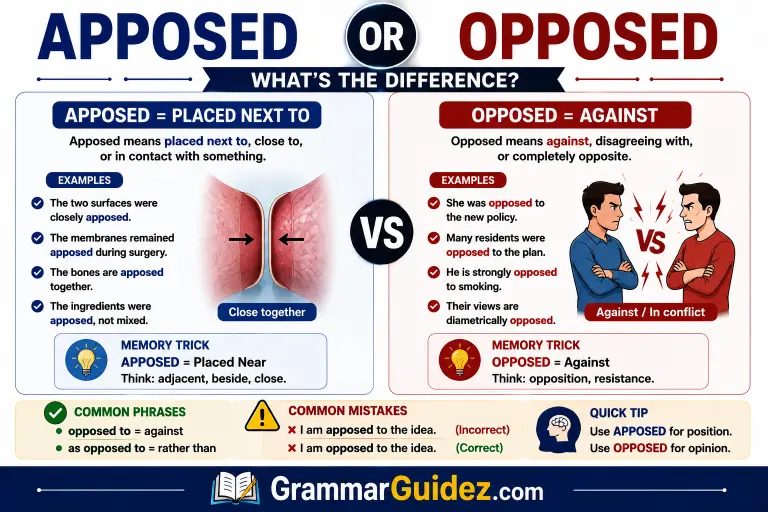
“Apposed” and “opposed” are both correct words, but they have very different meanings. “Apposed” means placed next to or brought into close contact with something, while “opposed” means against something or in disagreement with it.
Apposed or opposed is a confusing word pair because the two words look and sound very similar. However, they have completely different meanings.
Opposed is the much more common word. It usually means against, disagreeing with, or completely different from something. For example:
Many residents were opposed to the new building plan.
Apposed, on the other hand, is a much less common word. It is the past tense and past participle of appose, a formal verb meaning to place something next to or close to something else. Cambridge defines appose in this way, while Merriam-Webster also gives the meaning “to place in juxtaposition or proximity.”
So, if you mean against, use opposed.
If you mean placed next to or close to, use apposed.
This article explains the difference with simple definitions, examples, grammar tips, common mistakes, and an easy memory trick.
Apposed vs Opposed: Quick Answer
| Word | Meaning | Example |
| Apposed | Placed next to or close to something | The two surfaces were apposed. |
| Opposed | Against, disagreeing, or opposite | She was opposed to the plan. |
The easiest rule
APPOSED = placed beside
OPPOSED = against
Apposed is a specialized and relatively uncommon word. Opposed is the normal choice when talking about disagreement, resistance, or being against something. Cambridge lists opposed as meaning disagreeing with a principle or plan and also as meaning opposite or facing something.
What Does “Apposed” Mean?
Apposed comes from the verb appose.
To appose something means to place it next to or close to something else. Cambridge labels appose as a formal verb.
For example:
The two surfaces were apposed during the procedure.
This means the surfaces were placed close together.
Another example:
The ingredients were apposed rather than completely mixed.
Here, the ingredients were placed next to one another instead of being fully combined. Cambridge gives a similar example for appose.
Apposed is usually found in specialized writing
You are more likely to see apposed in:
- Medical writing
- Biology
- Anatomy
- Scientific papers
- Technical writing
- Linguistics
It is not a word most people need in everyday conversation.
What Does “Opposed” Mean?
Opposed is the past form and past participle of oppose. It commonly means against something or someone.
For example:
They were opposed to the proposal.
This means they disagreed with the proposal.
Cambridge defines be opposed to something as disagreeing with a principle or plan.
More examples
She is opposed to the new policy.
Many parents were opposed to the decision.
The workers were strongly opposed to the changes.
He has always been opposed to violence.
In all these examples, opposed means against.
The Key Difference Between Apposed and Opposed
The difference is easier when you think about the ideas behind the two words.
Apposed → Physical or positional closeness
Something is apposed when it is placed next to or close to another thing.
The two membranes were apposed.
Think:
apposed = beside
Opposed → Resistance or disagreement
Someone is opposed when they disagree with or resist something.
The committee was opposed to the proposal.
Think:
opposed = against
This is the most important distinction to remember.
Apposed or Opposed? A Simple Comparison
| Feature | Apposed | Opposed |
| Base verb | Appose | Oppose |
| Main meaning | Placed next to | Against |
| Commonness | Rare | Very common |
| Typical use | Technical/scientific | Everyday and formal English |
| Meaning of position | Close together | Opposite/facing |
| Meaning of disagreement | No | Yes |
| Example | The surfaces were apposed. | They were opposed to the plan. |
| Common phrase | closely apposed | opposed to |
The two words are therefore not interchangeable.
When Should You Use “Apposed”?
Use apposed when describing things that are positioned next to or very close to each other.
Example 1
The two layers were closely apposed.
The layers were positioned close together.
Example 2
The membranes remained apposed.
The membranes stayed next to each other.
Example 3
The tissues were apposed during the procedure.
The tissues were brought into close contact.
This specialized use is supported by dictionary examples of appose and apposed.
When Should You Use “Opposed”?
Use opposed when someone or something is against an idea, action, plan, person, or policy.
Example 1
She opposed the proposal.
Example 2
The community opposed the new road.
Example 3
He strongly opposes smoking.
Example 4
Several members opposed the decision.
A very common structure is:
oppose + noun
or:
oppose + -ing verb
For example:
I oppose raising taxes.
They oppose changing the rules.
Cambridge also gives oppose + -ing as a standard construction.
Opposed Can Also Mean “Opposite”
Opposed does not always describe disagreement.
It can also describe things that are opposite, facing each other, or positioned against each other.
For example:
The two teams stood at opposed ends of the field.
Cambridge lists opposed with the meaning “opposite or facing something.”
You may also see:
diametrically opposed
This means completely opposite.
For example:
Their views oppose each other diametrically.
In this sentence, their views are extremely different.
“As Opposed To” Means “Rather Than”
One of the most common expressions containing opposed is:
as opposed to
This means rather than or instead of.
For example:
I prefer tea as opposed to coffee.
This means:
I prefer tea rather than coffee.
Another example:
We chose a train as opposed to a bus.
The phrase is common in both everyday and formal English. Cambridge specifically lists as opposed to with the meaning “rather than.”
More examples
She chose to walk as opposed to driving.
The company uses digital records as opposed to paper files.
He studies science as opposed to history.
Why Do People Confuse These Words?
There are several reasons.
1. They sound similar
Apposed and opposed have very similar pronunciations.
2. They look similar
Both words contain:
-posed
3. Their origins are related
Both words historically relate to the act of placing something. Merriam-Webster explains that appose comes through French from a form meaning “to put,” while oppose developed from Latin roots associated with placing against.
4. “Apposed” is unfamiliar
Because apposed is uncommon, writers sometimes mistakenly use opposed when they encounter it or assume that apposed is simply a spelling mistake.
It is not.
Apposed is a real English word. It is simply much less common.
Apposed Is Not the Same as “Apposite”
There is another word that can cause confusion:
apposite
Apposite means appropriate, suitable, or relevant.
For example:
Her example was apposite to the discussion.
That means her example was relevant or appropriate.
Cambridge defines apposite as “suitable and right for the occasion.”
So we have three different words:
- Apposed = placed next to
- Opposed = against or opposite
- Apposite = appropriate or relevant
They look alike, but their meanings are different.
Common Mistakes
Mistake 1: Using “apposed” for disagreement
❌ I appose the new rule.
I oppose the new rule.
Why?
You mean against the rule, so use opposed.
Mistake 2: Treating “apposed” as a spelling error
❌ “Apposed” is always incorrect.
✅ “Apposed” is a real word meaning placed next to or close to.
It is simply uncommon outside technical contexts.
Mistake 3: Confusing “opposed” with “apposite”
❌ The comment was opposed to the topic.
If you mean relevant or appropriate:
✅ The comment was apposite to the topic.
Mistake 4: Writing “opposed” when you mean physical closeness
The two membranes did not lie closely together.
If you mean that someone placed them next to each other, use the technical term:
The two membranes lay closely together.
The exact choice depends on the intended scientific meaning.
Apposed vs Opposed in Different Contexts
Everyday conversation
Opposed is much more likely.
Do you oppose the idea?
Business writing
Opposed is common.
Several shareholders opposed the proposal.
Politics
Opposed is extremely common.
The opposition party opposed the bill.
Science
Apposed can appear.
The two structures lay closely together.
Medicine
Apposed describes structures positioned close together.
Grammar
You may encounter apposition, which is related to the idea of placing words or phrases together.
Cambridge defines apposition as a grammatical situation in which two nouns or noun phrases refer to the same person or thing, such as “my brother Joe.”
Apposition and “Apposed”
The word apposed is also related to apposition.
In grammar:
My friend Sarah arrived.
“Sarah” and “my friend” refer to the same person.
People call this apposition.
The connection is useful because apposition involves placing related elements next to each other.
So you can remember:
Apposed → placed near
This can help you recognize the word when you see it in grammar or technical writing.
Easy Memory Tricks
Here are three simple ways to remember the difference.
Trick 1: Apposed = Adjacent
Both apposed and adjacent relate to being close or next to something.
APPosed → Adjacent
Trick 2: Opposed = Against
Think:
OPposed → against
I oppose the plan.
Trick 3: Think of the two arrows
Apposed:
→ ←
Things are close together.
Opposed:
← →
Things face or push against each other.
The second trick is especially useful for remembering opposed = against.
Quick Test: Which Word Fits?
Choose apposed or opposed.
1. The two surfaces were closely ___.
Answer: apposed
They placed the two objects close together.
2. She was strongly ___ to the proposal.
Answer: opposed
She disagreed with the proposal.
3. The tissues remained ___ after the procedure.
Answer: apposed
They remained close together.
4. Many residents were ___ to the plan.
Answer: opposed
They were against it.
5. The two structures were ___ to each other.
Answer: apposed or opposed, depending on the intended technical meaning and context.
This is a good example of why context matters.
FAQs
Is “apposed” a real word?
Yes. Apposed is the past tense and past participle of appose, a formal verb meaning to place something next to or close to something else. It is a legitimate English word, although it is much less common than opposed.
Is it “apposed to” or “opposed to”?
It depends on the meaning.Opposed to usually means against or disagreeing with something: “She opposes the plan.” Apposed describes something placed next to or close to another thing and mainly appears in specialized contexts.
What does “apposed” mean?
Apposed means placed next to or close to something else. It is the past form of appose. For example, “The two surfaces lay very close together.”
What does “opposed” mean?
Opposed usually means against, disagreeing with, or resistant to something. For example, “They opposed the new policy” means they disagreed with or resisted the policy. It can also mean opposite or facing something.
“Apposed” rarely appears in everyday English. Writers mainly use it in technical, medical, or scientific contexts.
No. Apposed is relatively uncommon and is most likely to appear in formal, scientific, medical, anatomical, or technical writing. In ordinary conversation, opposed is far more common.
What does “as opposed to” mean?
As opposed to means rather than or instead of. For example, “I prefer tea as opposed to coffee” means “I prefer tea rather than coffee.” Cambridge lists this as a standard meaning of as opposed to.
No. Apposed and opposed are usually pronounced differently.
They are very similar, but not identical in pronunciation. People generally pronounce apposed with an initial vowel sound like uh-POHZD, while they pronounce opposed with a similar but slightly different vowel pattern. Because they sound close, context is often important.
Conclusion
The choice is simple once you focus on the meaning.
Use APPOSED when you mean:
- placed next to
- positioned close to
- brought into close contact
- arranged side by side
The two surfaces lay closely together.
Use OPPOSED when you mean:
- against
- disagreeing
- resistant
- opposite
- facing in an opposite direction
She opposed the proposal.
And remember the common expression:
as opposed to = rather than
The biggest lesson is that apposed is not a misspelling of opposed. Both are real words, but they belong to different contexts. Apposed describes position or closeness, while opposed commonly describes disagreement or opposition.
The easiest memory rule:
APPOSED = placed near
OPPOSED = against
Once you remember those two meanings, you will rarely confuse apposed or opposed again.
Read More Articales:
- Non or None: What’s the Difference and How Do You Use Them?
- As or Like: What’s the Difference and When Should You Use Each?

I am Evan Whitmore, an English language writer and the person who started GrammarGuidez.com. I made GrammarGuidez.com to make grammar, spelling, vocabulary and words that are often confused easier to understand.
I like taking to understand English words and grammar rules and turning them into simple and clear explanations. My aim is to help students, writers, bloggers, ESL learners and regular English speakers feel more sure when they write and talk.
At GrammarGuidez.com I work on real life examples easy to understand explanations comparing words, spelling changes and how American English is used every day.
I think learning English doesn’t need to be hard. A good explanation and some good examples can make tough grammar topics much simpler to learn