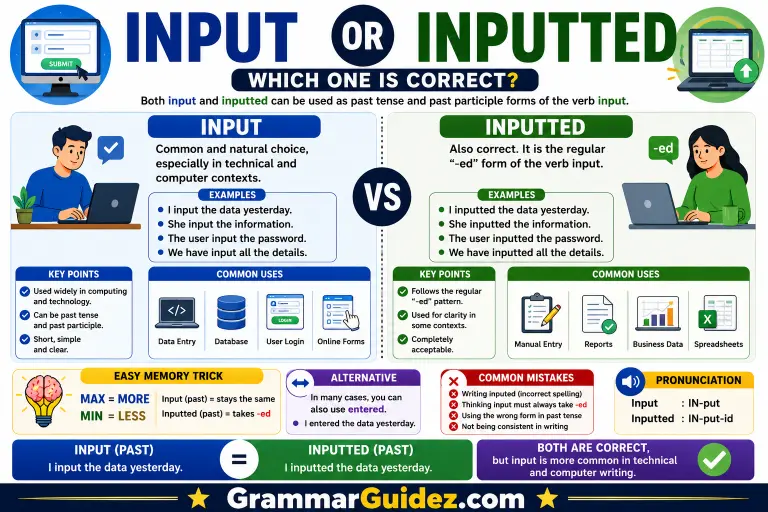
“Input” and “inputted” are both correct forms, but their usage depends on the context. “Input” is commonly used as the past tense of input, especially in American English, while “inputted” is also accepted and can be used when emphasizing the act of entering data or information.
Have you ever wondered if the correct past tense is inputted or input? This is a common question, especially in computer, data, and technical writing.
Both input and inputted can be used as past-tense and past-participle forms of the verb input. However, input is often the more common and natural choice, especially in American English and in computing contexts.
For example:
I input the data yesterday.
and:
I inputted the data yesterday.
Both forms can be found in English, but they do not always sound equally natural to every reader.
The confusion happens because input is an irregular-looking verb. Many English verbs form the past tense by adding -ed, so learners naturally expect inputted. But input can also work as its own past form.
In this guide, we will explain inputted vs input, their meanings, grammar, pronunciation, examples, common mistakes, American and British usage, and when you should use each form.
Inputted or Input – Quick Answer
Input and inputted can both be used as past-tense forms of the verb input.
However:
- Input is widely used and usually sounds more natural.
- Inputted is also correct and can be used when you want a regular -ed past form.
- In computer and technical writing, input is very common.
Examples
I input the information yesterday.
I inputted the information yesterday.
Both can mean that the information was entered into a system.
The Simple Rule
If you want the safest and most natural choice, especially in technical writing:
Use “input” as the past tense.
But inputted is not automatically wrong.
What Does Input Mean?
Input can be a noun, verb, or adjective in different contexts.
As a verb, input means to enter information, data, or instructions into a computer, system, form, or machine.
For example:
Please input your password.
She input the data into the system yesterday.
As a noun, input can mean information, advice, or data that is entered into a system.
We need your input on this project.
The computer received the user’s input.
The word is especially common in computing and technology.
What Does Inputted Mean?
Inputted is the regular -ed form of the verb input.
It means that someone entered or supplied information.
For example:
The technician inputted the data into the database.
She inputted all the customer information.
We inputted the numbers manually.
The form inputted is understandable and accepted in English, although many writers prefer input, particularly in computing.
What Is the Difference Between Input and Inputted?
The main difference is not meaning.
Both can describe the past action of entering information.
| Feature | Input | Inputted |
| Base verb | Input | Input |
| Past tense | Input | Inputted |
| Past participle | Input | Inputted |
| Meaning | Entered/supplied information | Entered/supplied information |
| Common in computing | Very common | Less common |
| Regular -ed form | No | Yes |
| Natural in technical writing | Very common | Acceptable |
| Example | I input the data. | I inputted the data. |
The important point is that input does not always need -ed to express the past.
Is Input or Inputted More Correct?
This is where the confusion usually begins.
Input
Input is a well-established past form of the verb.
She input the data yesterday.
It is especially common in computing and technical contexts.
Inputted
Inputted is also used as the regular past form.
She inputted the data yesterday.
It follows the normal English pattern:
input + ed = inputted
So it is not correct to say that inputted is always wrong.
Which One Should You Prefer?
For most general and technical writing, input is a strong choice.
For example:
The user input the information into the system.
This sounds concise and natural.
However, inputted can be useful when the writer wants to make the past tense especially clear or when following a style that favors regular -ed forms.
Input vs Inputted in Computer English
The word input is strongly connected with computers and technology.
You may use it when talking about:
- Data
- Passwords
- Numbers
- Commands
- Information
- Forms
- Records
- User details
- Search terms
- Computer systems
Examples with Input
The user input the password.
She input the customer’s information.
We input the data into the database.
He input the wrong number.
Examples with Inputted
The user inputted the password.
She inputted the customer’s information.
We inputted the data into the database.
He inputted the wrong number.
Both forms communicate the same basic action.
Input or Inputted as a Past Participle
The past participle is used with helping verbs such as has, have, had, and sometimes was/were in passive constructions.
Using Input
She has input all the data.
We had input the information before the meeting.
Using Inputted
She has inputted all the data.
We had inputted the information before the meeting.
Both forms can be encountered.
However, input may sound more natural to many speakers in computing contexts.
Input or Inputted in Passive Voice
The passive voice can also create confusion.
Input
The information was input into the system.
Inputted
The information was inputted into the system.
Both forms are possible.
However, many writers may prefer to avoid the awkwardness completely by using another verb:
The information was entered into the system.
This is often the clearest option.
Input vs Enter
Sometimes enter is a better choice than either input or inputted.
For example:
I entered the data yesterday.
This is very clear and natural.
Compare:
I input the data yesterday.
I inputted the data yesterday.
All three communicate the basic idea, but entered is often the most straightforward choice for everyday writing.
Use Input When:
You are talking about data or information being supplied to a system.
The user input the command.
Use Enter When:
You want a simple and familiar verb.
The user entered the command.
Why Do People Say “Inputted”?
English normally creates past tense by adding -ed.
For example:
- enter → entered
- type → typed
- upload → uploaded
- download → downloaded
Because of this pattern, speakers naturally form:
input → inputted
This is a regular grammatical formation.
But input has also developed a past form that stays unchanged:
input → input
This is similar to other English verbs that can keep the same form in different grammatical positions.
Is Input an Irregular Verb?
Input can behave like an irregular or unchanged-form verb in its past and past-participle uses.
You can see the pattern as:
Present: input
Past: input
Past participle: input
But you can also encounter:
Present: input
Past: inputted
Past participle: inputted
This makes input somewhat unusual.
British English vs American English
Unlike words such as color/colour or odor/odour, input and inputted are not simply British and American spelling differences.
Both forms can be found in different varieties of English.
| English Variety | Input | Inputted |
| American English | Common | Used |
| British English | Common | Used |
| Canadian English | Common | Used |
| Australian English | Common | Used |
| Technical English | Very common | Acceptable |
The choice is more about verb usage and style than regional spelling.
Pronunciation of Input and Inputted
Input
As a noun, input is commonly pronounced:
IN-put
As a verb, the stress can also be placed on the second syllable in some varieties:
in-PUT
The exact pronunciation can depend on if it is being used as a noun or verb.
Inputted
Inputted is pronounced approximately:
IN-put-id
The final -ed creates an additional syllable.
Simple Comparison
Input
in-put
Inputted
in-put-id
Which One Should You Use?
For General Writing
Input is a good choice when talking about entering information.
I input the information yesterday.
However, if the sentence sounds unclear to your audience, entered may be even better.
I entered the information yesterday.
For Technical Writing
Input is commonly used.
The user input the data into the system.
For Business Writing
Both forms can work.
The employee input the customer details.
or:
The employee inputted the customer details.
Choose one style and use it consistently.
For Academic Writing
Follow the style guide used by your institution or publication.
If there is no specific rule, input or entered may be preferable to avoid unnecessary debate.
For Everyday English
Entered is often the easiest option.
I entered the information.
This is clear and natural.
Common Mistakes
Mistake 1: Saying Inputted Is Always Wrong
❌
“Inputted” is never correct.
This is too strong.
Inputted is used as a past-tense and past-participle form of input.
Mistake 2: Assuming Input Must Always Be Present Tense
Some learners think:
Input = present only.
That is not necessarily true.
Input can also function as a past form.
I input the data yesterday.
Mistake 3: Adding Only “-ed”
A common spelling mistake is:
❌ inputed
The correct regular form is:
✅ inputted
The final consonant is doubled before -ed.
Mistake 4: Using Inputted When Entered Is Clearer
Sometimes the best sentence is simply:
I entered the data.
If your readers may find input or inputted awkward, entered is a useful alternative.
Input vs Inputted Examples
Example 1
I input the customer’s details yesterday.
I inputted the customer’s details yesterday.
Both refer to a completed past action.
Example 2
She input the numbers into the spreadsheet.
She inputted the numbers into the spreadsheet.
Both are understandable.
Example 3
The technician input the data manually.
The technician inputted the data manually.
Again, both forms can be used.
Example 4
We input the records into the database.
We inputted the records into the database.
Both communicate the same basic idea.
Input vs Inputted: Which Sounds More Natural?
This depends on the speaker, audience, and context.
Many people find:
I input the data.
more natural in technical contexts.
Others prefer:
I inputted the data.
because it follows the familiar -ed pattern.
If you want to avoid the issue completely:
I entered the data.
This is often the clearest option.
Quick Preference Guide
Most concise: Input
Regular past form: Inputted
Simplest everyday alternative: Entered
Examples in Different Situations
Data Entry
The employee input the customer information.
Computer Programming
The user input the command.
Online Forms
She inputted her address into the form.
Business Records
We input the sales figures into the system.
Medical Records
The nurse inputted the patient’s information into the database.
School Records
The administrator input the students’ grades.
Tips to Remember the Difference
There is an easy way to remember this topic:
Remember the Three Forms
Input → input → input
or:
Input → inputted → inputted
Both patterns can be encountered.
Think About the Context
If you are talking about computers or data, input is especially common.
If you want a regular -ed past form, inputted works.
Remember the Spelling
Never write:
❌ inputed
Write:
✅ inputted
or:
✅ input
Easy Memory Sentence
Input can stay the same, or it can take -ted.
Input or Inputted – Quick Comparison
| Sentence | Usage |
| I input the data. | Present |
| I input the data yesterday. | Past |
| I inputted the data yesterday. | Past |
| I have input the data. | Past participle |
| I have inputted the data. | Past participle |
| The data was input. | Passive |
| The data was inputted. | Passive |
Quiz
Choose the best answer.
1. Which word can be used as the past form of “input”?
A. Input
B. Inputted
C. Both A and B
D. Inputing
2. Which spelling is correct?
A. Inputed
B. Inputted
C. Inpuuted
D. Inputid
3. Which sentence is correct?
A. I input the data yesterday.
B. I inputted the data yesterday.
C. Both A and B
D. I inputed the data yesterday.
4. Which word is often the clearest alternative to input?
A. Entered
B. Took
C. Putted
D. Addeded
5. Which form is common in computing?
A. Input
B. Inputted
C. Both can be used
D. Neither
6. Which sentence is incorrect?
A. I input the information.
B. I inputted the information.
C. I inputed the information.
D. I entered the information.
7. What does input mean as a verb?
A. To delete information
B. To enter or supply information
8. Which form adds the regular “-ed” ending?
A. Input
B. Inputted
C. Enter
D. Inputing
Answers
- C — Both A and B
- B — Inputted
- C — Both A and B
- A — Entered
- C — Both can be used
- C — I inputed the information.
- B — To enter or supply information
- B — Inputted
Fill in the Blanks
Choose input, inputted, or entered.
- I ______ the information yesterday.
- She ______ the data into the database.
- The employee ______ the customer’s address.
- We ______ the numbers into the spreadsheet.
- He ______ the password into the computer.
- The technician ______ all the records yesterday.
- I ______ the information manually.
- She ______ the details into the online form.
Possible Answers
- input / inputted / entered
- input / inputted / entered
- input / inputted / entered
- input / inputted / entered
- input / inputted / entered
- input / inputted / entered
- input / inputted / entered
- input / inputted / entered
The best choice can depend on the style and context.
FAQs
Is input or inputted correct?
Both input and inputted can be used as past-tense and past-participle forms of the verb input. Input is particularly common in computing and technical contexts, while inputted is the regular -ed form.
Is inputted a real word?
Yes. Inputted is a recognized form of the verb input. It is used by English speakers and writers, although some prefer the unchanged form input.
Can I say “I input the data yesterday”?
Yes. Input can be used as a past-tense form.
I input the data yesterday.
This is especially common in computing and technical contexts.
Can I say “I inputted the data”?
Yes.
I inputted the data.
This is also used as the past form of input.
Is “inputed” correct?
No. If you use the regular -ed form, the correct spelling is inputted, not inputed.
Which is more common, input or inputted?
Input is widely used, particularly in computing and technical writing. Inputted is also used and can be acceptable. The preferred form may depend on the writer, audience, and style.
Is input an irregular verb?
It can function as an unchanged-form verb, with input used as the past and past participle. It can also take the regular form inputted.
Is “input” past tense?
Yes, input can be the past tense of the verb input.
I input the information yesterday.
Is “inputted” past tense?
Yes. Inputted is a regular past-tense form of input.
I inputted the information yesterday.
Which is better: inputted or entered?
Entered is often the simplest and clearest choice in everyday English.
I entered the data.
However, input and inputted are useful when you specifically want to describe supplying information to a computer or system.
Is input or inputted better for content and website content?
Neither word is automatically better for content. Choose the form that is grammatically appropriate and natural for your audience. If the sentence sounds awkward, entered may be a clearer alternative.
Conclusion
The inputted vs input question can be confusing because English allows more than one past form for the verb input.
Input can be used as the present form and also as a past-tense or past-participle form:
I input the data yesterday.
Inputted is the regular -ed form:
I inputted the data yesterday.
Both forms can be found in English. Input is especially common in computing and technical contexts, while inputted follows the normal pattern of forming a past tense with -ed.
One important spelling rule is easy to remember: if you use the -ed form, write inputted, not inputed.
When you want the simplest everyday wording, entered is often a great alternative:
I entered the data yesterday.
So, should you use input or inputted? In most technical and computer-related writing, input is a strong, concise choice. But inputted is not automatically wrong.
The key is to choose a form that sounds natural, fits your audience, and remains consistent throughout your writing.

I am Elliot Hartwell, an English language writer and the author at GrammarGuidez.com. For the 6 years I have been working with English grammar, vocabulary, spelling and everyday language usage with a focus on making confusing topics easier to understand.
I started GrammarGuidez.com with a goal: to give readers clear and practical answers to common English questions. English can sometimes be confusing especially when two words look or sound similar but have meanings or uses. I enjoy breaking down these differences in a way that’s simple and easy to remember.
I believe learning English should feel simple not overwhelming. My goal is to make every article on GrammarGuidez.com useful, for students, writers, bloggers, teachers and anyone who wants to communicate clearly in English.