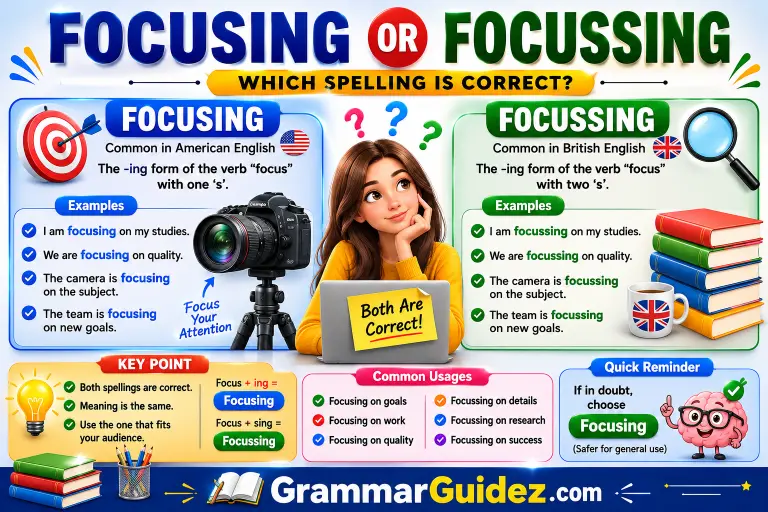
“Focusing” and “focussing” are both correct spellings, but their usage depends on the variety of English. “Focusing” is the standard spelling in American English, while “focussing” is commonly used in British English. Both mean paying close attention to something or directing attention toward it.
If you have ever typed focusing and wondered if it should be focussing, you are dealing with a real English spelling variation not a simple right-or-wrong mistake.
Both focusing and focussing are accepted spellings of the -ing form of the verb focus. Major dictionaries recognize both forms. Oxford lists focusing and focussing as verb forms, while Merriam-Webster also gives both spellings.
The interesting part is that the choice can depend on the variety of English you are using.
For most readers, especially those writing for a US audience, focusing is the safest and most familiar spelling. In British English, focussing is also well established, although focusing is accepted there too. Oxford’s current entries explicitly show both forms.
So, if your question is simply “Focusing or focussing which one should I use?”, the short answer is:
Both are correct. “Focusing” is the simpler default, especially in American English. “Focussing” is also standard, particularly in British English.
Let’s look at why these two spellings exist and when each one makes sense.
One Word, Two Spellings
The base word is:
focus
The verb means to direct attention, effort, or something such as a camera toward a particular point or subject. Oxford gives examples involving focusing attention, discussion, eyes, and cameras.
When we add -ing, we get two accepted forms:
focus → focusing
focus → focussing
The meaning does not change.
For example:
We are focusing on customer service.
and
We are focussing on customer service.
Both sentences mean the same thing.
The difference is mainly spelling preference, not meaning.
Why Does “Focussing” Have Two S’s?
This is where the spelling gets interesting.
Many English verbs that end in a single consonant double that consonant before -ing or -ed.
For example:
- run → running
- stop → stopping
- plan → planning
- admit → admitting
Because focus ends in s, some spelling systems apply a similar doubling pattern:
focus → focussing
Other spelling conventions do not double the final s:
focus → focusing
Both forms have become established in English.
Merriam-Webster’s dictionary entry for focus explicitly lists:
focused also focussed; focusing also focussing
So you should not treat the second s as a typo.
Focusing: The More Convenient Default
Focusing is the spelling you will often want when writing for an American audience.
For example:
We are focusing on improving customer service.
She is focusing on her studies.
The camera is focusing on the subject.
The company is focusing on small businesses.
Oxford’s American English entry lists focusing and focussing as possible -ing forms, while Merriam-Webster also recognizes both.
For a website targeting readers in the United States, I would normally recommend:
focusing
It is clean, familiar, and widely used in American writing.
Focussing: Is It Actually Correct?
Yes.
Focussing is not an incorrect spelling.
This is an important point because some spelling checkers may make it look unusual, especially when your software is set to American English.
Oxford lists focussing alongside focusing, and Merriam-Webster also recognizes it.
For example:
The team is focussing on the main problem.
This is grammatically correct.
So if you see focussing in British writing, there is no need to “correct” it to focusing simply because it has two S’s.
The British vs American Question
This is where the choice becomes useful.
| English variety | Common choice | Other form |
| American English | focusing | focussing is recognized |
| British English | focussing / focusing | both accepted |
| Canadian English | Both may appear | depends on style |
| Australian English | Both may appear | depends on style |
| International writing | focusing is a safe choice | focussing is also valid |
The important point is that this is not a strict American = focusing, British = focussing rule.
Oxford’s British English entry gives both focusing and focussing.
That means you should avoid telling readers that one spelling is “American only” and the other is “British only.”
The real difference is more about regional preference and consistency.
What Does “Focusing” Mean?
Focusing is the present participle of focus.
It can describe directing attention or effort toward something.
I am focusing on my work.
It can also describe adjusting a camera, eye, or lens.
The camera is focusing on the building.
Oxford gives both the attention-related meaning and the visual/camera meaning of focus.
Common uses
You will often see focusing in phrases such as:
- focusing on a problem
- focusing on students
- focusing on quality
- focusing attention
- focusing your efforts
- focusing on growth
- focusing on the future
- focusing the camera
- focusing on details
For example:
The teacher is focusing on pronunciation.
The business is focusing its efforts on new customers.
What Does “Focussing” Mean?
Focussing has exactly the same basic meaning as focusing.
It is simply the alternative spelling.
For example:
The teacher is focussing on pronunciation.
means the same as:
The teacher is focusing on pronunciation.
Likewise:
The photographer is focussing the camera on the subject.
has the same meaning as:
The photographer is focusing the camera on the subject.
There is no special definition that makes focussing mean something different.
The Difference in One Table
| Point | Focusing | Focussing |
| Base word | focus | focus |
| Meaning | directing attention/adjusting focus | same |
| Grammar | -ing form | -ing form |
| Spelling | one S | two S’s |
| American English | very common | less common |
| British English | accepted | accepted |
| Meaning difference | None | None |
| Correct spelling | Yes | Yes |
So if you were hoping to find a major difference in meaning, there isn’t one.
The main issue is spelling convention.
Focusing or Focussing in Formal Writing?
Both can be used in formal writing.
The bigger issue is consistency.
Imagine that a British company uses:
focussing
throughout its website.
Changing every instance to:
focusing
is not necessary.
Likewise, an American company that consistently uses focusing does not need to add another S.
A useful rule
Choose one style and stay consistent.
For example:
The report is focusing on three areas.
Then continue using:
focused
focusing
rather than randomly switching between:
focussed
focussing
unless you have a specific reason to follow another style.
What About “Focused” and “Focussed”?
The same spelling issue appears in the past tense and past participle.
You may see:
focused
or
focussed
Both are recognized.
Merriam-Webster lists focused also focussed and focusing also focussing.
Oxford also gives:
focused / focussed
and:
focusing / focussing.
So there is a larger spelling family:
One-S style
- focusing
- focused
Double-S style
- focussing
- focussed
Both systems are established.
Examples in Everyday English
Let’s see how the choice works in real sentences.
Education
Students are focusing on their final exams.
British-style alternative:
Students are focussing on their final exams.
Business
The company is focusing on customer needs.
Alternative:
The company is focussing on customer needs.
Photography
The camera is focusing on the person’s face.
Alternative:
The camera is focussing on the person’s face.
Personal goals
I am focusing on improving my writing.
Alternative:
I am focussing on improving my writing.
The meaning stays the same in every example.
When Should You Choose “Focusing”?
Choose focusing if:
- you write mainly for Americans
- your website uses American English
- you want the simpler spelling
- your style guide prefers one S
- you want consistency with other American spellings
For example:
Our blog is focusing on simple English lessons.
For a US-focused website, this is the spelling I would generally recommend.
When Should You Choose “Focussing”?
Choose focussing if:
- your publication follows a style that uses it
- you are writing in a British-English environment
- your organization already uses double-S forms
- you want to maintain an established spelling style
For example:
The report is focussing on the effects of climate change.
There is nothing grammatically wrong with this sentence.
Common Mistakes
❌ “Focussing is always wrong.”
No.
It is a recognized spelling. Oxford and Merriam-Webster both list it.
❌ “Focusing is only American English.”
Not quite.
Oxford’s British English dictionary includes focusing as an accepted form.
❌ “The two words have different meanings.”
They do not.
Focusing and focussing are spelling variants of the same verb form.
❌ “You must use focussing in British English.”
No.
British English can use both spellings.
❌ “You must use focusing everywhere.”
Also no.
If your style guide or regional convention prefers focussing, it is perfectly acceptable.
A Better Way to Remember It
Instead of trying to memorize a complicated rule, remember this:
FOCUS + ING = FOCUSING or FOCUSSING
Both are valid.
Then think about your audience.
Writing for the US?
Focusing is a strong default.
Writing for British readers?
Focusing and focussing are both acceptable. Follow your preferred style.
Writing for a global audience?
Pick one and use it consistently.
This approach is much easier than trying to decide that one spelling is always correct.
What Do Dictionaries Say?
This is one of those spelling questions where dictionary evidence is especially useful.
Oxford lists the verb forms as:
focuses / focusses
focused / focussed
focusing / focussing
Its American English entry also shows:
focusing / focussing
Merriam-Webster similarly lists:
focused also focussed
focusing also focussing
That gives us a clear conclusion:
Neither spelling should be labeled incorrect.
Quick Test
Choose the spelling that fits your style.
- The company is ______ on growth.
- She is ______ her attention on the lesson.
- The camera is ______ on the subject.
- We are ______ our efforts on customer service.
- He is ______ on his long-term goals.
Answers
All five can be written with:
focusing
or:
focussing
The meaning does not change.
If you are writing for a US audience, focusing is the natural default.
So, Is Focusing or Focussing Better?
If you want the simplest answer:
Focusing is the safest default.
It is widely recognized and especially familiar in American English.
But that does not make focussing wrong.
Focussing is also correct.
It is an established alternative, particularly associated with British spelling preferences.
The most important thing is to maintain consistency.
If your article starts with:
The team is focusing on customer needs.
do not switch randomly later to:
The team is focussing on quality.
Pick one style and stay with it.
FAQs
Is focusing or focussing correct?
Both are correct. They are alternative spellings of the -ing form of focus. Oxford lists both focusing and focussing, and Merriam-Webster does the same. The choice is mainly based on spelling convention and regional preference rather than meaning.
Is focusing American or British English?
Focusing is used in both American and British English. It is especially common in American writing, but Oxford’s British English dictionary also recognizes it. Therefore, it would be inaccurate to call focusing an American-only spelling.
Is focussing British English?
Focussing is strongly associated with British English, but it is not limited to Britain. It is an accepted alternative spelling of focusing. British English can use either form, so writers should follow the style preferred by their publication or organization.
Should I use focusing or focussing in American English?
For American English, focusing is the safest choice. It is familiar to US readers and fits the common American spelling pattern. If you are writing content for a US-based website, I would normally use focusing consistently.
Is “focussing” a spelling mistake?
No. Focussing is not a spelling mistake. Major dictionaries recognize it as an alternative form of focusing. If your spellchecker flags it, check if your software is set to American English rather than assuming the word is incorrect.
What is the past tense of focus?
The past tense can be focused or focussed. Both forms are recognized by major dictionaries. For example, “The discussion focused on education” and “The discussion focussed on education” are both grammatically valid.
Is focusing one word?
Yes. Focusing is one word. It is the present participle and gerund form of the verb focus. For example: “She is focusing on her studies.” It can describe directing attention or adjusting something such as a camera or lens.
Which spelling is best for content?
Neither spelling has a special grammar advantage for content. The better approach is to use the spelling that matches your target audience and search intent. For a US-focused English website, focusing is a sensible primary spelling, while focussing can be mentioned naturally as the alternative variant.
Conclusion
Focusing and focussing are both correct spellings.
They come from the verb focus, meaning to direct attention, effort, or something such as a camera toward a particular point. Oxford and Merriam-Webster both recognize the two forms.
The difference is spelling, not meaning.
Focusing uses one S and is an excellent default, especially for American English and US-focused websites.
Focussing uses two S’s and is also standard. It is particularly familiar in British English, although British English also accepts focusing.
So don’t worry if you have written focussing. It is not automatically a spelling mistake.
If you are unsure which form to choose, use focusing, then keep that spelling consistent throughout your article, website, or document.
The best spelling is often the one that matches your audience and your chosen style.

I am Evan Whitmore, an English language writer and the person who started GrammarGuidez.com. I made GrammarGuidez.com to make grammar, spelling, vocabulary and words that are often confused easier to understand.
I like taking to understand English words and grammar rules and turning them into simple and clear explanations. My aim is to help students, writers, bloggers, ESL learners and regular English speakers feel more sure when they write and talk.
At GrammarGuidez.com I work on real life examples easy to understand explanations comparing words, spelling changes and how American English is used every day.
I think learning English doesn’t need to be hard. A good explanation and some good examples can make tough grammar topics much simpler to learn