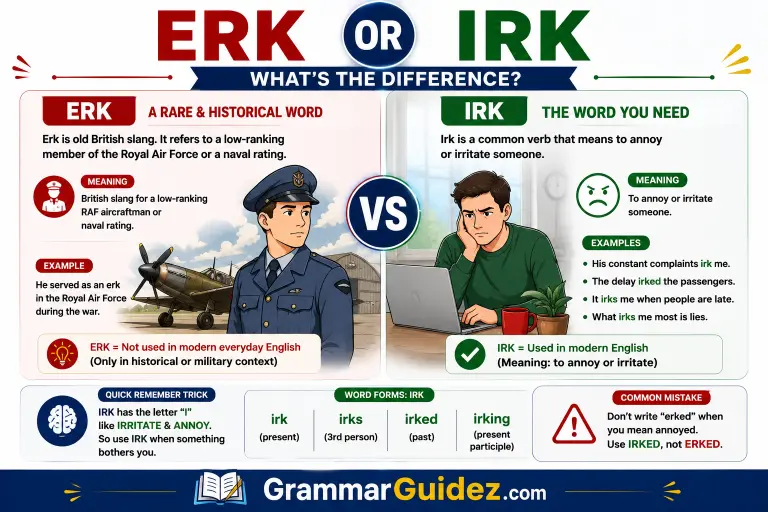
“Irk” is the correct spelling, while “erk” is generally a misspelling when you mean to annoy or irritate someone. “Irk” is a verb meaning to annoy, bother, or irritate, whereas “erk” has no standard English meaning in this context.
Erk or irk? These two words look almost identical, and that can make them easy to confuse. But they are not simply two spellings of the same word.
The word irk is a standard English verb. It means to annoy or irritate someone. For example, you can say, “His rude comments really irked me.” Cambridge and Oxford both list irk as a verb meaning to annoy someone.
Erk, on the other hand, is a much less common word. In British slang, it traditionally referred to a low-ranking member of the Royal Air Force or a naval rating. Collins and Merriam-Webster both record this historical slang meaning.
So, if you want to say that something annoys you, the correct word is:
✅ Irk
Not:
❌ Erk
This article explains the difference, meanings, history, examples, pronunciation, and common mistakes so you can use both words correctly.
The Quick Answer
If you mean to annoy, bother, or irritate someone, use irk.
The constant noise irked me.
Irk is a verb. Oxford describes it as a formal or literary word meaning “to annoy somebody.”
Erk is a different and uncommon word. It is recorded mainly as British slang for a low-ranking RAF aircraftman or naval rating. Collins also records an American-English dictionary sense of a worthless or ignorant person, related to jerk.
| Word | Meaning | Commonness |
| irk | To annoy or irritate | Common enough in formal writing |
| erk | Historical British slang for a low-ranking serviceman | Rare/dated |
Simple rule:
Annoy someone → IRK
Old British military slang → ERK
Irk Is the Word You Probably Need
For most modern English learners, irk is the important word to know.
It means:
to annoy someone
Cambridge defines irk as a verb meaning “to annoy someone.” Oxford gives the same basic meaning and labels the word formal or literary.
Examples
His constant complaints irk me.
The delay really irked the passengers.
It irks her when people arrive late.
The manager’s rude tone irked the customer.
What irks me most is the lack of communication.
In each sentence, irk means that something causes annoyance or irritation.
What Does “Erk” Mean?
Erk is a real English word, but it is much less common than irk.
Collins records erk as British slang for an aircraftman or naval rating. Merriam-Webster defines it as a member of the lowest rank in the Royal Air Force, particularly someone on the ground crew.
For example, in historical writing, you might encounter:
He served as an erk in the Royal Air Force.
This is not the everyday meaning most English speakers need.
Collins also records an American-English dictionary sense of erk meaning a worthless or ignorant person, related to jerk.
Because these meanings are uncommon, erk is not normally the word you want when talking about annoyance.
The Most Important Difference
The easiest way to separate the two words is to focus on their meanings.
IRK
Irk = annoy
The loud music irked the neighbors.
ERK
Erk = old British slang
The historical text referred to the young aircraftman as an erk.
The two words are therefore different in both meaning and usage.
Why Do People Confuse Erk and Irk?
The confusion is understandable.
The words differ by only one letter:
ERK
IRK
They also have similar pronunciations. Oxford gives irk as /ɜːk/ in British English and /ɝːk/ in American English.
When people hear the word rather than see it written, they may not immediately know if the vowel should be e or i.
There is another reason for the confusion: erk and irk have historical connections in some dictionary and slang sources. But in modern standard usage, you should not treat them as interchangeable spellings.
If your meaning is annoy, spell it:
Irk: Meaning and Grammar
Irk is a transitive verb.
That means it normally takes an object the person who is annoyed.
For example:
The noise irked me.
Here:
- The noise = subject
- irked = verb
- me = object
You can also use patterns such as:
It irks me that he never listens.
Oxford specifically gives the patterns irk somebody and it irks somebody that….
Common forms of “irk”
| Form | Example |
| irk | Loud music can irk people. |
| irks | His attitude irks me. |
| irked | Her comment irked him. |
| irking | The delay is irking customers. |
Cambridge also records irking as the present participle.
Irk vs Annoy vs Irritate
You may wonder why someone would use irk instead of the more common words annoy or irritate.
They are close in meaning.
Annoy
The noise annoyed me.
Irritate
The noise irritated me.
Irk
The noise irked me.
All three express the idea that something bothers you.
The main difference is style and frequency. Irk can sound more formal or literary. Oxford labels it formal or literary, while Cambridge also marks it as formal.
So in casual conversation, you might more naturally say:
That really annoys me.
In more formal writing, you may see:
That decision really irks me.
Where You Will See “Irk”
Although irk is not the most common everyday verb, it appears in many types of writing.
News writing
The decision irked local residents.
Business writing
The new policy irked several employees.
Opinion writing
What irks voters is the lack of transparency.
Academic or formal writing
The inconsistency irked several researchers.
Everyday writing
It really irks me when people interrupt.
Cambridge’s examples include irk in news, political, and general contexts, showing that it remains an active English word.
A Look at “Erk” Through History
Unlike irk, the word erk has a more specialized history.
Collins says the British slang noun erk dates from the 20th century and may have developed as a corruption of AC, short for aircraftman.
Merriam-Webster similarly gives its etymology as an alteration of airc, short for aircraftsman.
The term was connected with low-ranking personnel in the British military, particularly the Royal Air Force.
Because this is a historical slang term, you are unlikely to need it in normal modern writing.
Erk or Irk in Modern English?
This is where the answer becomes very practical.
If you are writing:
“The delay really me.”
Use:
✅ irked
Not:
❌ erked
If you are writing:
“His attitude me.”
Use:
✅ irks
Not:
❌ erks
If you are talking about the historical British military slang term, erk can be correct.
Think about the meaning first.
Annoyance? → IRK
Historical British military slang? → ERK
Common Mistakes
Mistake 1: Writing “erk” for “annoy”
❌ The rude comment erked me.
✅ The rude comment irked me.
The verb meaning “to annoy” is irk.
Mistake 2: Assuming “erk” is just an alternative spelling
❌ Erk is another spelling of irk.
This is misleading.
In modern standard usage, irk is the word for “annoy.” Erk has separate, specialized slang meanings.
Mistake 3: Using “irk” as a noun
❌ That is a big irk.
The standard dictionary entry for irk is a verb meaning to annoy.
Better:
That really irks me.
How to Remember Irk
Here is a simple memory trick:
IRK = Irritate
Both words start with IR.
IRK → IRRITATE
When something irritates you, it can irk you.
For example:
The constant noise irks me.
Think:
Irk = Irritate = Annoy
That is enough to remember the modern word.
Which Word Should You Use?
For almost all normal modern writing, choose irk when you mean annoy.
Students
The confusing question irked me.
Bloggers
One thing that really irks readers is poor formatting.
Businesses
Delayed responses can irk customers.
Academic writing
The inconsistency irked the researchers.
Everyday communication
It really irks me when people are late.
If you are writing historical material about the British military, erk may appear with its specialized meaning.
A Small but Important Grammar Point
You will often see irk with a person as the object.
Correct:
The noise irked me.
Correct:
Her behavior irked him.
Correct:
The decision irked many people.
You can also use:
It irks me that…
For example:
It irks me that nobody checked the information.
Oxford specifically recognizes this construction.
This is useful because learners sometimes try to construct the sentence in an unnatural way.
Can “Irk” Be Used in the Past Tense?
Yes.
The past tense is:
irked
The spelling is simple:
irk + ed = irked
Examples:
The delay irked everyone.
His response irked his manager.
The unfair rule irked many students.
The present participle is:
irking
For example:
The constant interruptions are irking me.
Cambridge lists irking as the present participle of irk.
Quick Comparison Chart
| Feature | Irk | Erk |
| Main modern meaning | To annoy | Historical British slang |
| Part of speech | Verb | Noun |
| Common today? | Yes | Rare |
| Example | It irks me. | He was an RAF erk. |
| Formality | Formal/literary | Slang/historical |
| Past form | irked | Usually not relevant |
| Best use for “annoy” | ✅ Yes | ❌ No |
Test Yourself
Choose erk or irk.
1. His constant interruptions really ___ me.
2. The unfair decision ___ many employees.
3. The historical book mentioned an RAF ___.
4. It really ___ me when people waste time.
5. Her rude attitude ___ her coworkers.
Answers
- irk
- irked
- erk
- irks
- irked
If the sentence is about annoyance, the answer will almost always be some form of irk.
Frequently Asked Questions
Is “erk” or “irk” correct?
Both erk and irk are real English words, but they have different meanings. Irk is the standard verb meaning “to annoy or irritate someone.” Erk is mainly a historical British slang noun associated with a low-ranking RAF serviceman or naval rating.
What does irk mean?
Irk means to annoy someone. For example, “His constant lateness irks me” means that his repeated lateness annoys me. Cambridge and Oxford both define irk this way. Oxford also labels the word formal or literary.
Is “erk” a real word?
Yes. Erk is a real but uncommon English word. Dictionaries record it mainly as British slang for a low-ranking member of the Royal Air Force or a naval rating. It is not the normal spelling of the verb irk.
Is it “irked me” or “erked me”?
The correct expression meaning annoyed me is “irked me.” For example: “The constant noise irked me.” Irk is the verb meaning to annoy, so its past tense is irked.
Is irk a formal word?
Yes. Irk is commonly described by dictionaries as formal or literary. It is perfectly correct, but in casual conversation, people may be more likely to use words such as annoy, bother, or irritate.
What is the past tense of irk?
The past tense of irk is irked. For example: “The unnecessary delay irked the customers.” The -ed form is also the past participle. Oxford lists irked as both the past simple and past participle.
What is the difference between irk and irritate?
Both words can mean to cause annoyance. Irk often sounds more formal or literary, while irritate is more common in everyday English. For example, “His comments irked me” and “His comments irritated me” communicate very similar ideas.
Erk or Irk: The Final Answer
So, erk or irk which one is correct?
The answer depends on what you mean.
If you mean to annoy, bother, or irritate someone, use:
✅ IRK
For example:
His careless behavior irked me.
Cambridge and Oxford both define irk as a verb meaning to annoy someone, with Oxford describing it as formal or literary.
Erk is a separate, much rarer word. In British slang, it historically referred to a low-ranking RAF aircraftman or naval rating.
Therefore, don’t write erk when you mean annoy.
The easiest memory trick is:
IRK = IRRITATE
If something irks you, it irritates you.
Once you connect those two words, you will be much less likely to confuse erk and irk.
Read More Articale:
Inputted or Input: Which One Is Correct?
Ally or Alley: What’s the Difference and Which One Should You Use?

I am Elliot Hartwell, an English language writer and the author at GrammarGuidez.com. For the 6 years I have been working with English grammar, vocabulary, spelling and everyday language usage with a focus on making confusing topics easier to understand.
I started GrammarGuidez.com with a goal: to give readers clear and practical answers to common English questions. English can sometimes be confusing especially when two words look or sound similar but have meanings or uses. I enjoy breaking down these differences in a way that’s simple and easy to remember.
I believe learning English should feel simple not overwhelming. My goal is to make every article on GrammarGuidez.com useful, for students, writers, bloggers, teachers and anyone who wants to communicate clearly in English.