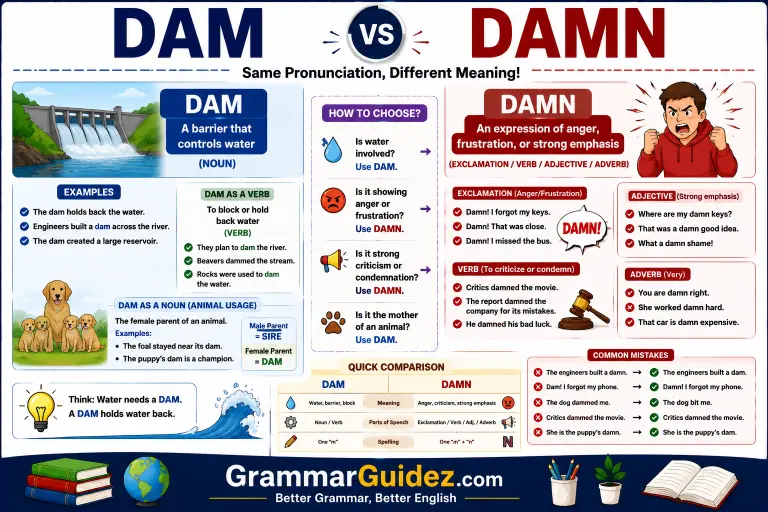
“Dam” and “damn” are both correct words, but they have very different meanings. “Dam” is a noun meaning a barrier built to hold back water, while “damn” is an expression used to show anger, surprise, or frustration and can also mean to strongly criticize or condemn.
Dam or damn? These two words sound almost exactly the same in English, but they have completely different meanings.
The easiest way to remember the difference is this:
Dam = a barrier that controls water
Damn = an expression of anger, criticism, or strong emphasis
For example:
The engineers built a dam across the river.
Here, dam is a structure that holds back or controls water.
Now look at this:
Damn! I forgot my keys.
Here, damn expresses anger or frustration.
Although dam and damn are pronounced the same in many varieties of English, they are not interchangeable. Their meanings, grammar, and uses are very different.
There is also another meaning of dam that many grammar articles miss. In animal breeding, a dam can mean the female parent of an animal.
This guide will help you understand dam vs. damn through meaning, context, pronunciation, examples, common mistakes, and simple memory tricks.
Dam or Damn: The Quick Answer
| Word | Main Meaning | Example |
| Dam | A barrier that controls water | The dam holds back water. |
| Dam | The female parent of an animal | The foal stayed near its dam. |
| Dam | To block or hold back | They dammed the stream. |
| Damn | An expression of anger or frustration | Damn! I forgot. |
| Damn | To strongly criticize or condemn | Critics damned the movie. |
A dam is usually connected with water or, in animal terminology, a mother animal.
Damn is connected with strong emotion, criticism, condemnation, or emphasis.
Start With the Meaning, Not the Spelling
When choosing between dam or damn, do not start by looking at the letters.
Start by asking:
What am I trying to say?
If your sentence is about:
- a river
- water
- a lake
- a barrier
- blocking something
you probably need:
dam
If your sentence expresses:
- anger
- frustration
- strong criticism
- condemnation
- strong emphasis
you probably need:
damn
This meaning-first method is the fastest way to choose the correct word.
What Does “Dam” Mean?
The most common meaning of dam is a structure built to stop or control the flow of water.
A dam may be built across:
- a river
- a stream
- a water channel
Its purpose may include storing water, controlling water flow, reducing flooding, or helping generate electricity.
A dictionary definition describes a dam as a barrier that prevents or restricts the flow of water or other material.
Examples
The dam controls the water level.
The river flows from the dam.
Engineers repaired the old dam.
The dam created a large reservoir.
In all of these sentences, dam is a noun.
Dam as a Verb
Dam can also be used as a verb.
To dam something means to block, stop, or hold back the flow of water.
Examples
Workers plan to dam the river.
The beavers dammed the stream.
Rocks were used to dam the water.
The company is damming part of the river.
The verb forms are:
| Verb Form | Word |
| Base form | Dam |
| Past tense | Dammed |
| Present participle | Damming |
The word is spelled with one m in its base form:
dam
But the m doubles before -ed and -ing:
dammed
damming
Dam Can Also Mean a Mother Animal
This is a less common meaning in everyday conversation, but it is important.
In animal breeding and zoology, dam means:
The female parent of an animal.
For example:
The puppy stayed close to its dam.
The horse’s dam was a champion.
The breeder provided information about the foal’s sire and dam.
In this context:
Dam = female parent
The male parent is often called:
Sire
This meaning has nothing to do with water.
What Does “Damn” Mean?
Damn has several uses.
It can be:
- an exclamation
- a verb
- an adjective
- an adverb
- part of an informal expression
Because of its history as a curse or swear word, damn may be considered offensive or impolite by some readers or listeners. Its strength can depend on the situation, culture, and audience.
Damn as an Expression of Anger or Frustration
One of the most common uses of damn is as an exclamation.
Examples
Damn! I missed the bus.
Damn! I forgot my phone.
The computer crashed again. Damn!
In these sentences, damn expresses:
- anger
- annoyance
- disappointment
- frustration
Cambridge lists this use as an informal expression and notes that it can be considered offensive.
Damn as a Verb
As a verb, damn can mean to strongly criticize, condemn, or curse someone or something.
Examples
Critics damned the movie.
The report damned the company for its mistakes.
He damned his bad luck.
The word can also have a religious meaning related to condemnation or punishment.
Verb Forms
| Verb Form | Word |
| Base form | Damn |
| Past tense | Damned |
| Present participle | Damning |
Examples:
Critics damn the film.
Critics damned the film.
The report is damning.
Damn as an Adjective for Emphasis
In informal English, damn can come before a noun to show strong emotion.
Examples
Where are my damn keys?
That is a damn good idea.
It was a damn shame.
The tone depends on the sentence.
Sometimes the speaker is angry:
This damn computer is broken again.
Sometimes the speaker is simply adding strong emphasis:
That was a damn good performance.
Cambridge recognizes damn as an informal adjective used for annoyance or emphasis.
Damn as an Adverb
Damn can also be used informally to mean:
Very
Examples
She worked damn hard.
You are damn lucky.
That car is damn expensive.
This use adds strong emphasis.
However, because damn can sound impolite, it may not be suitable for:
- formal business writing
- school assignments
- professional emails
- writing for children
Consider your audience before using it.
Dam vs. Damn: The Meaning Map
Here is a simple way to separate the two words.
Think About Water
If you think about:
River
Water
Barrier
Reservoir
Beaver
Use:
DAM
Example:
The beaver built a dam.
Think About Strong Emotion
If you think about:
Anger
Frustration
Surprise
Strong emphasis
Criticism
Use:
DAMN
Example:
Damn! I forgot the answer.
Do Dam and Damn Sound the Same?
Yes. In standard pronunciation, dam and damn are generally pronounced the same.
They are homophones in many varieties of English.
Both are commonly pronounced:
/dæm/
The silent n in damn does not normally create a separate sound.
For this reason:
dam
and
damn
can be confusing when listening to English.
The meaning usually becomes clear from context.
The Context Test: How to Choose the Right Word
Try this three-question test.
Question 1: Is Water Involved?
The workers built a ___.
Water is involved.
Correct:
dam
Question 2: Is the Sentence Showing Anger?
___! I dropped my phone.
The sentence shows frustration.
Correct:
Damn!
Question 3: Is Someone Being Strongly Criticized?
The critics ___ the film.
The sentence needs a verb meaning strongly criticize.
Correct:
damned
Dam or Damn in Everyday Sentences
Example 1: River
The dam stopped the water.
Correct because the sentence is about water.
Example 2: Frustration
Damn! I am late.
Correct because the speaker is expressing frustration.
Example 3: Animal Parent
The calf followed its dam.
Correct because dam means the female parent of an animal.
Example 4: Strong Criticism
Reviewers damned the poorly made film.
Correct because damned means strongly criticized.
Common Mistake 1: Writing “Damn” for a Water Barrier
Incorrect:
❌ The engineers built a damn across the river.
Correct:
✅ The engineers built a dam across the river.
Remember:
Water barrier = dam
Common Mistake 2: Writing “Dam” as an Expression of Anger
Incorrect:
❌ Dam! I forgot my homework.
Correct:
✅ Damn! I forgot my homework.
The extra n changes the word completely.
Common Mistake 3: Thinking Damn Is Always a Verb
Damn can be a verb, but it can also be an exclamation.
Compare:
Verb
Critics damned the movie.
Exclamation
Damn! That was close.
Adjective
Where are my damn shoes?
Adverb
He worked damn hard.
The meaning changes according to the sentence.
Common Mistake 4: Using Damn in Formal Writing Without Thinking
The word damn is common in everyday speech and informal writing.
However, some people consider it offensive.
In professional writing, you may prefer alternatives depending on the tone you need.
Instead of:
Damn! The report is late.
You could write:
Unfortunately, the report is late.
Instead of:
This damn problem is difficult.
You could write:
This frustrating problem is difficult.
Choosing language based on your audience is an important part of good writing.
Common Mistake 5: Forgetting That Dam Has More Than One Meaning
Most people know:
Dam = water barrier
But dam can also mean:
The female parent of an animal.
Example:
The breeder showed us the puppy’s dam.
This meaning is especially common in:
- animal breeding
- horse breeding
- dog breeding
- zoology
Dam and Damn: Side-by-Side Examples
| Sentence | Correct Word | Why? |
| The beaver built a ___ | Dam | A water barrier |
| ___! I lost my wallet | Damn | An expression of frustration |
| The horse stayed near its ___ | Dam | Female parent |
| Critics ___ the movie | Damned | Strongly criticized |
| The workers will ___ the stream | Dam | Block water |
| This is a ___ difficult problem | Damn | Strong emphasis |
The “Remove the N” Memory Trick
Here is a simple memory trick.
Think:
Dam has no N because it is a simple water barrier.
Damn has an N because it carries more emotional intensity.
You can also remember this sentence:
Water needs a dam. Anger needs damn.
This is not a grammar rule, but it is an easy memory aid.
Dam or Damn in Text Messages
In casual text messages, people may use:
Damn!
to express:
- surprise
- frustration
- disappointment
- admiration
Examples:
Damn, that looks good!
Damn! I forgot.
Damn, you did a great job.
The meaning depends heavily on tone and context.
In contrast, dam is normally used literally unless you are discussing water, engineering, beavers, or animal breeding.
Can You Say “Dam It”?
No, not when expressing frustration.
The correct expression is:
Damn it!
Example:
Damn it! I missed the train.
Writing:
❌ Dam it!
changes the meaning because dam is not the expression used here.
Dammed vs. Damning
The spelling of these words can also confuse writers.
Dam → Dammed
The beavers dammed the stream.
Damn → Damned
Critics damned the film.
Notice the difference:
dammed = related to blocking water
damned = related to criticism, condemnation, or cursing
The single letter n changes the entire meaning.
Damning vs. Damming
The same difference appears with -ing forms.
Damming
The workers are damming the river.
Meaning:
Blocking the water.
Damning
The newspaper published damning evidence.
Meaning:
Strongly damaging or strongly critical.
These words may look similar, but they belong to different meanings.
A Quick Sentence Challenge
Choose dam or damn.
1. The ___ controls the river’s water.
2. ___! I forgot the tickets.
3. The puppy stayed close to its ___.
4. The critics strongly ___ the movie.
5. Beavers often build a ___.
6. This is a ___ difficult situation.
Answers
- Dam
- Damn
- Dam
- Damned
- Dam
- Damn
Fill in the Blanks
Choose the correct word.
1.
The government repaired the old ______.
Answer: dam
2.
______! I left my phone at home.
Answer: Damn
3.
The animal stayed near its ______.
Answer: dam
4.
The report ______ the company for its poor decisions.
Answer: damned
5.
Workers tried to ______ the small stream.
Answer: dam
6.
That was a ______ good idea.
Answer: damn
FAQs
What is the difference between dam and damn?
A dam is usually a barrier that controls water. Damn is used to express anger, frustration, criticism, condemnation, or strong emphasis.
Are dam and damn pronounced the same?
Yes. In many varieties of English, dam and damn are pronounced the same.
The n in damn is usually silent.
Is dam a bad word?
No.
A dam is a normal word with meanings related to a water barrier or the female parent of an animal.
Is damn a bad word?
Some people consider damn a mild swear word or impolite expression. Its acceptability depends on the audience and situation.
It is generally safer to avoid it in formal or highly professional writing unless there is a clear reason to use it.
What does dam mean in animals?
In animal terminology, a dam is the female parent of an animal.
For example:
The puppy’s dam was a large dog.
What is the opposite of dam in animal breeding?
The male parent is commonly called the:
Sire
The female parent is the:
Dam
Is it “dam it” or “damn it”?
The correct expression is:
Damn it!
It is used to express anger or frustration.
What is the difference between dammed and damned?
Dammed = blocked with a dam.
Damned = strongly criticized, cursed, or condemned.
Example:
The beavers dammed the stream.
Critics damned the movie.
Conclusion
Although dam and damn sound almost the same, they have very different meanings.
Use dam when talking about:
- a water barrier
- blocking water
- the female parent of an animal
Use damn when expressing:
- anger
- frustration
- disappointment
- strong emphasis
- criticism or condemnation
The easiest way to remember is:
Water → Dam
Anger or strong emotion → Damn
For example:
The engineers built a dam across the river.
But:
Damn! I forgot my keys.
And remember the useful spelling distinction:
Dammed the river = blocked the water.
Damned the movie = strongly criticized the movie.
Once you focus on the meaning and context of the sentence, choosing between dam or damn becomes much easier.
Read More Article:
- To or Too: Difference and Usage
- Sees or See’s: Which Is Correct?
- Bit or Bite: What’s the Difference?

I am Evan Whitmore, an English language writer and the person who started GrammarGuidez.com. I made GrammarGuidez.com to make grammar, spelling, vocabulary and words that are often confused easier to understand.
I like taking to understand English words and grammar rules and turning them into simple and clear explanations. My aim is to help students, writers, bloggers, ESL learners and regular English speakers feel more sure when they write and talk.
At GrammarGuidez.com I work on real life examples easy to understand explanations comparing words, spelling changes and how American English is used every day.
I think learning English doesn’t need to be hard. A good explanation and some good examples can make tough grammar topics much simpler to learn