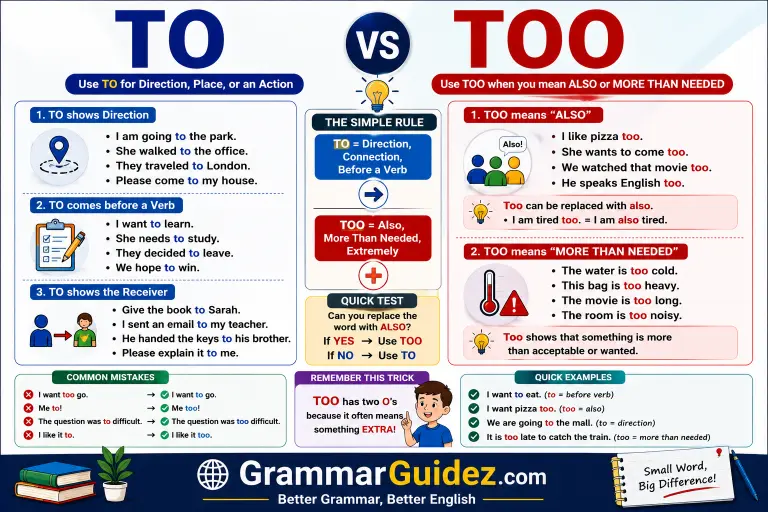
“To” and “too” are both correct words, but they have different meanings.“To” is commonly used as a preposition or before a verb, while “too” is an adverb meaning also or more than is needed or wanted.
Have you ever written a sentence and stopped at this simple question: to or too?
You are not alone.
These two words are very common in English. They are also easy to confuse because they sound exactly the same when spoken. However, they have different meanings and jobs in a sentence.
For example:
I want to learn English.
I want too much information.
A single extra o can completely change the meaning.
The good news is that learning the difference between to and too is much easier than many people think. You do not need to memorize complicated grammar rules. Once you understand the main jobs of each word, you can usually choose the correct one in seconds.
In this guide, you will learn the meaning of to, the meaning of too, common mistakes, easy memory tricks, and many real-life examples. By the end, choosing between to or too should feel much simpler.
Read More About: Then or Than
The Short Rule You Need to Remember
Before learning all the details, remember this simple rule:
Use to for direction, place, or an action.
Examples:
I am going to school.
She gave the book to me.
We want to eat.
Use too when you mean also or more than needed.
Examples:
I want to go too.
The coffee is too hot.
That is the main difference.
To usually connects something.
Too usually adds an extra meaning.
To vs Too at a Glance
| Word | Main Meaning | Example |
| To | Direction | I went to the store. |
| To | Before a verb | I want to sleep. |
| To | Shows a relationship | Give it to him. |
| Too | Also | She is coming too. |
| Too | More than needed | It is too expensive. |
| Too | Extremely | The box is too heavy. |
If you remember only one thing, remember this:
Too has an extra “o” because it often means something extra.
This simple trick can help you avoid many mistakes.
What Does “To” Mean?
The word to has several important jobs in English.
It is one of the most commonly used words in the language.
1. To Shows Direction
Use to when someone or something moves toward a place or person.
Examples:
We are going to the park.
She walked to the office.
They traveled to London.
Please come to my house.
In these sentences, to shows where someone is going.
2. To Comes Before Many Verbs
One of the most common uses of to is before the base form of a verb.
Examples:
I want to learn.
She needs to study.
They decided to leave.
We hope to win.
This structure is often called the to-infinitive.
You do not need to remember the grammar name to use it correctly. Just remember that to often comes before an action word.
For example:
I want to eat.
He plans to travel.
She forgot to call.
You would not use too in these sentences.
❌ I want too eat.
✅ I want to eat.
3. To Can Show Who Receives Something
Use to when something goes from one person to another.
Examples:
Give the letter to Sarah.
I sent an email to my teacher.
He handed the keys to his brother.
Please explain it to me.
Here, to helps show the receiver.
What Does “Too” Mean?
The word too has two major meanings.
Understanding these two meanings will solve most to or too mistakes.
Meaning 1: Too Means “Also”
When too means also, it adds another person or thing to the idea.
Examples:
I like pizza too.
She wants to come too.
We watched that movie too.
He speaks English too.
In many sentences, too can be replaced with also.
For example:
I am tired too.
You could say:
I am also tired.
The meaning is very similar.
A Quick Test
If also works in the sentence, too may be the correct choice.
Example:
Ali is coming ___.
Try:
Ali is coming also.
It works.
So:
Ali is coming too.
Meaning 2: Too Means “More Than Needed”
This is another very important use.
Use too when something is more than necessary, acceptable, possible, or wanted.
Examples:
The water is too cold.
This bag is too heavy.
The movie is too long.
The room is too noisy.
In these examples, too does not simply mean “very.”
There is often a negative idea.
For example:
The coffee is very hot.
This simply describes the coffee.
But:
The coffee is too hot.
This suggests a problem. Perhaps you cannot drink it.
That is an important difference.
The Most Useful Way to Choose Between To and Too
When writing, ask yourself one simple question:
Is this word showing an action, direction, or connection?
If yes, use to.
I need to leave.
Go to the door.
Give it to her.
Does the word mean “also” or “more than needed”?
If yes, use too.
I want one too.
It is too expensive.
She is coming too.
This method works in most everyday situations.
To or Too: See How the Meaning Changes
Look at these examples carefully.
Example 1
I want to eat.
Here, to comes before the verb eat.
Example 2
I want pizza too.
Here, too means also.
Example 3
The box is too heavy to lift.
The box is more than heavy enough to create a problem.
Example 4
I am going to work.
The word to shows direction.
Example 5
I am tired too.
The speaker is also tired.
The pronunciation is the same, but the meaning changes completely.
Common Situations Where People Confuse To and Too
Text Messages
Fast typing causes many mistakes.
❌ Your coming to?
This sentence has two problems.
The correct version could be:
You’re coming too?
Or:
Are you coming to the party?
The correct word depends on the meaning.
Social Media Posts
People often write:
❌ Me to!
The correct form is:
Me too!
Why?
Because too means also.
You are saying:
I feel the same way.
Emails
Consider this sentence:
❌ I would like too speak with you.
The correct sentence is:
I would like to speak with you.
The word comes before the verb speak, so use to.
School Writing
Students sometimes write:
❌ The question was to difficult.
The correct sentence is:
The question was too difficult.
The meaning is “more difficult than acceptable or manageable.”
A Simple Memory Trick
Here is the most popular trick for remembering too:
Too has two Os.
Think of the two Os as meaning:
- also
- extra
Or simply remember:
Too = extra
It has an extra letter, and it often means something extra.
For example:
too much
too many
me too
This trick is not a grammar rule, but it can help you remember the spelling.
Common Mistakes and How to Fix Them
Mistake 1: Me To
❌ Me to!
✅ Me too!
Why?
You mean:
Me also!
So use too.
Mistake 2: Too Before an Action Verb
❌ I want too go.
✅ I want to go.
When to comes before the base form of a verb, use to.
Other examples:
to eat
to sleep
Mistake 3: Using To for “Also”
❌ I like it to.
✅ I like it too.
The correct meaning is:
I also like it.
Therefore, use too.
Mistake 4: Confusing “Very” and “Too”
Consider these sentences:
The food is very spicy.
This means the food has a high level of spice.
Now look at:
The food is too spicy.
This suggests a problem.
Perhaps the speaker cannot eat it.
So too often means more than wanted or acceptable.
Real-Life Examples
At School
I need to finish my homework.
I need help too.
The homework is too difficult.
At Work
I have to send the report today.
My manager wants a copy too.
The deadline is too close.
At a Restaurant
I want to order pasta.
My friend wants pasta too.
The soup is too salty.
While Traveling
We are going to the airport.
Our friends are going there too.
It is too late to catch the train.
In Daily Conversation
Do you want to come?
Yes, I want to come too.
The first to comes before the verb come.
The second too means also.
To, Too, and Two: A Quick Warning
Although this article focuses on to or too, you should also remember the word two.
All three words sound alike:
to
too
two
But they have different meanings.
To
Shows direction or comes before a verb.
Go to school.
I want to learn.
Too
Means also or more than needed.
I want one too.
It is too expensive.
Two
Means the number 2.
I have two books.
A simple memory guide is:
Two = 2
Too = also or extra
To = direction or action
Try This Quick Test
Choose to or too.
1. I want ___ learn English.
2. This bag is ___ heavy.
3. She is coming ___.
4. We went ___ the store.
5. It is ___ late.
6. Please give this ___ your teacher.
7. I would like ___ join you.
8. My brother likes football ___.
9. The music is ___ loud.
10. They traveled ___ Canada.
Answers
- to
- too
- too
- to
- too
- to
- to
- too
- too
- to
Fill in the Blanks
Complete each sentence with to or too.
- I am going ___ call her later.
- The box is ___ big for the car.
- Can you come ___ my office?
- I want some coffee ___.
- It is ___ cold outside.
- She needs ___ study tonight.
- Give the message ___ your father.
- We watched the same movie ___.
- The table is ___ large for this room.
- They plan ___ visit us tomorrow.
Answers
- to
- too
- to
- too
- too
- to
- to
- too
- too
- to
Writing Tips for Using To and Too Correctly
Before you publish an email, article, assignment, or social media post, check these two rules.
Use to when:
- Moving toward something
- Naming a destination
- Showing a receiver
- Connecting to a base verb
Examples:
go to
talk to
give to
want to learn
Use too when:
- You mean also
- Something is excessive
- Something is more than needed
Examples:
me too
too much
too expensive
FAQs
Is “me too” correct?
Yes. Me too is correct when you mean that you feel, think, want, or experience the same thing as another person.
For example:
“I am tired.”
“Me too.”
Here, too means also.
How do I know when to use to or too?
Ask what you mean. Use to for direction, connection, or before many verbs. Use too when you mean also or more than needed.
For example:
I want to go.
I want to go too.
Is “too much” always correct?
Yes, too much is correct when something is excessive.
For example:
There is too much noise.
You eat too much sugar.
This work is too much for one person.
Why do to and too sound the same?
To and too are homophones. Homophones are words that have the same pronunciation but different spellings and meanings.
This is why they can be confusing in writing.
Can too come before an adjective?
Yes. Too often comes before an adjective when something is excessive.
Examples:
too expensive
too difficult
Is “I want to too” correct?
In casual speech, people may say sentences such as:
I want to too.
However, this can sound unclear in writing. It is often better to write:
I want to do that too.
Adding the main verb makes the sentence easier to understand.
Is “to much” correct?
No, not when you mean an excessive amount.
❌ to much
✅ too much
Example:
There is too much work.
Conclusion
The difference between to and too is simple once you know what each word does.
Use to when you are talking about direction, a connection, or an action.
I want to learn.
Go to school.
Give it to me.
Use too when you mean also or more than needed.
I want one too.
The bag is too heavy.
The easiest memory trick is to remember that too has an extra “o”, and it often adds an extra meaning.
When you are unsure, pause and ask:
Does this mean “also” or “more than needed”?
If yes, choose too.
If the word connects to a place, person, or action, choose to.
With a little practice, this common English mistake becomes very easy to avoid. Keep writing, check your meaning, and soon you will choose to or too without even thinking about it.

I am Evan Whitmore, an English language writer and the person who started GrammarGuidez.com. I made GrammarGuidez.com to make grammar, spelling, vocabulary and words that are often confused easier to understand.
I like taking to understand English words and grammar rules and turning them into simple and clear explanations. My aim is to help students, writers, bloggers, ESL learners and regular English speakers feel more sure when they write and talk.
At GrammarGuidez.com I work on real life examples easy to understand explanations comparing words, spelling changes and how American English is used every day.
I think learning English doesn’t need to be hard. A good explanation and some good examples can make tough grammar topics much simpler to learn