“Last” and “lasts” are both correct words, but they are used in different grammatical forms. “Last” can be a verb meaning to continue for a period of time or an adjective meaning final, while “lasts” is the third-person singular form of the verb last, meaning continues for a period of time.
Lasts or last is a common English grammar question because both words come from the same verb. The correct choice depends mainly on the subject of the sentence.
For example:
- The movie lasts two hours. ✅
- The movies last two hours. ✅
The word lasts is usually used with he, she, it, or one singular noun in the present simple tense. The word last is used with I, you, we, they, and plural nouns. Cambridge Grammar explains that most present-simple verbs add -s with third-person singular subjects such as he, she, and it.
However, last can also work as an adjective, adverb, or noun. That makes this comparison slightly more interesting than a simple spelling question.
In this guide, you will learn the difference between lasts and last, see clear examples, understand common mistakes, and discover an easy way to remember the correct form.
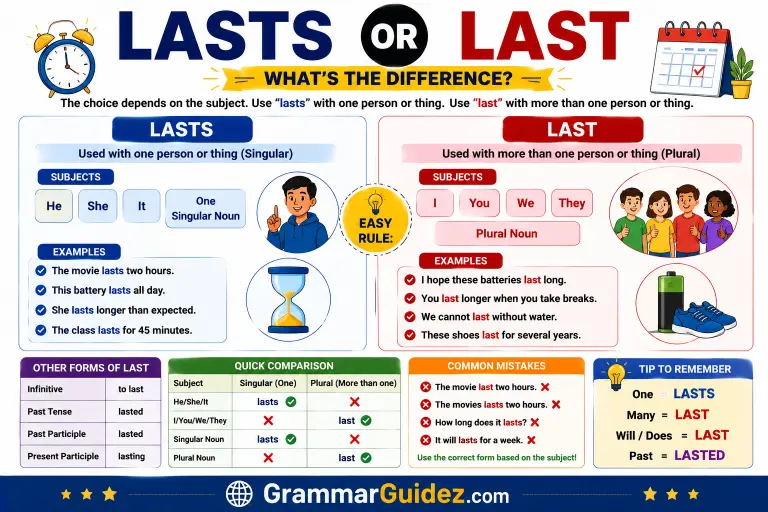
The Quick Rule: Lasts vs Last
Here is the fastest answer:
| Subject | Correct Word | Example |
| I | last | I hope the food will last. |
| You | last | Your battery lasts? ❌ / Your battery will last. ✅ |
| We | last | We cannot last forever. |
| They | last | These shoes last a long time. |
| He | lasts | He lasts longer than expected. |
| She | lasts | Her interest lasts for years. |
| It | lasts | The movie lasts two hours. |
| Singular noun | lasts | The battery lasts all day. |
| Plural noun | last | The batteries last all day. |
The main rule:
One person or thing → lasts
More than one person or thing → last
What Does “Last” Mean?
As a verb, last usually means:
- To continue for a period of time
- To continue to exist
- To remain in good condition
- To be enough for a certain period
Cambridge Dictionary defines the verb last as continuing to exist or continuing for a period of time.
Examples
How long will the meeting last?
These shoes should last for years.
We hope the good weather will last.
The food will last until Friday.
Merriam-Webster also lists last as a verb meaning to continue in time or remain useful or unimpaired.
What Does “Lasts” Mean?
Lasts is the present-simple form of the verb last used with a singular third-person subject.
For example:
The meeting lasts two hours.
Her phone battery lasts all day.
The summer festival lasts three days.
He lasts longer than most people expect.
The word lasts means the same basic thing as the verb last. The difference is grammatical.
Merriam-Webster identifies lasts as the present-tense third-person singular form of last.
Lasts or Last: The Subject Makes the Difference
The easiest way to choose between lasts and last is to look at the subject.
Use “Lasts” With One Person or Thing
Use lasts with:
- He
- She
- It
- One singular noun
Examples
She lasts longer under pressure.
The concert lasts three hours.
This battery lasts all day.
The class lasts for 45 minutes.
Because each subject is singular, lasts is correct.
Use “Last” With Plural Subjects
Use last with:
- I
- You
- We
- They
- Plural nouns
Examples
I hope these supplies last.
You last longer when you take breaks.
We cannot last without water.
They last for several years.
These batteries last longer.
No -s is added to the verb with these subjects.
Why Does “Last” Become “Lasts”?
This follows a common English grammar rule.
In the present simple tense, most verbs add -s when the subject is:
- He
- She
- It
- One singular noun
For example:
| Base Verb | He/She/It Form |
| work | works |
| play | plays |
| run | runs |
| come | comes |
| last | lasts |
Cambridge Grammar explains that the present simple generally uses the base verb, with -s added for the third-person singular form.
Therefore:
The movie lasts two hours. ✅
But:
The movies last two hours. ✅
Lasts vs Last in Real Sentences
Let’s compare the two forms directly.
Singular
The meeting lasts one hour.
There is one meeting.
Plural
The meetings last one hour.
There is more than one meeting.
Singular
This battery lasts all day.
One battery.
Plural
These batteries last all day.
More than one battery.
Singular
The show lasts until midnight.
One show.
Plural
The shows last until midnight.
More than one show.
The meaning stays similar. The subject changes, so the verb form changes.
The Important Difference Between “Will Last” and “Lasts”
Many learners become confused when they see will last.
Look at these sentences:
The event lasts two days.
The event will last two days.
Both sentences can be correct.
Lasts
Use lasts for a general fact, schedule, or regular arrangement.
The class lasts 60 minutes.
The festival lasts three days every year.
Will last
Use will last for the future.
The class will last 60 minutes tomorrow.
The festival will last three days.
After will, always use the base form.
❌ The event will lasts three days.
✅ The event will last three days.
Last or Lasts After “Does”?
This is another common mistake.
After does, use the base verb last, not lasts.
Correct
How long does the movie last?
Incorrect
How long does the movie lasts? ❌
The word does already carries the third-person singular grammar.
The same rule applies to other verbs:
Does she work? ✅
Not:
Does she works? ❌
So remember:
Does + last
Not:
Does + lasts
Last or Lasts After “Doesn’t”?
The same rule applies after doesn’t.
Correct
The battery doesn’t last long.
Incorrect
The battery doesn’t lasts long. ❌
Again:
doesn’t + base verb
Therefore:
It lasts. ✅
But:
It doesn’t last. ✅
Last as a Verb vs Last as an Adjective
One reason this keyword can be confusing is that last has more than one job in English.
Last as a Verb
It means to continue.
The meeting will last two hours.
The battery lasts all day.
Last as an Adjective
It can mean the final one or the most recent one.
This is my last chance.
I saw him last week.
She was the last person to leave.
Cambridge Dictionary records last with several grammatical uses, including adjective, adverb, pronoun, noun, and verb.
Last as an Adverb
Last can also describe something happening most recently or after everything else.
Examples
He finished last.
When did you last visit London?
I last saw her in June.
In these cases, last does not mean the same thing as the verb last.
Last as a Noun
Last can also be a noun.
For example:
He came in last.
This is the last of the cake.
It refers to the final person or thing remaining.
Merriam-Webster lists last as both a verb and a noun, with several different meanings depending on context.
Common Mistakes With Lasts and Last
Mistake 1: Using “Last” With a Singular Subject
❌ The movie last two hours.
✅ The movie lasts two hours.
The movie is singular.
Therefore, add -s.
Mistake 2: Using “Lasts” With a Plural Subject
❌ The movies lasts two hours.
✅ The movies last two hours.
Movies is plural.
Use the base verb.
Mistake 3: Using “Lasts” After Will
❌ The event will lasts three days.
✅ The event will last three days.
After will, use the base form.
Mistake 4: Using “Lasts” After Does
❌ How long does the meeting lasts?
✅ How long does the meeting last?
After does, use the base verb.
Mistake 5: Confusing the Past Form
The past tense of last is lasted.
The meeting lasted two hours yesterday.
Do not use:
❌ The meeting lasts two hours yesterday.
When talking about a completed event in the past, use lasted.
Merriam-Webster lists the verb forms as lasted, lasting, lasts.
A Simple Formula to Remember
Use this pattern:
Present Simple
I/You/We/They + last
They last a long time.
Present Simple
He/She/It + lasts
It lasts a long time.
Future
Subject + will + last
It will last a long time.
Past
Subject + lasted
It lasted a long time.
Negative
Doesn’t + last
It doesn’t last long.
This small formula will help you avoid most mistakes.
Everyday Examples
Talking About Batteries
This battery lasts for 12 hours.
These batteries last for 12 hours.
The battery will last until tomorrow.
The old battery lasted only two hours.
Talking About Meetings
The meeting lasts one hour.
Meetings usually last one hour.
How long will the meeting last?
Yesterday’s meeting lasted two hours.
Talking About Products
This phone lasts a long time.
Good phones last for years.
The new phone should last longer.
My old phone lasted five years.
Talking About Events
The concert lasts three hours.
Most concerts last between two and three hours.
How long will the concert last?
The concert lasted longer than expected.
British English vs American English
There is no important spelling difference between British and American English here.
Both varieties use:
- last
- lasts
- lasted
- lasting
For example:
🇬🇧 British English:
The meeting lasts two hours.
🇺🇸 American English:
The meeting lasts two hours.
The grammar rule remains the same.
Tips to Remember the Difference
Here are some easy memory tricks.
Tip 1: Look for “He, She, or It”
If the subject is he, she, or it, use:
lasts
Example:
It lasts all day.
Tip 2: Look for More Than One
If the subject is plural, use:
last
Example:
Batteries last longer in warm conditions.
Tip 3: Remember “Will + Base Verb”
If you see will, use:
will last
Never:
will lasts ❌
Tip 4: Remember “Does + Base Verb”
Does it last?
Not:
Does it lasts? ❌
Quick Comparison Table
| Situation | Correct Form |
| The movie ___ two hours. | lasts |
| Movies ___ two hours. | last |
| It will ___ two hours. | last |
| Does it ___ two hours? | last |
| It doesn’t ___ long. | last |
| It ___ yesterday. | lasted |
| She ___ longer than expected. | lasts |
| They ___ longer than expected. | last |
Mini Quiz: Lasts or Last?
Choose the correct answer.
1. The movie ___ for two hours.
A. last
B. lasts
2. These batteries ___ for a long time.
A. last
B. lasts
3. The event will ___ three days.
A. last
B. lasts
4. How long does the meeting ___?
A. last
B. lasts
5. My phone usually ___ all day.
A. last
B. lasts
6. Good friendships often ___ for many years.
A. last
B. lasts
7. The battery doesn’t ___ long.
A. last
B. lasts
8. The old phone ___ for five years.
A. last
B. lasted
Answers
- B — lasts
- A — last
- A — last
- A — last
- B — lasts
- A — last
- A — last
- B — lasted
Fill in the Blanks
Choose last, lasts, or lasted.
- The lesson ______ for one hour.
- These shoes ______ a long time.
- The food will ______ until tomorrow.
- How long does the movie ______?
- Her phone battery ______ all day.
- The meeting ______ three hours yesterday.
- Most good products ______ for years.
- It doesn’t ______ very long.
Answers
- lasts
- last
- last
- last
- lasts
- lasted
- last
- last
FAQs
Is it “lasts” or “last”?
Both are correct, depending on the subject. Use lasts with singular third-person subjects such as he, she, it, or one singular noun. Use last with I, you, we, they, and plural nouns.
Does a movie last or lasts?
If you are using does, say:
Does the movie last two hours?
If you are making a normal present-tense statement, say:
The movie lasts two hours.
The grammar changes because does requires the base verb.
Is “how long does it lasts” correct?
No.
The correct sentence is:
How long does it last?
After does, use the base form last.
Why does “last” become “lasts”?
In the present simple, English usually adds -s to the verb when the subject is he, she, or it. That is why we say “It lasts” but “They last.”
Is “will lasts” correct?
No.
After will, always use the base form.
Correct:
It will last.
Incorrect:
It will lasts. ❌
What is the past tense of last?
The past tense is lasted.
The meeting lasted two hours.
The battery lasted all day.
The verb forms are last, lasted, lasting, and lasts.
Can “last” be used as a noun?
Yes. Last can be a noun, adjective, adverb, or verb, depending on the sentence.
For example:
He finished last.
This is the last page.
How long will it last?
These sentences use the word in different grammatical ways.
Conclusion
The difference between lasts or last is mainly about subject-verb agreement.
Use lasts when the subject is:
- He
- She
- It
- One singular noun
The movie lasts two hours.
Use last when the subject is:
- I
- You
- We
- They
- More than one noun
Movies last two hours.
Also remember:
Will + last
Does + last
Doesn’t + last
Yesterday/Past event + lasted
The easiest way to remember everything is this:
One = lasts
Many = last
Will/does = last
Past = lasted
Once you focus on the subject and tense, choosing between last and lasts becomes simple.
Read More Articles:
- As or Like: Difference and Grammar Rules
- Non or None: Which One Should You Use?
- Feal or Feel: Difference and Correct Spelling

I am Evan Whitmore, an English language writer and the person who started GrammarGuidez.com. I made GrammarGuidez.com to make grammar, spelling, vocabulary and words that are often confused easier to understand.
I like taking to understand English words and grammar rules and turning them into simple and clear explanations. My aim is to help students, writers, bloggers, ESL learners and regular English speakers feel more sure when they write and talk.
At GrammarGuidez.com I work on real life examples easy to understand explanations comparing words, spelling changes and how American English is used every day.
I think learning English doesn’t need to be hard. A good explanation and some good examples can make tough grammar topics much simpler to learn