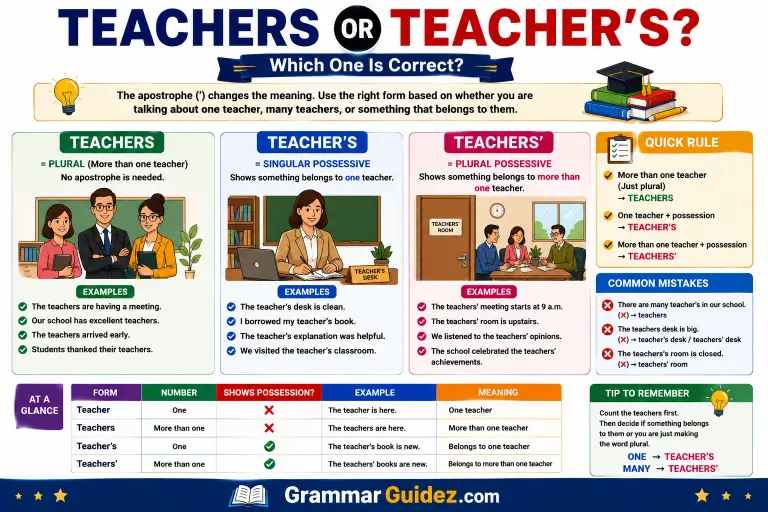
“Teachers” and “teacher’s” are both correct, but they have different meanings. “Teachers” is the plural form of teacher, meaning more than one teacher, while “teacher’s” is the possessive form, meaning something belongs to one teacher.
Many English learners search for teachers or teacher’s because one small apostrophe can completely change the meaning of a word.
The good news is that the rule is simple. Teachers means more than one teacher. Teacher’s shows that something belongs to, relates to, or is connected with one teacher.
However, there is also a third form that causes confusion: teachers’. This form shows possession or connection involving more than one teacher.
So, before choosing between teachers or teacher’s, you should ask one simple question:
Am I talking about more than one teacher, or am I showing that something belongs to one teacher?
This article explains teachers, teacher’s, and teachers’ with simple rules, real-life examples, common mistakes, writing tips, and practice exercises.
Teachers vs Teacher’s: The Quick Answer
Here is the simplest way to understand the difference:
| Form | Meaning | Example |
| Teacher | One teacher | The teacher is here. |
| Teachers | More than one teacher | The teachers are here. |
| Teacher’s | Something belonging to one teacher | The teacher’s desk is clean. |
| Teachers’ | Something belonging to more than one teacher | The teachers’ room is upstairs. |
The key rule is:
Teachers = plural
No apostrophe is needed.
Teacher’s = singular possessive
One teacher owns or is connected to something.
Teachers’ = plural possessive
More than one teacher owns or is connected to something.
Cambridge Grammar explains that singular nouns usually take ‘s, while regular plural nouns ending in s take an apostrophe after the s.
Start With the Word “Teacher”
A teacher is a person who teaches or instructs others.
Merriam-Webster defines a teacher as a person whose occupation is to instruct.
Examples
My teacher is very helpful.
The teacher explained the lesson.
Her teacher gave her good advice.
In all these examples, we are talking about one person.
When Should You Use “Teachers”?
Use teachers when you are talking about two or more teachers.
There is no apostrophe because you are simply making the noun plural.
Examples
The teachers are having a meeting.
Our school has many excellent teachers.
The teachers arrived early.
Students thanked their teachers.
The word teachers answers the question:
How many?
The answer is:
More than one.
Simple Formula
Teacher + s = Teachers
Remember:
An apostrophe does not make a noun plural.
Cambridge specifically warns against using apostrophes simply to create plurals.
When Should You Use “Teacher’s”?
Use teacher’s when something belongs to or is connected with one teacher.
The apostrophe comes before the s.
Formula
One teacher + possession = teacher’s
Examples
The teacher’s desk is near the window.
The desk belongs to one teacher.
I borrowed my teacher’s book.
One teacher owns or is connected with the book.
The teacher’s explanation was helpful.
The explanation came from one teacher.
We visited the teacher’s classroom.
The classroom is associated with one teacher.
Cambridge Grammar explains that ‘s is used with a singular noun to show possession or a close relationship.
Don’t Forget “Teachers’”
Although the main keyword is teachers or teacher’s, understanding teachers’ is essential.
Teachers’ is the plural possessive form.
It refers to something belonging to, created by, used by, or connected with more than one teacher.
Formula
More than one teacher + possession = teachers’
Examples
The teachers’ meeting starts at 9 a.m.
The meeting involves multiple teachers.
The teachers’ room is on the second floor.
The room is for multiple teachers.
We listened to the teachers’ opinions.
The opinions came from several teachers.
The school celebrated the teachers’ achievements.
The achievements belong to or relate to multiple teachers.
For regular plural nouns ending in s, Cambridge Grammar places the apostrophe after the final s.
Teachers or Teacher’s: The Main Difference
The easiest way to understand the difference is to look at meaning.
Teachers
Teachers means simply:
More than one teacher.
Example:
The teachers are talking.
Nothing belongs to anyone. You are only talking about multiple people.
Teacher’s
Teacher’s means:
Something connected with one teacher.
Example:
The teacher’s bag is on the chair.
The bag belongs to one teacher.
Teachers’
Teachers’ means:
Something connected with multiple teachers.
Example:
The teachers’ bags are in the office.
The bags belong to several teachers.
Comparison Table
| Form | Number of Teachers | Shows Possession? | Example |
| Teacher | One | No | The teacher arrived. |
| Teachers | More than one | No | The teachers arrived. |
| Teacher’s | One | Yes | The teacher’s car is outside. |
| Teachers’ | More than one | Yes | The teachers’ cars are outside. |
A Simple Trick: Count Before You Write
When deciding between teachers or teacher’s, do not look at the apostrophe first.
Instead, count the teachers.
Step 1: Is there one teacher?
If yes, use:
teacher
Example:
The teacher is busy.
If something belongs to that one teacher:
teacher’s
Example:
The teacher’s laptop is new.
Step 2: Are there multiple teachers?
If yes, use:
teachers
Example:
The teachers are busy.
If something belongs to or relates to those teachers:
teachers’
Example:
The teachers’ laptops are new.
This counting method works with many English nouns.
Teacher’s vs Teachers’: Why Does the Apostrophe Move?
The position of the apostrophe tells you if the owner is singular or plural.
One teacher
Teacher’s
The apostrophe comes before the s.
The teacher’s pen
Meaning:
The pen of one teacher.
More than one teacher
Teachers’
The word already ends in s because it is plural.
The apostrophe comes after the s.
The teachers’ pens
Meaning:
The pens of several teachers.
Cambridge gives the same basic rule for singular and plural possessive nouns.
Teachers or Teacher’s in School Writing
This confusion appears often in school essays, notices, emails, and assignments.
Consider these examples.
Correct
All the teachers attended the meeting.
More than one teacher.
Correct
The teacher’s presentation was excellent.
One teacher gave the presentation.
Correct
The teachers’ presentations were excellent.
Multiple teachers gave presentations.
A small apostrophe changes the meaning.
Common Mistakes
Mistake 1: Using an Apostrophe to Make “Teacher” Plural
❌ There are many teacher’s in our school.
✅ There are many teachers in our school.
Why?
You are talking about more than one teacher.
You are not showing possession.
So you only need s, not an apostrophe.
Mistake 2: Forgetting the Apostrophe
❌ The teachers desk is broken.
This sentence is unclear.
If one teacher owns the desk:
✅ The teacher’s desk is broken.
If several teachers share the desk:
✅ The teachers’ desk is broken.
Mistake 3: Putting the Apostrophe in the Wrong Place
❌ The teacher’s meeting starts at 10.
This could mean one teacher’s meeting.
If the meeting is for several teachers:
✅ The teachers’ meeting starts at 10.
Mistake 4: Writing “Teachers’s”
❌ The teachers’s room
✅ The teachers’ room
The word teachers already ends in s.
You only add an apostrophe after the plural s.
Cambridge Grammar notes that regular plural nouns ending in s take the apostrophe after the final s when used possessively.
Real-Life Examples of Teachers, Teacher’s, and Teachers’
In Emails
Dear Teachers, please check your email.
Here, teachers is plural.
I have attached the teacher’s report.
The report relates to one teacher.
We discussed the teachers’ reports.
The reports relate to multiple teachers.
In Academic Writing
The teachers used different teaching methods.
The teacher’s method improved student participation.
The teachers’ methods improved student participation.
Notice how the meaning changes.
In School Notices
All teachers must attend.
More than one teacher.
The teacher’s office is closed.
One teacher’s office.
The teachers’ offices are closed.
Offices belonging to multiple teachers.
In Everyday Conversation
Our teachers are very friendly.
My teacher’s advice helped me.
The teachers’ decision surprised the students.
Does “Teacher’s” Always Mean Ownership?
Not always.
Possessive forms can show more than direct ownership.
For example:
The teacher’s meeting
The teacher does not necessarily “own” the meeting.
The phrase simply shows a relationship or connection.
The same is true in:
The teacher’s advice.
The teacher’s classroom.
Possessive grammar can show belonging or a close relationship between nouns. Cambridge explains that possessive forms are used for ownership and other close relationships.
Teachers vs Teacher’s in British and American English
There is no major British-English versus American-English difference here.
Both varieties follow the same basic rules:
| Meaning | British English | American English |
| More than one teacher | Teachers | Teachers |
| One teacher’s possession | Teacher’s | Teacher’s |
| Multiple teachers’ possession | Teachers’ | Teachers’ |
Therefore, this is a grammar and punctuation issue, not a regional spelling difference.
Which Form Should Students Use?
Students should use the form that matches the meaning.
Use teachers when:
You mean more than one teacher.
The teachers explained the lesson.
Use teacher’s when:
Something belongs to or relates to one teacher.
The teacher’s lesson was interesting.
Use teachers’ when:
Something belongs to or relates to multiple teachers.
The teachers’ lessons were interesting.
Always ask:
How many teachers are involved?
That question usually gives you the answer.
Easy Memory Tricks
Here are three simple tricks.
1. No apostrophe = just plural
teachers
Think:
Many teachers. Nothing belongs to them in this sentence.
2. Apostrophe before S = one teacher
teacher’s
Think:
One teacher’s book.
3. Apostrophe after S = many teachers
teachers’
Think:
Many teachers’ books.
Quick Visual Rule
One → teacher’s
Many → teachers
Many + possession → teachers’
Mini Quiz: Teachers or Teacher’s?
Choose the correct answer.
1. The ______ are preparing for class.
A. teacher’s
B. teachers
2. The ______ desk is near the door.
A. teacher’s
B. teachers
3. Many ______ work at this school.
A. teacher’s
B. teachers
4. I liked my ______ explanation.
A. teacher’s
B. teachers
5. The ______ room is closed.
A. teachers’
B. teacher
6. All ______ attended the event.
A. teacher’s
B. teachers
7. The ______ opinions were different.
A. teachers’
B. teacher’s
8. My ______ book is on the table.
A. teacher’s
B. teachers
Answers
- B — teachers
- A — teacher’s
- B — teachers
- A — teacher’s
- A — teachers’
- B — teachers
- A — teachers’
- A — teacher’s
Fill in the Blanks
Choose teachers, teacher’s, or teachers’.
- The ______ are waiting outside.
- My ______ advice helped me.
- The ______ meeting begins at 8 a.m.
- All ______ received new books.
- The ______ laptop is on the desk.
- The ______ room was recently painted.
- Our ______ are very supportive.
- The ______ opinions were discussed.
Answers
- teachers
- teacher’s
- teachers’
- teachers
- teacher’s
- teachers’
- teachers
- teachers’
FAQs
Is it teachers or teacher’s?
Both can be correct, but they have different meanings. Teachers is the plural form and means more than one teacher. Teacher’s is the singular possessive form and shows that something belongs to or relates to one teacher.
What is the difference between teachers and teacher’s?
Teachers means multiple teachers. Teacher’s refers to something connected with one teacher. For example, “The teachers are here” refers to several people, while “The teacher’s book is here” refers to a book connected with one teacher.
Is “teachers’” correct?
Yes. Teachers’ is the plural possessive form. Use it when something belongs to or relates to more than one teacher.
The teachers’ meeting
The teachers’ opinions
Cambridge Grammar uses an apostrophe after a plural noun ending in s to show possession.
How do you write “teachers meeting” correctly?
If the meeting involves multiple teachers, write:
teachers’ meeting
The apostrophe comes after the s because teachers is plural.
If the meeting belongs to or involves only one teacher, write:
teacher’s meeting
Is “teacher’s” plural?
No. Teacher’s is usually the singular possessive form. It refers to one teacher and something connected with that teacher.
The teacher’s desk
The teacher’s book
Why does teachers’ have the apostrophe at the end?
The word teachers is already plural because it ends in s. To make a regular plural noun possessive, English places the apostrophe after the final s.
Can I use an apostrophe to make teacher plural?
No. The plural of teacher is simply:
teachers
An apostrophe is not used just to make a noun plural.
Conclusion
The difference between teachers or teacher’s becomes easy when you understand the purpose of the apostrophe.
Use teachers for more than one teacher.
The teachers are ready.
Use teacher’s for something related to one teacher.
The teacher’s book is missing.
Use teachers’ for something related to multiple teachers.
The teachers’ books are missing.
The best way to choose the correct form is to pause and ask:
Am I talking about one teacher or many teachers?
Then ask:
Am I simply making the word plural, or am I showing possession or connection?
Once you answer those two questions, the correct form becomes much easier to choose.
Read More Articles:
- Come or Cum: What’s the Difference?
- Non or None: Which Word Should You Use?
- Feal or Feel: Which Spelling Is Correct?

I am Elliot Hartwell, an English language writer and the author at GrammarGuidez.com. For the 6 years I have been working with English grammar, vocabulary, spelling and everyday language usage with a focus on making confusing topics easier to understand.
I started GrammarGuidez.com with a goal: to give readers clear and practical answers to common English questions. English can sometimes be confusing especially when two words look or sound similar but have meanings or uses. I enjoy breaking down these differences in a way that’s simple and easy to remember.
I believe learning English should feel simple not overwhelming. My goal is to make every article on GrammarGuidez.com useful, for students, writers, bloggers, teachers and anyone who wants to communicate clearly in English.