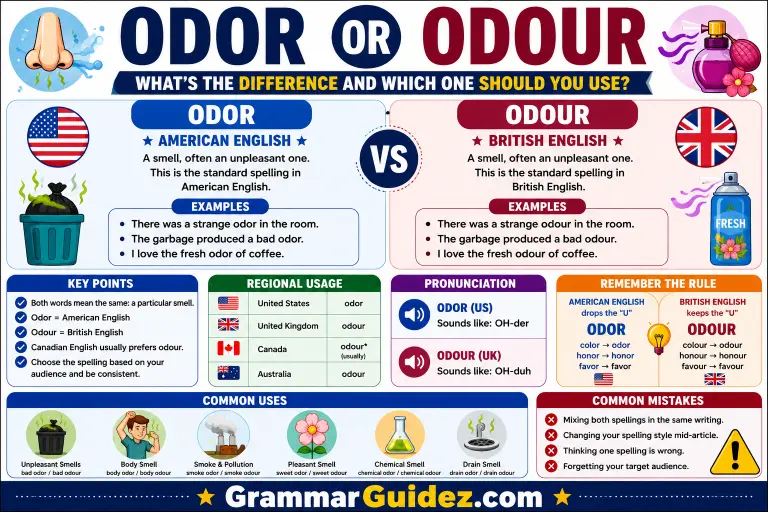
“Odor” and “odour” are both correct spellings, but their usage depends on the variety of English. “Odor” is the standard spelling in American English, while “odour” is the standard spelling in British English. Both refer to a smell, especially one that can be noticed by the nose.
Have you ever typed odor or odour and wondered which spelling is correct? Both words are correct, but the spelling you should use depends mainly on the type of English you are writing.
Odor and odour have the same meaning. They both refer to a smell, especially one that may be unpleasant. Cambridge Dictionary lists odor as the US spelling of odour, while odour is marked as the UK form.
The main difference is therefore not meaning. It is regional spelling.
American English normally uses odor. British English normally uses odour. Canadian English commonly uses odour, too. Oxford also identifies odor as the American form and notes that Canadian English usually uses odour.
In this guide, you will learn the meaning of both words, their history, pronunciation, British and American usage, common mistakes, examples, and simple tips to remember which spelling to choose.
Odor or Odour – Quick Answer
Odor and odour are both correct spellings of the same word.
The difference is mainly regional:
- Odor = American English
- Odour = British English
- Odour = Usually Canadian English
- Odour = Common in other varieties that follow British spelling
Both words mean a smell, often an unpleasant one. Cambridge Dictionary directly identifies odor as the US spelling of odour.
Examples
American English:
There was a strange odor coming from the kitchen.
British English:
There was a strange odour coming from the kitchen.
The meaning does not change.
Which One Should You Use?
If you are writing for readers in the United States, use odor.
If you are writing in British English, use odour.
Odour is generally the safer choice. Oxford specifically notes that Canadian English usually uses odour.
What Does Each Word Mean?
Meaning of Odor
Odor is a noun meaning a particular smell. It can describe a pleasant smell, but it is often used for an unpleasant smell.
Examples:
- The room had a strange odor.
- I noticed a strong odor of smoke.
- The garbage produced an unpleasant odor.
- The flowers gave off a sweet odor.
Cambridge defines odor as a particular smell, especially a bad one.
Part of speech: Noun
American pronunciation: /ˈoʊ.dɚ/
Meaning of Odour
Odour has exactly the same basic meaning as odor.
It is the spelling commonly used in British English.
Examples:
- There was a strange odour in the room.
- The kitchen was filled with the odour of fresh bread.
- A strong odour came from the drain.
- The odour of smoke filled the house.
Cambridge defines odour as a smell, often one that is unpleasant.
Part of speech: Noun
British pronunciation: /ˈəʊ.də/
What Is the Difference Between Odor and Odour?
The simple answer is:
There is no difference in meaning. The difference is spelling and regional usage.
| Feature | Odor | Odour |
| Meaning | A smell | A smell |
| Part of speech | Noun | Noun |
| American English | Preferred | Usually not used |
| British English | Usually not used | Preferred |
| Canadian English | Less common | Usually preferred |
| Australian English | Less common | Common |
| Pronunciation | Same basic word | Same basic word |
| Formality | Neutral/formal | Neutral/formal |
| Correct spelling | Yes | Yes |
For example:
The odor of smoke was strong.
and
The odour of smoke was strong.
Both sentences are grammatically correct. The spelling simply tells readers which regional variety of English you are following.
Odor vs Odour: Is One More Correct?
No.
It would be incorrect to say that odor is the correct spelling and odour is wrong, or vice versa.
Both forms are established English spellings.
Cambridge labels odor as the US spelling of odour, while its British entry lists odour and gives odor as the US form.
Think of this difference like:
- color / colour
- favor / favour
- honor / honour
- odor / odour
American English often removes the u in these words, while British English keeps it.
Origin and History
Etymology of Odor and Odour
Odor and odour come from the same historical word.
Oxford traces odour to Middle English, from Anglo-Norman French, and ultimately from the Latin odor, meaning “smell” or “scent.”
So the two modern spellings are not different words with different origins. They are regional forms of the same word.
Why Does the Spelling Differ?
The difference developed as English spelling changed on different sides of the Atlantic.
British English generally kept the -our spelling in words such as:
- colour
- honour
- favour
- labour
- odour
American English later adopted shorter spellings in many of these words:
- color
- honor
- favor
- labor
- odor
This is why American readers normally expect odor, while British readers normally expect odour.
British English vs American English
This is where the odor vs odour question becomes easiest to understand.
American English
American English normally uses:
odor
Examples:
- body odor
- bad odor
- unpleasant odor
- strong odor
- odor control
Cambridge’s American entry identifies odor as the US spelling.
British English
British English normally uses:
odour
Examples:
- body odour
- bad odour
- unpleasant odour
- strong odour
- odour control
Oxford lists odour as the British form and odor as the US spelling.
Regional Comparison
| Country/Region | Preferred Spelling |
| United States | odor |
| United Kingdom | odour |
| Canada | odour usually |
| Australia | odour |
| New Zealand | odour |
| International writing | Follow your chosen style |
The important thing is consistency.
If you start an article using odor, do not switch to odour halfway through unless you are discussing the spelling difference.
Pronunciation of Odor and Odour
Although the spellings are different, the words are pronounced in essentially the same way within their regional varieties.
American English
Odor: /ˈoʊ.dɚ/
It sounds roughly like:
OH-der
British English
Odour: /ˈəʊ.də/
It sounds roughly like:
OH-duh
Cambridge provides pronunciation information for both forms and shows the regional pronunciation difference.
The spelling difference is much more noticeable than the pronunciation difference.
Which One Should You Use?
For American Writers
Use odor.
The laboratory detected a chemical odor.
This is the standard spelling for American English.
For British Writers
Use odour.
The laboratory detected a chemical odour.
This matches standard British spelling.
For Canadian Writers
Odour is generally preferred.
Oxford specifically notes that Canadian English usually uses odour.
For Bloggers
Think about your target audience.
If your website targets US readers, use odor.
If your website targets UK readers, use odour.
For an international website, choose one English style and use it consistently.
For Businesses
Follow the spelling style used by your company, market, or brand.
A US company may write:
Odor control products
A UK company may write:
Odour control products
For Academic Writing
Follow the style guide or English variety required by your school, university, journal, or publisher.
Do not randomly switch between American and British spelling.
Common Mistakes
Mistake 1: Thinking Odour Is Wrong
❌ Odour is a misspelling.
Not true.
Odour is the standard British spelling.
Mistake 2: Thinking Odor Is Wrong
❌ Odor is incorrect because it has no “u.”
Also incorrect.
Odor is the standard American spelling.
Mistake 3: Mixing Both Forms
❌
The room had a strange odor, but the unpleasant odour disappeared later.
This is not necessarily grammatically wrong, but it creates inconsistent spelling if both words are being used with the same meaning in the same English variety.
Better:
The room had a strange odor, but the unpleasant odor disappeared later.
Or, in British English:
The room had a strange odour, but the unpleasant odour disappeared later.
Mistake 4: Changing Your English Style Mid-Article
If you use color, favorite, and honor, you are probably following American spelling. In that case, odor fits the same style.
If you use colour, favourite, and honour, then odour is the better match.
Everyday Examples
American English Examples
There was a strange odor in the garage.
The refrigerator has a bad odor.
The product helps remove household odors.
I noticed the odor of fresh coffee.
British English Examples
There was a strange odour in the garage.
The refrigerator has a bad odour.
The product helps remove household odours.
I noticed the odour of fresh coffee.
The meaning stays the same.
Odor or Odour in Business and Technical Writing
You may see these words often in product descriptions, cleaning instructions, environmental reports, and technical documents.
For example:
American English:
This filter helps reduce unpleasant odors.
British English:
This filter helps reduce unpleasant odours.
The choice is based on the publication’s English style.
For professional writing, consistency matters more than choosing one form as universally “correct.”
Odor vs Odour and Related Words
The same spelling pattern appears in related words.
| American English | British English |
| odor | odour |
| odors | odours |
| odorless | odourless |
| odoriferous | odoriferous |
Notice that not every related word changes in the same simple way.
For example, odoriferous is generally spelled without the u in both varieties. So do not assume that every word containing “odor” must have a British -our form.
Tips to Remember the Difference
Use these simple rules:
- US → odor
- UK → odour
- Canada → usually odour
- Both words mean smell.
- The difference is mainly regional spelling.
- Choose one spelling style and stay consistent.
- If your article uses color, use odor.
- If your article uses colour, use odour.
Easy Memory Trick
Think of the U.
British English keeps the U:
colour → odour
American English drops the U:
color → odor
This is a useful memory trick for learners.
Quiz
Choose the best answer.
1. Which spelling is standard in American English?
A. Odour
B. Odor
C. Odoor
D. O’dor
2. Which spelling is standard in British English?
A. Odor
B. Odour
C. Odoor
D. Oduor
3. Do odor and odour have the same meaning?
A. Yes
B. No
C. Only in Canada
D. Only in the US
4. Which sentence follows American English?
A. The room had a strange odour.
B. The room had a strange odor.
C. The room had a strange odourr.
D. The room had a strange odoor.
5. Which sentence follows British English?
A. There was a bad odor.
B. There was a bad odour.
C. There was a bad odorr.
D. There was a bad odoour.
6. Which country usually prefers “odour”?
A. United States
B. Canada
C. Only Ireland
D. None
7. What does odor mean?
A. A sound
B. A smell
C. A color
D. A taste
8. Which pair follows American spelling?
A. Colour / odour
B. Color / odor
C. Colour / odor
D. Color / odour
Answers
- B — Odor
- B — Odour
- A — Yes
- B — The room had a strange odor.
- B — There was a bad odour.
- B — Canada
- B — A smell
- B — Color / odor
Fill in the Blanks
Choose odor or odour according to the English variety mentioned.
- American English: The room had a strange ______.
- British English: There was a strong ______ from the drain.
- American English: The product removes household ______.
- British English: The product removes household ______.
- American English: I noticed an unpleasant ______.
- British English: I noticed an unpleasant ______.
- American English: The garbage produced a terrible ______.
- British English: The garbage produced a terrible ______.
Answers
- odor
- odour
- odors
- odours
- odor
- odour
- odor
- odour
FAQs
Is odor or odour correct?
Both odor and odour are correct. Odor is the standard American spelling, while odour is the standard British spelling. Canadian English usually prefers odour as well. The two words have the same meaning.
Is odor American or British?
Odor is the American English spelling. British English normally uses odour. Cambridge directly identifies odor as the US spelling of odour.
Is odour British or American?
Odour is the British English spelling. American English normally uses odor. Oxford lists odour as the British form and odor as the US form.
Does odor mean smell?
Yes. Odor means a particular smell, often an unpleasant one. For example, “There was a strong odor in the room.” Cambridge defines it as a particular smell, especially a bad one.
Do Canadians spell it odor or odour?
Canadian English generally uses odour. Oxford specifically notes that Canadian English usually uses odour, although you may encounter odor in some Canadian contexts.
How do you spell odor in British English?
In British English, spell it odour. For example, write “There was a strange odour in the room.”
How do you spell odour in American English?
In American English, spell it odor. For example, write “There was a strange odor in the room.”
Are odor and odour pronounced differently?
The pronunciation is very similar, although British and American accents have their normal pronunciation differences. Cambridge gives separate British and American pronunciations for the two forms.
Which spelling should I use for my website?
Choose the spelling that matches your target audience. Use odor for a primarily American audience and odour for a primarily British audience. If your website serves an international audience, select one style and use it consistently.
Conclusion
The odor vs odour question has a simple answer: both spellings are correct.
The difference is mainly regional. Odor is the standard spelling in American English, while odour is the standard spelling in British English. Canadian English generally favors odour as well.
Both words mean the same thing. They describe a smell, often an unpleasant one. For example, an American writer may say, “There was a strange odor in the room,” while a British writer may say, “There was a strange odour in the room.”
The easiest way to remember the difference is to look at the U. British English keeps the U in words such as colour, honour, favour, and odour. American English often removes it: color, honor, favor, and odor.
If you are writing for a specific audience, match its spelling style. Most importantly, stay consistent throughout your article, website, school assignment, or professional document.
So, the next time you wonder if to write odor or odour, do not ask which one is “correct.” Ask which English variety you are using.

I am Evan Whitmore, an English language writer and the person who started GrammarGuidez.com. I made GrammarGuidez.com to make grammar, spelling, vocabulary and words that are often confused easier to understand.
I like taking to understand English words and grammar rules and turning them into simple and clear explanations. My aim is to help students, writers, bloggers, ESL learners and regular English speakers feel more sure when they write and talk.
At GrammarGuidez.com I work on real life examples easy to understand explanations comparing words, spelling changes and how American English is used every day.
I think learning English doesn’t need to be hard. A good explanation and some good examples can make tough grammar topics much simpler to learn