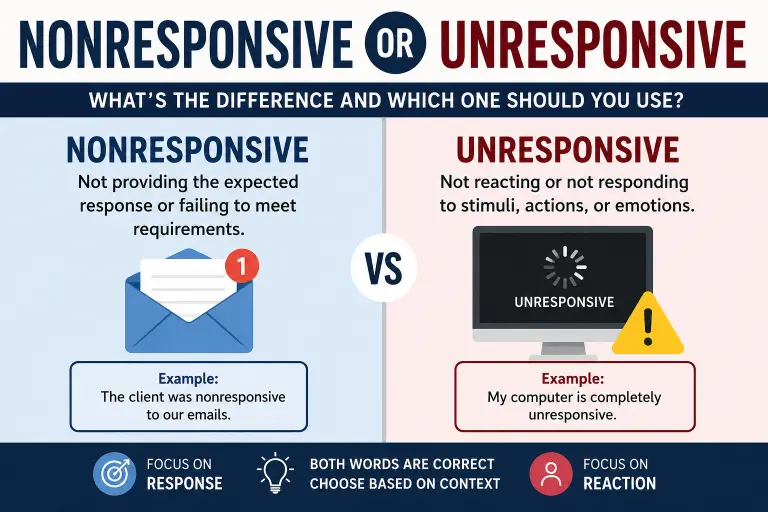
“Nonresponsive” and “unresponsive” are both correct words, but they are used slightly differently. “Nonresponsive” usually means not responding to a request, treatment, or stimulus, while “unresponsive” generally means not reacting or replying, especially when describing a person who does not respond to attempts to communicate.
Have you ever wondered if nonresponsive or unresponsive is the better word? You are not alone. These two adjectives look almost the same and often describe the same basic idea: a person, device, system, or organization is not responding.
The confusion comes from the fact that both words are correct. Merriam-Webster defines nonresponsive as “not giving response” and also uses it for things that fail to meet the requirements of a request. It defines unresponsive simply as “not responsive.”
In everyday English, the two words can often be used interchangeably. However, unresponsive is especially natural when talking about a person, patient, device, or something that does not react. Nonresponsive is also common in formal, technical, legal, business, and procedural contexts.
This guide explains the meaning, difference, history, usage, examples, common mistakes, and easy ways to remember nonresponsive vs unresponsive.
Nonresponsive vs Unresponsive – Quick Answer
Both nonresponsive and unresponsive are correct English words.
The main difference is context and nuance, not basic grammar. Both can mean that someone or something does not respond.
Unresponsive is often the more natural choice when describing a person, patient, device, or emotional reaction.
- The patient was unresponsive.
- My phone became unresponsive.
- She seemed unresponsive to his questions.
Nonresponsive works well when the focus is on a failure to provide a response, especially in formal or technical situations.
- The client was nonresponsive to repeated emails.
- The answer was nonresponsive to the question.
- The company was nonresponsive to the request.
Merriam-Webster recognizes both words as adjectives, so neither spelling is wrong.
Simple rule: Use unresponsive for general lack of reaction. Use nonresponsive when you want to emphasize that a response was not provided or a requirement was not met.
What Does Each Word Mean?
Meaning of Nonresponsive
Nonresponsive is an adjective that means not responsive or failing to provide a response.
It can describe people, systems, organizations, answers, bids, and other things.
For example:
- The customer was nonresponsive to our emails.
- The website became nonresponsive after the update.
- The lawyer objected to the nonresponsive answer.
- The bid was considered nonresponsive to the requirements.
Merriam-Webster also records a specific use in which a bid is called nonresponsive because it does not adequately meet the requirements of a request.
Part of speech: Adjective
Pronunciation: /ˌnɑːn-rɪˈspɑːn-sɪv/ in American English
Meaning of Unresponsive
Unresponsive is also an adjective. It means not responding or not reacting.
Cambridge Dictionary gives several uses. It can describe something that does not react or answer satisfactorily, and it can describe a person who is not reacting or moving because they are unconscious or very ill.
Examples:
- The patient was unresponsive.
- My computer became unresponsive.
- The company was unresponsive to my complaint.
- He seemed unresponsive to her emotions.
Part of speech: Adjective
Pronunciation: /ˌʌn.rɪˈspɑːn.sɪv/ in American English
What Is the Difference Between Nonresponsive and Unresponsive?
The difference between nonresponsive and unresponsive is often subtle.
In many sentences, either word can work. The better choice depends on what you want to emphasize.
| Feature | Nonresponsive | Unresponsive |
| Basic meaning | Not responding | Not responding |
| Part of speech | Adjective | Adjective |
| Correct English | Yes | Yes |
| People | Yes | Yes |
| Devices | Yes | Yes |
| Medical contexts | Yes | Yes |
| Business communication | Very useful | Also natural |
| Legal/formal contexts | Common | Also possible |
| Emotional reaction | Less typical | More natural |
| General English | Common | Very common |
The key point is that these are overlapping synonyms, not two completely different words.
For example, both of these sentences can be understood:
The client was nonresponsive to my emails.
The client was unresponsive to my emails.
However, unresponsive can also describe emotional or physical lack of reaction. Cambridge specifically includes emotional and medical uses for the word.
Origin and History
Etymology of Nonresponsive
Nonresponsive is formed from:
non- + responsive
The prefix non- generally means “not” or “absence of.”
Merriam-Webster lists the first known use of nonresponsive as 1845.
Etymology of Unresponsive
Unresponsive is formed from:
un- + responsive
The prefix un- can mean “not” or indicate the opposite of a quality.
Merriam-Webster lists the first known use of unresponsive as 1768, making it older in recorded English use than nonresponsive.
The two words developed around the same basic idea: a lack of response.
British English vs American English
There is no simple British-versus-American spelling rule that makes one word correct and the other incorrect.
Both nonresponsive and unresponsive are used in English varieties, including American and British English.
| Region | Nonresponsive | Unresponsive |
| United States | Correct | Correct |
| United Kingdom | Correct | Correct |
| Canada | Correct | Correct |
| Australia | Correct | Correct |
| International English | Correct | Correct |
Your choice should depend more on context, meaning, and natural usage than on nationality.
For example, unresponsive is a natural choice in:
The patient was unresponsive.
And nonresponsive works naturally in:
The company was nonresponsive to the formal request.
Do not assume that one is simply the “American spelling” and the other is the “British spelling.” The distinction is more about usage than regional spelling.
Which One Should You Use?
For Students
Use unresponsive when you want a simple, natural word for something that does not react.
Example:
The student was unresponsive to the teacher’s question.
But nonresponsive is also correct in suitable contexts.
For Bloggers
Either word can work.
Choose the word that matches the subject. For general readers, unresponsive may sound more familiar.
Example:
Why is my laptop unresponsive?
For Businesses
Nonresponsive can be useful when describing customers, clients, requests, applications, or formal responses.
Example:
The supplier remained nonresponsive after several follow-up emails.
However, unresponsive is also completely natural:
The supplier remained unresponsive.
For Academic Writing
Both words are acceptable. Choose the one that gives your sentence the clearest meaning.
For example:
Nonresponsive survey participants were excluded from the analysis.
For Professional Writing
Follow the terminology commonly used in your field.
In legal, technical, administrative, or contractual writing, nonresponsive may be especially useful when something fails to address a specific request or requirement.
For Everyday Communication
Unresponsive is often the easiest choice.
My phone is unresponsive.
He has been unresponsive to my messages.
Common Mistakes
Mistake 1: Thinking Nonresponsive Is Wrong
❌ Nonresponsive is not a real word.
This is incorrect.
Nonresponsive is a standard dictionary word. Merriam-Webster lists it as an adjective.
Mistake 2: Thinking Unresponsive Is Only a Medical Word
❌ Unresponsive can only describe patients.
This is also wrong.
You can describe a phone, computer, organization, person, or emotional reaction as unresponsive.
My laptop is unresponsive.
The company was unresponsive to my complaint.
Cambridge gives both general and medical meanings for unresponsive.
Mistake 3: Treating Them as Completely Different
The two words overlap heavily.
❌ Assuming that nonresponsive always means one thing and unresponsive always means another.
Instead, think about the context.
Mistake 4: Using a Hyphen Without a Reason
You may sometimes see non-responsive in older or style-specific writing.
Modern dictionaries commonly list nonresponsive as one word. Merriam-Webster uses the closed form.
For normal modern writing, nonresponsive is a safe choice.
Everyday Examples
Emails
Nonresponsive:
The client was nonresponsive to our follow-up emails.
Unresponsive:
The client remained unresponsive after several messages.
Both are understandable. The first sounds slightly more formal and procedural.
Academic Writing
The researchers removed nonresponsive survey entries.
This use focuses on entries that did not provide the expected response.
Business Writing
The supplier has been nonresponsive to our requests.
Here, nonresponsive clearly communicates a failure to respond.
Social Media
I messaged him twice, but he was unresponsive.
This sounds natural in everyday communication.
Daily Conversation
My phone is completely unresponsive.
This is a very natural use of unresponsive.
Medical Context
The patient was unresponsive when the emergency team arrived.
Unresponsive is strongly established in medical language. Merriam-Webster also defines it medically as not responsive to a stimulus or treatment.
Nonresponsive vs Unresponsive in Technology
Both words can describe technology that does not react to user commands.
Examples:
My computer became unresponsive.
The software became nonresponsive after the update.
The website was unresponsive when I clicked the button.
In everyday technology writing, unresponsive often sounds more natural.
This is also reflected in common dictionary examples and usage. Merriam-Webster includes examples of unresponsive software and user interfaces.
Nonresponsive vs Unresponsive in Legal Writing
Nonresponsive has a useful formal meaning in legal and procedural settings.
For example:
The witness gave a nonresponsive answer.
This means the answer did not properly address the question.
Merriam-Webster also records nonresponsive for something that fails to meet the requirements of a request, such as a competitive bid.
So if the issue is if an answer, bid, proposal, or response meets a specific requirement, nonresponsive can be a very precise choice.
Tips to Remember the Difference
Use these simple memory tips:
- Unresponsive = not reacting
- Nonresponsive = not providing the expected response
- Use unresponsive naturally for people, patients, devices, and emotional reactions.
- Use nonresponsive when discussing formal responses, requests, surveys, bids, or requirements.
- Remember that the two words can overlap.
- Do not treat nonresponsive as incorrect.
- Do not assume unresponsive is limited to medical situations.
Easy Memory Trick
Think:
UNresponsive → no reaction
NONresponsive → no response
This is only a memory aid, not a strict grammar rule. In real English, the two words can be interchangeable in many contexts.
Quiz
Choose the best answer.
1. Which word is correct?
A. Nonresponsive
B. Unresponsive
C. Both
D. Neither
2. Which sentence sounds most natural for a frozen phone?
A. My phone is unresponsive.
B. My phone is responsive.
C. My phone is answering.
D. My phone is replying.
3. Which word works well for a bid that fails to meet requirements?
A. Nonresponsive
B. Responsive
C. Answering
D. Reacting
4. Which sentence is correct?
A. The patient was unresponsive.
B. The patient was unresponse.
C. The patient was unresponding.
D. The patient was nonrespond.
5. Are nonresponsive and unresponsive both correct words?
A. Yes
B. No
C. Only in British English
D. Only in American English
6. Which word can describe an emotional lack of reaction?
A. Unresponsive
B. Responsive
C. Nonanswer
D. Replyless
7. Which sentence is correct?
A. The client was nonresponsive to our request.
B. The client was nonresponse to our request.
C. The client was nonrespond to our request.
D. The client was non-responser.
8. Which word is often more natural in everyday English?
A. Unresponsive
B. Nonresponse
C. Responseless
D. Irresponsive
Answers
- C — Both
- A — My phone is unresponsive.
- A — Nonresponsive
- A — The patient was unresponsive.
- A — Yes
- A — Unresponsive
- A — The client was nonresponsive to our request.
- A — Unresponsive
Fill in the Blanks
Choose nonresponsive or unresponsive.
- My computer became ______ after the update.
- The patient was ______ when the doctor arrived.
- The client remained ______ despite several emails.
- The bid was considered ______ because it did not meet the requirements.
- She seemed ______ to his emotional concerns.
- The website became ______ when too many users visited it.
- The company was ______ to the formal complaint.
- The witness gave a ______ answer.
Answers
- unresponsive
- unresponsive
- nonresponsive
- nonresponsive
- unresponsive
- unresponsive
- nonresponsive
- nonresponsive
FAQs
Is nonresponsive a correct word?
Yes. Nonresponsive is a correct English adjective. It means not giving a response or not being responsive. Merriam-Webster also uses it for something that fails to meet the requirements of a request.
Is unresponsive a correct word?
Yes. Unresponsive is a standard and widely used English adjective. It can describe someone or something that does not respond or react. It can also describe emotional and medical situations.
Are nonresponsive and unresponsive the same?
They are very similar and often interchangeable. Both describe a lack of response. However, unresponsive has broader uses, including physical and emotional reactions, while nonresponsive can be especially useful when a specific response or requirement was expected.
Should I say nonresponsive or unresponsive?
Use unresponsive when describing a person, patient, device, or general lack of reaction. Use nonresponsive when the focus is on a missing response, formal request, answer, survey, bid, or requirement. In many situations, either word can work.
Is “non-responsive” correct?
You may encounter non-responsive, but the standard closed spelling nonresponsive is widely used today. Merriam-Webster lists nonresponsive as the headword.
What does nonresponsive mean in court?
In legal contexts, nonresponsive can describe an answer that does not address the question being asked. It can also describe a bid or submission that does not meet stated requirements. This is a more specific formal use of the word.
What does unresponsive mean medically?
In medical English, unresponsive can describe someone who does not react to stimuli or someone who is not reacting or moving because of unconsciousness or serious illness. It can also describe a condition or treatment that does not respond.
Is “unresponsive” better than “nonresponsive”?
Not always. Unresponsive is often the more natural general choice, but nonresponsive can be more precise in formal or procedural contexts. The best word depends on the sentence and intended meaning.
Conclusion
The choice between nonresponsive or unresponsive is easier than it first appears. Both are correct English adjectives, and both can describe a lack of response. The main difference is the context in which they sound most natural.
Use unresponsive when you are talking about a person, patient, device, emotional reaction, or general failure to react. For example, “The patient was unresponsive” and “My phone is unresponsive” are both natural sentences.
Use nonresponsive when you want to describe a missing or inadequate response, especially in formal, legal, business, technical, or procedural settings. For example, “The witness gave a nonresponsive answer” clearly shows that the answer did not address the question.
Still, remember that these words overlap. You do not need to treat them as completely separate terms.
The easiest rule is simple: unresponsive usually focuses on a lack of reaction, while nonresponsive can focus on a failure to provide the expected response.
Once you understand that small difference, choosing the right word becomes much easier. Keep the context in mind, write naturally, and do not worry about using nonresponsive when it fits your sentence.

I am Elliot Hartwell, an English language writer and the author at GrammarGuidez.com. For the 6 years I have been working with English grammar, vocabulary, spelling and everyday language usage with a focus on making confusing topics easier to understand.
I started GrammarGuidez.com with a goal: to give readers clear and practical answers to common English questions. English can sometimes be confusing especially when two words look or sound similar but have meanings or uses. I enjoy breaking down these differences in a way that’s simple and easy to remember.
I believe learning English should feel simple not overwhelming. My goal is to make every article on GrammarGuidez.com useful, for students, writers, bloggers, teachers and anyone who wants to communicate clearly in English.