“Friend” and “faux” are both correct words, but they have very different meanings. “Friend” is a noun meaning a person you like and trust, while “faux” is an adjective meaning fake or imitation, often used to describe something that looks real but is not.
Have you ever wondered if someone is a friend or faux? You may have a person in your life who acts like a friend but does not always treat you like one. This is where the expression friend or faux becomes useful.
The word friend refers to someone who has a genuine relationship with you. A friend usually cares about you, supports you, and enjoys spending time with you.
The word faux means fake, false, or not genuine. It comes from French and is often used in English to describe something that looks real but is not.
So, friend or faux is a playful way to ask if someone is a real friend or a fake friend.
For example:
Is she really your friend, or is she faux?
The phrase can also be used as a catchy way to discuss fake friendships, one-sided friendships, and people who pretend to care.
In this guide, we will explain the meaning of friend or faux, the difference between a genuine friend and a fake friend, common signs of a faux friend, everyday examples, and simple ways to remember the phrase.
Friend or Faux – Quick Answer
faux or Friend is a playful expression that asks if someone is a genuine friend or a fake friend.
Friend
A friend is someone who has a genuine relationship with you.
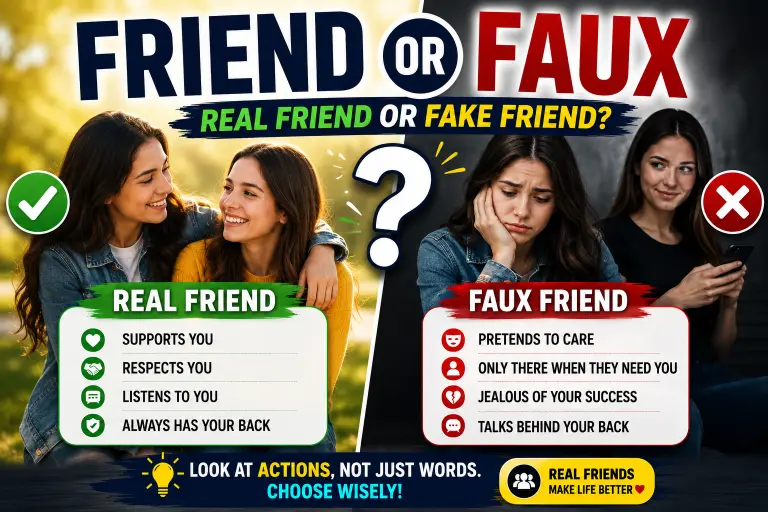
A real friend may:
- Support you
- Respect you
- Listen to you
- Celebrate your success
- Help you when possible
- Be honest with you
Faux
Faux means fake, false, or imitation.
When someone is described as a faux friend, it means they may appear to be a friend but their feelings or behavior may not be genuine.
Simple Meaning
Friend = genuine
Faux = fake
Therefore:
Friend or faux? = Real friend or fake friend?
What Does Friend Mean?
The word friend is a noun that describes a person you know and like, usually because you share a relationship based on trust, care, or common interests.
A friend does not have to agree with you all the time.
A healthy friendship can include honesty, respect, support, and different opinions.
Examples
Sarah is my best friend.
He has been my friend for many years.
A good friend listens when you need to talk.
My friends supported me during a difficult time.
The word friend can also be used as a verb.
I friended him on social media.
In everyday English, however, friend is most often used as a noun.
What Does Faux Mean?
Faux means fake, false, or imitation.
The word comes from French and is commonly used in English as a descriptive word.
It often describes something that looks like the real thing but is not actually genuine.
Examples
She bought a faux leather jacket.
This means the jacket looks like leather but is made from another material.
The restaurant has faux marble tables.
The tables look like marble but are not real marble.
He gave a faux smile.
This suggests that the smile was not genuine.
The same basic idea applies to faux friend.
A faux friend is someone who appears to be a friend but may not have genuine friendship or good intentions.
What Is a Faux Friend?
A faux friend is a person who acts like a friend but may not genuinely care about you or the relationship.
A faux friend may behave differently when they need something.
For example, they may contact you only when they need help.
They may also:
- Talk badly about you behind your back
- Ignore your problems
- Become jealous of your success
- Use you for personal benefits
- Pretend to support you
- Disappear when you need help
- Compete with you constantly
However, one bad action does not automatically make someone a fake friend.
People can make mistakes.
A friendship should be judged by patterns of behavior, not by one isolated event.
Friend vs. Faux Friend
| Feature | Real Friend | Faux Friend |
| Care | Genuine | May be superficial |
| Support | Usually supportive | Often conditional |
| Honesty | Usually honest | May pretend |
| Success | Happy for you | May become jealous |
| Problems | Tries to help | May disappear |
| Trust | Builds trust | May break trust |
| Relationship | Mutual | Often one-sided |
| Motivation | Friendship | May want something |
Signs of a Real Friend
A real friend does not have to be perfect.
Everyone makes mistakes.
What matters is the overall relationship.
1. They Respect You
A good friend respects your opinions, boundaries, and decisions.
They may disagree with you, but they do not need to insult you.
2. They Listen
A real friend gives you space to talk.
They do not always turn every conversation back to themselves.
3. They Support Your Success
A genuine friend can celebrate your achievements without feeling the need to compete with you.
I got the job!
A good friend might say:
That’s great! I’m really happy for you.
4. They Are There During Difficult Times
A real friend may not always be able to solve your problems, but they can offer support.
Sometimes simply listening can mean a lot.
5. They Tell You the Truth
A true friend does not have to agree with everything you do.
They can respectfully tell you when they think you are making a mistake.
6. They Value the Relationship
Friendship should not always feel like one person is giving while the other person only takes.
A healthy friendship has some level of mutual effort.
Signs of a Faux Friend
A faux friend may appear friendly but repeatedly show behavior that suggests the relationship is not genuine.
1. They Only Call When They Need Something
If someone regularly disappears but suddenly contacts you when they need money, help, information, or a favor, this can be a warning sign.
2. They Are Jealous of Your Success
A fake friend may struggle to celebrate your achievements.
Instead of saying:
Congratulations!
They may try to minimize your success.
3. They Talk About You Behind Your Back
Everyone may make mistakes in relationships, but repeated gossip and betrayal can damage trust.
4. They Compete With Everything You Do
A faux friend may turn normal conversations into competitions.
You share good news, and they immediately try to prove that they have something better.
5. They Disappear When You Need Them
A person who is always available when they need something but never available when you need support may not be acting like a genuine friend.
Why Do People Say “Friend or Faux”?
The phrase friend or faux uses a wordplay between the idea of a friend and something faux, meaning fake.
It is often used as a catchy expression.
For example:
Friend or faux? How can you tell?
This means:
Is this person a real friend or a fake friend?
The phrase can work well in:
- Social media posts
- Blog titles
- Quizzes
- Relationship discussions
- Lifestyle articles
- Friendship advice
- Informal conversations
It has a playful tone rather than being a formal psychological term.
Friend or Faux: Simple Examples
Example 1
She always supports me when I need her. She is a true friend.
Example 2
He only talks to me when he wants something. Maybe he is a faux friend.
Example 3
They celebrate each other’s success. That looks like a healthy friendship.
Example 4
He pretends to support her but constantly puts her down.
This could be a sign of a faux friendship.
Example 5
Are they really friends, or is it just a faux friendship?
Here, faux means that the friendship may not be genuine.
Friend or Faux: Key Difference
The easiest way to understand the phrase is:
Friend = someone who is genuinely your friend.
Faux = something fake or not genuine.
So:
Friend or faux?
means:
Is this person a genuine friend or a fake one?
Friend or Faux in Everyday Situations
The phrase friend or faux becomes easier to understand when you see it in real-life situations. A person may call themselves your friend, but their actions can tell you more than their words.
Situation 1: They Only Contact You When They Need Help
Imagine someone rarely talks to you. But whenever they need a favor, they suddenly message you.
“Hey! Can you help me with this?”
This does not automatically mean they are a faux friend. However, if this happens repeatedly and the relationship is always one-sided, it may be a warning sign.
Situation 2: They Celebrate Your Success
You get a new job, win an award, or achieve an important goal.
A genuine friend may say:
“Congratulations! I’m really happy for you.”
They do not need to compete with you or make your achievement feel unimportant.
Situation 3: They Put You Down
A person constantly makes negative comments about you.
“You only got that job because you were lucky.”
One comment does not prove that someone is a fake friend. But repeated behavior like this can damage trust and may indicate an unhealthy friendship.
Situation 4: They Support You During Difficult Times
You are having a difficult day, and your friend checks on you.
They may not be able to fix the problem, but they listen and offer support.
This is an example of behavior often associated with genuine friendship.
Friend or Faux: Common Types of Fake Friends
Not every difficult friendship looks the same. A faux friend can behave in different ways.
1. The User
This person mainly contacts you when they want something.
They may need:
- Money
- Help
- Advice
- A favor
- A connection
- Your time
The relationship can feel one-sided.
2. The Competitor
This person turns everything into a competition.
You buy something new.
They buy something more expensive.
You get a promotion.
They immediately tell you about their own achievements.
Healthy friends can compete in fun ways, but constant competition can make a friendship stressful.
3. The Gossip
This person frequently talks about other friends behind their backs.
Be careful.
If they constantly share other people’s private information with you, they may eventually share your private information with someone else.
4. The Fair-Weather Friend
A fair-weather friend is someone who stays close when things are going well but may disappear when you face difficulties.
For example:
They are always around for parties but never available when you need support.
This does not necessarily mean the person is intentionally fake. Some people simply have different levels of availability.
Look at the overall pattern before making a judgment.
5. The Jealous Friend
A jealous friend may struggle to celebrate your success.
They might:
- Minimize your achievements
- Make negative comments
- Compare themselves with you
- Change the subject when you share good news
Again, occasional jealousy is a normal human emotion. Repeated behavior is more important than one moment.
6. The Fake Supporter
This person says they support you but repeatedly does things that undermine you.
For example:
“I’m happy for you.”
But then they constantly criticize your choices.
Words and actions do not match.
Real Friend vs. Faux Friend: Behavior Comparison
| Behavior | Real Friend | Faux Friend |
| Contacts you | To stay connected | Often when they need something |
| Your success | Celebrates it | May minimize it |
| Your problems | Listens and supports | May disappear |
| Your boundaries | Respects them | May ignore them |
| Your mistakes | Gives honest advice | May mock you |
| Your private information | Protects it | May gossip about it |
| Relationship effort | Usually mutual | Often one-sided |
| Trust | Builds over time | May repeatedly break trust |
Remember that this table describes patterns, not strict rules.
A genuine friend can have a bad day. A good friend can also make mistakes.
How to Tell If Someone Is a Genuine Friend
There is no single test that can perfectly identify a true friend.
Instead, look at the person’s behavior over time.
1. Look for Consistency
Do their actions match their words?
Someone who says they care but repeatedly treats you poorly may be showing an important pattern.
2. Notice Mutual Effort
Healthy friendships usually involve effort from both people.
One person should not always be:
- Calling
- Planning
- Helping
- Listening
- Apologizing
Friendships can be unequal at times, especially during difficult periods, but long-term one-sided effort can become unhealthy.
3. Watch How They Handle Your Success
A genuine friend does not have to feel happy every second.
But they should generally be able to celebrate your achievements without constantly turning them into a competition.
4. Watch How They Handle Your Boundaries
You have the right to say:
“No, I can’t do that.”
A healthy friend can respect your answer.
Someone who repeatedly pressures or manipulates you may not be respecting the friendship.
5. Pay Attention to Trust
Trust develops over time.
If someone repeatedly breaks promises, shares private information, or lies to you, it can seriously affect the relationship.
How to Deal With a Faux Friend
If you believe a friendship is unhealthy, you do not always need to end it immediately.
You can start by understanding what is happening.
Step 1: Look at the Pattern
Do not judge the entire friendship based on one bad conversation.
Ask yourself:
“Does this happen regularly?”
Step 2: Communicate Clearly
If something bothers you, explain it calmly.
For example:
“I feel like you only contact me when you need something.”
This gives the other person an opportunity to respond.
Step 3: Set Boundaries
You can decide what behavior you will and will not accept.
For example:
“I can’t lend you money.”
A genuine friend should be able to respect your decision.
Step 4: Protect Your Personal Information
If you no longer trust someone, be careful about sharing sensitive or private information.
Step 5: Give Yourself Space
Sometimes taking a step back can help you understand the relationship more clearly.
You do not have to make every decision immediately.
Friend or Faux: Common Mistakes
Mistake 1: Thinking Every Argument Means Someone Is Fake
❌ “We had an argument, so they must be a faux friend.”
Arguments can happen in healthy friendships.
A disagreement does not automatically mean a friendship is fake.
Mistake 2: Judging Someone From One Action
One mistake does not define an entire person.
Look at repeated behavior instead.
Mistake 3: Confusing “Faux” With “Friend”
Faux means fake or imitation.
Friend means a person with whom you have a friendship.
The phrase friend or faux creates a contrast between something genuine and something fake.
Mistake 4: Thinking Faux Is a Psychological Term
Faux friend is an informal expression.
It is not a formal diagnosis or clinical category.
It is simply a way to describe a friendship that appears fake, insincere, or one-sided.
Friend or Faux: Word Meaning
The two words have very different meanings.
Friend
Part of speech: Noun
Meaning: A person you know and like who has a relationship with you.
Example:
Maria is my closest friend.
Faux
Part of speech: Adjective
Meaning: Fake, false, or made to look like something real.
Example:
He bought a faux leather jacket.
Faux Friend
Meaning: A person who appears to be a friend but may not be genuine.
Example:
She eventually realized that he was a faux friend.
Friend or Faux: Pronunciation
Friend
Pronunciation: /frend/
It sounds like:
frend
Example:
She is my friend.
Faux
Pronunciation: /foʊ/
It sounds like:
foh
The word faux comes from French, but English speakers commonly pronounce it like foh.
Example:
The store sells faux leather.
Friend or Faux
The phrase sounds approximately like:
frend or foh
Why Is “Faux” Used Instead of “Fake”?
Both faux and fake can describe something that is not genuine.
But faux can sound more stylish, playful, or clever.
For example:
Fake friend
is direct and simple.
Faux friend
sounds more playful and creates wordplay with the phrase friend or faux.
That is why friend or faux works well as a catchy title for articles, quizzes, social media content, and discussions about friendship.
Friend or Faux: Easy Memory Trick
Use this simple rule:
Friend = Real
Think:
A friend is someone who genuinely cares about the relationship.
Faux = Fake
Think:
Faux sounds like “foh,” but remember its meaning: fake or imitation.
So:
Friend or faux?
means:
Real friend or fake friend?
Friend or Faux: Quick Examples
Genuine Friendship
My friend checks on me when I am having a difficult day.
Possible Faux Friendship
He only calls me when he wants something.
Genuine Friendship
She celebrates my achievements without trying to compete.
Possible Faux Friendship
He constantly puts down my accomplishments.
Genuine Friendship
We can disagree and still respect each other.
Possible Unhealthy Friendship
She repeatedly ignores my boundaries.
Quick Comparison
| Word/Phrase | Meaning | Example |
| Friend | Genuine companion | He is my friend. |
| Faux | Fake or imitation | She wore faux leather. |
| Faux friend | Someone who appears to be a friend but may not be genuine | He turned out to be a faux friend. |
| Friend or faux | Real friend or fake friend? | Is this friendship real or faux? |
FAQs
1. What does “friend or faux” mean?
Friend or faux is a playful phrase that means “real friend or fake friend?” It contrasts a genuine friendship with a relationship that may not be sincere.
2. What does “faux friend” mean?
A faux friend is someone who appears to be your friend but may not genuinely care about you or the friendship.
For example:
He only contacts me when he needs something, so I wonder if he is a faux friend.
3. What does “faux” mean?
Faux means fake, false, or imitation.
For example:
She bought a faux leather bag.
The bag looks like leather but is made from another material.
4. Is “friend or faux” a formal expression?
No. Friend or faux is an informal and playful expression. It is often used in articles, social media, quizzes, and conversations about friendships.
5. Is a faux friend the same as a fake friend?
In most informal contexts, yes.
Faux friend and fake friend can both describe someone who appears to be a friend but does not behave like a genuine friend.
6. How can you recognize a faux friend?
Look for repeated patterns such as:
- Only contacting you when they need something
- Constantly putting you down
- Breaking your trust
- Ignoring your boundaries
- Refusing to support you
- Making the relationship one-sided
One mistake alone does not prove that someone is a faux friend.
7. Is every jealous friend a faux friend?
No.
Jealousy is a normal human emotion. A person may feel jealous occasionally and still be a genuine friend.
The important thing is how they behave over time.
8. Is “faux” pronounced like “fox”?
No.
Faux is commonly pronounced approximately like “foh” /foʊ/.
9. What is the opposite of a faux friend?
The simplest opposite is a true friend, real friend, or genuine friend.
10. Can a friendship become faux over time?
A friendship can change over time. Someone who was once a close friend may become distant or the relationship may become one-sided.
It is better to look at the current pattern of behavior rather than assume that every change means the person is fake.
Friend or Faux: True Friend vs. Fake Friend
| Question | True Friend | Faux Friend |
| Do they care about you? | Usually genuinely | May pretend |
| Do they respect you? | Yes | May ignore boundaries |
| Do they support you? | Usually | Often only when convenient |
| Do they listen? | Yes | May make everything about themselves |
| Are they happy for you? | Usually | May become competitive |
| Do they protect your privacy? | Usually | May gossip |
| Is effort mutual? | Generally | Often one-sided |
| Can you trust them? | Trust develops | Trust may repeatedly be broken |
Friend or Faux in Social Media
The phrase friend or faux can also apply to online friendships.
Social media makes it easy to have hundreds or thousands of connections. But having someone on your friend list does not necessarily mean you have a genuine friendship.
For example:
Someone likes all your posts but never checks on you when you need support.
That does not automatically make them a faux friend. Online friendships can look different from offline friendships.
The key is the quality of the relationship, not simply the number of likes, followers, or messages.
Friend or Faux: Online Example
Imagine you meet someone through social media.
At first, they are friendly.
They regularly comment on your posts and send messages.
Later, they repeatedly ask you for favors but never show interest in your life.
You might ask:
“Is this a real friendship or a faux friendship?”
The answer depends on the full pattern of behavior.
Do not judge someone only because they communicate differently online.
Friend or Faux: Friendship Red Flags
Some behaviors may be worth paying attention to.
Red Flag 1: One-Sided Communication
You always start the conversation.
Red Flag 2: Constant Requests
They frequently ask for favors but rarely offer help.
Red Flag 3: Repeated Gossip
They regularly share other people’s private information.
Red Flag 4: Lack of Respect
They repeatedly ignore your boundaries.
Red Flag 5: Constant Competition
They turn your achievements into a competition.
Red Flag 6: No Support
They disappear whenever you need emotional support.
Again, these are possible warning signs, not proof that someone is automatically a fake friend.
Friend or Faux: Healthy Friendship Signs
A healthy friendship can have disagreements and difficult periods.
What matters is how people handle those situations.
Respect
Both people respect each other’s boundaries.
Trust
Both people can gradually build trust.
Honesty
Friends can communicate honestly without intentionally hurting each other.
Support
Both people can offer support when they are able.
Mutual Effort
Both people contribute to the relationship.
Freedom
A healthy friend does not need to control every part of your life.
Friend or Faux: Common Questions About the Phrase
Is “faux friend” grammatically correct?
Yes.
Faux is an adjective, so it can describe friend.
faux friend
means a friend who is not genuine.
Is “friend or faux” a common idiom?
It is better described as a playful phrase or wordplay rather than a fixed traditional idiom.
The expression is easy to understand because faux means fake.
Can I use “friend or faux” in formal writing?
You can use it as a title or creative phrase, but it has an informal and playful tone.
For formal writing, genuine friendship, insincere friendship, or false friendship may be clearer.
Is faux the same as false?
They are related in meaning, but their usage is different.
Faux often describes something that is made to look real or genuine.
False can mean untrue, incorrect, or not genuine.
For example:
faux leather
But:
a false statement
Friend or Faux: Quiz
Choose the correct answer.
1. What does “friend or faux” mean?
A. Old friend or new friend
B. Real friend or fake friend
C. Friend or family member
D. Online friend or offline friend
2. What does “faux” mean?
A. Real
B. Genuine
C. Fake or imitation
D. Friendly
3. Which is more likely to describe a genuine friend?
A. Respecting your boundaries
B. Constantly using you
C. Repeatedly breaking your trust
D. Always competing with you
4. What is a faux friend?
A. A family member
B. A person who appears to be a friend but may not be genuine
C. A childhood friend
D. An online follower
5. Is one argument enough to prove someone is a faux friend?
A. Yes
B. No
C. Always
D. Only online
6. How is “faux” commonly pronounced?
A. Fox
B. Foh
C. Few
D. Fow
7. What is a common sign of a one-sided friendship?
A. Mutual effort
B. Respect
C. One person always giving while the other only takes
D. Honest communication
8. Which phrase has a similar meaning to “faux friend”?
A. Fake friend
B. Best friend
C. Family friend
D. Old friend
9. What should you consider before labeling someone a faux friend?
A. One small mistake
B. A repeated pattern of behavior
C. Their clothing
D. Their social media follower count
10. What is a good quality of a healthy friendship?
A. Constant competition
B. Manipulation
C. Mutual respect
D. Repeated dishonesty
Quiz Answers
- B — Real friend or fake friend
- C — Fake or imitation
- A — Respecting your boundaries
- B — A person who appears to be a friend but may not be genuine
- B — No
- B — Foh
- C — One person always giving while the other only takes
- A — Fake friend
- B — A repeated pattern of behavior
- C — Mutual respect
Fill in the Blanks
Complete each sentence with the correct word.
- A ______ is someone with whom you have a genuine friendship.
- ______ means fake or imitation.
- A ______ friend may appear genuine but may not truly care about the relationship.
- A healthy friendship usually includes mutual ______.
- A genuine friend should generally respect your ______.
- The phrase “friend or faux” means real friend or ______ friend.
- “Faux” is commonly pronounced like ______.
- One bad day does not automatically make someone a ______ friend.
- Trust develops through consistent ______.
- A friendship should not always be completely ______-sided.
Answers
- friend
- faux
- faux
- effort
- boundaries
- fake
- foh
- faux
- behavior
- one
Conclusion
Friend or faux is a catchy way to ask if someone is a real friend or a fake friend. The word friend describes a genuine relationship, while faux means fake, false, or imitation.
A faux friend may look like a friend on the surface but repeatedly behave in ways that make the relationship feel one-sided or insincere. They may only contact you when they need something, constantly compete with you, ignore your boundaries, or break your trust.
However, one disagreement does not make someone a faux friend. Healthy friendships can include arguments, mistakes, different opinions, and difficult periods. The important thing is the long-term pattern of behavior.
A genuine friendship usually includes respect, trust, honesty, support, and mutual effort. These qualities help create a relationship that feels safe and balanced.
So, when you hear “friend or faux?”, think:
Friend = genuine.
Faux = fake or not genuine.
The best way to understand a friendship is not to focus only on what someone says. Look at what they consistently do.

I am Evan Whitmore, an English language writer and the person who started GrammarGuidez.com. I made GrammarGuidez.com to make grammar, spelling, vocabulary and words that are often confused easier to understand.
I like taking to understand English words and grammar rules and turning them into simple and clear explanations. My aim is to help students, writers, bloggers, ESL learners and regular English speakers feel more sure when they write and talk.
At GrammarGuidez.com I work on real life examples easy to understand explanations comparing words, spelling changes and how American English is used every day.
I think learning English doesn’t need to be hard. A good explanation and some good examples can make tough grammar topics much simpler to learn