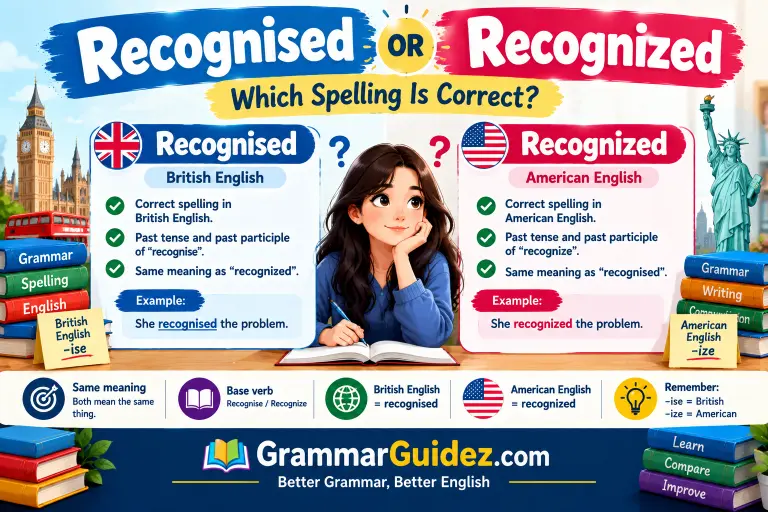
“Recognised” and “Recognized” are both correct spellings, but they are used in different English styles. Recognized is the preferred spelling in American English. Recognised is the preferred spelling in British English. Both mean to identify, notice, or accept something as true or valid.
If you are confused about recognised or recognized, you are not alone. Both spellings are correct, but they are used in different forms of English.
Recognized is the standard spelling in American English.
Recognised is the standard spelling in British English and is also common in other varieties that follow British spelling.
Both words have the same meaning. The only difference is the spelling of the ending.
For example:
- The teacher recognized the student. 🇺🇸
- The teacher recognised the student. 🇬🇧
Both sentences are correct.
The verb recognize/recognise means to identify someone or something, understand something as familiar, or accept something as true or important.
In this guide, you will learn the difference between recognised and recognized, when to use each spelling, American and British English rules, examples, common mistakes, pronunciation, and an easy way to remember the difference.
Quick Answer: Recognised or Recognized?
Recognised and recognized are both correct spellings.
The main difference is regional spelling.
- Recognized = American English
- Recognised = British English
| Spelling | Correct? | Main Usage |
| Recognized | ✅ Yes | American English |
| Recognised | ✅ Yes | British English |
Easy Rule
If you write in American English, use recognized.
If you write in British English, use recognised.
The meaning stays exactly the same.
What Does Recognized Mean?
Recognized is the past tense and past participle of recognize.
It can mean:
- to identify someone or something
- to know someone or something because you have seen it before
- to understand or accept something
- to acknowledge someone’s achievement or importance
Examples
- I recognized her voice immediately.
- He recognized the man from the photograph.
- The school recognized her hard work.
- She recognized the importance of good communication.
In these examples, recognized follows American English spelling.
What Does Recognised Mean?
Recognised has the same meaning as recognized.
It is the British English spelling of the past tense and past participle of recognise.
Examples
- I recognised her voice immediately.
- He recognised the man from the photograph.
- The school recognised her hard work.
- She recognised the importance of good communication.
The meaning does not change.
Only the spelling changes from -ize to -ise.
Recognised vs Recognized
The main difference is one letter:
Recognized
Recognised
The American form uses -ized.
The British form commonly uses -ised.
| Feature | Recognized | Recognised |
| Meaning | Same | Same |
| Base verb | Recognize | Recognise |
| Main English variety | American | British |
| Past tense | Recognized | Recognised |
| Past participle | Recognized | Recognised |
| Pronunciation | Same | Same |
Recognized in American English
Recognized is the normal spelling in American English.
American English commonly uses -ize in words such as:
- recognize
- organize
- realize
- apologize
- criticize
So the forms are:
recognize → recognized
For example:
The manager recognized his excellent work.
If your website targets readers in the United States, recognized is usually the best choice.
Recognised in British English
Recognised is the common British English spelling.
British English often uses -ise in words such as:
- recognise
- organise
- realise
- apologise
- criticise
So the forms are:
recognise → recognised
For example:
The manager recognised his excellent work.
If your website follows British English spelling, recognised is a natural choice.
Is Recognised British or American?
Recognised is mainly associated with British English.
It is also used in other English-speaking regions that commonly follow British spelling conventions.
For example:
British English: recognised
American English: recognized
However, this does not mean that recognised is wrong in every context outside Britain. English spelling styles can vary by country, organization, publisher, and style guide.
Is Recognized British or American?
Recognized is strongly associated with American English.
American English generally prefers the -ize ending in this word:
recognize → recognized
For US-focused websites, school work, and business writing, recognized is the usual choice.
Recognize vs Recognise
The difference starts with the base verb.
American English
recognize
British English
recognise
Then the past tense follows the same spelling pattern:
recognize → recognized
recognise → recognised
The meaning remains the same.
Example
American:
She recognized the problem.
British:
She recognised the problem.
Both sentences are grammatically correct.
Recognized vs Recognised Pronunciation
Recognized and recognised are normally pronounced the same way.
A common pronunciation is:
REK-ug-nized
The spelling changes, but the pronunciation does not normally change.
This makes the two words a common spelling question for English learners.
You may hear the word before you see it written, so you cannot always know which spelling the writer will use.
Common Uses of Recognized and Recognised
The word can be used in several ways.
1. Identifying Someone
I recognized him from school.
British:
I recognised him from school.
Here, the word means that you knew who the person was.
2. Identifying Something Familiar
She recognized the song immediately.
British:
She recognised the song immediately.
3. Accepting Something as Important
The company recognized the need for better training.
British:
The company recognised the need for better training.
4. Praising an Achievement
The organization recognized her contribution.
British:
The organisation recognised her contribution.
Recognised or Recognized in Formal Writing
Both spellings are correct in formal writing.
The important point is to use the spelling that matches your chosen English style.
If your document uses American English, write:
recognized
If it uses British English, write:
recognised
Do not switch between the two styles without a reason.
For example, if you start your article with:
The company recognized the problem.
It is better to continue using American spelling throughout the article.
Common Mistakes
Mistake 1: Thinking Recognised Is Wrong
Some American English readers may think recognised is misspelled.
It is not.
Recognised is a standard British English spelling.
Mistake 2: Thinking Recognized Is Wrong
Some British English learners may think recognized is incorrect.
It is not.
Recognized is the standard American English spelling.
Mistake 3: Mixing Spelling Styles
A common mistake is to use both forms in the same document.
For example:
The company recognised the problem and later recognized the need for change.
This is not necessarily grammatically wrong, but it creates inconsistent spelling if there is no stylistic reason for the switch.
Choose one style and stay consistent.
Mistake 4: Confusing Recognise With Recognition
Recognise/recognize is a verb.
Recognition is a noun.
Examples:
The teacher recognized the student.
The student received recognition for her work.
The noun recognition does not change to recognisation in standard usage.
Recognized and Recognised Examples
Here are more examples to help you understand the difference.
American English
- She recognized his voice.
- The teacher recognized her effort.
- He was recognized for his bravery.
- The company recognized the problem.
- I immediately recognized the building.
- The award recognized his contribution.
- They recognized the importance of education.
- She recognized the name from the news.
British English
- She recognised his voice.
- The teacher recognised her effort.
- He was recognised for his bravery.
- The company recognised the problem.
- I immediately recognised the building.
- The award recognised his contribution.
- They recognised the importance of education.
- She recognised the name from the news.
Notice that the meaning and grammar are the same.
Only the spelling changes.
Recognised or Recognized in a Sentence
Both forms work in the same sentence structure.
American English
The school recognized her achievement.
British English
The school recognised her achievement.
Both mean that the school acknowledged her achievement.
Another example:
American
I recognized the man at the door.
British
I recognised the man at the door.
Again, there is no difference in meaning.
Recognised vs Recognized: Comparison Table
| Point | Recognized | Recognised |
| Correct spelling | ✅ | ✅ |
| Base form | Recognize | Recognise |
| English variety | American English | British English |
| Meaning | Identify or acknowledge | Identify or acknowledge |
| Past tense | Yes | Yes |
| Past participle | Yes | Yes |
| Pronunciation | Same | Same |
| Common ending | -ized | -ised |
What About Recognizing and Recognising?
The same spelling difference appears in the -ing form.
American English
recognizing
British English
recognising
Examples:
She is recognizing the signs of a problem.
She is recognising the signs of a problem.
Both forms are correct within their respective spelling styles.
This gives you a useful word family:
American English
recognize → recognized → recognizing
British English
recognise → recognised → recognising
What About Recognition?
The noun is:
recognition
This spelling is the same in both American and British English.
Examples:
- She received recognition for her work.
- The award gave him international recognition.
- The company deserves recognition for its efforts.
So the spelling difference mainly appears in the verb forms.
Which Spelling Should You Use?
The best spelling depends on your audience.
Use “Recognized” if:
- You write for an American audience.
- Your website follows American English.
- Your school or company uses American English.
- You want to follow US spelling conventions.
Use “Recognised” if:
- You write for a British audience.
- Your website follows British English.
- Your organization uses British spelling.
- Your style guide prefers -ise endings.
For an international website, either can work. The key is consistency.
Easy Memory Trick
Here is a simple way to remember the difference:
🇺🇸 America → Recognized
Think:
American = -ize
So:
recognize → recognized
🇬🇧 Britain → Recognised
Think:
British = -ise
So:
recognise → recognised
You can also remember these pairs:
organize → organized
organise → organised
recognize → recognized
recognise → recognised
Once you remember the -ize / -ise pattern, many similar spelling questions become easier.
FAQs About Recognised or Recognized
Is recognized or recognised correct?
Both are correct. Recognized is the American English spelling, while recognised is the British English spelling.
Is recognised British spelling?
Yes. Recognised is the standard British English spelling.
Is recognized American spelling?
Yes. Recognized is the standard American English spelling.
Do recognized and recognised mean the same thing?
Yes. Both words have the same meaning. The difference is spelling style.
Are recognized and recognised pronounced the same?
Yes. They are normally pronounced the same.
Which is better, recognized or recognised?
Neither is universally better. Choose recognized for American English and recognised for British English.
What is the base form of recognized?
The base form is recognize in American English and recognise in British English.
What is the present participle of recognize?
The American form is recognizing. The British form is recognising.
Can I use recognized in British English?
Yes. Recognized is also found in British English, especially in styles that prefer -ize spellings. However, recognised is the traditional and very common British spelling.
Can I use recognised in American English?
For standard American English writing, recognized is the usual spelling. Recognised may appear in names, quotations, or material following another spelling convention, but it is not the normal US spelling.
Conclusion
So, recognised or recognized which one is correct?
Both are correct.
The difference is mainly based on English spelling conventions.
Recognized is the standard American English spelling.
Recognised is the standard British English spelling.
Both forms mean the same thing and are pronounced the same way.
If you are writing for people in the United States, choose recognized.
If you are following British English, choose recognised.
Most importantly, keep your spelling consistent throughout your article, website, school assignment, or professional document.
Remember:
Recognized = American English 🇺🇸
Recognised = British English 🇬🇧
Same meaning. Different spelling.
Read More Articles:
- Apologising or Apologizing: Which Spelling Should You Use?
- Focused or Focussed: Which Spelling Is Correct?
- Cataloged or Catalogued: Which Spelling Is Correct?

I am Elliot Hartwell, an English language writer and the author at GrammarGuidez.com. For the 6 years I have been working with English grammar, vocabulary, spelling and everyday language usage with a focus on making confusing topics easier to understand.
I started GrammarGuidez.com with a goal: to give readers clear and practical answers to common English questions. English can sometimes be confusing especially when two words look or sound similar but have meanings or uses. I enjoy breaking down these differences in a way that’s simple and easy to remember.
I believe learning English should feel simple not overwhelming. My goal is to make every article on GrammarGuidez.com useful, for students, writers, bloggers, teachers and anyone who wants to communicate clearly in English.