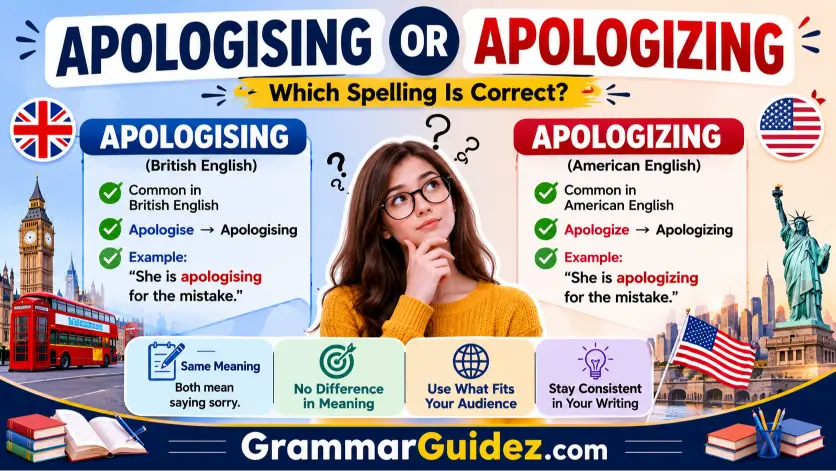
“Apologising” and “apologizing” are both correct spellings, but their usage depends on the variety of English. “Apologizing” is the standard spelling in American English, while “apologising” is the standard spelling in British English. Both mean saying that you are sorry for something.
If you are writing an email, essay, report, or social media post, you may stop and ask: Is it apologising or apologizing?
Both spellings are correct. The difference is British vs. American English, not grammar.
Apologising is the usual British-style spelling, while apologizing is the standard American spelling. Cambridge identifies apologizing as the present participle of apologize and notes that British English usually uses apologise. Oxford likewise lists apologizing as the -ing form of apologize and gives apologise as the British form.
So, if you write:
She is apologising for the mistake.
or:
She is apologizing for the mistake.
Both sentences are correct.
The spelling you choose depends on which form of English you are following.
The Short Answer: Apologising or Apologizing?
Here is the answer at a glance:
| Spelling | English variety | Correct? |
| Apologising | British English | ✅ Yes |
| Apologizing | American English | ✅ Yes |
There is no difference in meaning.
Both forms mean that someone is saying sorry or expressing regret for something they did.
For example:
- British: She is apologising for being late.
- American: She is apologizing for being late.
The meaning stays exactly the same.
The difference comes from the spelling of the base verb:
apologise → apologising
apologize → apologizing
Cambridge gives apologizing as the present participle of apologize and notes that British English usually uses apologise.
Why Are There Two Spellings?
The interesting part is that the difference does not begin with the -ing ending.
It begins with the final letter of the base verb.
English uses both:
- apologise
- apologize
When you add -ing, the spelling becomes:
- apologise → apologising
- apologize → apologizing
This is part of a wider pattern in English.
You may have seen:
- organise / organize
- realise / realize
- recognise / recognize
- apologise / apologize
- analyse / analyze
British English commonly uses -ise in these words, while American English generally uses -ize.
Oxford lists apologize as the main form and gives apologise as the British English form.
What Does “Apologising” Mean?
Apologising is the British spelling of the present participle of apologise.
It means saying sorry for something you have done or for causing a problem.
For example:
She is apologising for her mistake.
It can also be used as a gerund:
Apologising is not always easy.
Here, apologising acts like a noun and refers to the act of saying sorry.
Cambridge provides examples of apologizing being used in this way, including sentences where it functions as a present participle or gerund.
British English Examples
I am apologising for the delay.
He kept apologising for his mistake.
She is apologising to her customers.
Apologising can help resolve a conflict.
What Does “Apologizing” Mean?
Apologizing is the American spelling.
It has exactly the same meaning as apologising.
It means saying sorry, admitting regret, or expressing regret for something.
For example:
She is apologizing for being late.
Oxford lists apologizing as the -ing form of apologize.
American English Examples
I am apologizing for the confusion.
He is apologizing to his customers.
She kept apologizing after the mistake.
Apologizing was the right thing to do.
Apologising vs Apologizing in Real Writing
The easiest way to understand the difference is to see both forms in the same situations.
British English
The manager is apologising for the delay.
American English
The manager is apologizing for the delay.
British English
She was apologising to her friend.
American English
She was apologizing to her friend.
British English
We are apologising for any inconvenience.
American English
We are apologizing for any inconvenience.
Notice something important:
Nothing about the meaning changes.
Only s → z changes.
A Useful Spelling Pattern
If you understand the base verb, the -ing form becomes easy.
| British English | American English |
| apologise | apologize |
| apologises | apologizes |
| apologised | apologized |
| apologising | apologizing |
This is useful because you do not need to memorize each form separately.
Learn the base spelling first.
If your writing uses apologise, use apologising.
If your writing uses apologize, use apologizing.
Which Spelling Is Correct in the UK?
For most British English writing, apologising is the natural choice.
For example:
The company is apologising for the inconvenience.
Cambridge marks apologize as “UK usually apologise,” while Oxford identifies apologise as the British English alternative.
So if you are writing for:
- a UK school
- a British newspaper
- a British website
- a UK business
- a British audience
Apologising is usually the better choice.
Which Spelling Is Correct in the US?
For American English, use apologizing.
For example:
The company is apologizing for the delay.
Oxford’s American English dictionary lists apologizing as the standard -ing form.
This spelling is appropriate for:
- US websites
- American schools
- US business documents
- American publications
- US-focused blogs
What About Canada, Australia, and New Zealand?
This is where things become slightly less simple.
English spelling is not always divided into two perfect groups.
Australia and New Zealand generally follow British-style spelling, so apologising is a natural choice.
Canada can show both British and American influences. The important point is to follow the spelling system required by your publication, school, employer, or style guide.
For international content, consistency matters more than trying to force every word into one regional system.
For example, do not write:
The company is apologising for the delay, but later apologized for another problem.
That mixture may look inconsistent.
Instead, choose one system:
The company is apologising for the delay and later apologised for another problem.
Or:
The company is apologizing for the delay and later apologized for another problem.
The Grammar Behind “Apologising” and “Apologizing”
There is another reason people search for this keyword.
They may not only be asking about spelling. They may also want to know if the -ing form is grammatically correct.
It is.
Both words are present participles of their respective base verbs.
British
apologise → apologising
American
apologize → apologizing
You can use the form with the verb be to create continuous tenses:
She is apologising.
He was apologising.
They are apologising.
American English:
She is apologizing.
He was apologizing.
They are apologizing.
“Apologising for” or “Apologising to”?
This is a useful point that many comparison articles miss.
You can use apologise/apologize to someone for something.
Apologising to a person
She is apologising to her teacher.
Apologising for something
She is apologising for being late.
You can combine both:
She is apologising to her teacher for being late.
The same pattern works with the American spelling:
She is apologizing to her teacher for being late.
Oxford lists both apologize to somebody and apologize for something as standard constructions.
Easy Formula
apologise/apologize + to + person
apologise/apologize + for + reason
For example:
I apologise to my friend for my mistake.
I apologize to my friend for my mistake.
When Should You Use “Apologising”?
Choose apologising when your writing follows British-style spelling.
It works well in:
Formal Letters
We are apologising for the inconvenience caused.
Emails
I am apologising for my late response.
Schoolwork
She was apologising for missing the meeting.
British Websites
Our team is apologising for the technical problem.
Everyday Conversation
He kept apologising for being late.
When Should You Use “Apologizing”?
Choose apologizing when your writing follows American English.
Business Email
We are apologizing for the delay.
Customer Service
We are apologizing for the inconvenience.
Academic Writing
The speaker was apologizing for the misunderstanding.
Social Media
We are apologizing to our customers for the issue.
Everyday Conversation
He kept apologizing for being late.
Common Mistakes to Avoid
1. Mixing British and American Forms
❌ She is apologising and later apologized.
This is not necessarily grammatically wrong, but it mixes spelling systems.
✅ British:
She is apologising and later apologised.
✅ American:
She is apologizing and later apologized.
2. Writing “Appologizing”
❌ appologizing
✅ apologizing
There is only one p after the initial “a.”
The same applies to the British form:
❌ appologising
✅ apologising
3. Writing “Apologizeing”
❌ apologizeing
✅ apologizing
Do not keep the final e before adding -ing.
The pattern is:
apologize → apologizing
not:
apologize → apologizeing
4. Confusing “Apologising” With “Apology”
These words are related but have different grammatical jobs.
Apology is a noun:
She gave me an apology.
Apologising is an -ing form:
She is apologising to me.
A Better Way to Remember It
Forget the long grammar rules.
Just remember the base verbs:
British: apologise
American: apologize
Then add -ing:
British: apologising
American: apologizing
Memory Trick
Think:
S = British
Z = American
So:
apologiS + ing = apologising
apologiZ + ing = apologizing
This simple trick also works for several related spelling pairs:
- organise / organize
- realise / realize
- recognise / recognize
- apologise / apologize
Apologising or Apologizing in Different Types of Content
| Situation | Better Choice |
| US school assignment | Apologizing |
| UK school assignment | Apologising |
| US business email | Apologizing |
| UK business email | Apologising |
| American blog | Apologizing |
| British blog | Apologising |
| Australian writing | Apologising |
| International website | Either, but stay consistent |
If a company has its own style guide, follow that guide even if it differs from your usual preference.
Do You Say “I Am Apologising” or “I Am Apologizing”?
Both are correct.
The choice depends on your spelling system.
British English
I am apologising for the mistake.
American English
I am apologizing for the mistake.
There is no difference in grammar or meaning.
A Few Natural Ways to Apologize
The spelling question is useful, but knowing how the word works in real communication is even more helpful.
Cambridge’s language guidance shows that an apology often includes more than simply saying “sorry.” Speakers may explain what happened, accept responsibility, or say what they should have done instead.
For example:
I’m really sorry I forgot to call.
I apologise for the delay.
I apologize for the confusion.
It was my fault.
I owe you an apology.
These phrases make the language sound more natural.
Apologising vs Apologizing: Examples You Can Copy
British:
I am apologising for the delay in responding to your email.
American:
I am apologizing for the delay in responding to your email.
Customer Service
British:
We are apologising for the inconvenience caused.
American:
We are apologizing for the inconvenience caused.
Personal Message
British:
I am really sorry. I am apologising because I know I hurt you.
American:
I am really sorry. I am apologizing because I know I hurt you.
Formal Writing
British:
The company issued a statement apologising for the error.
American:
The company issued a statement apologizing for the error.
Quick Test: Can You Choose the Right One?
Fill in the blanks with apologising or apologizing.
- British English: She is ______ for the mistake.
- American English: She is ______ for the mistake.
- British English: We are ______ to our customers.
- American English: We are ______ to our customers.
- British English: He kept ______ for being late.
- American English: He kept ______ for being late.
Answers
- apologising
- apologizing
- apologising
- apologizing
- apologising
- apologizing
FAQs
Is apologising or apologizing correct?
Both are correct. Apologising follows the common British spelling of apologise, while apologizing follows American English apologize. The meaning and pronunciation are essentially the same. The choice depends on the variety of English you are using.
Is apologising British English?
Yes. Apologising is the British-style spelling. It comes from apologise, whereas American English generally uses apologize → apologizing. Oxford lists apologise as the British English form.
Is apologizing American English?
Yes. Apologizing is the standard American spelling. It is the -ing form of apologize. Oxford’s American English dictionary lists apologizing as the verb’s -ing form.
Is “apologising” grammatically correct?
Yes. Apologising is grammatically correct in British English. It can function as a present participle in sentences such as “She is apologising” or as a gerund in “Apologising can be difficult.” Cambridge provides examples of both types of use.
Is “apologizing” grammatically correct?
Yes. Apologizing is grammatically correct in American English. It is the present participle and -ing form of apologize. For example, “He is apologizing for the mistake.”
Do apologising and apologizing mean the same thing?
Yes. They have the same meaning. Both refer to saying sorry or expressing regret for something. The only standard difference between the two forms is the regional spelling: -s- in British-style apologising and -z- in American apologizing.
Should I use apologising or apologizing on my website?
Use the spelling that matches your target audience. A US-focused website should normally use apologizing, while a UK-focused website can use apologising. If your website serves an international audience, either is acceptable. The most important thing is to use one spelling system consistently.
Final Verdict
Apologising and apologizing are both correct.
The difference is spelling, not meaning.
Use apologising when following British-style spelling.
Use apologizing when following American English.
The base forms make the pattern easy:
apologise → apologising
apologize → apologizing
You should also remember that the -ing form can be used in continuous tenses:
She is apologising.
She is apologizing.
And it can act as a noun:
Apologising can be difficult.
Apologizing can be difficult.
For content writers, students, bloggers, and professionals, the best rule is simple: choose the English variety that matches your audience and keep your spelling consistent throughout the article or document.

I am Elliot Hartwell, an English language writer and the author at GrammarGuidez.com. For the 6 years I have been working with English grammar, vocabulary, spelling and everyday language usage with a focus on making confusing topics easier to understand.
I started GrammarGuidez.com with a goal: to give readers clear and practical answers to common English questions. English can sometimes be confusing especially when two words look or sound similar but have meanings or uses. I enjoy breaking down these differences in a way that’s simple and easy to remember.
I believe learning English should feel simple not overwhelming. My goal is to make every article on GrammarGuidez.com useful, for students, writers, bloggers, teachers and anyone who wants to communicate clearly in English.