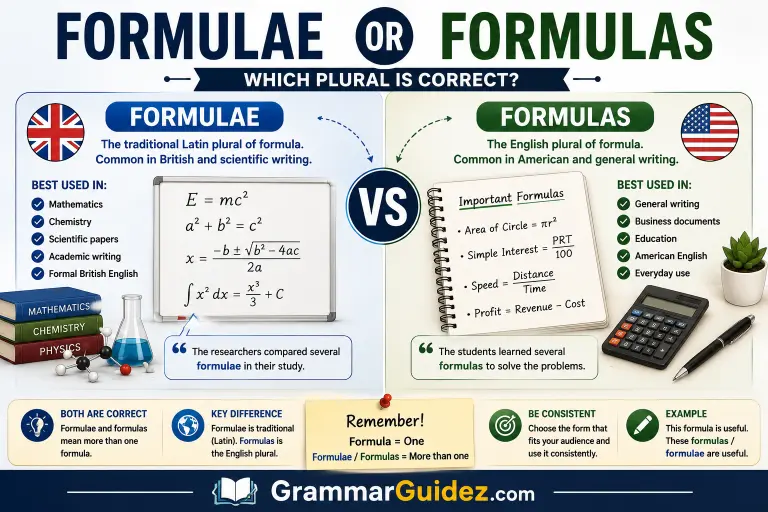
“Formulae” and “formulas” are both correct plural forms, but their usage depends on context and style. “Formulas” is the more common plural in modern English, especially in American English, while “formulae” is the traditional Latin-derived plural often used in British English or in scientific and academic contexts.
Formulae or formulas? If you are writing about mathematics, science, chemistry, business, or even a simple “formula for success,” you may wonder which plural form is correct.
The good news is that both formulae and formulas are correct plurals of formula. The choice is often influenced by style, region, and context rather than grammar. Cambridge lists both forms, while Oxford notes that formulae is used especially in scientific language.
For example:
Scientists tested several formulae in the laboratory.
Or:
Scientists tested several formulas in the laboratory.
Both sentences are grammatically acceptable.
However, there is an important detail. Formulae is the traditional plural borrowed from Latin, while formulas is the regular English plural. In modern English, formulas is especially familiar in American English, while formulae remains common in mathematical and scientific writing. Oxford’s style guidance even recommends formulas generally, but formulae in maths/chemistry.
So, which one should you use? Let’s look at the difference.
Read More About: Odor or Odour
Formulae vs Formulas: The Answer in One Minute
If you only need the quick answer, remember this:
- Formula = singular
- Formulas = English plural
- Formulae = traditional Latin plural
Examples
One formula:
This formula calculates the area of a circle.
More than one:
These formulas calculate different values.
Or:
These formulae calculate different values.
Both are correct.
The main difference is style and context, not meaning.
Cambridge lists formulas or formulae as the plural forms, and Oxford gives the same two forms.
The simplest rule
Use “formulas” for general English.
Use “formulae” when a scientific or mathematical style calls for it.
There is no need to treat one as universally correct and the other as wrong.
Why Does “Formula” Have Two Plurals?
This word has an interesting history.
Formula entered English from Latin. Like several other words borrowed from Latin, it kept a traditional Latin-style plural: formulae.
But English often turns borrowed nouns into regular English plurals by adding -s.
That gives us:
formula → formulas
This is not unusual.
English has many words with both traditional and English-style plurals.
For example:
| Singular | Traditional/alternative plural | English plural |
| formula | formulae | formulas |
| antenna | antennae | antennas |
| appendix | appendices | appendixes |
| index | indices | indexes |
The Government of Canada’s language resources specifically lists formula → formulas or formulae among foreign nouns that have both forms.
So formulas is not a “wrong” version of the plural. It is a normal English plural.
Formulae and Formulas Do Not Have Different Meanings
This is one of the most important points.
You do not choose formulae because it has one meaning and formulas because it has another.
In most cases, they mean exactly the same thing: more than one formula.
For example:
The students learned three mathematical formulas.
You could also write:
The students learned three mathematical formulae.
The basic meaning stays the same.
What changes is the style and preference.
When “Formulas” Sounds More Natural
Formulas is often the easier choice in everyday English.
It follows the familiar English plural pattern:
formula → formulas
You will commonly see it in:
- General writing
- American English
- Business writing
- Popular science
- Educational content
- Websites
- Everyday explanations
For example:
The book contains several useful formulas.
We need different formulas to solve these problems.
These formulas are easy to remember.
The company uses pricing formulas to calculate costs.
Oxford’s American English dictionary lists formulas first, followed by formulae.
When “Formulae” Is a Better Choice
Formulae can sound more traditional or technical.
Oxford specifically notes that formulae is used especially in scientific language.
You may see it in:
- Mathematics
- Chemistry
- Physics
- Scientific papers
- Academic writing
- Technical writing
- Formal British English
For example:
The researchers compared several mathematical formulae.
The textbook explains the chemical formulae of common compounds.
These formulae are used to calculate molecular weight.
That does not mean formulas would automatically be wrong. In many scientific contexts, both are acceptable.
A Small Twist: Oxford’s Own Style
This is where the answer becomes more interesting.
It is tempting to say:
“British English always uses formulae, and American English always uses formulas.”
That is too simple.
Oxford University’s style guide recommends:
formula → formulas
but says to use formulae in maths/chemistry.
This shows why a good comparison article should not turn a usage preference into an absolute grammar rule.
The real question is often:
What type of writing are you doing?
For a general article:
We tested several formulas.
For a technical mathematics context:
We compared several formulae.
Both can work.
Formulae or Formulas in American English
American English generally accepts both forms.
However, formulas is often the more natural choice for general American writing.
For example:
The students used three different formulas.
This sounds completely normal.
You can also find:
The students used three different formulae.
That is not grammatically incorrect, but it can sound more formal or technical.
Oxford’s American English dictionary gives formulas and formulae as plural forms.
Best choice for a US audience
For most general content:
Formulas
For highly technical or traditional scientific writing:
Formulae can also be appropriate.
Formulae or Formulas in British English
British English allows both.
For example:
The students learned several mathematical formulas.
and:
The students learned several mathematical formulae.
Both can be found in British English.
The important point is that formulae is not simply “the British spelling” and formulas is not simply “the American spelling.”
The distinction is more nuanced.
Cambridge itself lists both forms without making one grammatically correct and the other incorrect.
What About Canada and Other English Varieties?
The same basic principle applies in Canadian English.
The Government of Canada lists:
formula: formulas or formulae
This confirms that both plural forms are recognized.
In Australia and New Zealand, you may also encounter both forms, especially because scientific and academic writing can preserve traditional plurals.
For international content, the safest approach is simple:
Follow the style guide used by your publication and stay consistent.
Formulae vs Formulas in Mathematics
Mathematics is one area where formulae remains particularly familiar.
For example:
The students memorized several algebraic formulae.
You may also see:
The students memorized several algebraic formulas.
Neither automatically changes the mathematical meaning.
Cambridge defines formula in mathematics as a rule expressed using numbers and letters, and lists both formulas and formulae as plural forms.
Examples
Singular:
This formula calculates the area of a circle.
Plural:
These formulae calculate the areas of different shapes.
Or:
These formulas calculate the areas of different shapes.
Formulae vs Formulas in Chemistry
Chemistry is another field where formulae is often used.
For example:
The students studied the chemical formulae of several compounds.
But formulas is also possible:
The students studied the chemical formulas of several compounds.
Oxford specifically identifies formulae as a preferred contextual form in maths and chemistry in its style guidance.
So if you are writing a formal chemistry paper and your institution uses traditional scientific terminology, formulae may be the better fit.
What About “Formula for Success”?
Not every use of formula is mathematical.
The word can also mean a method, plan, or combination of things that produces a result. Cambridge gives examples such as a “formula for success.”
Here, formulas often sounds more natural in general writing.
For example:
There are no magic formulas for success.
You could technically write:
There are no magic formulae for success.
But the second version sounds much more formal and is less common in everyday writing.
Natural choice:
There is no magic formula for success.
More than one:
There are no magic formulas for success.
A Useful Context Test
When you’re unsure, ask yourself:
Am I writing general English or technical scientific English?
General English
Choose:
formulas
Mathematics or chemistry
Consider:
formulae
But remember: formulas is still acceptable in these fields unless your particular style guide says otherwise.
This is a better rule than simply memorizing:
British = formulae
American = formulas
That shortcut can lead to mistakes.
Common Mistakes With Formulae and Formulas
Mistake 1: Saying “Formulaes”
❌ formulaes
✅ formulae
The traditional plural is formulae, not formulaes.
Mistake 2: Saying “Formulases”
❌ formulases
✅ formulas
The regular English plural only needs -s.
formula → formulas
Mistake 3: Thinking “Formulae” Is Always More Correct
❌ “Formulae is the only correct plural.”
✅ “Formulae and formulas are both correct plurals.”
Major dictionaries recognize both forms.
Mistake 4: Assuming “Formulas” Is Unprofessional
❌ “Formulas should never be used in academic writing.”
✅ “Formulas can be used in academic writing, depending on the style and field.”
The choice depends on the publication, discipline, and house style.
Formulae vs Formulas: Examples Side by Side
| Context | Natural Example |
| General writing | The book contains several formulas. |
| US classroom | We learned five formulas today. |
| Mathematics | The textbook explains several formulae. |
| Chemistry | The students studied chemical formulae. |
| Business | The company uses pricing formulas. |
| General advice | There are no magic formulas for success. |
| Academic science | The paper compares several mathematical formulae. |
| Technical writing | The software uses several calculation formulas. |
The table shows why context matters more than a simple British/American rule.
Should You Write “Formulas” or “Formulae” on Your Website?
If you are writing online content for a broad audience, formulas is often the safest and most familiar choice.
It is simple.
It looks like a normal English plural.
But if your website is aimed at:
- mathematicians
- chemists
- researchers
- academics
- technical readers
then formulae may fit the tone better, especially if your field or style guide prefers traditional scientific terminology.
The golden rule
Do not switch between them randomly.
If your article says:
These formulas are useful.
Keep using formulas unless there is a clear reason to change.
Can You Use Both in the Same Article?
Yes, but there should be a reason.
For example, a style guide may recommend formulae for mathematical expressions while allowing formulas in general contexts.
Oxford’s style guidance demonstrates exactly this type of context-based distinction.
What you should avoid is random switching:
The formulas were tested. Three formulae were then selected. The formulas produced similar results.
If there is no stylistic reason for the switch, it looks inconsistent.
The Singular Is Always “Formula”
One thing is not confusing:
Formula is singular.
Formulas / formulae are plural.
Examples:
This formula is correct.
These formulas are correct.
These formulae are correct.
Do not use formulae when you are talking about only one formula.
Formulae or Formulas? A Simple Decision Guide
Use this quick guide before publishing.
Choose “formulas” if:
- You are writing for a general audience.
- You prefer modern English.
- You are writing American English.
- You are writing business or web content.
- You want the most straightforward plural.
Choose “formulae” if:
- Your scientific style guide prefers it.
- You are writing formal mathematics or chemistry.
- Your publication traditionally uses Latin-derived plurals.
- You want to follow a technical convention.
Either can work if:
- You are writing general British English.
- Your style guide accepts both.
- The context does not require a specific form.
FAQs
Is formulae or formulas correct?
Both formulae and formulas are correct plural forms of formula. Formulae is the traditional Latin plural, while formulas is the regular English plural. Cambridge lists both forms, and Oxford also recognizes both.
Is “formulas” more common in American English?
Formulas is a very common choice in American English, especially in general, educational, and business writing. However, formulae is also recognized and can appear in technical or scientific contexts. Oxford’s American English dictionary lists both formulas and formulae.
Is “formulae” British English?
Formulae is widely used in British English, particularly in scientific and mathematical contexts, but it is not exclusively British. British English also uses formulas. Cambridge lists both forms, so it would be inaccurate to say that British English allows only formulae.
What is the plural of formula in mathematics?
Both formulas and formulae can be used. In formal mathematical or scientific writing, formulae may be preferred by some style guides. Oxford’s style guide specifically recommends formulae in maths and chemistry, while using formulas more generally.
What is the plural of formula in chemistry?
Both formulas and formulae are accepted. Formulae is particularly common in traditional scientific writing. If your university, journal, or organization has a preferred style, follow it.
Is “formulaes” correct?
No. The two accepted plural forms are formulas and formulae. Formulaes is not the standard plural form.
Should I use formulae or formulas in an SEO article?
For a general SEO article aimed at a broad audience, formulas is usually the clearer choice. However, if the article targets a technical mathematics or chemistry audience, formulae may fit the subject and terminology better. Most importantly, use the form consistently.
Conclusion
So, formulae or formulas which is correct?
Formulas is the regular English plural and is especially common in general and American English.
Formulae is the traditional Latin plural and remains particularly common in scientific and mathematical writing. Oxford specifically notes formulae for maths and chemistry in its style guidance.
The key is not to think of this as a simple “right versus wrong” spelling question.
Think about audience, subject, and style.
If you are writing a general article, formulas is usually the easiest choice.
If you are writing formal scientific or mathematical material, formulae may be the more traditional choice.
And if your school, university, journal, or employer has a style guide, follow that guide first.
The most important rule is consistency. Once you choose your preferred form, use it consistently throughout your document.

I am Evan Whitmore, an English language writer and the person who started GrammarGuidez.com. I made GrammarGuidez.com to make grammar, spelling, vocabulary and words that are often confused easier to understand.
I like taking to understand English words and grammar rules and turning them into simple and clear explanations. My aim is to help students, writers, bloggers, ESL learners and regular English speakers feel more sure when they write and talk.
At GrammarGuidez.com I work on real life examples easy to understand explanations comparing words, spelling changes and how American English is used every day.
I think learning English doesn’t need to be hard. A good explanation and some good examples can make tough grammar topics much simpler to learn