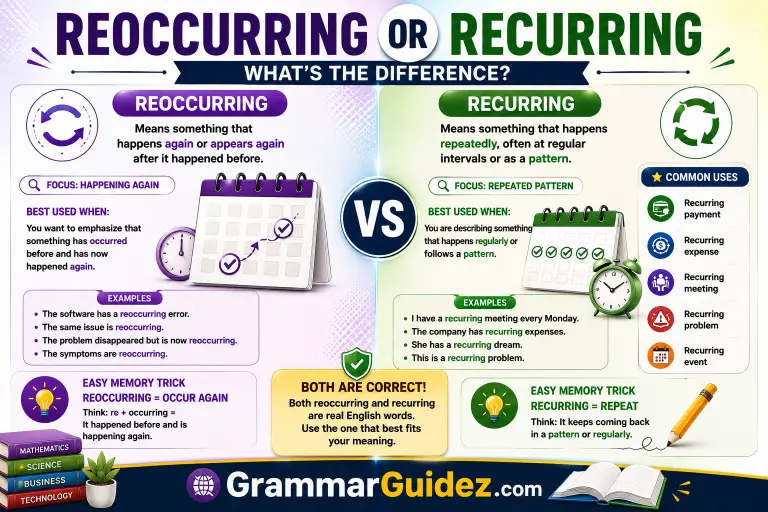
“Recurring” and “reoccurring” are both correct words, but they have slightly different meanings. “Recurring” means happening repeatedly or regularly, while “reoccurring” means happening again, often after it has stopped.
Have you ever written reoccurring and then wondered if recurring would be better?
You are not alone. These two words look almost identical, and both can describe something that happens again. That makes the choice confusing, especially in phrases such as recurring payment, recurring problem, reoccurring issue, and recurring event.
Here is the key point: both “recurring” and “reoccurring” are real English words. However, they can carry slightly different emphasis.
Recurring usually describes something that happens repeatedly, often as part of a pattern or at regular intervals. Reoccurring focuses more directly on something happening again after it happened before. Merriam-Webster treats reoccurring as the present participle of reoccur and recurring as the present participle of recur.
In many everyday situations, the two overlap. But when you want the clearest word, recurring is usually the better choice for regular or repeated events, while reoccurring can emphasize a new occurrence of something that has happened before.
Read More About: Formulae or Formulas
The Easy Way to Tell Them Apart
Think about the difference like this:
Recurring = happening again and again
Reoccurring = happening again
For example:
We have a recurring meeting every Monday.
The meeting follows a pattern, so recurring is the natural choice.
Now imagine a computer problem that was fixed six months ago but suddenly appears again:
The software has a reoccurring problem.
Here, reoccurring highlights the fact that the problem has returned.
That distinction is not absolute. In many sentences, either word can work. Dictionary.com also explains the common distinction between regular repetition with recurring and another occurrence with reoccurring.
Recurring: The Word You Will Use Most Often
Recurring comes from the verb recur.
It can describe something that:
- happens repeatedly
- returns over time
- appears at intervals
- follows a pattern
- keeps happening
Merriam-Webster defines recurring as something occurring or appearing at intervals and also lists it as the present participle of recur.
Examples
I have a recurring appointment every Friday.
The company has recurring expenses each month.
She has a recurring dream.
This is a recurring problem.
We noticed a recurring pattern in the data.
In these examples, the idea is not simply that something happened twice. The emphasis is on repetition or a continuing pattern.
Reoccurring: What Does It Mean?
Reoccurring comes from reoccur.
The basic idea is:
to occur again
Merriam-Webster gives reoccur as meaning “to occur again” and lists reoccurring as its present participle.
For example:
The error is reoccurring after the update.
This suggests that the error occurred before and has now appeared again.
Another example:
The same issue keeps reoccurring.
Here, the word can overlap with recurring because the issue has appeared more than once.
Important point
Reoccurring is not a misspelling of recurring.
It is a legitimate word.
Merriam-Webster’s current entries include reoccur, reoccurred, and reoccurring.
Recurring vs Reoccurring at a Glance
| Feature | Recurring | Reoccurring |
| Base verb | Recur | Reoccur |
| Basic idea | Happen repeatedly | Happen again |
| Suggests a pattern | Often | Not necessarily |
| Regular intervals | Common | Not required |
| Unexpected return | Possible | Often a useful emphasis |
| Common phrase | Recurring payment | Reoccurring problem |
| Correct word? | Yes | Yes |
The difference is mainly about emphasis, not a strict grammar rule.
A Real-Life Example That Makes the Difference Clear
Imagine your gym membership charges you every month.
You could say:
I have a recurring payment.
Why?
Because the payment happens on a regular schedule.
Now imagine your phone develops a software bug.
The technician fixes it.
Three months later, the same bug appears again.
You might say:
The problem is reoccurring.
The focus is on the problem appearing again.
This is why recurring is so common in business and subscription language.
Merriam-Webster’s recent examples include phrases such as recurring basis, recurring costs, and recurring savings.
Why “Recurring” Is Common in Business English
If you work with invoices, subscriptions, budgets, or contracts, you have probably seen recurring many times.
Common expressions include:
- recurring payment
- recurring bill
- recurring expense
- recurring revenue
- recurring subscription
- recurring charge
- recurring cost
- recurring meeting
- recurring order
For example:
Your recurring payment will be processed on the first of each month.
This sounds natural because the payment follows a regular schedule.
You would usually not choose reoccurring payment when you mean a scheduled payment.
Another example
The business has high recurring costs.
The costs happen repeatedly as part of normal operations.
That makes recurring the stronger choice.
When “Reoccurring” Makes More Sense
Use reoccurring when your main idea is that something has happened again.
For example:
The error is reoccurring after every software update.
The same complaint is reoccurring among customers.
The problem stopped for a while but is now reoccurring.
The symptoms of the issue are reoccurring.
The word can be especially useful when the event is not part of a predictable schedule.
A problem can disappear and then return without following a fixed pattern.
That is a useful context for reoccurring.
Is Reoccurring Always Different From Recurring?
No.
This is where many online explanations become too strict.
It would be misleading to say that recurring always means regular and reoccurring always means only twice.
Real English is more flexible.
Merriam-Webster’s current thesaurus entries actually connect the two words closely: recurring is listed as “as in reoccurring,” while reoccurring is listed “as in recurring.”
Both can mean that something happens again.
The difference is often one of focus and natural usage.
Compare:
We have a recurring meeting every Tuesday.
This clearly describes a repeated schedule.
The same technical error keeps reoccurring.
This highlights the return of the error.
But you could also say:
The same technical error keeps recurring.
That is perfectly natural too.
Recurring or Reoccurring for a Problem?
This is one of the most common questions.
The answer depends on what you want to say.
Use “recurring problem” when:
The problem keeps happening as a pattern.
Late deliveries are a recurring problem for the company.
Use “reoccurring problem” when:
You want to stress that the problem has appeared again.
The software has a reoccurring problem after every major update.
However, recurring problem is very common and works in both situations.
If you are unsure, recurring is usually the safer choice.
Recurring or Reoccurring for Payments?
For payments, recurring is the clear choice.
Use:
recurring payment
recurring charge
For example:
You can cancel your recurring subscription at any time.
A recurring payment is normally one that repeats according to an established schedule.
Reoccurring payment is possible to understand, but it is not the normal phrase for a scheduled payment.
Recurring or Reoccurring for Events?
Again, context matters.
Scheduled event
The conference is a recurring event.
This suggests the conference happens repeatedly.
Event that happened again
The same problem is reoccurring during the event.
Here, reoccurring focuses on the problem happening again.
So:
Recurring event = repeated event or established pattern.
Reoccurring event = an event that occurs again, with emphasis on its return.
Recurring vs Reoccurring in Grammar
Both words can function as present participles.
Recurring
Base verb:
recur
Present participle:
recurring
Example:
The problem is recurring.
It can also work as an adjective:
We have a recurring problem.
Reoccurring
Base verb:
reoccur
Present participle:
reoccurring
Example:
The problem is reoccurring.
It can also work as an adjective:
We have a reoccurring problem.
So neither spelling is a grammar error.
Do Not Confuse “Recur” and “Reoccur”
The base verbs are important.
Recur
Recur means to happen or appear again, often with the idea of repetition or return.
The problem may recur next month.
Reoccur
Reoccur means to occur again.
The problem may reoccur after the repair.
Merriam-Webster explains that both verbs can mean “to happen or appear again,” while recur can additionally suggest periodic or frequent repetition.
This gives us a useful family:
recur → recurring
reoccur → reoccurring
Common Mistakes
❌ “Recurring” is the only correct word.
Not true.
Reoccurring is also a real word.
❌ “Reoccurring” is always wrong.
Also false.
Merriam-Webster recognizes reoccurring as the present participle of reoccur.
❌ “Reoccurring” means exactly the same thing in every situation.
Not quite.
Although the words overlap, recurring often emphasizes repeated or patterned occurrence, while reoccurring can emphasize something happening again.
❌ “Recurring payment” and “reoccurring payment” are equally natural.
They can both be understood, but recurring payment is the standard and more natural expression.
Which One Should You Use?
If you need one practical rule, use this:
Choose recurring when something:
- happens regularly
- repeats over time
- follows a pattern
- is scheduled
- continues to happen
Examples:
recurring payment
recurring meeting
Choose reoccurring when you want to emphasize:
- something happening again
- a previous event returning
- an issue appearing another time
- a second or later occurrence
Examples:
a reoccurring error
a reoccurring issue
the problem is reoccurring
the same event is reoccurring
A Simple Memory Trick
Here is an easy way to remember the difference:
RECUR = REPEAT
Think of recurring as something that keeps coming back.
recurring = repeated pattern
REOCCUR = OCCUR AGAIN
Think of reoccurring as:
re + occurring
Something occurred before, and now it is occurring again.
This is not a perfect rule for every sentence, but it is useful when you need to make a quick choice.
Which Word Sounds More Natural?
If you are writing general English and you are unsure, recurring will usually be the better choice.
Compare:
We have a recurring problem.
This is very natural.
We have a reoccurring problem.
This is also understandable and can be correct, but it puts more emphasis on the problem appearing again.
That is why recurring is often the better default.
Quick Practice
Choose recurring or reoccurring.
- My credit card has a ______ payment.
- The same software bug keeps ______.
- We hold a ______ meeting every Monday.
- The company has several ______ expenses.
- The problem disappeared but is now ______.
- She has a ______ dream about flying.
Answers
- recurring
- reoccurring or recurring
- recurring
- recurring
- reoccurring or recurring
- recurring
Notice that some answers can take either word. Context determines which one communicates your intended meaning more clearly.
FAQs
Is “reoccurring” a real word?
Yes. Reoccurring is a real English word. It is the present participle of reoccur, meaning to occur again. Merriam-Webster includes reoccurring and gives examples of it being used for something that happens again.
Is recurring or reoccurring better?
Recurring is usually the better choice when something happens repeatedly or follows a pattern. Reoccurring can be better when you want to emphasize that something happened before and has appeared again. In many contexts, however, both words are possible.
Is “reoccurring problem” correct?
Yes. Reoccurring problem is grammatically correct. It can describe a problem that has appeared before and has returned. However, recurring problem is also correct and is often the more natural choice when the problem happens repeatedly.
Is it recurring payment or reoccurring payment?
The standard phrase is recurring payment. It normally describes a payment that happens automatically or regularly, such as a monthly subscription. Reoccurring payment can be understood, but it is not the usual term for a scheduled payment.
Is recurring the same as repeated?
They are closely related, but not always identical. Recurring suggests something that happens again over time, often as a pattern. Repeated is broader and simply means something happened more than once. A recurring event is therefore a type of repeated event.
Can recurring and reoccurring be used interchangeably?
Sometimes, yes. Both can refer to something happening again, so there are many sentences where either word works. The difference is usually one of emphasis. Recurring often highlights repetition or a pattern, while reoccurring can highlight another occurrence.
Which is better for formal writing?
For most formal writing, recurring is the safer and more established choice when you mean something that happens repeatedly. If you specifically want to emphasize that an event has occurred again, reoccurring may be appropriate.
Conclusion
Both “reoccurring” and “recurring” are correct English words.
The difference is subtle.
Recurring is the better choice when something happens repeatedly, regularly, or as part of a continuing pattern.
We have a recurring meeting every Friday.
Reoccurring is useful when you want to emphasize that something has happened before and has now happened again.
The software has a reoccurring error.
But these meanings overlap. Merriam-Webster treats reoccurring and recurring as closely related terms, and both are established forms.
So, if you are unsure, recurring is usually the safest choice, especially for phrases such as recurring payment, recurring expense, recurring meeting, and recurring event.
The main thing is to choose the word that best matches your intended meaning not to assume that one is correct and the other is wrong.

I am Elliot Hartwell, an English language writer and the author at GrammarGuidez.com. For the 6 years I have been working with English grammar, vocabulary, spelling and everyday language usage with a focus on making confusing topics easier to understand.
I started GrammarGuidez.com with a goal: to give readers clear and practical answers to common English questions. English can sometimes be confusing especially when two words look or sound similar but have meanings or uses. I enjoy breaking down these differences in a way that’s simple and easy to remember.
I believe learning English should feel simple not overwhelming. My goal is to make every article on GrammarGuidez.com useful, for students, writers, bloggers, teachers and anyone who wants to communicate clearly in English.