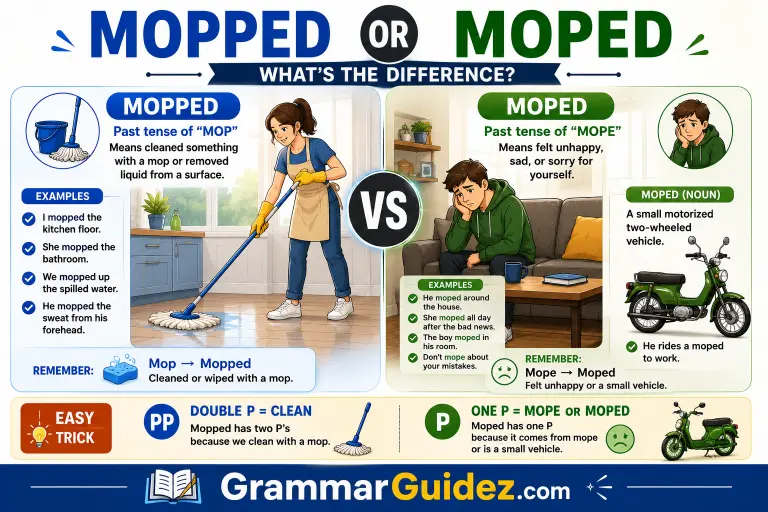
“Mopped” and “moped” are both correct words, but they have different meanings. “Mopped” is the past tense of mop, meaning cleaned a floor with a mop, while “moped” is the past tense of mope, meaning spent time feeling sad or miserable.
Mopped or moped? These words look almost the same, but they have very different meanings. One is usually connected with cleaning, while the other can describe feeling sad or moving around slowly. Moped can also be a noun for a small motorized two-wheeled vehicle.
That is why this pair can be tricky. You might want to write:
I mopped the kitchen floor.
But you could accidentally type:
I moped the kitchen floor.
That changes the meaning completely.
The correct word depends on what you want to say. Mopped is the past tense and past participle of mop. It means cleaned something with a mop or removed liquid from a surface. Oxford lists mopped as the past form of mop.
Moped, on the other hand, is the past tense and past participle of mope, meaning to spend time feeling unhappy or sorry for yourself. It is also a noun meaning a small motorcycle or motorized two-wheeled vehicle.
Let’s make the difference easy to remember.
Read More About: Reoccurring or Recurring
The 10-Second Answer
If you mean cleaning, use mopped.
Sarah mopped the floor.
If you mean feeling sad, bored, or sorry for yourself, use moped.
He moped around the house all day.
If you mean a small motorcycle with pedals, use moped as a noun.
He bought a new moped.
So the simple rule is:
Mopped = cleaned with a mop.
Moped = felt unhappy or moved sadly.
Moped = also a small motorized vehicle.
Oxford gives mopped as the past form of mop, while moped is the past form of mope.
The Key Difference Is the Base Word
A very easy way to understand these words is to look at their base verbs.
Mop → Mopped
Mop means to clean something with a mop or remove liquid from a surface.
I mop the floor every Saturday.
Past tense:
I mopped the floor yesterday.
Oxford lists:
- mop
- mops
- mopped
- mopping
as the main forms of the verb.
Mope → Moped
Mope means to spend time feeling unhappy, disappointed, or sorry for yourself.
He tends to mope when things go wrong.
Past tense:
He moped after losing the game.
Oxford lists moped as the past simple and past participle of mope.
This gives you the basic pattern:
| Base Verb | Past Tense | Meaning |
| mop | mopped | cleaned |
| mope | moped | felt unhappy |
Why “Mopped” Has Two P’s
This is one of the biggest spelling questions in this comparison.
Why do we write:
mopped
instead of:
moped?
Because mop is a short verb ending in a consonant-vowel-consonant pattern.
When we add -ed, the final consonant is doubled:
mop → mopped
The same pattern appears in words such as:
stop → stopped
plan → planned
drop → dropped
So:
❌ mop + ed = moped
✅ mop + ped = mopped
The spelling moped is already associated with the verb mope and the noun moped, so the extra p is important.
What Does “Mopped” Mean?
Mopped is the past tense and past participle of mop.
It normally means that someone cleaned a floor, surface, or other area with a mop.
Oxford defines mop as cleaning something with a mop. It also gives another use: removing liquid from a surface with a cloth.
Examples
I mopped the kitchen floor.
She mopped the bathroom this morning.
We mopped the hallway after the children spilled juice.
He mopped the water from the floor.
The cleaner mopped the entire office.
In all these examples, mopped describes a cleaning action.
“Mopped” Can Also Mean Wiping Something
You do not always need to use mopped with a literal floor.
The verb can also describe removing liquid from a surface.
For example:
He mopped the sweat from his forehead.
Oxford gives mop something from something as a use for removing liquid from a surface.
You may also see:
She mopped up the spilled milk.
Here, mopped up means cleaned up or absorbed a liquid.
Cambridge also lists mop up as a phrasal verb.
What Does “Moped” Mean?
The word moped has two important uses.
The first is related to the verb mope.
To mope means to spend time doing little while feeling unhappy or sorry for yourself. Oxford gives mope the synonym brood and lists moped as its past form.
Examples
He moped around the house after the argument.
She moped all day because her plans were canceled.
The boy moped in his room after losing the match.
He moped about his bad luck.
In these sentences, nobody is cleaning anything.
The person is simply feeling unhappy or behaving sadly.
“Moped” Is Also a Vehicle
There is another meaning that makes this word especially interesting.
A moped is a small motorized two-wheeled vehicle. Cambridge defines it as a small motorcycle with pedals that can help when starting or traveling uphill.
For example:
He rides a moped to work.
She bought a red moped.
The moped was parked outside the store.
Here, moped is a noun, not a verb.
This meaning has nothing to do with cleaning or feeling sad.
Three Meanings You Should Remember
You can make the whole topic easier by separating the three uses.
1. Mopped = cleaned
They mopped the floor.
2. Moped = felt unhappy
He moped after the breakup.
3. Moped = small motorized vehicle
She rode a moped to school.
This is why context is so important.
Compare These Sentences
Look carefully at these examples:
Cleaning
Maria mopped the kitchen.
Maria cleaned the kitchen with a mop.
Feeling unhappy
Maria moped in her room.
Maria stayed in her room feeling unhappy.
Vehicle
Maria rode a moped to work.
Maria used a small motorized two-wheeled vehicle.
Only one letter changes, but the meaning changes dramatically.
Mopped vs Moped: A Visual Comparison
| Word | Part of Speech | Meaning | Example |
| mopped | verb | cleaned with a mop | He mopped the floor. |
| moped | verb | felt unhappy or miserable | She moped all afternoon. |
| moped | noun | small motorized two-wheeled vehicle | He bought a moped. |
The easiest distinction is:
Mopped has double P because it comes from mop.
Moped with one P can come from mope or refer to a vehicle.
Mopped or Moped in Everyday Writing?
Here are some common situations.
Cleaning the house
Use mopped:
I mopped the floors before the guests arrived.
Cleaning a spill
Use mopped:
She mopped up the spilled water.
Feeling disappointed
Use moped:
He moped around after failing the test.
Feeling sorry for yourself
Use moped:
Don’t sit there and mope about it.
Talking about transportation
Use moped:
They traveled around town on a moped.
Common Mistakes to Avoid
Mistake 1: “I moped the floor.”
❌ I moped the floor.
This does not normally mean you cleaned the floor.
If cleaning is your intended meaning, write:
✅ I mopped the floor.
Mistake 2: “He mopped around all day.”
❌ He mopped around all day.
If you mean he was sad or miserable, use:
✅ He moped around all day.
Mistake 3: “She mopped a motorcycle.”
❌ She bought a mopped.
If you mean the vehicle, the noun is:
✅ She bought a moped.
Cambridge identifies moped as a noun for a small motorized two-wheeled vehicle.
A Useful Spelling Trick
Here is a simple memory trick:
MOP = MOPP
When you turn mop into the past tense, remember:
MOP + PED = MOPPED
The extra P helps you remember the cleaning meaning.
Now think about MOPE:
MOPE → MOPED
There is no doubled P because the base verb already ends in e.
So:
mop → mopped
mope → moped
This is one of the easiest ways to avoid the spelling mistake.
Pronunciation Can Help, Too
The two words are also pronounced differently.
Mopped ends with a /t/ sound:
mopped
Moped, when it is the past tense of mope, has a /t/ sound at the end as well, but the vowel sound is different because the base word is mope.
The noun moped is pronounced differently from the past tense of mope in many dictionaries.
Cambridge gives the noun moped as /ˈməʊ.ped/ in UK English and /ˈmoʊ.ped/ in US English.
The spelling and context are therefore more reliable than pronunciation alone when deciding which word you need.
Mopped in Different Forms
If you know the word family, the spelling becomes easier.
Present
I mop the floor.
Third-person singular
She mops the floor.
Past
She mopped the floor.
Present participle
She is mopping the floor.
Cambridge confirms mopping as the present participle and mopped as the past tense and past participle.
Notice the spelling change:
mop → mopped → mopping
The double p stays in these forms.
Moped as a Verb
When moped comes from mope, its forms are:
mope
mopes
moped
moping
For example:
Don’t mope about your mistake.
He mopes when he is disappointed.
She moped after the argument.
He is moping in his room.
Oxford confirms moped as the past form and moping as the -ing form of mope.
Which One Should You Use?
Ask one simple question:
What am I trying to describe?
If the answer is cleaning, choose:
Mopped
If the answer is feeling unhappy, choose:
Moped
If the answer is a small motorized vehicle, choose:
Moped
Quick decision chart
Cleaning a floor? → Mopped
Removing spilled water? → Mopped
Feeling sad? → Moped
Feeling sorry for yourself? → Moped
Small motorcycle? → Moped
Mini Quiz
Choose the correct word.
- Sarah ______ the kitchen floor.
- A. moped
- B. mopped
- He ______ around after losing the competition.
- A. mopped
- B. moped
- They bought a new ______.
- A. mopped
- B. moped
- We ______ up the spilled juice.
- A. mopped
- B. moped
- She ______ in her room after the bad news.
- A. mopped
- B. moped
Answers
- B — mopped
- B — moped
- B — moped
- A — mopped
- B — moped
Frequently Asked Questions
Is “mopped” or “moped” correct?
Both are correct, but they have different meanings. Mopped is the past tense of mop and usually means cleaned something with a mop. Moped is the past tense of mope, meaning felt unhappy or sorry for yourself. Moped is also a noun for a small motorized vehicle.
Is it “I mopped the floor” or “I moped the floor”?
The correct sentence is “I mopped the floor.” The verb mop means to clean with a mop, and its past tense is mopped. Moped comes from mope, which means to spend time feeling unhappy.
What is the past tense of mop?
The past tense of mop is mopped. The final p is doubled before adding -ed. For example: “She mopped the kitchen floor.” Oxford lists mopped as both the past simple and past participle of mop.
What is the past tense of mope?
The past tense of mope is moped. For example: “He moped around the house after the bad news.” Oxford lists moped as the past simple and past participle of mope.
What does moped mean?
Moped has two common meanings. It can be the past tense of mope, meaning someone felt unhappy or sorry for themselves. It can also be a noun for a small motorized two-wheeled vehicle with pedals.
Why is mopped spelled with two Ps?
Mopped comes from the short verb mop. When the verb takes -ed, the final consonant is doubled: mop → mopped. This distinguishes it from moped, which comes from the verb mope.
Is “moped” a verb or a noun?
It can be both. As a verb, moped is the past tense of mope. As a noun, a moped is a small motorized two-wheeled vehicle. The surrounding sentence tells you which meaning is intended.
Mopped or Moped: Final Verdict
Mopped and moped are both correct words, but they do not mean the same thing.
Use mopped when you are talking about cleaning with a mop or removing liquid from a surface.
We mopped the floor.
Use moped when you mean someone spent time feeling unhappy or sorry for themselves.
He moped around after the argument.
And remember that moped is also a noun for a small motorized two-wheeled vehicle.
She rides a moped to work.
The easiest way to remember the difference is to connect mopped with mop and moped with mope.
Mop → mopped.
Mope → moped.
Once you remember the base verbs, this confusing pair becomes much easier.

I am Evan Whitmore, an English language writer and the person who started GrammarGuidez.com. I made GrammarGuidez.com to make grammar, spelling, vocabulary and words that are often confused easier to understand.
I like taking to understand English words and grammar rules and turning them into simple and clear explanations. My aim is to help students, writers, bloggers, ESL learners and regular English speakers feel more sure when they write and talk.
At GrammarGuidez.com I work on real life examples easy to understand explanations comparing words, spelling changes and how American English is used every day.
I think learning English doesn’t need to be hard. A good explanation and some good examples can make tough grammar topics much simpler to learn