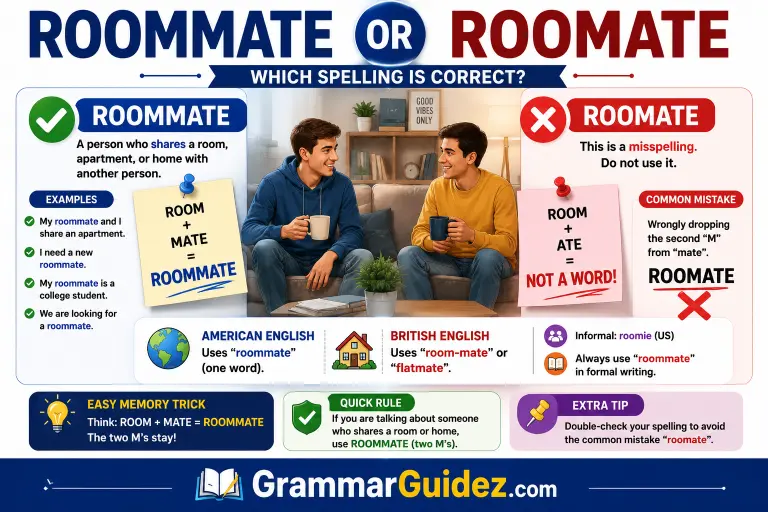
“Roommate” is the correct spelling, while “roomate” is a common misspelling and not a standard English word. “Roommate” is a noun meaning a person who shares a room or home with someone, whereas “roomate” has no accepted meaning in standard English.
Have you ever typed roomate and then wondered if you forgot a letter? You are not alone. Roommate or roomate is a common spelling question, especially for English learners and people writing quickly online.
The correct spelling is roommate with two m’s.
Roomate is a misspelling.
The word roommate is a noun for someone who shares a room, apartment, or home with another person. Cambridge lists roommate as the standard spelling and explains that it can refer to someone who shares a room or, in US English, an apartment or house.
There is also an interesting regional difference. In British English, room-mate can be used, while flatmate is common for someone who shares a flat. In North American English, roommate is the usual form.
So if you are asking “roommate or roomate?”, the answer is simple:
✅ Roommate
❌ Roomate
But there is more to this word than just one extra m.
Roommate vs Roomate at a Glance
| Spelling | Correct? | Meaning |
| Roommate | ✅ Yes | A person who shares a room, apartment, or home |
| Roomate | ❌ No | Misspelling of roommate |
| Room-mate | ✅ Yes, in some British usage | Same basic meaning |
| Flatmate | ✅ Yes | Common British English term for someone sharing a flat |
Oxford lists roommate as the North American form and room-mate as a British English form. It also notes that flatmate is the British English equivalent when referring to someone sharing a flat.
Why Is “Roommate” Spelled With Two M’s?
This is the part that causes the mistake.
The word is made from two words:
room + mate = roommate
The first word ends in m:
room
The second word begins with m:
mate
When they join together, both letters remain:
room + mate → roommate
So the spelling has two m’s in the middle:
r o o m m a t e
It is not:
r o o m a t e
That gives us:
Correct
roommate
Incorrect
roomate
A useful way to remember it is to see the two parts:
ROOM + MATE
The final M of room and the first M of mate both stay.
What Does “Roommate” Mean?
Roommate is a noun.
At its most basic level, it means a person who shares a room with you.
For example:
Jake was my roommate in college.
However, modern American English often uses roommate more broadly for someone who shares an apartment or house with you. Cambridge gives both meanings.
For example:
My roommate and I share a two-bedroom apartment.
Here, the two people may have separate bedrooms but still share the same home.
Oxford similarly defines roommate as someone who shares a room or apartment, especially in a college or university setting.
Roommate Is a Compound Word
There is a simple language lesson hidden inside roommate.
English often combines two words to create a new word.
For example:
- class + mate → classmate
- school + mate → schoolmate
- team + mate → teammate
- room + mate → roommate
Notice something interesting:
class + mate = classmate
team + mate = teammate
room + mate = roommate
The first word keeps its final letter, and mate keeps its first m.
That is why roommate needs two m’s.
The Easy Memory Trick: “Room + Mate”
If you frequently write roomate, don’t try to memorize the whole word.
Break it into two parts:
ROOM
MATE
=
ROOMMATE
Say it mentally:
ROOM — MATE
That makes the double m much easier to remember.
Another quick trick:
Your room has two M’s when you have a mate.
It is a little playful, but it can help learners remember the spelling.
Roommate or Room-Mate?
This is a slightly different question.
You may see:
roommate
and:
room-mate
Both forms have been used in English.
Oxford identifies room-mate as British English and roommate as North American English.
Today, roommate is the safest choice for most general and especially US-focused writing.
For example:
I need a new roommate.
If you are following a British publication’s house style, you may encounter:
I need a new room-mate.
The important point is that room-mate and roommate are not the same issue as roomate.
Roomate is missing an m and should be avoided.
Roommate vs Flatmate
Regional English can make this word a little more interesting.
In North American English:
roommate
is widely used.
In British English:
flatmate
is common when two people share a flat.
Oxford specifically identifies flatmate as British English and roommate as North American English.
For example:
American English
I share an apartment with my roommate.
British English
I share a flat with my flatmate.
But roommate can still be understood in British English, especially when referring to someone sharing an actual room.
Roommate vs Housemate
These words are close, but they are not always identical.
Roommate
A person who shares a room, apartment, or house with you.
My roommate is a medical student.
Housemate
A person who lives in the same house as you.
My housemate works from home.
The exact choice depends on the living arrangement and regional English.
Cambridge notes that housemate can be used alongside roommate in the US when talking about someone who shares a home.
What About “Roomie”?
You may also hear roomie.
This is an informal word for roommate.
Cambridge describes roomie as a US informal term and a shortened form of roommate.
For example:
My roomie is really funny.
This sounds casual and friendly.
In formal writing, however, roommate is usually the better choice.
Formal
My roommate moved to Chicago.
Casual
My roomie moved to Chicago.
So you have several related words:
roommate → standard
room-mate → British variant
flatmate → common British term
roomie → informal
Common “Roomate” Mistakes
1. Missing the Second M
❌ roomate
✅ roommate
The incorrect form drops the first m of mate.
2. Adding an Unnecessary Space
❌ room mate
✅ roommate
Modern standard American usage normally writes it as one word.
3. Confusing Roommate With Flatmate
These words can overlap, but regional usage differs.
roommate especially common in North American English
flatmate especially common in British English
Oxford supports this regional distinction.
Real-Life Examples of “Roommate”
The word appears in many everyday situations.
College
My roommate and I study in the library every evening.
Apartment living
I am looking for a new roommate.
Rent
My roommate pays half of the rent.
House sharing
Her roommate moved out last month.
Travel
I had the same roommate throughout college.
Conversation
Have you met my new roommate?
These examples show why the word is common in everyday English.
Roommate in Different Sentences
Singular
My roommate is from Texas.
Plural
My roommates are very friendly.
Possessive
My roommate’s car is outside.
With an adjective
I have a quiet roommate.
With a verb
My roommate cooks dinner every night.
Notice that the spelling remains:
roommate
The double m does not disappear when the word changes form.
A Quick Spelling Test
Which sentence is correct?
A
I need a new roomate.
B
I need a new roommate.
The answer is:
✅ B. I need a new roommate.
Now try these:
1.
My ______ is moving next week.
Answer: roommate
2.
I shared a room with my ______ at college.
Answer: roommate
3.
My ______ and I split the rent.
Answer: roommate
4.
She is looking for a new ______.
Answer: roommate
Why “Roomate” Looks So Natural
There is a reason this spelling mistake is easy to make.
When we pronounce roommate, the two m’s do not feel like two separate sounds.
You naturally hear something close to:
room-mate
The letters blend together when you speak.
That can make the written form feel like it should be:
roomate
But spelling follows the two original words:
room + mate
So the written form preserves both m’s.
This is a good example of why English spelling cannot always be predicted from pronunciation.
Which Spelling Should You Use?
For most writers, the answer is straightforward:
Use roommate
This is the best choice if you are:
- writing for American readers
- writing website content
- writing blog posts
- creating educational material
- writing everyday English
- preparing professional documents
- helping English learners
If you are specifically following British English, room-mate may appear, and flatmate is often more natural for someone sharing a flat.
But regardless of regional style:
❌ roomate is not the standard spelling.
Roommate in American English
Roommate is particularly common in American English.
Cambridge’s American English dictionary defines a roommate as someone with whom you share a room or apartment.
Oxford’s American dictionary also uses roommate and gives examples involving college and apartment living.
So for a US-focused website, the recommendation is very clear:
Use roommate.
Roommate in British English
British English has a few more choices.
You may see:
- room-mate
- flatmate
- roommate
Oxford labels room-mate as British English and roommate as North American English. It also identifies flatmate as the British equivalent of North American roommate when referring to someone who shares a flat.
For example:
My flatmate is from Manchester.
This sounds very natural in British English.
If the people literally share the same bedroom, room-mate can be more precise.
The Bottom Line
If you only remember one thing from this article, remember this:
ROOM + MATE = ROOMMATE
Not:
❌ ROOMATE
The correct standard spelling is roommate, with two m’s.
Roommate is a noun for someone who shares a room, apartment, or home with another person. Cambridge and Oxford both recognize the word and explain its use in college, apartment, and shared-home contexts.
British English also has room-mate, while flatmate is common for someone sharing a flat.
So when you are unsure between roommate or roomate, choose:
✅ Roommate
And remember the simple formula:
ROOM + MATE = ROOMMATE
FAQs
Is it roommate or roomate?
The correct spelling is roommate. It contains two consecutive m’s because the word combines room and mate: room + mate = roommate. Roomate is a common spelling mistake and should not be used in standard English writing.
Why does roommate have two m’s?
Roommate has two m’s because it is formed from room + mate. The final m in room and the initial m in mate are both retained when the words combine. Therefore, the correct spelling is roommate, not roomate.
Is roomate a word?
No. Roomate is not the standard spelling of the English noun. The correct form is roommate. If you see roomate in a text, it is almost certainly a spelling error.
Is roommate one word?
Yes. Roommate is normally written as one word in North American English. Oxford also records room-mate as a British English form.
Is roommate American or British English?
Roommate is especially associated with North American English. In British English, room-mate and flatmate are also used. Oxford identifies room-mate as British and roommate as North American.
What is the British word for roommate?
Flatmate is a common British English word for someone who shares a flat with you. Oxford specifically lists flatmate as the British English equivalent of North American roommate in this context.
What is a roomie?
Roomie is an informal shortened form of roommate. It is particularly common in North American English. For example, “My roomie is coming home later” is a casual way to say “My roommate is coming home later.”
Is “room-mate” correct?
Yes. Room-mate is a recognized British English spelling. However, roommate is the standard form to use for most US-focused writing. Oxford identifies the hyphenated form as British English and the closed form as North American English.

I am Elliot Hartwell, an English language writer and the author at GrammarGuidez.com. For the 6 years I have been working with English grammar, vocabulary, spelling and everyday language usage with a focus on making confusing topics easier to understand.
I started GrammarGuidez.com with a goal: to give readers clear and practical answers to common English questions. English can sometimes be confusing especially when two words look or sound similar but have meanings or uses. I enjoy breaking down these differences in a way that’s simple and easy to remember.
I believe learning English should feel simple not overwhelming. My goal is to make every article on GrammarGuidez.com useful, for students, writers, bloggers, teachers and anyone who wants to communicate clearly in English.