“Honey is the correct standard spelling for the sweet substance made by bees and is also a term of affection. Hunny is an informal, playful spelling sometimes used in messages or nicknames, but it is not the standard spelling”.
Have you ever received a text that said “Good night, hunny” and wondered whether the person spelled the word correctly? You are not alone. Many English learners and native speakers confuse honey and hunny because both words sound the same. However, they are not used in exactly the same way.
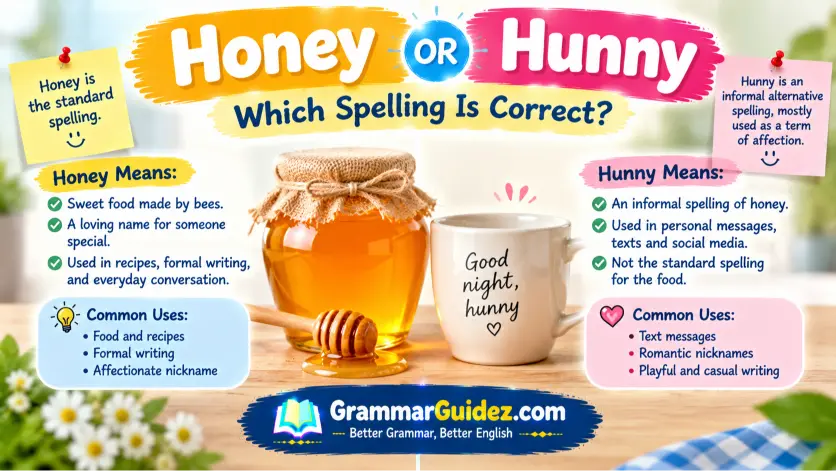
The word honey is the standard English spelling. It refers to the sweet substance made by bees, but it can also be a loving name for someone special. The spelling hunny is an informal alternative that people often use in affectionate messages, playful conversations, and social media posts.
The good news is that you do not need to memorize two different meanings for two completely different words. Instead, you need to understand the difference between standard spelling and informal style.
In this guide, you will learn when to use honey, when hunny may be suitable, how the words work in sentences, and which common mistakes to avoid. You will also learn how to choose the right spelling for school, work, recipes, and personal messages.
Quick Answer: Honey or Hunny?
Honey is the standard English spelling. It refers to a sweet substance produced by bees and can also be used as an affectionate term for a person.
Hunny is an informal alternative spelling of honey, mainly used as a term of affection. It can make a message feel cute, playful, or personal.
| Word | Meaning | Best Use |
| Honey | Sweet food made by bees; an affectionate name | Standard writing and everyday speech |
| Hunny | Informal alternative spelling of honey | Casual messages and playful nicknames |
Neither word has to be romantic in every situation. However, honey is the safest choice for standard writing, while hunny is best reserved for informal situations where the playful spelling is intentional.
What Does Honey Mean?
Honey is a standard English word with several common uses. Its meaning depends on the sentence.
1. Honey as Food
Honey is a sweet substance that bees make from flower nectar. People use it in food and drinks, including tea, desserts, and breakfast dishes.
When you talk about this food, always use the standard spelling honey.
2. Honey as an Affectionate Name
People also use honey when speaking warmly to someone they love or care about. It can be used between romantic partners, family members, or other people when the relationship and situation make the term appropriate.
This use is informal, but the spelling itself is still standard English.
3. Honey as a Friendly Form of Address
In some situations, people use honey to sound warm or caring. However, the word may feel too personal or familiar when used with strangers, customers, or coworkers. The relationship, culture, and tone all matter.
What Does Hunny Mean?
Hunny is an informal alternative spelling of honey. It is mainly used when addressing someone affectionately.
The spelling may make a message feel more playful, cute, or personal. Some people choose it because they like the way it looks, while others use it as part of their usual texting style.
Cambridge Dictionary recognizes hunny as an informal alternative spelling of honey when used as a form of address. This means it is not accurate to say that the spelling never exists or can never be used. However, it is not the standard spelling for the sweet food made by bees.
Is Hunny a Real Word?
The answer depends on what you mean by “real word.”
Hunny is recognized as an informal spelling variation in a specific use. It is not the usual spelling for honey as food, and it is not the right choice for most formal writing.
If you see hunny in a personal message, it may be intentional rather than a typing mistake. If you see it in a recipe or a school assignment about food, it will usually look like a spelling error.
Honey vs. Hunny: Key Differences
The biggest difference is standard spelling versus informal style.
| Feature | Honey | Hunny |
| Standard spelling | Yes | No, not the standard form |
| Meaning as food | Yes | Not in standard usage |
| Affectionate nickname | Yes | Yes, informally |
| Formal writing | Usually appropriate when relevant | Usually avoid |
| Text messages | Common | Can sound playful or cute |
| Pronunciation | Usually HUN-ee | Usually HUN-ee |
Both spellings are pronounced in much the same way in ordinary English. The sound does not determine which spelling you should use. Context does.
When Should You Use Honey?
Use honey whenever you need the standard spelling. It works in both literal and affectionate meanings.
In Recipes and Food Writing
Use honey when describing ingredients, cooking, food products, or nutrition.
This is important because hunny is not the standard spelling for the food.
In School and Professional Writing
Use honey in essays, reports, website articles, business documents, and other writing where conventional spelling matters.
In Everyday Messages
You can also use honey in personal messages. There is no rule that says an affectionate nickname must use the spelling hunny.
The standard spelling can still sound loving, warm, and natural.
When Is Hunny Appropriate?
Use hunny when you deliberately want an informal or playful tone.
In Text Messages
Some people use hunny in private messages because they like the cute appearance of the word.
In Personal Nicknames
A couple, family, or group of friends may use hunny as a personal spelling. If it is part of their normal communication, the choice can be intentional.
In Creative Writing
Writers may use hunny in dialogue to show a character’s personal style. It can also appear in a nickname, username, or name that is deliberately spelled that way.
The important point is that hunny is a style choice, not a replacement you should make every time you write honey.
Honey or Hunny for a Husband, Wife, or Partner
Both honey and hunny can be used as affectionate names for a partner. The difference is mainly tone and spelling.
Honey is the conventional choice. It works in a loving message without looking unusual.
Hunny can feel more playful or personal. Some people prefer it in casual texts, but it is not required for romantic communication.
Neither spelling is limited to a particular gender. The right choice depends on what the person likes and how you normally speak to each other.
You should also remember that affectionate names depend on the relationship. A word that feels warm between partners may feel too familiar when used with a stranger or professional contact.
Honey or Hunny in Texting and on Social Media
Online communication often includes shortened words, emojis, playful spelling, and personal nicknames. That is one reason you may see hunny in messages, captions, and comments.
The spelling may be used to make a message feel more relaxed. It can also reflect a person’s usual writing style.
However, standard spelling is still useful online. If you are writing a public educational post, a recipe, a product description, or a professional message, honey is the better choice.
A good rule is to consider your purpose:
- Use honey when clarity and standard spelling matter.
- Use hunny when you deliberately want an informal, playful style.
- Preserve Hunny if it is part of an official name or an exact quotation.
Why Do People Spell Honey as Hunny?
There are several reasons people choose the alternative spelling.
First, both forms sound alike, so some people write the word according to how they hear it. Second, the unusual spelling can feel cute or personal in a message. Third, people may copy a spelling they see in social media posts, fictional stories, or conversations with friends.
The spelling is also widely associated with Winnie-the-Pooh, whose honey pots are famously labeled “HUNNY.” This fictional spelling is part of the character’s playful world. It does not change the standard spelling of the food.
The key lesson is that spelling can communicate tone as well as meaning. Even when two forms sound alike, readers may understand them differently depending on the context.
Common Mistakes to Avoid
1. Using Hunny for the Food
When writing about the substance made by bees, use honey. The alternative spelling is not standard in recipes or food descriptions.
2. Thinking Honey Is Not Romantic Enough
You do not need to write hunny to show affection. Honey is already a common and accepted affectionate name.
3. Calling Hunny Always Incorrect
This statement is too broad. Hunny is an informal alternative spelling used as a term of address and is recognized by Cambridge Dictionary in that context. The key is knowing when the informal spelling fits.
4. Using Hunny in Formal Writing
In schoolwork, reports, recipes, and professional articles, honey is normally the correct choice. Use hunny only if you are preserving a name, quotation, or intentional informal style.
5. Forgetting the Comma in Direct Address
When you directly address someone, use a comma to separate the name or term of address from the rest of the sentence.
For example, when a sentence begins with honey, place a comma after it. This punctuation helps readers understand that you are speaking to someone.
Mini Quiz
1. Which is the standard English spelling?
A. Hunny
B. Honey
C. Hunney
D. Hony
Answer: B. Honey
2. What does hunny usually represent?
A. A type of bee
B. A formal spelling of honey
C. An informal, affectionate spelling of honey
D. A different sweet food
Answer: C. An informal, affectionate spelling of honey
3. Which word should you use in a recipe?
A. Hunny
B. Honey
C. Hunnie
D. Hony
Answer: B. Honey
4. Is it necessary to write hunny when addressing a romantic partner?
A. Yes, always
B. Only in British English
C. No, honey is also correct
D. Only in text messages
Answer: C. No, honey is also correct
5. Why might someone choose the spelling hunny in a text?
A. To make the message sound playful or personal
B. Because honey is always incorrect
C. Because hunny is the standard spelling for food
D. To change the pronunciation completely
Answer: A. To make the message sound playful or personal
Fill in the Blanks
Complete each sentence with the correct word: honey or hunny.
- Bees produce ________, which people often use as a sweetener.
- The standard English spelling of the affectionate word is ________.
- Some people write “Good night, ________” in a playful text message.
- Use ________ in a recipe or a formal article about food.
- The word “HUNNY” is famously associated with Winnie-the-________.
Answers
- Honey
- Honey
- Hunny
- Honey
- Pooh
FAQs
Is Honey or Hunny Correct?
Honey is the standard English spelling. Hunny is an informal alternative spelling that can be used as an affectionate form of address.
Is Hunny a Misspelling?
Not always. It may be an intentional, informal spelling when used as a nickname. However, it is not the standard spelling for the food made by bees.
Do Honey and Hunny Mean the Same Thing?
When used as affectionate names, they usually communicate the same basic idea. The difference is that honey is standard, while hunny has a more informal or playful style.
Can I Call My Partner Hunny?
Yes, if that is a style both of you like. Hunny can be used as a casual nickname. Honey is equally suitable and is the standard spelling.
Why Does Winnie-the-Pooh Spell It Hunny?
“HUNNY” is the playful spelling associated with Winnie-the-Pooh’s honey pots. It is part of the fictional character’s presentation, not the standard spelling used in everyday English.
Is Hunny Used in American or British English?
It can appear in informal English communication, including messages and personal nicknames. It is an alternative spelling rather than a spelling that belongs exclusively to American or British English.
How Do You Spell Honey Correctly?
The standard spelling is H-O-N-E-Y. Use this form when writing about the food or when you want the conventional spelling of the affectionate term.
Conclusion
When choosing between honey and hunny, remember that honey is the standard English spelling, while hunny is an informal alternative that is mainly used as an affectionate form of address. Both can communicate warmth in a personal message, but they are not suitable in every situation.
Use honey for food, recipes, school assignments, professional writing, and conventional affectionate messages. Choose hunny only when you want a playful or personal style, or when it is part of a name or quotation.
The simplest rule is easy to remember: honey is the standard form; hunny is the informal choice. Knowing the difference will help you write clearly while still allowing you to use playful language when it fits.
Read More Articles:

I am Evan Whitmore, an English language writer and the person who started GrammarGuidez.com. I made GrammarGuidez.com to make grammar, spelling, vocabulary and words that are often confused easier to understand.
I like taking to understand English words and grammar rules and turning them into simple and clear explanations. My aim is to help students, writers, bloggers, ESL learners and regular English speakers feel more sure when they write and talk.
At GrammarGuidez.com I work on real life examples easy to understand explanations comparing words, spelling changes and how American English is used every day.
I think learning English doesn’t need to be hard. A good explanation and some good examples can make tough grammar topics much simpler to learn