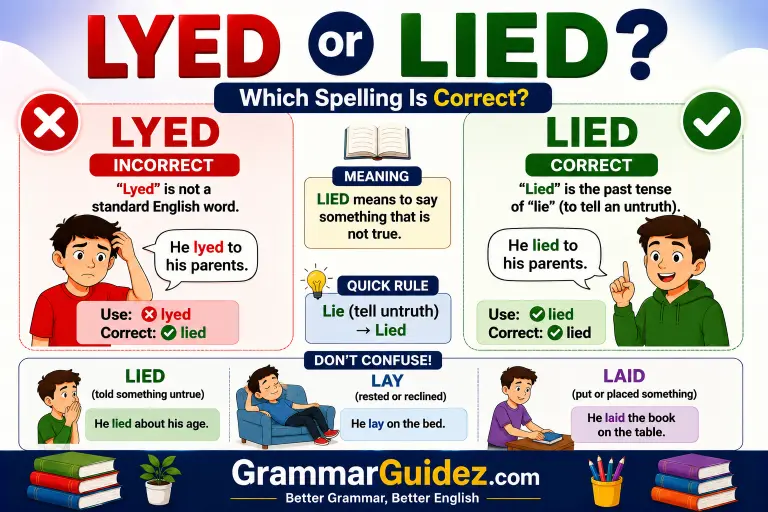
“Lied” is the correct spelling, while “lyed” is a common misspelling and is not the standard spelling in English. Lied is the past tense of lie, meaning to rest or be in a flat position. It can also mean telling something that is not true.
Lyed or lied? If you are confused about the correct spelling, the answer is simple: lied is the correct spelling, while lyed is not a standard English word.
Lied is the past tense and past participle of the verb lie when lie means to say something that is not true.
For example:
He lied to his parents.
This means that he told his parents something that was not true.
You may sometimes see lyed written online, but it is considered an incorrect spelling. The correct form is always:
lie → lied
However, English has another verb lie that means to rest or be in a flat position. Its past tense is lay, not lied.
For example:
I lay on the bed yesterday.
This difference is one of the main reasons learners confuse lyed, lied, lay, and laid.
In this guide, you will learn the meaning of lied, why lyed is incorrect, the difference between lied and lay, common mistakes, example sentences, and an easy way to remember the correct spelling.
Lyed or Lied: Quick Answer
The correct word is:
✅ Lied
The incorrect spelling is:
❌ Lyed
Lied is the past tense of lie when the verb means to say something that is not true.
Example
She lied about her age.
Not:
❌ She lyed about her age.
The correct form is:
Lie → Lied
What Does Lied Mean?
Lied is the past tense of lie, meaning:
To say something that you know is not true.
Examples
He lied to me.
She lied about what happened.
They lied to their teacher.
I lied because I was afraid.
In each sentence, lied means that someone gave false information.
Is Lyed a Correct Word?
No. Lyed is not the standard spelling of the past tense of lie.
Incorrect:
❌ He lyed to his friend.
Correct:
✅ He lied to his friend.
The spelling does not change to lyed when -ed is added.
The correct form is:
lie + d = lied
Why Is “Lyed” Incorrect?
The word lie already has an established past-tense form:
lied
English does not form this word by changing the spelling to lyed.
So remember:
❌ lie → lyed
✅ lie → lied
This is simply an irregular-looking spelling pattern that must be learned.
Lied as a Verb
Lied is a verb.
It is the past tense of lie when lie means telling something false.
Present
I lie to my parents.
Past
I lied to my parents.
Past participle
I have lied to my parents.
Examples:
He lied yesterday.
She has lied before.
They lied about the situation.
Lie and Lied: The Basic Pattern
When lie means “to tell something that is not true,” use this pattern:
| Form | Word |
| Base form | Lie |
| Present | Lie / Lies |
| Past | Lied |
| Past participle | Lied |
| -ing form | Lying |
Examples
I lie sometimes.
He lies to his friends.
She lied yesterday.
They have lied before.
He is lying now.
Lied vs. Lay
This is where many English learners become confused.
Both lied and lay can come from a verb spelled lie, but they have different meanings.
Lied
Lied means:
Said something that was not true.
Example:
He lied to me.
Lay
Lay is the past tense of lie when lie means:
To rest or be in a flat position.
Example:
I lay on the sofa yesterday.
So:
lied = told something untrue
lay = rested or reclined
Lied vs. Laid
Lied and laid are also different.
From:
lie = rest/recline? No, specifically lie = tell an untruth
Example:
She lied to her mother.
Laid
Laid is the past tense and past participle of lay, which means to put or place something somewhere.
Example:
She laid the book on the table.
So remember:
lied = told something untrue
laid = placed something somewhere
The Three Words: Lied, Lay, and Laid
This is one of the most useful comparisons to remember.
| Word | Meaning | Example |
| Lied | Told something untrue | He lied to me. |
| Lay | Rested or reclined | He lay on the bed. |
| Laid | Put or placed something | He laid the book down. |
Compare these sentences
He lied about the accident.
He gave false information.
Lied vs. Lying
Do not confuse lied with lying.
Lied
Past tense:
She lied to me yesterday.
Lying
Present participle:
She is lying to me now.
The spelling changes when the -ing form is used.
lie → lying
The final e is removed before -ing.
How to Use Lied in a Sentence
Use lied when talking about a past situation in which someone said something untrue.
Example 1
He lied about his grades.
Example 2
She lied to her parents.
Example 3
I knew he had lied.
Example 4
They lied about where they had been.
Example 5
The witness lied during the investigation.
Lied With “To”
A common structure is:
lied to someone
Examples:
He lied to me.
She lied to her parents.
They lied to the teacher.
The person receiving the false information can be introduced with to.
Lied About
Another common structure is:
lied about something
Examples:
He lied about his age.
She lied about the money.
They lied about what happened.
You can also combine both:
He lied to me about his age.
Lied vs. Said
Lied and said are not the same.
Said
Means:
Spoke or expressed something.
Example:
She said that she was tired.
This does not tell us if the statement was true.
Lied
Means:
Said something that was not true.
Example:
She lied about being tired.
The speaker knowingly gave false information.
Common Mistake
Common Mistake 1: Using Lyed
Incorrect:
❌ He lyed to his parents.
Correct:
✅ He lied to his parents.
Always use:
lied
not:
lyed
Common Mistake 2: Using Lied for Resting
Incorrect:
❌ I lied on the bed yesterday.
If you mean that you rested on the bed, the correct sentence is:
✅ I lay on the bed yesterday.
Why?
Because the verb lie has two different meanings.
Lie = tell an untruth
Past:
lied
Lie = rest or recline
Past:
lay
Common Mistake 3: Using Laid Instead of Lied
Incorrect:
❌ She laid to me.
Correct:
✅ She lied to me.
Laid means placed something somewhere.
She laid the phone on the table.
Lied means told something untrue.
She lied to me.
Common Mistake 4: Using “Lied” for Every Meaning of Lie
The word lie has more than one meaning.
If someone says something false:
lie → lied
If someone rests:
lie → lay → lain
This is why context is important.
Lie Meaning “Tell an Untruth”
Here is the complete verb pattern:
lie → lied → lied
Examples
He lies to his friends.
He lied yesterday.
Lie Meaning “Rest”
Here is the different pattern:
lie → lay → lain
Examples
I lie on the sofa every afternoon.
I lay on the sofa yesterday.
This is a completely different verb pattern.
Lied vs. Lay: Easy Examples
Compare the following:
She lied to her mother.
Meaning:
She told her mother something false.
Now:
She lay on the sofa.
Meaning:
She rested on the sofa.
The spelling changes because the meanings are different.
Why Do People Write “Lyed”?
Lyed is usually a spelling mistake caused by treating lie like a regular verb.
Someone may think:
lie + ed = lyed
But English does not work that way here.
The correct form is:
lie → lied
The spelling lied is standard.
Is “Lied” a Regular Verb?
Yes, when lie means “to tell an untruth,” its past tense is formed with -ed:
lie → lied
Although the spelling may look unusual, lied follows the regular past-tense pattern.
The confusion mainly comes from the other verb lie, whose past tense is lay.
Pronunciation of Lied
Lied is pronounced:
/laɪd/
It rhymes with words such as:
side
ride
hide
wide
Example:
He lied to me.
The pronunciation is lyd, not leed.
Lied vs. Lead
Another word that can sometimes cause confusion is lead.
Lied
Pronounced:
/laɪd/
Meaning:
Told something untrue.
Lead
When used as a verb meaning “to guide,” it is pronounced:
/liːd/
Example:
She will lead the team.
These are completely different words.
Focus on the Meaning
When you see lied, ask:
Did someone tell something that was not true?
If yes, use:
lied
Example:
He lied about the money.
If someone was resting, do not use lied.
Use:
lay
Example:
He lay on the floor.
Everyday Examples of Lied
At School
The student lied about finishing the homework.
At Work
He lied about completing the report.
In Conversation
She lied to her friend.
In a Story
The character lied about his identity.
In Daily Life
I lied when I said I had not eaten the cake.
Formal and Informal Use
Lied is a standard English word and can be used in both formal and informal writing.
Informal
He lied to me.
Formal
The witness lied about the information provided.
The word itself is not slang.
Lyed or Lied: Quick Comparison
| Word | Correct? | Meaning |
| Lied | ✅ Yes | Told something untrue |
| Lyed | ❌ No | Incorrect spelling |
| Lay | ✅ Yes | Past tense of lie meaning rest |
| Laid | ✅ Yes | Past tense of lay meaning put/place |
Easy Memory Trick
Use this simple rule:
Lie + false statement = Lied
Think:
He lied about it.
But:
Lie + rest = Lay
Think:
He lay on the bed.
And:
Lay + object = Laid
Think:
He laid the book on the table.
So remember:
Lied = told a falsehood
Lay = rested
Laid = placed something
Quick Quiz: Lyed or Lied?
Choose the correct word.
1. He ______ to his parents.
A. Lyed
B. Lied
Answer: Lied
2. She ______ about her age.
A. Lyed
B. Lied
Answer: Lied
3. Which spelling is correct?
A. Lyed
B. Lied
Answer: Lied
4. He ______ on the sofa yesterday.
A. Lied
B. Lay
Answer: Lay
5. She ______ the phone on the table.
A. Lied
B. Laid
Answer: Laid
Fill in the Blanks
Choose lied, lay, or laid.
- He ______ to me about the money.
- She ______ on the bed yesterday.
- I ______ the keys on the table.
- They ______ about what happened.
- He ______ down for a short rest.
- She ______ the book beside the computer.
Answers
- lied
- lay
- laid
- lied
- lay
- laid
FAQs
Is lyed a word?
Lyed is not the standard English spelling. If you mean the past tense of lie meaning “to tell something untrue,” the correct word is lied.
Is lied the correct spelling?
Yes. Lied is the correct past tense and past participle of lie when it means “to tell something that is not true.”
What is the past tense of lie?
It depends on the meaning.
If lie means “tell an untruth”:
lie → lied
If lie means “rest or recline”:
lie → lay
What is the difference between lied and lay?
Lied means someone told something untrue.
Lay is the past tense of lie when it means to rest or recline.
Examples:
He lied to me.
He lay on the bed.
What is the difference between lied and laid?
Lied means told something untrue.
Laid means put or placed something somewhere.
Examples:
She lied to me.
She laid the book on the desk.
Is “I lyed” correct?
No.
The correct sentence is:
I lied.
How do you pronounce lied?
Lied is pronounced /laɪd/, like the word side with a different first sound.
Is lied a past tense word?
Yes. Lied is the past tense and past participle of lie when lie means to tell something untrue.
Conclusion
The correct spelling is:
✅ Lied
The spelling:
❌ Lyed
is incorrect in standard English.
Use lied when someone said something that was not true.
He lied to me.
She lied about her age.
They lied about what happened.
However, be careful with the other meanings of lie.
When lie means to rest or recline, its past tense is:
lay
For example:
I lay on the bed yesterday.
And when lay means to put or place something, its past tense is:
laid
For example:
I laid the book on the table.
The easiest rule to remember is:
Lied = told something untrue
Lay = rested
Laid = placed something
So, if you are choosing between lyed or lied, always choose lied when you mean that someone told a lie.
Read More Articles:
- Sees or See’s: Which Is Correct?
- Prove or Proof: Meaning and Correct Usage
- Lead or Led: What’s the Difference?

I am Elliot Hartwell, an English language writer and the author at GrammarGuidez.com. For the 6 years I have been working with English grammar, vocabulary, spelling and everyday language usage with a focus on making confusing topics easier to understand.
I started GrammarGuidez.com with a goal: to give readers clear and practical answers to common English questions. English can sometimes be confusing especially when two words look or sound similar but have meanings or uses. I enjoy breaking down these differences in a way that’s simple and easy to remember.
I believe learning English should feel simple not overwhelming. My goal is to make every article on GrammarGuidez.com useful, for students, writers, bloggers, teachers and anyone who wants to communicate clearly in English.