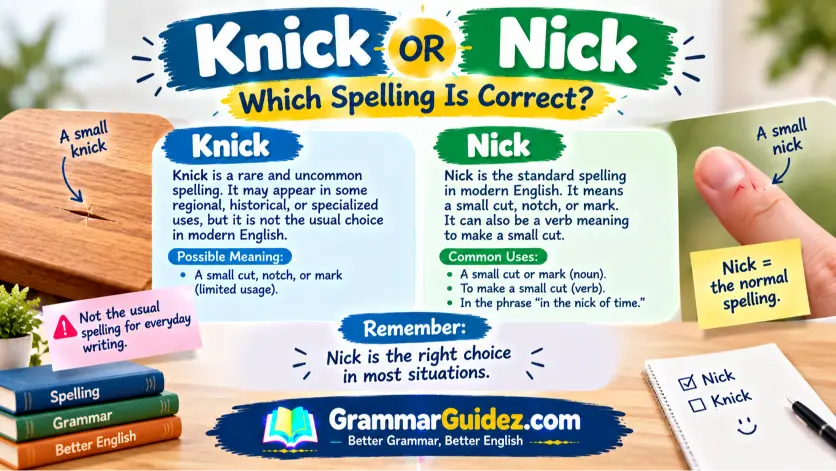
“Knick” is a rare word, while “nick” is the common English word. Nick can mean a small cut or notch, or to steal something informally. “Knick” is usually a misspelling unless used in a specific name or term.
Is it knick or nick? These words sound the same, so it is easy to mix them up. However, nick is the usual spelling in modern English when you mean a small cut, mark, or notch.
The spelling knick is much less common. It appears in some alternative, historical, or regional uses, but it is not the normal choice for everyday writing.
In this guide, you will learn the meaning of each word, how to use it, common spelling mistakes, and a simple way to remember the correct form.
Quick Answer: Knick vs. Nick
- Nick: The standard everyday word for a small cut, notch, or mark. It can also be a verb meaning to make a small cut.
- Knick: A rare form that may appear in limited or regional usage. It is not the usual spelling for a small cut.
For most everyday English writing, choose nick.
What Does Nick Mean?
Nick can be a noun or a verb. Its meaning depends on how it is used in a sentence.
Nick as a Noun
As a noun, nick can mean a small cut, chip, or mark on a surface. It may describe a small area of damage on an object or a minor cut on the skin.
Nick as a Verb
As a verb, nick means to make a small cut or mark in something.
The word also has other meanings in informal English. In British slang, nick can mean to steal something or arrest someone. Its meaning depends on the context.
What Does Knick Mean?
Knick is an uncommon spelling in modern general English. Some references recognize it as an alternative form of the verb nick, meaning to make a small notch or cut.
You may also find knick in historical or regional language sources. For example, the Dictionaries of the Scots Language records older regional uses connected with clicking, cracking, or snapping sounds.
However, these limited uses do not make knick the normal spelling for everyday writing.
If you mean a small cut on a table, a mark on a surface, or a minor cut on your skin, use nick.
Knick or Nick: Main Differences
| Feature | Knick | Nick |
| Everyday usage | Very uncommon | Common |
| Standard spelling for a small cut | Not the usual choice | Yes |
| Can be used as a verb | In limited usage | Yes |
| Can describe a small notch | Rare or alternative usage | Yes |
| Best choice for general writing | Usually avoid it | Use it |
The main difference is not pronunciation. Both forms sound alike. The important difference is how commonly and naturally each spelling is used.
When Should You Use Nick?
Use nick in normal writing when you mean a small cut, chip, notch, or mark.
It is also the correct spelling in familiar expressions such as “in the nick of time.”
This expression means that something happens just before it is too late.
For example, the word nick can describe a small mark on an object or a moment when someone arrives just in time.
When Should You Use Knick?
In ordinary writing, you should usually choose nick instead.
Use knick only when you have a specific reason, such as reproducing an established spelling from a source or referring to a documented regional or specialized use.
Do not add a silent k simply because the word sounds as though it could begin with one.
Is It “In the Nick of Time” or “In the Knick of Time”?
The standard expression is “in the nick of time.”
It means that something happens at the last possible moment or just before it is too late.
The spelling knick is not the standard form of this expression.
When writing an email, school assignment, article, or social media post, use nick of time.
Is Knick or Nick Correct in American and British English?
For the common meaning of a small cut or mark, nick is the usual spelling in both American and British English.
There is no general American-versus-British spelling difference that makes knick the standard form in one country and nick the standard form in the other.
British English also uses nick in informal expressions involving stealing or arresting someone. These meanings depend on context and are separate from the meaning of a small cut.
Common Mistakes with Knick and Nick
Mistake 1: Adding an Extra K
For the usual meaning of a small cut, knick is not the normal spelling.
Remember to write nick when describing a small mark or cut.
Mistake 2: Misspelling “Nick of Time”
The standard expression is in the nick of time, not in the knick of time.
Mistake 3: Assuming Knick Is Never Used
Although knick is uncommon, some dictionaries and historical sources record it in limited contexts. It is more accurate to call it rare than to claim that it never exists.
Mistake 4: Confusing Pronunciation with Spelling
Because the words sound the same, listening alone will not tell you which spelling to use. Think about the meaning and choose the standard word for your sentence.
Easy Ways to Remember the Difference
Use this simple memory tip:
Nick = the normal spelling.
You can connect it to familiar words such as nickname and nicked. These words use the same spelling without an extra k.
When you mean a small cut, mark, or notch, write nick. If you see knick in an unusual source, check its context before using it yourself.
Fill in the Blanks
Complete each sentence with knick or nick.
- There is a small ______ on the wooden table.
- I arrived just in the ______ of time.
- The sharp edge may ______ the surface.
- For a small cut on an object, ______ is the usual spelling.
- In everyday English, ______ is much less common than nick.
Answers
- nick
- nick
- nick
- nick
- knick
Mini Quiz
1. Which spelling is standard for a small cut?
A. Knick
B. Nick
C. Both are equally common
Answer: B. Nick. It is the usual spelling for a small cut or mark.
2. Which expression is correct?
A. In the knick of time
B. In the nick of time
Answer: B. In the nick of time. This expression means just before it is too late.
3. Are knick and nick pronounced the same?
A. Yes
B. No
C. Only in British English
Answer: A. Yes. The two forms sound alike.
4. Is knick the usual spelling in everyday English?
A. Yes
B. No
C. Only in American English
Answer: B. No. Knick is uncommon in general modern English.
5. Which statement is most accurate?
A. Knick never appears in any reference.
B. Nick is the standard everyday spelling, while knick has limited uses.
C. Knick is always the American spelling.
Answer: B. This describes the difference without claiming that the
FAQs
1. Is knick or nick correct?
Nick is the standard spelling for a small cut, notch, or mark. Knick is much less common and appears in limited alternative or regional usage.
2. Is knick a real word?
Yes, some references record knick in limited contexts. However, it is not the usual spelling for a small cut in everyday English.
3. What does nick mean?
Nick can mean a small cut, chip, or notch. It can also be a verb meaning to make a small cut. In informal British English, it has other meanings too.
4. Is it “a nick” or “a knick” in a table?
Use a nick when describing a small cut or mark on a table.
5. Is “in the knick of time” correct?
No. The standard expression is “in the nick of time.”
6. Is nick spelled differently in the UK and the US?
No. Nick is the usual spelling for a small cut or mark in both British and American English.
7. Why do people write knick?
People may add the extra k because the word sounds the same when spoken. Others may encounter the rare form in a specialized or historical source.
Conclusion
The choice between knick and nick is simple for everyday English.
Use nick when you mean a small cut, chip, notch, or mark. It is also the correct spelling in the expression “in the nick of time.”
Knick exists in limited uses, but it is not the normal spelling for these everyday meanings.
Remember: Nick is the spelling to choose in most situations.
Read More Articles:

I am Evan Whitmore, an English language writer and the person who started GrammarGuidez.com. I made GrammarGuidez.com to make grammar, spelling, vocabulary and words that are often confused easier to understand.
I like taking to understand English words and grammar rules and turning them into simple and clear explanations. My aim is to help students, writers, bloggers, ESL learners and regular English speakers feel more sure when they write and talk.
At GrammarGuidez.com I work on real life examples easy to understand explanations comparing words, spelling changes and how American English is used every day.
I think learning English doesn’t need to be hard. A good explanation and some good examples can make tough grammar topics much simpler to learn