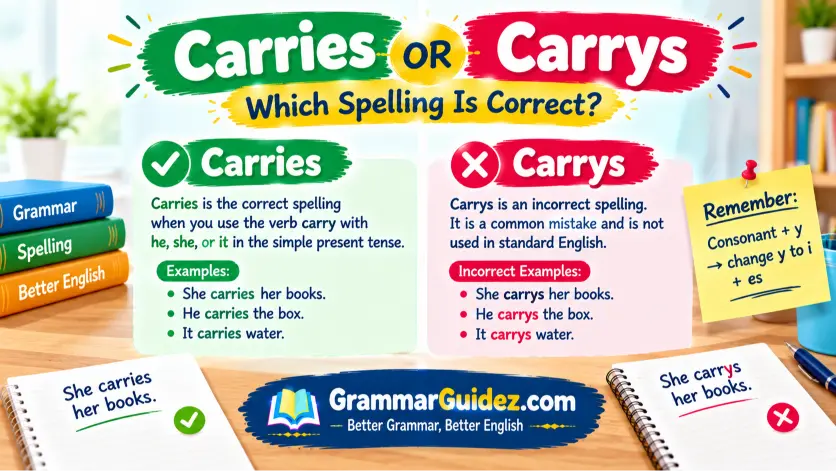
“Carries” is the correct spelling for the present-tense verb meaning to transport or hold something. “Carrys” is a misspelling because verbs ending in a consonant + y usually change y to ies.
Is it carries or carrys? Both spellings may look right at first, but only one is correct for standard English grammar.
Carries is the correct spelling when you use the verb carry with he, she, or it in the simple present tense. Carrys is a common spelling mistake.
The rule is easy to learn. When a verb ends in a consonant followed by y, change the y to i and add -es. That is why carry becomes carries, just as try becomes tries and study becomes studies.
Quick Answer: Carries vs. Carrys
- Carries: The correct third-person singular form of carry.
- Carrys: An incorrect spelling of this verb in standard English.
| Word | Correct? | Example |
| Carries | Yes | She carries her books. |
| Carrys | No | She carrys her books. |
| Carry | Yes | They carry their bags. |
| Carried | Yes | He carried the box. |
| Carrying | Yes | I am carrying a bag. |
Remember: Write carries, not carrys, when the subject is he, she, or it.
What Does Carries Mean?
Carries is a form of the verb carry. It can mean to hold something and move it, take something from one place to another, or support something.
The word also has other meanings. For example, a message can carry meaning, a product can carry a label, and a decision can carry a risk.
The exact meaning depends on the sentence.
Why Is Carries Correct?
English has a spelling rule for many verbs that end in a consonant followed by y.
When you use one of these verbs with he, she, or it in the simple present tense, change y to i and add -es.
The pattern is:
Carry → Carries
Here are some other examples:
| Base verb | Correct form |
| Carry | Carries |
| Try | Tries |
| Study | Studies |
| Cry | Cries |
| Worry | Worries |
| Hurry | Hurries |
This rule applies because a consonant comes before the final y.
Why Is Carrys Incorrect?
Carrys does not follow the standard spelling rule for this verb.
Some people write it because they think they can form the third-person singular by adding only s to carry. That pattern works with many verbs, such as walk → walks, but not with verbs that end in a consonant plus y.
Compare these forms:
- Incorrect: She carrys a bag.
- Correct: She carries a bag.
- Incorrect: He carrys the boxes.
- Correct: He carries the boxes.
For standard English writing, always use carries.
When Should You Use Carries?
Use carries when the subject is one person, animal, object, or thing and the sentence is in the simple present tense.
With He, She, or It
Use carries with these pronouns.
- He carries his lunch to work.
- She carries a small purse.
- It carries water through the pipe.
With a Singular Noun
A single person’s name or a singular noun also takes carries.
- Maria carries her books to class.
- The truck carries heavy goods.
- My brother carries an umbrella.
When Carry Means Support or Contain
Carries does not always mean physically moving something.
- This bag carries all my school supplies.
- The report carries important information.
- The plan carries some risk.
The spelling stays the same even when the meaning changes.
When Should You Use Carry Instead of Carries?
Use carry with I, you, we, and they in the simple present tense.
- I carry my own bag.
- You carry the keys.
- We carry our supplies.
- They carry the boxes.
You also use the base form carry after words such as do, does, don’t, and doesn’t when the sentence requires the base verb.
- Does she carry a bag?
- He does not carry cash.
- They don’t carry heavy items.
Notice the difference:
- She carries a bag.
- Does she carry a bag?
The helping verb does already carries the third-person grammar, so the main verb stays in its base form.
Carries vs. Carried vs. Carrying
These words all come from the verb carry, but they serve different grammatical purposes.
| Form | Use | Example |
| Carry | Base form | I carry my books. |
| Carries | Simple present with a singular third-person subject | She carries her books. |
| Carried | Simple past or past participle | She carried her books yesterday. |
| Carrying | -ing form | She is carrying her books. |
Choose the form that matches the subject and the time of the action.
Is Carries Correct in American and British English?
Yes. Carries is the correct spelling in both American and British English.
There is no regional spelling difference for this verb form. The same basic grammar rule applies in both varieties of English.
If you write for readers in the United States, the United Kingdom, Canada, or Australia, use carries when the grammar calls for it.
Common Mistakes with Carries and Carrys
Mistake 1: Adding Only S
Incorrect: He carrys his lunch.
Correct: He carries his lunch.
Change the y to i and add -es.
Mistake 2: Using Carries with They
Incorrect: They carries their bags.
Correct: They carry their bags.
Use carry with they in the simple present tense.
Mistake 3: Using Carries After Does
Incorrect: Does she carries a bag?
Correct: Does she carry a bag?
After does, use the base form of the verb.
Mistake 4: Using Carries for the Past
Incorrect: Yesterday, she carries the box.
Correct: Yesterday, she carried the box.
Use carried for a completed action in the past.
Easy Ways to Remember Carries
Use this simple memory trick:
Consonant + y → change y to i + es.
Think of these word pairs:
- Carry → Carries
- Try → Tries
- Study → Studies
You can also remember this sentence:
She carries, but they carry.
Practicing this short pattern can help you avoid the spelling mistake.
Fill in the Blanks
Complete each sentence with the correct form of the verb in brackets.
- She ______ her lunch to school every day. (carry)
- They ______ their bags to the car. (carry)
- He ______ the box yesterday. (carry)
- Does Maria ______ her own books? (carry)
- The student is ______ a heavy backpack. (carry)
Answers
- carries
- carry
- carried
- carry
- carrying
Mini Quiz
1. Which spelling is correct?
A. Carrys
B. Carries
C. Carryes
Answer: B. Carries. The y changes to i before adding -es.
2. Which sentence is correct?
A. He carrys his bag.
B. He carries his bag.
C. He carry his bag every day.
Answer: B. He carries his bag. Use carries with he in the simple present tense.
3. Which sentence uses the correct base form?
A. They carries the boxes.
B. They carry the boxes.
C. They carrys the boxes.
Answer: B. They carry the boxes. Use carry with they.
4. What is the past tense of carry?
A. Carries
B. Carrying
C. Carried
Answer: C. Carried. Use carried for a completed past action.
5. Which question is correct?
A. Does she carries a bag?
B. Does she carry a bag?
C. Does she carrys a bag?
Answer: B. Does she carry a bag? After does, use the base v
FAQs
1. Is carries or carrys correct?
Carries is correct. Carrys is a spelling mistake when used as the verb form of carry in standard English.
2. Why does carry change to carries?
Because the verb ends in a consonant followed by y. In the third-person singular simple present, the y changes to i and -es is added.
3. Is carries correct in American English?
Yes. Carries is the standard spelling in American English.
4. Is carries correct in British English?
Yes. British English uses carries as well.
5. What is the past tense of carry?
The past tense is carried. For example: “She carried the bag yesterday.”
6. Should I write “she carry” or “she carries”?
Write “she carries” in the simple present tense. For example: “She carries her lunch to school.”
7. Do we say “does she carry” or “does she carries”?
Say “Does she carry?” After does, the main verb uses its base form.
8. What are similar words that follow the same rule?
Words such as try, study, cry, and worry follow the same consonant-plus-y rule: tries, studies, cries, and worries.
Conclusion
When choosing between carries or carrys, the correct spelling is carries.
Use carries with he, she, or it in the simple present tense. Use carry with I, you, we, and they. When a verb ends in a consonant plus y, change the y to i and add -es for the third-person singular form.
Remember the pattern: carry → carries. Once you learn this rule, you can apply it to many other English verbs.
Read More Articles:

I am Elliot Hartwell, an English language writer and the author at GrammarGuidez.com. For the 6 years I have been working with English grammar, vocabulary, spelling and everyday language usage with a focus on making confusing topics easier to understand.
I started GrammarGuidez.com with a goal: to give readers clear and practical answers to common English questions. English can sometimes be confusing especially when two words look or sound similar but have meanings or uses. I enjoy breaking down these differences in a way that’s simple and easy to remember.
I believe learning English should feel simple not overwhelming. My goal is to make every article on GrammarGuidez.com useful, for students, writers, bloggers, teachers and anyone who wants to communicate clearly in English.