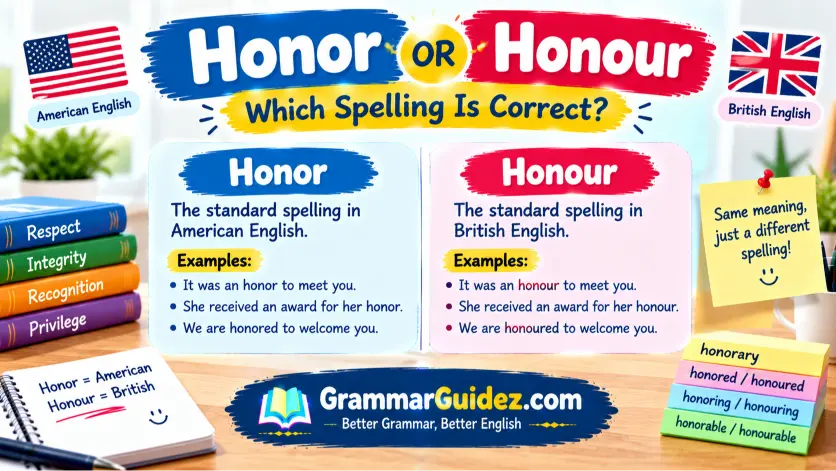
“Honor” is the American English spelling, while “honour” is the British English spelling used in the UK, Canada, and other countries. Both are correct and have the same meaning: respect, dignity, or high moral standards.
Have you ever wondered if to write honor or honour? Both spellings are correct, but the right choice depends on the type of English you use. Honor is the standard spelling in American English, while honour is commonly used in British English.
Both words have the same meaning and pronunciation. They can describe respect, honesty, good character, or a special privilege. They can also mean showing respect to someone or keeping a promise.
For example, an American writer may say, “It is an honor to meet you,” while a British writer may write, “It is an honour to meet you.” Neither sentence is wrong. The difference is simply a regional spelling rule.
In this guide, you will learn when to use honor or honour, how their related forms are spelled, and which version suits your audience. You will also discover common mistakes and simple tips to keep your writing clear and consistent
Quick Answer: Honor or Honour?
Honor is the standard spelling in American English. Honour is the standard spelling in British English.
Both words have the same meaning. They can refer to respect, honesty, a good reputation, or a special privilege. They can also mean showing respect to someone or keeping a promise.
- American English: It is an honor to meet you.
- British English: It is an honour to meet you.
Neither spelling is wrong. Choose the one that matches your audience and use it consistently.
What Is the Difference Between Honor and Honour?
The main difference between honor and honour is the letter u.
American English usually leaves out the u in this word. British English keeps it.
The meaning, pronunciation, and grammatical use stay the same. Both spellings can work as a noun or a verb.
| Feature | Honor | Honour |
| English variety | American English | British English |
| Correct spelling? | Yes | Yes |
| Meaning | Respect, dignity, or privilege | The same |
| Used as a noun? | Yes | Yes |
| Used as a verb? | Yes | Yes |
| Pronunciation | Generally the same | Generally the same |
Remember this simple rule: honor is American, and honour is British.
What Does Honor or Honour Mean?
Honor or honour has several related meanings. The correct meaning depends on how the word is used.
1. Respect for Someone
The word can describe the respect people feel for someone because of their actions, character, or achievements.
For example, a community may honor a person who has helped others.
2. Honesty and Good Character
Honor can also mean having strong values and doing what is right.
A person with honor tries to tell the truth, keep promises, and treat others fairly.
3. A Special Privilege
The word can describe something that makes a person feel proud or grateful.
For example, speaking at an important event may be an honor.
4. Showing Respect
As a verb, honor or honour means to show respect or recognize someone’s work.
For example, a school may honor its best students.
5. Keeping a Promise
The verb can also mean following an agreement or doing what you promised to do.
For example, a business should honor the terms of its agreement.
All these meanings work with both spellings. Only the regional spelling changes.
When Should You Use Honor?
Use honor when writing in American English.
This spelling is common in American books, school assignments, news articles, business documents, and websites aimed at readers in the United States.
Here are some examples:
- It was an honor to meet the author.
- The school will honor its top students.
- She received an award for her work and honor.
- We are honored to welcome our guests.
- He believes that honesty is a matter of honor.
American English also uses related forms such as honored, honoring, and honorable.
If your website targets American readers, choose these forms and keep them consistent throughout your content.
When Should You Use Honour?
Use honour when writing in British English.
This spelling is common in the United Kingdom and in many publications that follow British spelling conventions.
Here are some examples:
- It was an honour to meet the author.
- The school will honour its top students.
- She received an award for her work and honour.
- We are honoured to welcome our guests.
- He believes that honesty is a matter of honour.
British English also uses related forms such as honoured, honouring, and honourable.
If your writing follows British English, keep the u in these words unless a name, quotation, or specific style guide requires another spelling.
Honor vs. Honour: Related Word Forms
The spelling difference also appears in many related words. Learning these forms can help you avoid mistakes.
| American English | British English |
| honor | honour |
| honored | honoured |
| honoring | honouring |
| honorable | honourable |
| honorably | honourably |
| dishonor | dishonour |
| dishonored | dishonoured |
| dishonorable | dishonourable |
For example, an American writer might say, “We are honored to help you.”
A British writer would normally say, “We are honoured to help you.”
Both sentences are correct. The spelling follows the English variety being used.
Is It Honorary or Honourary?
The correct spelling is honorary in both American and British English.
Honorary describes a title, position, or award given as a special recognition, often without the usual duties or requirements.
Do not add a u to this word. The standard spelling is honorary, not honourary.
Honor or Honour in American and British Writing
The choice between honor and honour often depends on where your readers live and which spelling system your writing follows.
| Country or audience | Common spelling |
| United States | Honor |
| United Kingdom | Honour |
| Canada | Often honour |
| Australia | Honour |
| New Zealand | Honour |
These are general conventions. A school, company, publisher, or website may follow its own style guide.
Canadian English often follows British-style spellings such as honour, although some organizations use different rules. Always check the style required for your work.
If you write for an international audience, decide which English variety to use before publishing. Consistency matters more than choosing one variety over the other.
Common Mistakes With Honor and Honour
Writers sometimes treat one spelling as wrong everywhere. This is not correct. Both forms are accepted, but each belongs to a different standard spelling system.
Mistake 1: Calling Honour Wrong
Incorrect claim: “Honour is always a spelling mistake.”
Why it is wrong: Honour is the standard British spelling.
Mistake 2: Calling Honor Wrong
Incorrect claim: “Honor is always a spelling mistake.”
Why it is wrong: Honor is the standard American spelling.
Mistake 3: Mixing Spelling Styles
A writer may use honor in one paragraph and honoured in another. This can make the writing look inconsistent.
Better approach: Use honor, honored, and honoring in American English. Use honour, honoured, and honouring in British English.
Mistake 4: Changing the Meaning
Some learners think honor and honour have different meanings.
They do not. The spelling changes, but the basic meaning stays the same.
Mistake 5: Adding a U to Honorary
The word honorary keeps its spelling in both major varieties of English.
Remember this exception when learning the honor/honour word family.
How to Remember Honor or Honour
Use this easy memory trick:
- American English: honor, color, favor
- British English: honour, colour, favour
British English often keeps the letter u in this group of words. American English usually leaves it out.
This pattern also appears in labor/labour and neighbor/neighbour.
The rule does not apply to every English word, but it helps with many common spelling differences.
Which Spelling Should You Use on Your Website?
Choose the spelling that matches your target audience.
If your website mainly targets the United States, use honor. If it targets readers in the United Kingdom, use honour.
For example, an American website would normally write, “We are honored to serve our customers.” A British website would normally write, “We are honoured to serve our customers.”
You should also check your other pages for related forms. Using the same spelling style across your website helps create a clear and professional reading experience.
Do not change spellings randomly to target extra keywords. Write naturally for your readers and follow one style throughout each piece of content.
Fill in the Blanks
Choose the correct spelling for each sentence. Follow the English variety given in the question.
- In American English, it was an great ______ to meet the writer.
- In British English, the school will ______ its students.
- In American English, we are ______ to welcome you.
- In British English, she was ______ for her service.
- In both American and British English, the correct word is ______.
Answers
- honor
- honour
- honored
- honoured
- honorary
Mini Quiz: Honor or Honour?
1. Which spelling is standard in American English?
A. Honour
B. Honor
C. Honourr
D. Honur
Answer: B. Honor
2. Which spelling is standard in British English?
A. Honor
B. Honer
C. Honour
D. Honur
Answer: C. Honour
3. Do honor and honour have different basic meanings?
A. Yes
B. No
C. Only in formal writing
D. Only as verbs
Answer: B. No
4. Which spelling is standard in American English?
A. Honoured
B. Honourred
C. Honored
D. Honourd
Answer: C. Honored
5. Which spelling is correct in both American and British English?
A. Honourary
B. Honorary
C. Honourery
D. Honarary
Answer: B. Honorary
FAQs
1. Is honor or honour correct?
Both are correct. Honor is standard in American English, while honour is standard in British English.
2. Do honor and honour mean the same thing?
Yes. Both words can mean respect, dignity, integrity, recognition, or a special privilege. They can also mean showing respect or keeping an agreement.
3. Is honour British or American?
Honour is the standard British English spelling. It is also common in other varieties that follow British spelling conventions.
4. Is honor American English?
Yes. Honor is the standard spelling in American English.
5. Is it honored or honoured?
Both spellings are correct. Use honored in American English and honoured in British English.
6. Is it honoring or honouring?
Use honoring in American English and honouring in British English.
7. Is honorable or honourable correct?
Both are correct. Honorable is American English, while honourable is British English.
8. Is honorary spelled with a u?
No. Honorary is the standard spelling in both American and British English.
9. Do honor and honour sound different?
They are generally pronounced the same. The main difference is how they are written.
Conclusion
Honor and honour are two correct spellings of the same word. The main difference is regional: honor is standard in American English, while honour is standard in British English.
Both forms can refer to respect, honesty, recognition, or a special privilege. They can also be used as verbs.
Choose the spelling that matches your readers, keep related words consistent, and remember that neither form is wrong when used in its proper English variety.
Read More Articles:

I am Evan Whitmore, an English language writer and the person who started GrammarGuidez.com. I made GrammarGuidez.com to make grammar, spelling, vocabulary and words that are often confused easier to understand.
I like taking to understand English words and grammar rules and turning them into simple and clear explanations. My aim is to help students, writers, bloggers, ESL learners and regular English speakers feel more sure when they write and talk.
At GrammarGuidez.com I work on real life examples easy to understand explanations comparing words, spelling changes and how American English is used every day.
I think learning English doesn’t need to be hard. A good explanation and some good examples can make tough grammar topics much simpler to learn