“Site” and “cite” are both correct words, but they have different meanings.
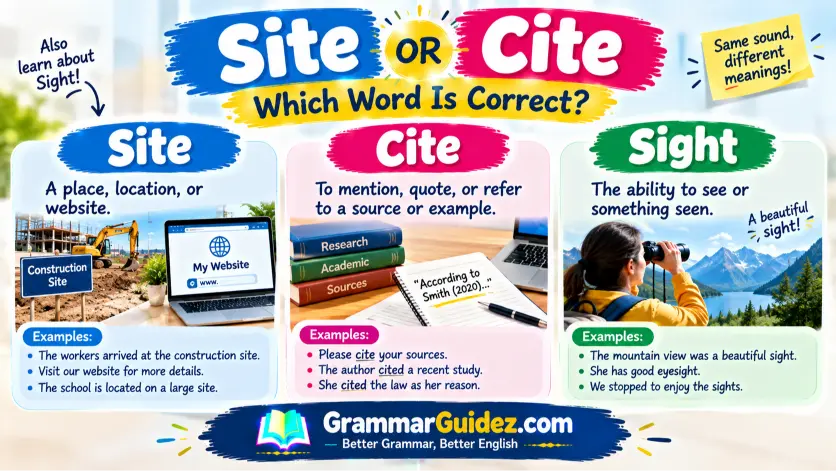
- Site: A place or location, such as a building site or a website.
- Cite: To mention or refer to a source as evidence or support.
Have you ever wondered if to write site or cite? These two words sound exactly the same, but they have different meanings. Choosing the wrong word can change the meaning of your sentence.
The good news is that both site and cite are correct English words. You just need to know when to use each one.
Site usually refers to a place, location, or website. Cite means to mention, quote, or refer to a source, example, or authority as evidence.
For example, you visit a website, but you cite a source in your research paper. Both words sound like “sight,” so you cannot tell which spelling is correct by pronunciation alone.
In this guide, you will learn the difference between site and cite, how to use them in sentences, and how to avoid common spelling mistakes.
Quick Answer: Site vs. Cite
Site is a noun that usually means a place or website. It can also be a verb meaning to place something in a particular location.
Cite is mainly a verb. It means to quote, mention, or refer to a source or example to support a statement.
| Word | Meaning | Example |
| Site | A place, location, or website | I visited the school website. |
| Cite | To refer to a source or use it as evidence | Please cite your sources. |
| Sight | The ability to see or something seen | The mountain was a beautiful sight. |
Both site and cite are correct words. The right choice depends on what you want to say.
One extra word is worth learning: sight. It sounds the same as the other two, but it relates to seeing or something that can be seen.
What Does Site Mean?
Site is usually a noun. It refers to a particular place or location where something exists, happens, or is built.
It can describe a physical place, such as a construction area, a school location, or a historical landmark.
Site as a Physical Location
Use site when you are talking about a place where an activity happens or something is located.
Examples:
- The workers arrived at the construction site.
- The company selected a site for its new office.
- The school stands on the site of an old factory.
- The police examined the site of the accident.
- The team visited the project site before work began.
In each sentence, site refers to a physical location.
Site as a Website
In modern English, site is also a common short form of website.
Examples:
- I found the information on a news site.
- Our company launched a new website.
- The shopping site offers several payment options.
- Please visit our site for more information.
- The school site contains details about its courses.
When you talk about a website, use site, not cite.
For example, “Visit our site” is correct because you are asking someone to visit an online location.
Can Site Be a Verb?
Yes. Although site is most often used as a noun, it can also be a verb.
As a verb, site means to place or locate something in a particular position.
For example:
- The company plans to site its new factory near the highway.
- The planners sited the building away from the river.
This use is more common in planning, construction, and formal writing.
What Does Cite Mean?
Cite is mainly a verb. It means to mention, quote, or refer to a source, example, fact, or authority to support a statement.
You may need to cite sources in school assignments, research papers, articles, legal documents, or professional reports.
When you cite something, you show where your information came from or provide evidence to support what you are saying.
Cite in Academic Writing
Students and researchers often use cite when referring to books, articles, studies, and other sources.
Examples:
- Please cite your sources in the research paper.
- The student cited three books in the essay.
- The researcher cited a recent study.
- You must cite the author when using the information.
- The report cites several reliable sources.
In these sentences, cite means to refer to information or evidence from another source.
Cite as Evidence
You can also use cite when giving a reason, fact, or example to support a claim.
Examples:
- The manager cited high costs as the main problem.
- The report cited several reasons for the delay.
- She cited a lack of time as her reason for leaving.
- The teacher cited the results to support the decision.
Here, cite does not necessarily mean quoting a book. It can also mean mentioning a fact or reason as support.
Cite in Legal Writing
In legal contexts, cite can mean referring to a law, court case, or legal authority.
It can also mean officially summoning someone or recording an official violation, depending on the context.
For example:
- The lawyer cited an earlier court decision.
- The officer cited the driver for a traffic violation.
These uses show why cite is connected with references, evidence, and official records.
What Is the Difference Between Site and Cite?
The main difference is their meaning and usual grammatical role.
Site usually names a place or website. Cite usually describes the action of referring to a source or mentioning something as evidence.
Compare these sentences:
- The journalist published the article on the news site.
- The journalist cited a government report in the article.
The first sentence uses site because it refers to an online location. The second uses cited because the journalist referred to a report as a source.
Site vs. Cite Comparison Table
| Feature | Site | Cite |
| Main meaning | A place or website | To mention or refer to a source |
| Usual part of speech | Noun | Verb |
| Can be a verb? | Yes | Yes |
| Common context | Construction, locations, websites | Research, evidence, references |
| Past tense | Sited | Cited |
| Memory clue | A spot or place | A citation or source |
The words are called homophones because they have the same pronunciation but different spellings and meanings.
You cannot rely on how they sound. Instead, think about the meaning of your sentence.
Site, Cite, or Sight: Understand All Three
Many people confuse site and cite because they sound the same. However, sight belongs in the same group and is just as important to understand.
What Does Sight Mean?
Sight is a noun that refers to the ability to see. It can also mean something you see or observe.
Examples:
- The doctor checked her sight.
- The sunset was a beautiful sight.
- The sight of the ocean made him smile.
- We enjoyed the sights during our trip.
The word can also be used as a verb, meaning to see or notice something.
For example, “The sailors sighted land.”
How Do the Three Words Compare?
| Word | Meaning | Memory clue |
| Site | A place or website | A spot |
| Cite | To refer to a source | A citation |
| Sight | Seeing or something seen | Vision |
Consider this sentence:
“The writer visited the historical site, cited an old book, and described the beautiful sight.”
Each word has a different meaning. The writer visited a place, referred to a source, and described something seen.
Learning all three words together can help you avoid several common spelling errors.
How to Use Site and Cite in Everyday Writing
The easiest way to choose between these words is to look at what the sentence is doing.
Use Site When You Mean a Place
Choose site when you refer to a physical location, building area, or website.
For example, a person may visit a company site, inspect a building site, or choose a site for a new school.
Ask yourself: “Am I talking about a place?”
If the answer is yes, site is usually the right choice.
Use Cite When You Mean a Source
Choose cite when you mention a source, report, law, quotation, study, or example as support.
For example, a student may cite a book, a journalist may cite a report, and a lawyer may cite a court case.
Ask yourself: “Am I referring to a source or evidence?”
If the answer is yes, use cite.
Use Sight When You Mean Seeing
Choose sight when you are talking about vision or something that can be seen.
Ask yourself: “Does this sentence relate to seeing?”
If it does, sight may be the correct word.
These simple questions are more useful than trying to memorize complicated spelling rules.
Common Mistakes With Site and Cite
Mistake 1: Writing “Site Your Sources”
Incorrect: Please site your sources in the essay.
Correct: Please cite your sources in the essay.
You should use cite because you are asking someone to refer to their sources.
Mistake 2: Writing “Construction Cite”
Incorrect: The workers arrived at the construction cite.
Correct: The workers arrived at the construction site.
A construction site is a physical location, so site is correct.
Mistake 3: Confusing a Website With a Citation
Incorrect: I found the report on a government cite.
Correct: I found the report on a government site.
A website is an online location. A citation is a reference to a source.
Mistake 4: Using “Sight” for a Source
Incorrect: The writer sighted two studies in the report.
Correct: The writer cited two studies in the report.
Use cited when the writer refers to studies as evidence.
However, sighted is a real word when it means saw or noticed something. The correct choice depends on the intended meaning.
Mistake 5: Choosing the Word by Sound Alone
All three words sound alike in standard pronunciation. That is why listening to a sentence will not always help you identify the correct spelling.
Instead, identify the meaning first. Then choose the word that matches it.
Easy Ways to Remember Site or Cite
A short memory trick can help you choose the correct word quickly.
Site = spot.
Both words begin with the letter “s.” Think of a site as a spot or place.
Cite = citation.
Both words begin with the letter “c.” Think of citing a source in a paper or report.
Sight = seeing.
Think of eyesight or something that catches your eye.
You can remember the three words like this:
- Site: Where something is.
- Cite: Where information comes from.
- Sight: What you see.
This simple method works for schoolwork, business writing, website content, and everyday messages.
Fill in the Blanks
Complete each sentence with the correct word: site, cite, or sight.
- Please __________ all the sources you used in your research paper.
- The workers arrived at the construction __________ early in the morning.
- The mountain view was a beautiful __________.
- I found the information on the company’s official __________.
- The writer __________ a recent study to support the claim.
Answer Key
- Cite
- Site
- Sight
- Site
- Cited
Mini Quiz
1. Which word means a physical location or website?
A. Cite
B. Site
C. Sight
Answer: B. Site. A site can be a physical place or an online location.
2. Which word should you use when referring to a source in an essay?
A. Site
B. Sight
C. Cite
Answer: C. Cite. You cite a source to show where your information or evidence came from.
3. What does sight usually relate to?
A. Seeing
B. Building a website
C. Quoting a book
Answer: A. Seeing. Sight refers to the ability to see or something that is seen.
4. Which sentence is correct?
A. Please site your sources.
B. Please cite your sources.
C. Please sight your sources.
Answer: B. Please cite your sources. Cite is the correct verb when referring to sources.
5. Which sentence uses site correctly?
A. The student sited a research paper.
B. The writer visited the construction site.
C. The author sighted the report as evidence.
Answer: B. The writer visited the construction site. A construction site is a physical location.
FAQs
Is site or cite correct?
Both words are correct, but they have different meanings. Site usually means a place or website. Cite means to refer to a source, quote, or mention something as evidence.
What is the difference between site and cite?
A site is a physical or online location. To cite means to refer to a source or mention evidence. Both words sound the same but are used in different situations.
Is cite a noun or a verb?
Cite is mainly a verb. It means to quote, mention, or refer to a source or authority. The related noun is citation.
Is site a noun or a verb?
Site is commonly a noun meaning a place or website. It can also be a verb meaning to locate or place something in a particular position.
What does cite your sources mean?
It means identifying the sources you used to support your work. A citation helps readers find the original information and understand where your claims came from.
Is sight the same as site?
No. Sight relates to seeing or something seen. Site refers to a place or website. They sound the same but have different meanings.
How do you remember site, cite, and sight?
Remember these three clues: site means a spot, cite means to refer to a source, and sight relates to seeing.
Can site and cite be used in the same sentence?
Yes. For example: “The writer published the article on the site and cited two research papers.” Here, site refers to a website, while cited refers to the sources.
Conclusion
The difference between site or cite is simple once you understand what each word means.
Use site for a physical place, location, or website. Use cite when you refer to a source, quotation, study, or example as evidence.
Remember the quick rule: Site = place, Cite = source, Sight = seeing.
Check the meaning of your sentence before choosing a spelling. This small habit can help you write more clearly and avoid common English mistakes.
Read More Articles:

I am Elliot Hartwell, an English language writer and the author at GrammarGuidez.com. For the 6 years I have been working with English grammar, vocabulary, spelling and everyday language usage with a focus on making confusing topics easier to understand.
I started GrammarGuidez.com with a goal: to give readers clear and practical answers to common English questions. English can sometimes be confusing especially when two words look or sound similar but have meanings or uses. I enjoy breaking down these differences in a way that’s simple and easy to remember.
I believe learning English should feel simple not overwhelming. My goal is to make every article on GrammarGuidez.com useful, for students, writers, bloggers, teachers and anyone who wants to communicate clearly in English.